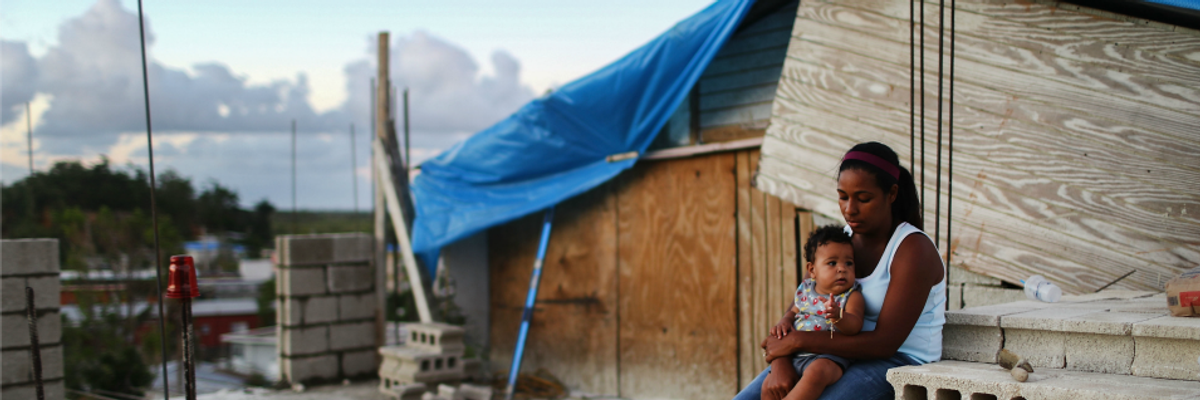
Mother Isamar holds her baby Saniel at their makeshift home, under reconstruction, after being mostly destroyed by Hurricane Maria in San Isidro, Puerto Rico. (Photo: Mario Tama/Getty Images)
'Vindictive Behavior': Trump Complains Puerto Rico Getting 'Too Much' Disaster Aid as Over a Million Face Food Crisis
"He continues to make the humanitarian crisis worse. He is ensuring that people don't have food to put on the table," said San Juan Mayor Carmen Yulín Cruz
With over a million U.S. citizens in Puerto Rico facing devastating food stamp cuts as Congress fails to provide necessary hurricane relief funding, President Donald Trump reportedly complained to Republican senators on Tuesday that the island is receiving "too much" aid--a position that was decried as both false and cruel.
"The president continues to show his vindictive behavior towards Puerto Rico and he continues to make the humanitarian crisis worse," said San Juan Mayor Carmen Yulin Cruz. "He is ensuring that people don't have food to put on the table."
"The federal response and its treatment during these past months in the aftermath of Hurricane Maria is clear evidence of our second-class citizenship."
--Ricardo Rossello, governor of Puerto Rico
Trump's remarks came during a private lunch with Republicans Tuesday, during which--according to the Washington Post--the president inflated the amount of aid Puerto Rico has received since Hurricane Maria and pushed lawmakers to limit funding to the island.
"At the lunch Tuesday, Trump rattled off the amount of aid that had been designated for other disaster-hit states and compared it with the amount allocated for Puerto Rico following the 2017 hurricane, which he said was too high," the Post reported.
After claiming that Puerto Rico has received $91 billion in federal aid--it is unclear where he got this number--Trump reportedly said "one could buy Puerto Rico four times over for $91 billion."
Puerto Rico Gov. Ricardo Rossello responded with outrage to Trump's reported comments in a statement late Tuesday.
"People from all over the nation, and the world, have witnessed the inequalities Americans face on the island," Rossello said. "The federal response and its treatment during these past months in the aftermath of Hurricane Maria is clear evidence of our second-class citizenship."
"Mr. President: Enough with the insults and demeaning characterizations," he added. "We are not asking for anything more than any other U.S. state has received. We are merely asking for equality."
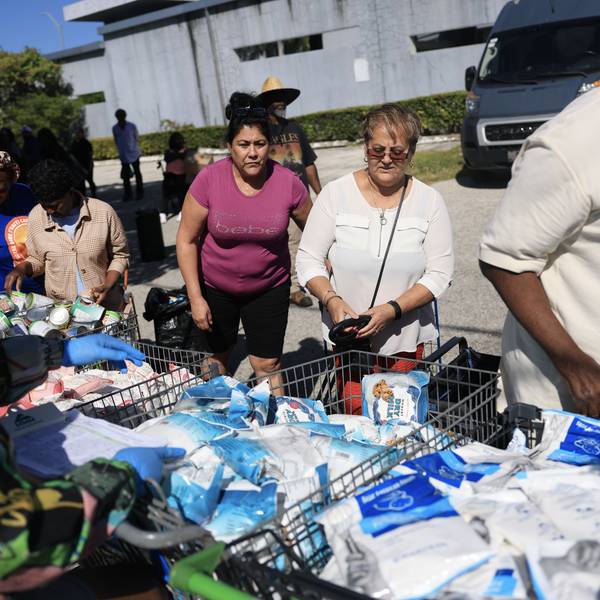
Trump's complaint about aid to the storm-ravaged island comes as an estimated 1.3 million Puerto Ricans--including hundreds of thousands of children and elderly people--have had life-saving food aid cut amid inaction and obstruction from the White House and congressional Republicans.
"We just don't have the money right now," said Myrna Izquierdo, an administrator at a Puerto Rican health clinic that relies on food stamp funding. "It's very hard. It is so unfair. That cut is going to kill us."
Late Tuesday afternoon, the Senate advanced a disaster relief bill that Democrats said is far from adequate to address the crises in Puerto Rico in the aftermath of Hurricane Maria. According to one study, the storm may have killed nearly 6,000 people.
"The lack of leadership and coordination, combined with delays in meeting the basic needs of the island, more than 18 months after receiving a presidential disaster declaration, has left far too many children and elderly citizens in unhealthy and unsafe conditions, families in severely damaged homes and communities without adequate infrastructure to sustain a decent quality of life," Sens. Patrick Leahy (D-Vt.) and Chuck Schumer (D-N.Y.) wrote in a letter to the White House on Tuesday.
Despite the island's dire situation, Trump has reportedly said that he "doesn't want another single dollar going to the island."
"Puerto Rico is in dire need of increased food assistance funding," Sen. Bernie Sanders (I-Vt.) wrote on Twitter this week. "It's unconscionable that we've allowed our fellow Americans to suffer for so long without the full resources of the U.S. government. We must act now to end this crisis."
We are at a crossroads
This country and this world are at a monumental crossroads. In a few short weeks, US voters will have an opportunity to beat back the forces of fascism and confront the billionaires who are rigging the economy, our media system, and our democracy, making it increasingly impossible for ordinary people to get by. We’re not just talking about the election. We’re talking about what must be done once these fascist elements are vanquished from power. We need a bolder set of solutions than what either major party has so far been willing to offer and a working-class movement ready to fight like hell for it. Trump didn't emerge from nowhere. The conditions that fueled MAGA authoritarianism were created by decades of radical neoliberal economic policies and a corrupt political system dominated by corporate interests. They slashed taxes on the super-rich, promising that the benefits would trickle down. They said giveaways to the corporate titans would make life more affordable for the rest of us. It was all bullshit. And when a bitter, betrayed populace searches for someone to blame, right-wing demagogues have little trouble finding scapegoats. People know when they're being lied to, but you won't hear any of this from the corporate media. Only independent journalism—powered and funded by people who believe in building a better world—can deliver truly trustworthy daily news. Our Fall Campaign is underway, and we need your help. To power our newsroom through the rest of the year, we need to raise $125,000 by midnight on October 31. So if you share our vision, please contribute whatever you can to sustain our work. |
With over a million U.S. citizens in Puerto Rico facing devastating food stamp cuts as Congress fails to provide necessary hurricane relief funding, President Donald Trump reportedly complained to Republican senators on Tuesday that the island is receiving "too much" aid--a position that was decried as both false and cruel.
"The president continues to show his vindictive behavior towards Puerto Rico and he continues to make the humanitarian crisis worse," said San Juan Mayor Carmen Yulin Cruz. "He is ensuring that people don't have food to put on the table."
"The federal response and its treatment during these past months in the aftermath of Hurricane Maria is clear evidence of our second-class citizenship."
--Ricardo Rossello, governor of Puerto Rico
Trump's remarks came during a private lunch with Republicans Tuesday, during which--according to the Washington Post--the president inflated the amount of aid Puerto Rico has received since Hurricane Maria and pushed lawmakers to limit funding to the island.
"At the lunch Tuesday, Trump rattled off the amount of aid that had been designated for other disaster-hit states and compared it with the amount allocated for Puerto Rico following the 2017 hurricane, which he said was too high," the Post reported.
After claiming that Puerto Rico has received $91 billion in federal aid--it is unclear where he got this number--Trump reportedly said "one could buy Puerto Rico four times over for $91 billion."
Puerto Rico Gov. Ricardo Rossello responded with outrage to Trump's reported comments in a statement late Tuesday.
"People from all over the nation, and the world, have witnessed the inequalities Americans face on the island," Rossello said. "The federal response and its treatment during these past months in the aftermath of Hurricane Maria is clear evidence of our second-class citizenship."
"Mr. President: Enough with the insults and demeaning characterizations," he added. "We are not asking for anything more than any other U.S. state has received. We are merely asking for equality."
Trump's complaint about aid to the storm-ravaged island comes as an estimated 1.3 million Puerto Ricans--including hundreds of thousands of children and elderly people--have had life-saving food aid cut amid inaction and obstruction from the White House and congressional Republicans.
"We just don't have the money right now," said Myrna Izquierdo, an administrator at a Puerto Rican health clinic that relies on food stamp funding. "It's very hard. It is so unfair. That cut is going to kill us."
Late Tuesday afternoon, the Senate advanced a disaster relief bill that Democrats said is far from adequate to address the crises in Puerto Rico in the aftermath of Hurricane Maria. According to one study, the storm may have killed nearly 6,000 people.
"The lack of leadership and coordination, combined with delays in meeting the basic needs of the island, more than 18 months after receiving a presidential disaster declaration, has left far too many children and elderly citizens in unhealthy and unsafe conditions, families in severely damaged homes and communities without adequate infrastructure to sustain a decent quality of life," Sens. Patrick Leahy (D-Vt.) and Chuck Schumer (D-N.Y.) wrote in a letter to the White House on Tuesday.
Despite the island's dire situation, Trump has reportedly said that he "doesn't want another single dollar going to the island."
"Puerto Rico is in dire need of increased food assistance funding," Sen. Bernie Sanders (I-Vt.) wrote on Twitter this week. "It's unconscionable that we've allowed our fellow Americans to suffer for so long without the full resources of the U.S. government. We must act now to end this crisis."
With over a million U.S. citizens in Puerto Rico facing devastating food stamp cuts as Congress fails to provide necessary hurricane relief funding, President Donald Trump reportedly complained to Republican senators on Tuesday that the island is receiving "too much" aid--a position that was decried as both false and cruel.
"The president continues to show his vindictive behavior towards Puerto Rico and he continues to make the humanitarian crisis worse," said San Juan Mayor Carmen Yulin Cruz. "He is ensuring that people don't have food to put on the table."
"The federal response and its treatment during these past months in the aftermath of Hurricane Maria is clear evidence of our second-class citizenship."
--Ricardo Rossello, governor of Puerto Rico
Trump's remarks came during a private lunch with Republicans Tuesday, during which--according to the Washington Post--the president inflated the amount of aid Puerto Rico has received since Hurricane Maria and pushed lawmakers to limit funding to the island.
"At the lunch Tuesday, Trump rattled off the amount of aid that had been designated for other disaster-hit states and compared it with the amount allocated for Puerto Rico following the 2017 hurricane, which he said was too high," the Post reported.
After claiming that Puerto Rico has received $91 billion in federal aid--it is unclear where he got this number--Trump reportedly said "one could buy Puerto Rico four times over for $91 billion."
Puerto Rico Gov. Ricardo Rossello responded with outrage to Trump's reported comments in a statement late Tuesday.
"People from all over the nation, and the world, have witnessed the inequalities Americans face on the island," Rossello said. "The federal response and its treatment during these past months in the aftermath of Hurricane Maria is clear evidence of our second-class citizenship."
"Mr. President: Enough with the insults and demeaning characterizations," he added. "We are not asking for anything more than any other U.S. state has received. We are merely asking for equality."
Trump's complaint about aid to the storm-ravaged island comes as an estimated 1.3 million Puerto Ricans--including hundreds of thousands of children and elderly people--have had life-saving food aid cut amid inaction and obstruction from the White House and congressional Republicans.
"We just don't have the money right now," said Myrna Izquierdo, an administrator at a Puerto Rican health clinic that relies on food stamp funding. "It's very hard. It is so unfair. That cut is going to kill us."
Late Tuesday afternoon, the Senate advanced a disaster relief bill that Democrats said is far from adequate to address the crises in Puerto Rico in the aftermath of Hurricane Maria. According to one study, the storm may have killed nearly 6,000 people.
"The lack of leadership and coordination, combined with delays in meeting the basic needs of the island, more than 18 months after receiving a presidential disaster declaration, has left far too many children and elderly citizens in unhealthy and unsafe conditions, families in severely damaged homes and communities without adequate infrastructure to sustain a decent quality of life," Sens. Patrick Leahy (D-Vt.) and Chuck Schumer (D-N.Y.) wrote in a letter to the White House on Tuesday.
Despite the island's dire situation, Trump has reportedly said that he "doesn't want another single dollar going to the island."
"Puerto Rico is in dire need of increased food assistance funding," Sen. Bernie Sanders (I-Vt.) wrote on Twitter this week. "It's unconscionable that we've allowed our fellow Americans to suffer for so long without the full resources of the U.S. government. We must act now to end this crisis."