SUBSCRIBE TO OUR FREE NEWSLETTER
Daily news & progressive opinion—funded by the people, not the corporations—delivered straight to your inbox.
5
#000000
#FFFFFF
To donate by check, phone, or other method, see our More Ways to Give page.
Daily news & progressive opinion—funded by the people, not the corporations—delivered straight to your inbox.
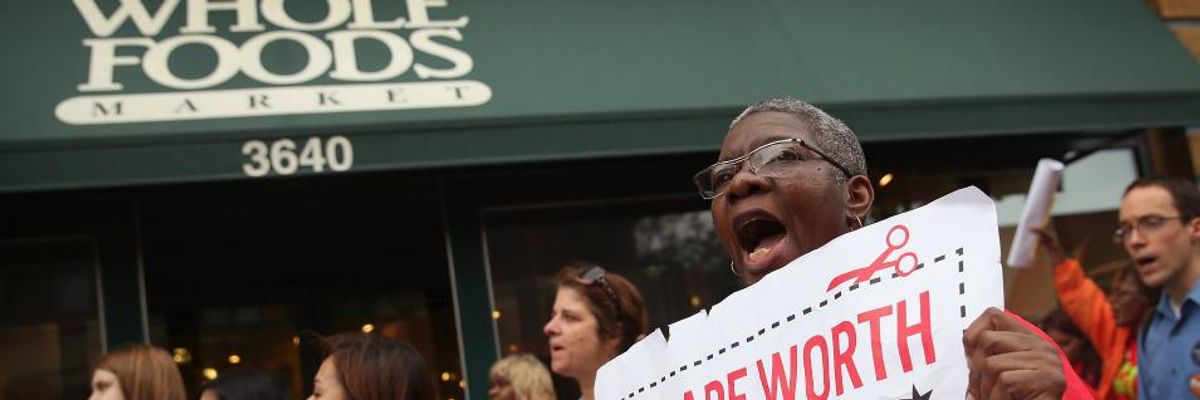
Betty Bailey of SEIU Local 1 protests with Whole Foods Market employees and other union activists outside a Whole Foods Market store on July 31, 2013 in Chicago, Illinois. (Photo by Scott Olson/Getty Images)
While Amazon caved to massive public pressure last fall and raised all company wages to at least $15 per hour--including at its subsidiary Whole Foods Market--in the months since, workers at the popular grocery chain have had their hours cut, negating their raises.
"Just about every person on our team has complained about their hours being cut. Some have had to look for other jobs as they can't make ends meet."
--Whole Foods worker in California
The Guardian reported on the cuts Wednesday, citing interviews with workers at Whole Foods stores in Illinois, California, Maryland, and Oregon, as well as emails and schedules the employees shared with the paper.
Workers who remained unnamed due to fears of retaliation said internal emails show the cuts to employees' hours have come at the direction of regional management.
An employee in Illinois, who provided schedules from November 1--when the wage increase took effect--through the end of January, said that part-time workers' at their location saw weekly hours reduced from an average of 30 to 21 while full-time workers saw an average drop from 37.5 to 34.5 hours per week.
"At my store all full-time team members are 36 to 38 hours per week now," said a worker in Oregon. "So what workers do if they want a full 40 hours is take a little bit of their paid time off each week to fill their hours to 40. Doing the same thing myself."
Meanwhile, in Maryland, an employee said regional management has cut full-time workers' hours from 40 to 36 per week. "This hours cut makes that raise pointless as people are losing more than they gained and we rely on working full shifts," the worker said.
The cuts have taken a toll on both workers' paychecks and workplace environment, a California-based employee said, which carries over to customers:
Things that have made it more noticeable are the long lines, the need to call for cashier and bagging assistance, and customers not being able to find help in certain departments because not enough are scheduled, and we are a big store...
Just about every person on our team has complained about their hours being cut. Some have had to look for other jobs as they can't make ends meet.
"There are many team members working at Whole Foods today whose total compensation is actually less than what it was before the wage increase due to these labor reductions," a spokesperson for Whole Worker--which started organizing for a Whole Foods employee union a shortly before Amazon's wage hike--told the Guardian.
Whole Foods and Amazon did not respond to the paper's multiple requests for comment. However, this is far from the first time the high-end grocery chain and its parent company--owned by the richest man in the world, Jeff Bezos--have come under fire for anti-worker practices.
Frustration with Whole Foods' well established anti-worker reputation and Amazon's 2017 takeover led to the union push, which Amazon has tried to quash. A training video that teaches management how to detect "early warning signs of potential organizing" leaked to the media in late September.
In early October, Amazon announced it would raise workers' hourly wages. That came less than a month after Sen. Bernie Sanders (I-Vt.) and Rep. Ro Khanna (D-Calif.) introduced the cleverly named Stop Bad Employers by Zeroing Out Subsidies (BEZOS) Act, which would force hugely profitable companies such as Amazon and Walmart to pay a corporate welfare tax that matches the amount of public assistance their employees receive.
Whole Foods workers' ongoing fight to be paid enough money to survive comes amid mounting national pressure to raise wages. Just last month, Illinois became the fifth state to require a $15 hourly minimum wage. In January, Sanders and Rep. Bobby Scott (D-Va.) introduced the Raise the Wage Act of 2019, which, according to the Economic Policy Institute, would boost the incomes of nearly 40 million Americans across the country.
Dear Common Dreams reader, It’s been nearly 30 years since I co-founded Common Dreams with my late wife, Lina Newhouser. We had the radical notion that journalism should serve the public good, not corporate profits. It was clear to us from the outset what it would take to build such a project. No paid advertisements. No corporate sponsors. No millionaire publisher telling us what to think or do. Many people said we wouldn't last a year, but we proved those doubters wrong. Together with a tremendous team of journalists and dedicated staff, we built an independent media outlet free from the constraints of profits and corporate control. Our mission has always been simple: To inform. To inspire. To ignite change for the common good. Building Common Dreams was not easy. Our survival was never guaranteed. When you take on the most powerful forces—Wall Street greed, fossil fuel industry destruction, Big Tech lobbyists, and uber-rich oligarchs who have spent billions upon billions rigging the economy and democracy in their favor—the only bulwark you have is supporters who believe in your work. But here’s the urgent message from me today. It's never been this bad out there. And it's never been this hard to keep us going. At the very moment Common Dreams is most needed, the threats we face are intensifying. We need your support now more than ever. We don't accept corporate advertising and never will. We don't have a paywall because we don't think people should be blocked from critical news based on their ability to pay. Everything we do is funded by the donations of readers like you. When everyone does the little they can afford, we are strong. But if that support retreats or dries up, so do we. Will you donate now to make sure Common Dreams not only survives but thrives? —Craig Brown, Co-founder |
While Amazon caved to massive public pressure last fall and raised all company wages to at least $15 per hour--including at its subsidiary Whole Foods Market--in the months since, workers at the popular grocery chain have had their hours cut, negating their raises.
"Just about every person on our team has complained about their hours being cut. Some have had to look for other jobs as they can't make ends meet."
--Whole Foods worker in California
The Guardian reported on the cuts Wednesday, citing interviews with workers at Whole Foods stores in Illinois, California, Maryland, and Oregon, as well as emails and schedules the employees shared with the paper.
Workers who remained unnamed due to fears of retaliation said internal emails show the cuts to employees' hours have come at the direction of regional management.
An employee in Illinois, who provided schedules from November 1--when the wage increase took effect--through the end of January, said that part-time workers' at their location saw weekly hours reduced from an average of 30 to 21 while full-time workers saw an average drop from 37.5 to 34.5 hours per week.
"At my store all full-time team members are 36 to 38 hours per week now," said a worker in Oregon. "So what workers do if they want a full 40 hours is take a little bit of their paid time off each week to fill their hours to 40. Doing the same thing myself."
Meanwhile, in Maryland, an employee said regional management has cut full-time workers' hours from 40 to 36 per week. "This hours cut makes that raise pointless as people are losing more than they gained and we rely on working full shifts," the worker said.
The cuts have taken a toll on both workers' paychecks and workplace environment, a California-based employee said, which carries over to customers:
Things that have made it more noticeable are the long lines, the need to call for cashier and bagging assistance, and customers not being able to find help in certain departments because not enough are scheduled, and we are a big store...
Just about every person on our team has complained about their hours being cut. Some have had to look for other jobs as they can't make ends meet.
"There are many team members working at Whole Foods today whose total compensation is actually less than what it was before the wage increase due to these labor reductions," a spokesperson for Whole Worker--which started organizing for a Whole Foods employee union a shortly before Amazon's wage hike--told the Guardian.
Whole Foods and Amazon did not respond to the paper's multiple requests for comment. However, this is far from the first time the high-end grocery chain and its parent company--owned by the richest man in the world, Jeff Bezos--have come under fire for anti-worker practices.
Frustration with Whole Foods' well established anti-worker reputation and Amazon's 2017 takeover led to the union push, which Amazon has tried to quash. A training video that teaches management how to detect "early warning signs of potential organizing" leaked to the media in late September.
In early October, Amazon announced it would raise workers' hourly wages. That came less than a month after Sen. Bernie Sanders (I-Vt.) and Rep. Ro Khanna (D-Calif.) introduced the cleverly named Stop Bad Employers by Zeroing Out Subsidies (BEZOS) Act, which would force hugely profitable companies such as Amazon and Walmart to pay a corporate welfare tax that matches the amount of public assistance their employees receive.
Whole Foods workers' ongoing fight to be paid enough money to survive comes amid mounting national pressure to raise wages. Just last month, Illinois became the fifth state to require a $15 hourly minimum wage. In January, Sanders and Rep. Bobby Scott (D-Va.) introduced the Raise the Wage Act of 2019, which, according to the Economic Policy Institute, would boost the incomes of nearly 40 million Americans across the country.
While Amazon caved to massive public pressure last fall and raised all company wages to at least $15 per hour--including at its subsidiary Whole Foods Market--in the months since, workers at the popular grocery chain have had their hours cut, negating their raises.
"Just about every person on our team has complained about their hours being cut. Some have had to look for other jobs as they can't make ends meet."
--Whole Foods worker in California
The Guardian reported on the cuts Wednesday, citing interviews with workers at Whole Foods stores in Illinois, California, Maryland, and Oregon, as well as emails and schedules the employees shared with the paper.
Workers who remained unnamed due to fears of retaliation said internal emails show the cuts to employees' hours have come at the direction of regional management.
An employee in Illinois, who provided schedules from November 1--when the wage increase took effect--through the end of January, said that part-time workers' at their location saw weekly hours reduced from an average of 30 to 21 while full-time workers saw an average drop from 37.5 to 34.5 hours per week.
"At my store all full-time team members are 36 to 38 hours per week now," said a worker in Oregon. "So what workers do if they want a full 40 hours is take a little bit of their paid time off each week to fill their hours to 40. Doing the same thing myself."
Meanwhile, in Maryland, an employee said regional management has cut full-time workers' hours from 40 to 36 per week. "This hours cut makes that raise pointless as people are losing more than they gained and we rely on working full shifts," the worker said.
The cuts have taken a toll on both workers' paychecks and workplace environment, a California-based employee said, which carries over to customers:
Things that have made it more noticeable are the long lines, the need to call for cashier and bagging assistance, and customers not being able to find help in certain departments because not enough are scheduled, and we are a big store...
Just about every person on our team has complained about their hours being cut. Some have had to look for other jobs as they can't make ends meet.
"There are many team members working at Whole Foods today whose total compensation is actually less than what it was before the wage increase due to these labor reductions," a spokesperson for Whole Worker--which started organizing for a Whole Foods employee union a shortly before Amazon's wage hike--told the Guardian.
Whole Foods and Amazon did not respond to the paper's multiple requests for comment. However, this is far from the first time the high-end grocery chain and its parent company--owned by the richest man in the world, Jeff Bezos--have come under fire for anti-worker practices.
Frustration with Whole Foods' well established anti-worker reputation and Amazon's 2017 takeover led to the union push, which Amazon has tried to quash. A training video that teaches management how to detect "early warning signs of potential organizing" leaked to the media in late September.
In early October, Amazon announced it would raise workers' hourly wages. That came less than a month after Sen. Bernie Sanders (I-Vt.) and Rep. Ro Khanna (D-Calif.) introduced the cleverly named Stop Bad Employers by Zeroing Out Subsidies (BEZOS) Act, which would force hugely profitable companies such as Amazon and Walmart to pay a corporate welfare tax that matches the amount of public assistance their employees receive.
Whole Foods workers' ongoing fight to be paid enough money to survive comes amid mounting national pressure to raise wages. Just last month, Illinois became the fifth state to require a $15 hourly minimum wage. In January, Sanders and Rep. Bobby Scott (D-Va.) introduced the Raise the Wage Act of 2019, which, according to the Economic Policy Institute, would boost the incomes of nearly 40 million Americans across the country.