SUBSCRIBE TO OUR FREE NEWSLETTER
Daily news & progressive opinion—funded by the people, not the corporations—delivered straight to your inbox.
5
#000000
#FFFFFF
To donate by check, phone, or other method, see our More Ways to Give page.
As the pool of candidates vying for the 2020 Democratic nomination for president continues to grow, so does a "sustained and ongoing" push to spread lies about them on social media--with one key aim being to sow division among progressive voters--according to an alarming Politico report published Wednesday.
Citing analyses by and conversations with data scientists and digital campaign strategists, the outlet reported:
Researchers and others interviewed for this story say they cannot conclusively point to the actors behind the coordinated activity. It's unclear if they are rogue hackers, political activists or, as some contend, foreign state actors such as Russia, since it bears the hallmarks of past foreign attacks. One of the objectives of the activity, they say, is to divide the left by making the Democratic presidential primary as chaotic and toxic as possible.
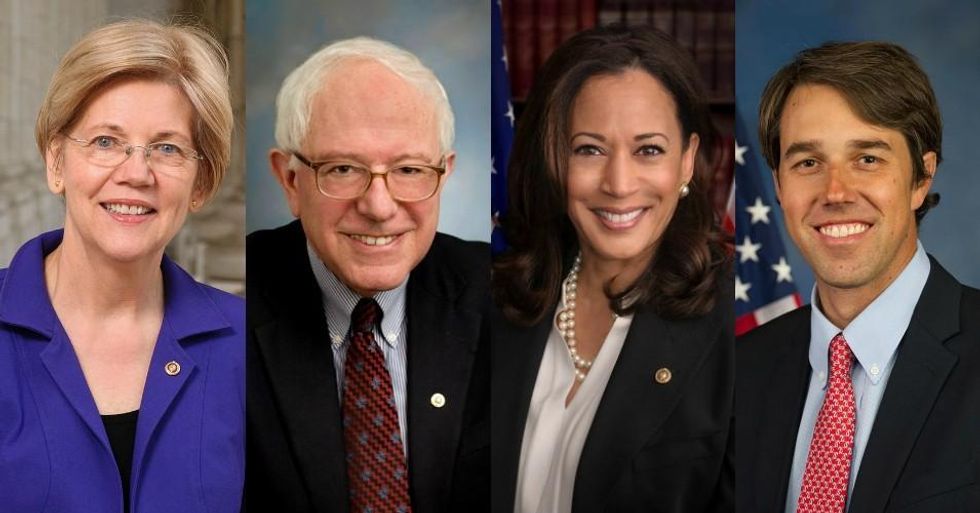
Research by the pro-democracy tech firm Guardians.ai found that Sens. Kamala Harris (D-Calif.), Elizabeth Warren (D-Mass.), and Bernie Sanders (I-Vt.) as well as former Rep. Beto O'Rourke (D-Texas)--who has not formally announced his candidacy for president--appear to be the top targets.
"As it relates to information warfare in the 2020 cycle, we're not on the verge of it--we're already in the third inning."
--Brett Horvath, Guardians.ai
"It looks like the 2020 presidential primary is going to be the next battleground to divide and confuse Americans," warned Guardians.ai co-founder Brett Horvath. "As it relates to information warfare in the 2020 cycle, we're not on the verge of it--we're already in the third inning."
The firm's research revealed that over a recent month-long period, a small group of suspicious Twitter accounts generated much of the conversation about those four candidates on the platform--commentary that was amplified by a larger collection of accounts.
From the analysis, Horvath told Politico, "we can conclusively state that a large group of suspicious accounts that were active in one of the largest influence operations of the 2018 cycle is now engaged in sustained and ongoing activity for the 2020 cycle."
Politico also pointed to research by Storyful researcher Kelly Jones, who tracked "spikes in misinformation activity over social media platforms and online comment boards," particularly "fringe" sites such as 4Chan and 8Chan, in the days following candidates' 2020 announcements.
Jones examined online activity in the three days after Harris, Warren, Rep. Tulsi Gabbard (D-Hawaii), and Sen. Cory Booker (D-N.J.) confirmed they are running for president. As Democratic candidates launch campaigns, she told Politico, "there is a call to action on these fringe sites. The field is going to be so crowded that they say 'OK: Operation Divide the Left.'"
An unnamed "high-ranking official" from the Sanders campaign expressed "serious concerns" about the consequences of misinformation on social media from domestic and foreign actors, telling Politico that this is a "type of political cyber warfare that's clearly having an impact on the democratic process."
Sanders, who announced his candidacy on Tuesday, also has publicly acknowledged concerns about misinformation. In a wide-ranging interview with CBS News, the senator noted that "there's a lot of misinformation that's going around" about Medicare for All (10:00):
Politico's report comes amid mounting concerns about not only how social media platforms--and particularly, the misinformation circulated on them--influence political elections, but also how major techonology companies can combat election interference without unfairly censoring real users or media outlets.
Social media giants have taken some steps to try to curb political interference and misinformation. In a post published late last month, Facebook noted its "massive investments to help protect the integrity of elections" over the past two years and detailed "the additional ways we are working to strengthen our platform ahead of elections in 2019."
Twitter also publicly outlined its efforts last month after publishing data on possible foreign operations in October. While declining to comment on the Guardian.ai analysis, a Twitter spokesperson told Politico that "our investigations are global and ongoing," and "we'll share more information if and when it's available."
As the pool of candidates vying for the 2020 Democratic nomination for president continues to grow, so does a "sustained and ongoing" push to spread lies about them on social media--with one key aim being to sow division among progressive voters--according to an alarming Politico report published Wednesday.
Citing analyses by and conversations with data scientists and digital campaign strategists, the outlet reported:
Researchers and others interviewed for this story say they cannot conclusively point to the actors behind the coordinated activity. It's unclear if they are rogue hackers, political activists or, as some contend, foreign state actors such as Russia, since it bears the hallmarks of past foreign attacks. One of the objectives of the activity, they say, is to divide the left by making the Democratic presidential primary as chaotic and toxic as possible.
Research by the pro-democracy tech firm Guardians.ai found that Sens. Kamala Harris (D-Calif.), Elizabeth Warren (D-Mass.), and Bernie Sanders (I-Vt.) as well as former Rep. Beto O'Rourke (D-Texas)--who has not formally announced his candidacy for president--appear to be the top targets.
"As it relates to information warfare in the 2020 cycle, we're not on the verge of it--we're already in the third inning."
--Brett Horvath, Guardians.ai
"It looks like the 2020 presidential primary is going to be the next battleground to divide and confuse Americans," warned Guardians.ai co-founder Brett Horvath. "As it relates to information warfare in the 2020 cycle, we're not on the verge of it--we're already in the third inning."
The firm's research revealed that over a recent month-long period, a small group of suspicious Twitter accounts generated much of the conversation about those four candidates on the platform--commentary that was amplified by a larger collection of accounts.
From the analysis, Horvath told Politico, "we can conclusively state that a large group of suspicious accounts that were active in one of the largest influence operations of the 2018 cycle is now engaged in sustained and ongoing activity for the 2020 cycle."
Politico also pointed to research by Storyful researcher Kelly Jones, who tracked "spikes in misinformation activity over social media platforms and online comment boards," particularly "fringe" sites such as 4Chan and 8Chan, in the days following candidates' 2020 announcements.
Jones examined online activity in the three days after Harris, Warren, Rep. Tulsi Gabbard (D-Hawaii), and Sen. Cory Booker (D-N.J.) confirmed they are running for president. As Democratic candidates launch campaigns, she told Politico, "there is a call to action on these fringe sites. The field is going to be so crowded that they say 'OK: Operation Divide the Left.'"
An unnamed "high-ranking official" from the Sanders campaign expressed "serious concerns" about the consequences of misinformation on social media from domestic and foreign actors, telling Politico that this is a "type of political cyber warfare that's clearly having an impact on the democratic process."
Sanders, who announced his candidacy on Tuesday, also has publicly acknowledged concerns about misinformation. In a wide-ranging interview with CBS News, the senator noted that "there's a lot of misinformation that's going around" about Medicare for All (10:00):
Politico's report comes amid mounting concerns about not only how social media platforms--and particularly, the misinformation circulated on them--influence political elections, but also how major techonology companies can combat election interference without unfairly censoring real users or media outlets.
Social media giants have taken some steps to try to curb political interference and misinformation. In a post published late last month, Facebook noted its "massive investments to help protect the integrity of elections" over the past two years and detailed "the additional ways we are working to strengthen our platform ahead of elections in 2019."
Twitter also publicly outlined its efforts last month after publishing data on possible foreign operations in October. While declining to comment on the Guardian.ai analysis, a Twitter spokesperson told Politico that "our investigations are global and ongoing," and "we'll share more information if and when it's available."
As the pool of candidates vying for the 2020 Democratic nomination for president continues to grow, so does a "sustained and ongoing" push to spread lies about them on social media--with one key aim being to sow division among progressive voters--according to an alarming Politico report published Wednesday.
Citing analyses by and conversations with data scientists and digital campaign strategists, the outlet reported:
Researchers and others interviewed for this story say they cannot conclusively point to the actors behind the coordinated activity. It's unclear if they are rogue hackers, political activists or, as some contend, foreign state actors such as Russia, since it bears the hallmarks of past foreign attacks. One of the objectives of the activity, they say, is to divide the left by making the Democratic presidential primary as chaotic and toxic as possible.
Research by the pro-democracy tech firm Guardians.ai found that Sens. Kamala Harris (D-Calif.), Elizabeth Warren (D-Mass.), and Bernie Sanders (I-Vt.) as well as former Rep. Beto O'Rourke (D-Texas)--who has not formally announced his candidacy for president--appear to be the top targets.
"As it relates to information warfare in the 2020 cycle, we're not on the verge of it--we're already in the third inning."
--Brett Horvath, Guardians.ai
"It looks like the 2020 presidential primary is going to be the next battleground to divide and confuse Americans," warned Guardians.ai co-founder Brett Horvath. "As it relates to information warfare in the 2020 cycle, we're not on the verge of it--we're already in the third inning."
The firm's research revealed that over a recent month-long period, a small group of suspicious Twitter accounts generated much of the conversation about those four candidates on the platform--commentary that was amplified by a larger collection of accounts.
From the analysis, Horvath told Politico, "we can conclusively state that a large group of suspicious accounts that were active in one of the largest influence operations of the 2018 cycle is now engaged in sustained and ongoing activity for the 2020 cycle."
Politico also pointed to research by Storyful researcher Kelly Jones, who tracked "spikes in misinformation activity over social media platforms and online comment boards," particularly "fringe" sites such as 4Chan and 8Chan, in the days following candidates' 2020 announcements.
Jones examined online activity in the three days after Harris, Warren, Rep. Tulsi Gabbard (D-Hawaii), and Sen. Cory Booker (D-N.J.) confirmed they are running for president. As Democratic candidates launch campaigns, she told Politico, "there is a call to action on these fringe sites. The field is going to be so crowded that they say 'OK: Operation Divide the Left.'"
An unnamed "high-ranking official" from the Sanders campaign expressed "serious concerns" about the consequences of misinformation on social media from domestic and foreign actors, telling Politico that this is a "type of political cyber warfare that's clearly having an impact on the democratic process."
Sanders, who announced his candidacy on Tuesday, also has publicly acknowledged concerns about misinformation. In a wide-ranging interview with CBS News, the senator noted that "there's a lot of misinformation that's going around" about Medicare for All (10:00):
Politico's report comes amid mounting concerns about not only how social media platforms--and particularly, the misinformation circulated on them--influence political elections, but also how major techonology companies can combat election interference without unfairly censoring real users or media outlets.
Social media giants have taken some steps to try to curb political interference and misinformation. In a post published late last month, Facebook noted its "massive investments to help protect the integrity of elections" over the past two years and detailed "the additional ways we are working to strengthen our platform ahead of elections in 2019."
Twitter also publicly outlined its efforts last month after publishing data on possible foreign operations in October. While declining to comment on the Guardian.ai analysis, a Twitter spokesperson told Politico that "our investigations are global and ongoing," and "we'll share more information if and when it's available."