SUBSCRIBE TO OUR FREE NEWSLETTER
Daily news & progressive opinion—funded by the people, not the corporations—delivered straight to your inbox.
5
#000000
#FFFFFF
To donate by check, phone, or other method, see our More Ways to Give page.
Daily news & progressive opinion—funded by the people, not the corporations—delivered straight to your inbox.
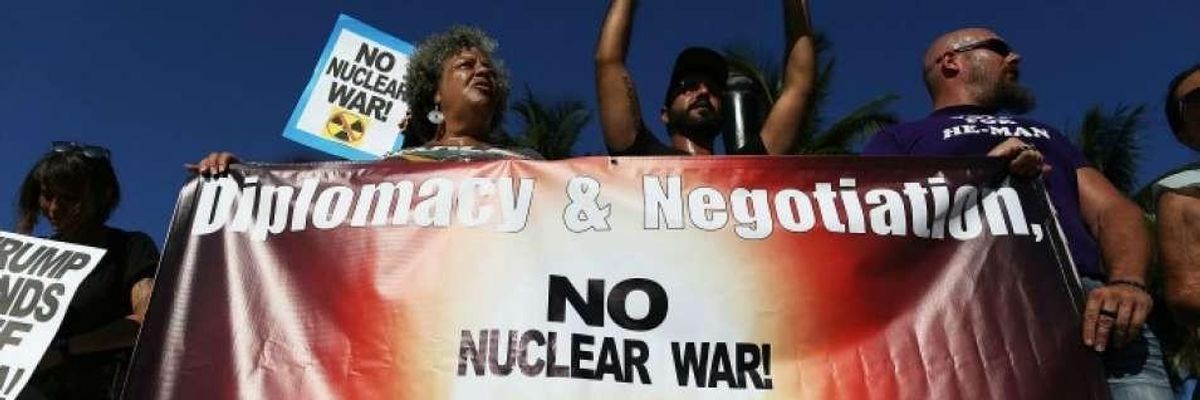
Demonstrators attend a protest demanding nuclear disarmament. (Photo: Joe Raedle/Getty Images)
Warning that the U.S. is already engaging in a new nuclear arms race as officials announced the development of a new "low-yield" warhead, nuclear disarmament campaigners ramped up their calls Monday for nations to sign on to an international treaty prohibiting the use of nuclear weapons.
The National Nuclear Security Administration (NNSA) announced that the U.S. has begun manufacturing the new weapon, the W76-2, and that the first batch of missiles is set to be delivered to the U.S. military by October 2019. The warhead will give new so-called "flexibility" to Trident missiles, making it easier for President Donald Trump--a future presidents--to deploy the weapons.
The International Campaign to Abolish Nuclear Weapons (ICAN) wrote on Twitter that the availability of such a weapon will make nuclear war even more likely than it has been under President Donald Trump.
The "low-yield U.S. Trident [will] make first use more likely" by the Trump administration, ICAN researcher Stuart Casey-Maslen wrote.
The Trump administration has pushed for the development of a low-yield weapon that would destroy a smaller area than its existing warheads, writing in its Nuclear Posture Review (NPR) last year that such warheads would make nuclear deployment by adversaries "less likely."
But according to the Guardian, critics including Stephen Young of the Union for Concerned Scientists (UCS) say that a weapon which is easier to deploy is an especially dangerous development with Trump in office, putting the globe at the mercy of "a president who takes pride in his unpredictability and has literally asked: 'Why can't we use our nuclear weapons?'"
The explosive power of the W76-2 is expected to be about five kilotons of TNT--a third of the power of the bomb the U.S. launched at Hiroshima in 1945, making it still incredibly destructive.
Trump has shown a disconcerting willingness to engage in nuclear war--hiring former Reagan and Bush official John Bolton as his National Security Adviser. Bolton has pushed the president to withdraw from the 1987 Intermediate-range Nuclear Forces (INF) treaty with Russia. Trump is expected to announce this coming weekend that the U.S. is suspending its compliance with the treaty, accusing Russia of violating the agreement.
"Frankly, mission creep is my greatest worry" regarding the development of a new low-yield warhead, Hans Kristensen of the Federation of American Scientists told the Guardian. "To what extent does this signal a new willingness on the part of the U.S. to start using strategic nuclear weapons in a tactical and very limited way early in a potential conflict?"
Dear Common Dreams reader, It’s been nearly 30 years since I co-founded Common Dreams with my late wife, Lina Newhouser. We had the radical notion that journalism should serve the public good, not corporate profits. It was clear to us from the outset what it would take to build such a project. No paid advertisements. No corporate sponsors. No millionaire publisher telling us what to think or do. Many people said we wouldn't last a year, but we proved those doubters wrong. Together with a tremendous team of journalists and dedicated staff, we built an independent media outlet free from the constraints of profits and corporate control. Our mission has always been simple: To inform. To inspire. To ignite change for the common good. Building Common Dreams was not easy. Our survival was never guaranteed. When you take on the most powerful forces—Wall Street greed, fossil fuel industry destruction, Big Tech lobbyists, and uber-rich oligarchs who have spent billions upon billions rigging the economy and democracy in their favor—the only bulwark you have is supporters who believe in your work. But here’s the urgent message from me today. It's never been this bad out there. And it's never been this hard to keep us going. At the very moment Common Dreams is most needed, the threats we face are intensifying. We need your support now more than ever. We don't accept corporate advertising and never will. We don't have a paywall because we don't think people should be blocked from critical news based on their ability to pay. Everything we do is funded by the donations of readers like you. When everyone does the little they can afford, we are strong. But if that support retreats or dries up, so do we. Will you donate now to make sure Common Dreams not only survives but thrives? —Craig Brown, Co-founder |
Warning that the U.S. is already engaging in a new nuclear arms race as officials announced the development of a new "low-yield" warhead, nuclear disarmament campaigners ramped up their calls Monday for nations to sign on to an international treaty prohibiting the use of nuclear weapons.
The National Nuclear Security Administration (NNSA) announced that the U.S. has begun manufacturing the new weapon, the W76-2, and that the first batch of missiles is set to be delivered to the U.S. military by October 2019. The warhead will give new so-called "flexibility" to Trident missiles, making it easier for President Donald Trump--a future presidents--to deploy the weapons.
The International Campaign to Abolish Nuclear Weapons (ICAN) wrote on Twitter that the availability of such a weapon will make nuclear war even more likely than it has been under President Donald Trump.
The "low-yield U.S. Trident [will] make first use more likely" by the Trump administration, ICAN researcher Stuart Casey-Maslen wrote.
The Trump administration has pushed for the development of a low-yield weapon that would destroy a smaller area than its existing warheads, writing in its Nuclear Posture Review (NPR) last year that such warheads would make nuclear deployment by adversaries "less likely."
But according to the Guardian, critics including Stephen Young of the Union for Concerned Scientists (UCS) say that a weapon which is easier to deploy is an especially dangerous development with Trump in office, putting the globe at the mercy of "a president who takes pride in his unpredictability and has literally asked: 'Why can't we use our nuclear weapons?'"
The explosive power of the W76-2 is expected to be about five kilotons of TNT--a third of the power of the bomb the U.S. launched at Hiroshima in 1945, making it still incredibly destructive.
Trump has shown a disconcerting willingness to engage in nuclear war--hiring former Reagan and Bush official John Bolton as his National Security Adviser. Bolton has pushed the president to withdraw from the 1987 Intermediate-range Nuclear Forces (INF) treaty with Russia. Trump is expected to announce this coming weekend that the U.S. is suspending its compliance with the treaty, accusing Russia of violating the agreement.
"Frankly, mission creep is my greatest worry" regarding the development of a new low-yield warhead, Hans Kristensen of the Federation of American Scientists told the Guardian. "To what extent does this signal a new willingness on the part of the U.S. to start using strategic nuclear weapons in a tactical and very limited way early in a potential conflict?"
Warning that the U.S. is already engaging in a new nuclear arms race as officials announced the development of a new "low-yield" warhead, nuclear disarmament campaigners ramped up their calls Monday for nations to sign on to an international treaty prohibiting the use of nuclear weapons.
The National Nuclear Security Administration (NNSA) announced that the U.S. has begun manufacturing the new weapon, the W76-2, and that the first batch of missiles is set to be delivered to the U.S. military by October 2019. The warhead will give new so-called "flexibility" to Trident missiles, making it easier for President Donald Trump--a future presidents--to deploy the weapons.
The International Campaign to Abolish Nuclear Weapons (ICAN) wrote on Twitter that the availability of such a weapon will make nuclear war even more likely than it has been under President Donald Trump.
The "low-yield U.S. Trident [will] make first use more likely" by the Trump administration, ICAN researcher Stuart Casey-Maslen wrote.
The Trump administration has pushed for the development of a low-yield weapon that would destroy a smaller area than its existing warheads, writing in its Nuclear Posture Review (NPR) last year that such warheads would make nuclear deployment by adversaries "less likely."
But according to the Guardian, critics including Stephen Young of the Union for Concerned Scientists (UCS) say that a weapon which is easier to deploy is an especially dangerous development with Trump in office, putting the globe at the mercy of "a president who takes pride in his unpredictability and has literally asked: 'Why can't we use our nuclear weapons?'"
The explosive power of the W76-2 is expected to be about five kilotons of TNT--a third of the power of the bomb the U.S. launched at Hiroshima in 1945, making it still incredibly destructive.
Trump has shown a disconcerting willingness to engage in nuclear war--hiring former Reagan and Bush official John Bolton as his National Security Adviser. Bolton has pushed the president to withdraw from the 1987 Intermediate-range Nuclear Forces (INF) treaty with Russia. Trump is expected to announce this coming weekend that the U.S. is suspending its compliance with the treaty, accusing Russia of violating the agreement.
"Frankly, mission creep is my greatest worry" regarding the development of a new low-yield warhead, Hans Kristensen of the Federation of American Scientists told the Guardian. "To what extent does this signal a new willingness on the part of the U.S. to start using strategic nuclear weapons in a tactical and very limited way early in a potential conflict?"