SUBSCRIBE TO OUR FREE NEWSLETTER
Daily news & progressive opinion—funded by the people, not the corporations—delivered straight to your inbox.
5
#000000
#FFFFFF
To donate by check, phone, or other method, see our More Ways to Give page.
Daily news & progressive opinion—funded by the people, not the corporations—delivered straight to your inbox.
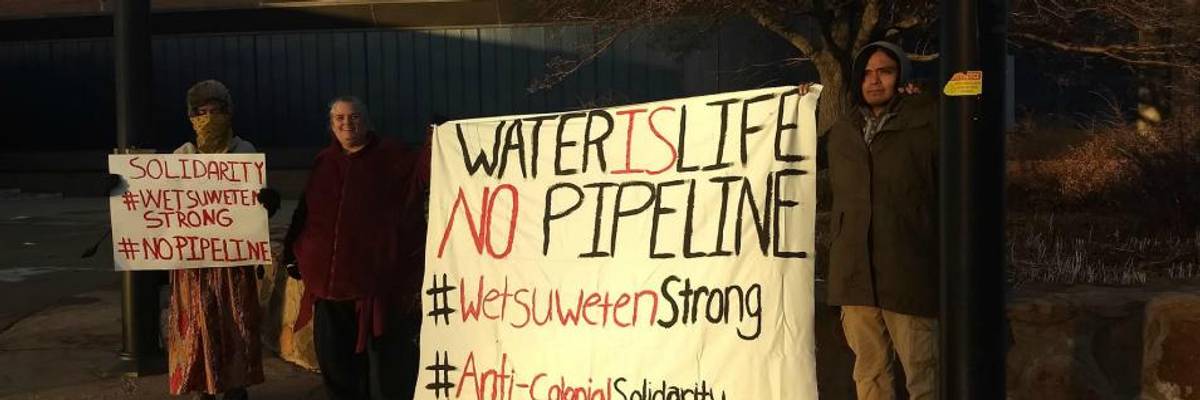
Protests were planned worldwide in solidarity with a First Nations group fighting against the construction of a pipeline through Wet'suwet'en territory. (Photo: Unist'ot'en Camp/Facebook)
More than 50 protests have been planned for across the globe on Tuesday in solidarity with a First Nations group fighting against the construction of TransCanada's Coastal GasLink through unceded Wet'suwet'en territory, with the number of protests rising overnight after Canadian police broke down a checkpoint gate erected by Indigenous land protectors and arrested more than a dozen people.
Reacting to footage of the "invasion" by the Royal Canadian Mounted Police (RCMP), author and activist Naomi Klein said it was "a shameful day for Canada, which has marketed itself as a progressive leader on climate and Indigenous rights."
Klein condemned the government's raid on unceded Wet'suwet'en territory and the arrest of First Nations land defenders, "all for a gas pipeline that is entirely incompatible with a safe climate."
People at the Gidimt'en camp have been anticipating the arrival of the RCMP, who are enforcing a B.C. Supreme Court injunction that came last month in response to another camp on the territory formed by another Wet'suwet'en clan, the Unist'ot'en, in opposition to the fossil fuel company's proposed route for the fracked gas pipeline.
"This is Canada's response to unarmed Indigenous defenders asserting their own rights on their own territory."
--Mike Hudema, Greenpeace
"Camp members faced both uniformed RCMP and camouflage-wearing Emergency Response Team tactical unit officers through the barbed wire," according to the Toronto Star. "Police climbed a ladder over the top of the gate, circumventing a secondary blockade formed by the bodies of the camp members themselves. Then they began to arrest people."
The Mounties established a "temporary exclusion zone," and said in a statement that "there are both privacy and safety concerns in keeping the public and the media at the perimeter, which should be as small as possible and as brief as possible in the circumstances, based on security and safety needs." The statement noted that "during the arrests, the RCMP observed a number of fires being lit along the roadway by unknown persons, and large trees felled across the roadway."
Journalists and supporters of the land defenders posted updates from the scene to social media and called out Canadian Prime Minister Justin Trudeau for the clear contrast between his claims that he wants to build a legacy of "reconciliation" with First Nations and how his government has responded to objections from the Wet'suwet'en people over the pipeline.
As Common Dreams reported Monday, although TransCanada claims it has signed agreements with First Nations leaders along the pipeline routes, Wet'suwet'en hereditary chiefs were not consulted, and say that those who signed off on the pipeline, which is set to cut through traditional lands, were not authorized to do so under Indigenous laws.
Dear Common Dreams reader, It’s been nearly 30 years since I co-founded Common Dreams with my late wife, Lina Newhouser. We had the radical notion that journalism should serve the public good, not corporate profits. It was clear to us from the outset what it would take to build such a project. No paid advertisements. No corporate sponsors. No millionaire publisher telling us what to think or do. Many people said we wouldn't last a year, but we proved those doubters wrong. Together with a tremendous team of journalists and dedicated staff, we built an independent media outlet free from the constraints of profits and corporate control. Our mission has always been simple: To inform. To inspire. To ignite change for the common good. Building Common Dreams was not easy. Our survival was never guaranteed. When you take on the most powerful forces—Wall Street greed, fossil fuel industry destruction, Big Tech lobbyists, and uber-rich oligarchs who have spent billions upon billions rigging the economy and democracy in their favor—the only bulwark you have is supporters who believe in your work. But here’s the urgent message from me today. It's never been this bad out there. And it's never been this hard to keep us going. At the very moment Common Dreams is most needed, the threats we face are intensifying. We need your support now more than ever. We don't accept corporate advertising and never will. We don't have a paywall because we don't think people should be blocked from critical news based on their ability to pay. Everything we do is funded by the donations of readers like you. When everyone does the little they can afford, we are strong. But if that support retreats or dries up, so do we. Will you donate now to make sure Common Dreams not only survives but thrives? —Craig Brown, Co-founder |
More than 50 protests have been planned for across the globe on Tuesday in solidarity with a First Nations group fighting against the construction of TransCanada's Coastal GasLink through unceded Wet'suwet'en territory, with the number of protests rising overnight after Canadian police broke down a checkpoint gate erected by Indigenous land protectors and arrested more than a dozen people.
Reacting to footage of the "invasion" by the Royal Canadian Mounted Police (RCMP), author and activist Naomi Klein said it was "a shameful day for Canada, which has marketed itself as a progressive leader on climate and Indigenous rights."
Klein condemned the government's raid on unceded Wet'suwet'en territory and the arrest of First Nations land defenders, "all for a gas pipeline that is entirely incompatible with a safe climate."
People at the Gidimt'en camp have been anticipating the arrival of the RCMP, who are enforcing a B.C. Supreme Court injunction that came last month in response to another camp on the territory formed by another Wet'suwet'en clan, the Unist'ot'en, in opposition to the fossil fuel company's proposed route for the fracked gas pipeline.
"This is Canada's response to unarmed Indigenous defenders asserting their own rights on their own territory."
--Mike Hudema, Greenpeace
"Camp members faced both uniformed RCMP and camouflage-wearing Emergency Response Team tactical unit officers through the barbed wire," according to the Toronto Star. "Police climbed a ladder over the top of the gate, circumventing a secondary blockade formed by the bodies of the camp members themselves. Then they began to arrest people."
The Mounties established a "temporary exclusion zone," and said in a statement that "there are both privacy and safety concerns in keeping the public and the media at the perimeter, which should be as small as possible and as brief as possible in the circumstances, based on security and safety needs." The statement noted that "during the arrests, the RCMP observed a number of fires being lit along the roadway by unknown persons, and large trees felled across the roadway."
Journalists and supporters of the land defenders posted updates from the scene to social media and called out Canadian Prime Minister Justin Trudeau for the clear contrast between his claims that he wants to build a legacy of "reconciliation" with First Nations and how his government has responded to objections from the Wet'suwet'en people over the pipeline.
As Common Dreams reported Monday, although TransCanada claims it has signed agreements with First Nations leaders along the pipeline routes, Wet'suwet'en hereditary chiefs were not consulted, and say that those who signed off on the pipeline, which is set to cut through traditional lands, were not authorized to do so under Indigenous laws.
More than 50 protests have been planned for across the globe on Tuesday in solidarity with a First Nations group fighting against the construction of TransCanada's Coastal GasLink through unceded Wet'suwet'en territory, with the number of protests rising overnight after Canadian police broke down a checkpoint gate erected by Indigenous land protectors and arrested more than a dozen people.
Reacting to footage of the "invasion" by the Royal Canadian Mounted Police (RCMP), author and activist Naomi Klein said it was "a shameful day for Canada, which has marketed itself as a progressive leader on climate and Indigenous rights."
Klein condemned the government's raid on unceded Wet'suwet'en territory and the arrest of First Nations land defenders, "all for a gas pipeline that is entirely incompatible with a safe climate."
People at the Gidimt'en camp have been anticipating the arrival of the RCMP, who are enforcing a B.C. Supreme Court injunction that came last month in response to another camp on the territory formed by another Wet'suwet'en clan, the Unist'ot'en, in opposition to the fossil fuel company's proposed route for the fracked gas pipeline.
"This is Canada's response to unarmed Indigenous defenders asserting their own rights on their own territory."
--Mike Hudema, Greenpeace
"Camp members faced both uniformed RCMP and camouflage-wearing Emergency Response Team tactical unit officers through the barbed wire," according to the Toronto Star. "Police climbed a ladder over the top of the gate, circumventing a secondary blockade formed by the bodies of the camp members themselves. Then they began to arrest people."
The Mounties established a "temporary exclusion zone," and said in a statement that "there are both privacy and safety concerns in keeping the public and the media at the perimeter, which should be as small as possible and as brief as possible in the circumstances, based on security and safety needs." The statement noted that "during the arrests, the RCMP observed a number of fires being lit along the roadway by unknown persons, and large trees felled across the roadway."
Journalists and supporters of the land defenders posted updates from the scene to social media and called out Canadian Prime Minister Justin Trudeau for the clear contrast between his claims that he wants to build a legacy of "reconciliation" with First Nations and how his government has responded to objections from the Wet'suwet'en people over the pipeline.
As Common Dreams reported Monday, although TransCanada claims it has signed agreements with First Nations leaders along the pipeline routes, Wet'suwet'en hereditary chiefs were not consulted, and say that those who signed off on the pipeline, which is set to cut through traditional lands, were not authorized to do so under Indigenous laws.