SUBSCRIBE TO OUR FREE NEWSLETTER
Daily news & progressive opinion—funded by the people, not the corporations—delivered straight to your inbox.
5
#000000
#FFFFFF
To donate by check, phone, or other method, see our More Ways to Give page.
Daily news & progressive opinion—funded by the people, not the corporations—delivered straight to your inbox.
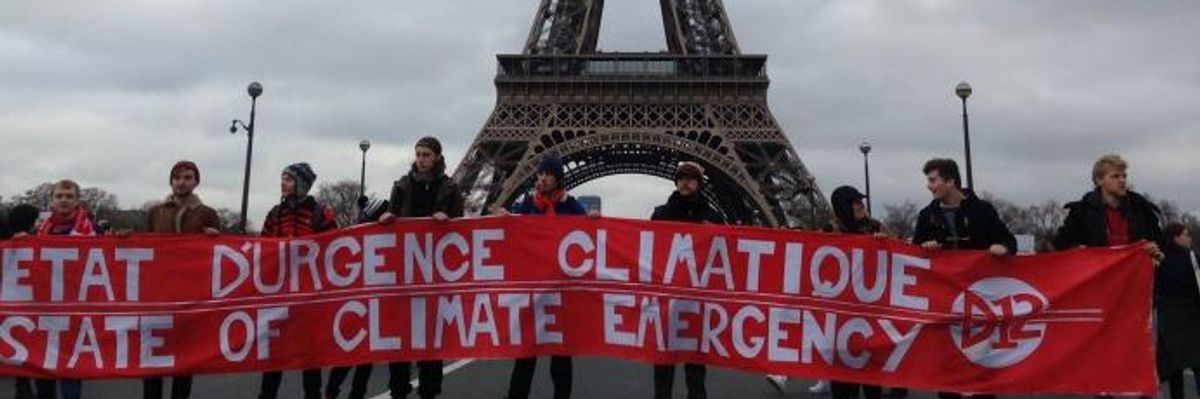
Climate activists hold a sign outside COP21 in Paris on Dec. 12, 2015. (Photo: Carlos Felipe Pardo/flickr/cc)
Climate campaigners welcomed what they saw as a "step forward" and "glimmer of hope" following the European Commission's announcement Wednesday that it had set a goal of 2050 to get to net zero climate emissions. But, they warned, the plan still doesn't go far enough to avert planetary crisis.
"Going climate neutral is necessary, possible, and in Europe's interest," stated Commissioner for Climate Action and Energy, Miguel Arias Canete. He added that it "is in Europe's interest to stop spending on fossil fuel imports and invest in meaningful improvements to the daily lives of all Europeans."
The latest IPCC report, Arias Canete told reporters, was "a real wake-up call," and "today we are responding to this call."
The proposal, put forth days before the United Nations climate summit known as COP24 kicks off in Katowice, Poland, declares that the "status quo is not an option." It also says the "vision presented today does not propose to change the 2030 climate and energy targets but will enable the EU to build on them and develop in due time policies towards 2050." Greenpeace adds in a press statement: "The IPCC report also clearly states that emission cuts between now and 2030 are what will make or break the world's response to climate change."
Herein lies a problem, says Climate Action Network (CAN) Europe.
"By opting for net zero emissions by 2050, the EU will be better equipped to prevent the climate catastrophe," said Wendel Trio, director of the group. "But this commitment alone would not be enough to pull us back from the brink of the climate breakdown. As a matter of urgency, the EU needs to massively increase the 2030 target. It is the short term emission cuts that will make or break our response to climate change."
Moreover, "With communities already feeling the effects of climate breakdown, today's suggestion by the EU to go 'net zero' in 2050 is simply too late for Europe to stop burning carbon," said Clemence Hutin, climate justice campaigner for Friends of the Earth Europe.
"Europe is largely responsible for the carbon pollution in Earth's atmosphere and must do its fair share of action--meaning we must massively and speedily transform our society to phase out fossil fuels in the next decade, not thirty years' time," she continued.
Another problem in the proposal is the reliance on carbon capture and storage to address emissions. Corporate Europe Observatory says that shows the thumbprint of the natural gas industry lobby on the vision statement.
"As long as gas industry lobbyists continue to have a strong grip over policy-making, we will not be able to break free from fossil fuels," said the group's climate policy researcher Pascoe Sabido. "We need a firewall that protects EU and national level decision-makers from gas industry lobbyists if we are serious about tackling the climate crisis."
Dear Common Dreams reader, It’s been nearly 30 years since I co-founded Common Dreams with my late wife, Lina Newhouser. We had the radical notion that journalism should serve the public good, not corporate profits. It was clear to us from the outset what it would take to build such a project. No paid advertisements. No corporate sponsors. No millionaire publisher telling us what to think or do. Many people said we wouldn't last a year, but we proved those doubters wrong. Together with a tremendous team of journalists and dedicated staff, we built an independent media outlet free from the constraints of profits and corporate control. Our mission has always been simple: To inform. To inspire. To ignite change for the common good. Building Common Dreams was not easy. Our survival was never guaranteed. When you take on the most powerful forces—Wall Street greed, fossil fuel industry destruction, Big Tech lobbyists, and uber-rich oligarchs who have spent billions upon billions rigging the economy and democracy in their favor—the only bulwark you have is supporters who believe in your work. But here’s the urgent message from me today. It's never been this bad out there. And it's never been this hard to keep us going. At the very moment Common Dreams is most needed, the threats we face are intensifying. We need your support now more than ever. We don't accept corporate advertising and never will. We don't have a paywall because we don't think people should be blocked from critical news based on their ability to pay. Everything we do is funded by the donations of readers like you. When everyone does the little they can afford, we are strong. But if that support retreats or dries up, so do we. Will you donate now to make sure Common Dreams not only survives but thrives? —Craig Brown, Co-founder |
Climate campaigners welcomed what they saw as a "step forward" and "glimmer of hope" following the European Commission's announcement Wednesday that it had set a goal of 2050 to get to net zero climate emissions. But, they warned, the plan still doesn't go far enough to avert planetary crisis.
"Going climate neutral is necessary, possible, and in Europe's interest," stated Commissioner for Climate Action and Energy, Miguel Arias Canete. He added that it "is in Europe's interest to stop spending on fossil fuel imports and invest in meaningful improvements to the daily lives of all Europeans."
The latest IPCC report, Arias Canete told reporters, was "a real wake-up call," and "today we are responding to this call."
The proposal, put forth days before the United Nations climate summit known as COP24 kicks off in Katowice, Poland, declares that the "status quo is not an option." It also says the "vision presented today does not propose to change the 2030 climate and energy targets but will enable the EU to build on them and develop in due time policies towards 2050." Greenpeace adds in a press statement: "The IPCC report also clearly states that emission cuts between now and 2030 are what will make or break the world's response to climate change."
Herein lies a problem, says Climate Action Network (CAN) Europe.
"By opting for net zero emissions by 2050, the EU will be better equipped to prevent the climate catastrophe," said Wendel Trio, director of the group. "But this commitment alone would not be enough to pull us back from the brink of the climate breakdown. As a matter of urgency, the EU needs to massively increase the 2030 target. It is the short term emission cuts that will make or break our response to climate change."
Moreover, "With communities already feeling the effects of climate breakdown, today's suggestion by the EU to go 'net zero' in 2050 is simply too late for Europe to stop burning carbon," said Clemence Hutin, climate justice campaigner for Friends of the Earth Europe.
"Europe is largely responsible for the carbon pollution in Earth's atmosphere and must do its fair share of action--meaning we must massively and speedily transform our society to phase out fossil fuels in the next decade, not thirty years' time," she continued.
Another problem in the proposal is the reliance on carbon capture and storage to address emissions. Corporate Europe Observatory says that shows the thumbprint of the natural gas industry lobby on the vision statement.
"As long as gas industry lobbyists continue to have a strong grip over policy-making, we will not be able to break free from fossil fuels," said the group's climate policy researcher Pascoe Sabido. "We need a firewall that protects EU and national level decision-makers from gas industry lobbyists if we are serious about tackling the climate crisis."
Climate campaigners welcomed what they saw as a "step forward" and "glimmer of hope" following the European Commission's announcement Wednesday that it had set a goal of 2050 to get to net zero climate emissions. But, they warned, the plan still doesn't go far enough to avert planetary crisis.
"Going climate neutral is necessary, possible, and in Europe's interest," stated Commissioner for Climate Action and Energy, Miguel Arias Canete. He added that it "is in Europe's interest to stop spending on fossil fuel imports and invest in meaningful improvements to the daily lives of all Europeans."
The latest IPCC report, Arias Canete told reporters, was "a real wake-up call," and "today we are responding to this call."
The proposal, put forth days before the United Nations climate summit known as COP24 kicks off in Katowice, Poland, declares that the "status quo is not an option." It also says the "vision presented today does not propose to change the 2030 climate and energy targets but will enable the EU to build on them and develop in due time policies towards 2050." Greenpeace adds in a press statement: "The IPCC report also clearly states that emission cuts between now and 2030 are what will make or break the world's response to climate change."
Herein lies a problem, says Climate Action Network (CAN) Europe.
"By opting for net zero emissions by 2050, the EU will be better equipped to prevent the climate catastrophe," said Wendel Trio, director of the group. "But this commitment alone would not be enough to pull us back from the brink of the climate breakdown. As a matter of urgency, the EU needs to massively increase the 2030 target. It is the short term emission cuts that will make or break our response to climate change."
Moreover, "With communities already feeling the effects of climate breakdown, today's suggestion by the EU to go 'net zero' in 2050 is simply too late for Europe to stop burning carbon," said Clemence Hutin, climate justice campaigner for Friends of the Earth Europe.
"Europe is largely responsible for the carbon pollution in Earth's atmosphere and must do its fair share of action--meaning we must massively and speedily transform our society to phase out fossil fuels in the next decade, not thirty years' time," she continued.
Another problem in the proposal is the reliance on carbon capture and storage to address emissions. Corporate Europe Observatory says that shows the thumbprint of the natural gas industry lobby on the vision statement.
"As long as gas industry lobbyists continue to have a strong grip over policy-making, we will not be able to break free from fossil fuels," said the group's climate policy researcher Pascoe Sabido. "We need a firewall that protects EU and national level decision-makers from gas industry lobbyists if we are serious about tackling the climate crisis."