SUBSCRIBE TO OUR FREE NEWSLETTER
Daily news & progressive opinion—funded by the people, not the corporations—delivered straight to your inbox.
5
#000000
#FFFFFF
To donate by check, phone, or other method, see our More Ways to Give page.
Daily news & progressive opinion—funded by the people, not the corporations—delivered straight to your inbox.
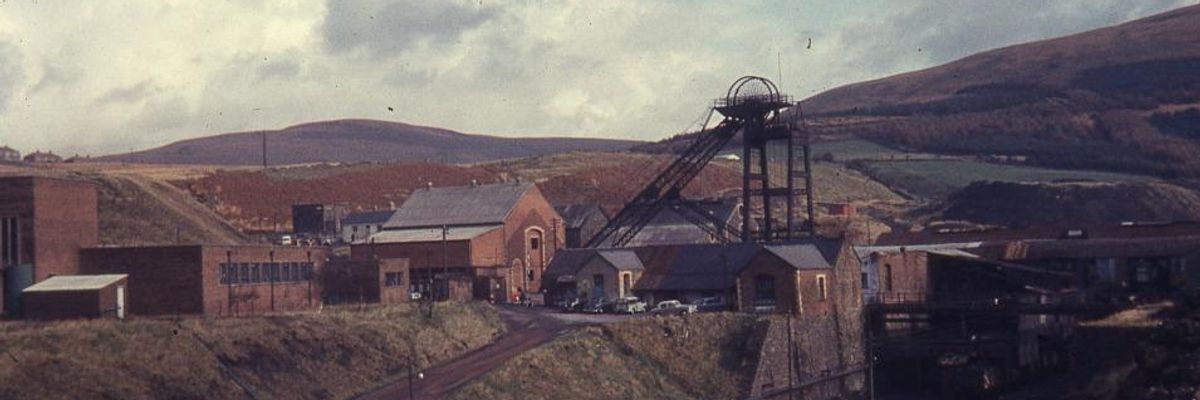
Breaking with its past as one of the world's top coal users, Wales announced it would end its use of all fossil fuels following the IPCC's report on the climate crisis. (Photo: Walt Jabsco/Flickr/cc)
Climate action groups on Monday applauded the government of Wales for demonstrating that it is taking seriously the existential and planetary threat posed by fossil fuels by announcing that the country would end its extraction of coal.
Wales' new proposed plan to reject all future coal mining applications is set to be finalized by the end of the year, a government spokesperson told the BBC last week, as part of the country's new energy strategy which will aim to ensure that 70 percent of Wales' energy is derived from renewable sources by 2030.
"We applaud the Welsh government in taking these vital steps for a climate safe future. Their actions are in direct contrast to its English neighbor who this week has given the green light to start fracking and created an unfavorable environment for renewable energy," said Anna Vickerstaff, spokesperson for 350.org, referring to fracking operations which restarted in Blackpool, England recently--days before five small earthquakes were recorded in the area.
"It is a historic moment. This is the end of coal in Wales after a long association and history." --Haf Elgar, Friends of the Earth Cymru
The announcement came days weeks after the Intergovernmental Panel on Climate Change (IPCC) released a harrowing report on the steps the world's government must take immediately in order to avoid the catastrophic effects of the climate crisis which would come about by 2040 if the Earth warms more than 1.5 degrees Celsius (or 2.7 degrees Fahrenheit).
"We have to be aware of our global responsibility and the impact all of the coal has had over the years and to make sure that we really do play our part in Wales now to be globally responsible and to reduce our carbon emissions," Haf Elgar, director of Friends of the Earth Cymru, told the BBC.
Payal Parekh, program director for 350.org, praised Wales for heeding the call of the IPCC and expressed urgent hope that other countries follow in its footsteps.
"The IPCC report released last week should act as a wake-up call for leaders worldwide. More countries must rapidly follow the path of Wales in leaving fossil fuels in the ground and transitioning to renewables," said Parekh in a statement.
The government's decision was significant for a country which once counted the coal industry as its single biggest employer, producing 57 million tons of coal in one year at the beginning of the last century. Production has slowed significantly over the last 100 years, with the country extracting 2.5 million tons in 2014--but green groups expressed optimism about the plan to eliminate the fossil fuel from Wales' economy.
"It is a historic moment. This is the end of coal in Wales after a long association and history," said Elgar.
The announcement makes Wales one of a small but growing group of nations which have pledged to take bold action and abandon long relied-upon energy sources for the sake of the planet and future generations.
Earlier this year, Costa Rica announced it would shift to 100 percent renewable energy by 2021, and fracking has been banned in Uruguay, Scotland, Germany, Australia, and a number of U.S. states.
The IPCC's report noted that putting a stop to fossil fuel emissions could feasibly be achieved, but that successfully limiting global warming to 1.5 degrees Celsius "would require rapid and far-reaching transitions in energy, land, urban, and infrastructure (including transport and buildings), and industrial systems"--the kind of change to which the Welsh government has now committed.
Dear Common Dreams reader, It’s been nearly 30 years since I co-founded Common Dreams with my late wife, Lina Newhouser. We had the radical notion that journalism should serve the public good, not corporate profits. It was clear to us from the outset what it would take to build such a project. No paid advertisements. No corporate sponsors. No millionaire publisher telling us what to think or do. Many people said we wouldn't last a year, but we proved those doubters wrong. Together with a tremendous team of journalists and dedicated staff, we built an independent media outlet free from the constraints of profits and corporate control. Our mission has always been simple: To inform. To inspire. To ignite change for the common good. Building Common Dreams was not easy. Our survival was never guaranteed. When you take on the most powerful forces—Wall Street greed, fossil fuel industry destruction, Big Tech lobbyists, and uber-rich oligarchs who have spent billions upon billions rigging the economy and democracy in their favor—the only bulwark you have is supporters who believe in your work. But here’s the urgent message from me today. It's never been this bad out there. And it's never been this hard to keep us going. At the very moment Common Dreams is most needed, the threats we face are intensifying. We need your support now more than ever. We don't accept corporate advertising and never will. We don't have a paywall because we don't think people should be blocked from critical news based on their ability to pay. Everything we do is funded by the donations of readers like you. When everyone does the little they can afford, we are strong. But if that support retreats or dries up, so do we. Will you donate now to make sure Common Dreams not only survives but thrives? —Craig Brown, Co-founder |
Climate action groups on Monday applauded the government of Wales for demonstrating that it is taking seriously the existential and planetary threat posed by fossil fuels by announcing that the country would end its extraction of coal.
Wales' new proposed plan to reject all future coal mining applications is set to be finalized by the end of the year, a government spokesperson told the BBC last week, as part of the country's new energy strategy which will aim to ensure that 70 percent of Wales' energy is derived from renewable sources by 2030.
"We applaud the Welsh government in taking these vital steps for a climate safe future. Their actions are in direct contrast to its English neighbor who this week has given the green light to start fracking and created an unfavorable environment for renewable energy," said Anna Vickerstaff, spokesperson for 350.org, referring to fracking operations which restarted in Blackpool, England recently--days before five small earthquakes were recorded in the area.
"It is a historic moment. This is the end of coal in Wales after a long association and history." --Haf Elgar, Friends of the Earth Cymru
The announcement came days weeks after the Intergovernmental Panel on Climate Change (IPCC) released a harrowing report on the steps the world's government must take immediately in order to avoid the catastrophic effects of the climate crisis which would come about by 2040 if the Earth warms more than 1.5 degrees Celsius (or 2.7 degrees Fahrenheit).
"We have to be aware of our global responsibility and the impact all of the coal has had over the years and to make sure that we really do play our part in Wales now to be globally responsible and to reduce our carbon emissions," Haf Elgar, director of Friends of the Earth Cymru, told the BBC.
Payal Parekh, program director for 350.org, praised Wales for heeding the call of the IPCC and expressed urgent hope that other countries follow in its footsteps.
"The IPCC report released last week should act as a wake-up call for leaders worldwide. More countries must rapidly follow the path of Wales in leaving fossil fuels in the ground and transitioning to renewables," said Parekh in a statement.
The government's decision was significant for a country which once counted the coal industry as its single biggest employer, producing 57 million tons of coal in one year at the beginning of the last century. Production has slowed significantly over the last 100 years, with the country extracting 2.5 million tons in 2014--but green groups expressed optimism about the plan to eliminate the fossil fuel from Wales' economy.
"It is a historic moment. This is the end of coal in Wales after a long association and history," said Elgar.
The announcement makes Wales one of a small but growing group of nations which have pledged to take bold action and abandon long relied-upon energy sources for the sake of the planet and future generations.
Earlier this year, Costa Rica announced it would shift to 100 percent renewable energy by 2021, and fracking has been banned in Uruguay, Scotland, Germany, Australia, and a number of U.S. states.
The IPCC's report noted that putting a stop to fossil fuel emissions could feasibly be achieved, but that successfully limiting global warming to 1.5 degrees Celsius "would require rapid and far-reaching transitions in energy, land, urban, and infrastructure (including transport and buildings), and industrial systems"--the kind of change to which the Welsh government has now committed.
Climate action groups on Monday applauded the government of Wales for demonstrating that it is taking seriously the existential and planetary threat posed by fossil fuels by announcing that the country would end its extraction of coal.
Wales' new proposed plan to reject all future coal mining applications is set to be finalized by the end of the year, a government spokesperson told the BBC last week, as part of the country's new energy strategy which will aim to ensure that 70 percent of Wales' energy is derived from renewable sources by 2030.
"We applaud the Welsh government in taking these vital steps for a climate safe future. Their actions are in direct contrast to its English neighbor who this week has given the green light to start fracking and created an unfavorable environment for renewable energy," said Anna Vickerstaff, spokesperson for 350.org, referring to fracking operations which restarted in Blackpool, England recently--days before five small earthquakes were recorded in the area.
"It is a historic moment. This is the end of coal in Wales after a long association and history." --Haf Elgar, Friends of the Earth Cymru
The announcement came days weeks after the Intergovernmental Panel on Climate Change (IPCC) released a harrowing report on the steps the world's government must take immediately in order to avoid the catastrophic effects of the climate crisis which would come about by 2040 if the Earth warms more than 1.5 degrees Celsius (or 2.7 degrees Fahrenheit).
"We have to be aware of our global responsibility and the impact all of the coal has had over the years and to make sure that we really do play our part in Wales now to be globally responsible and to reduce our carbon emissions," Haf Elgar, director of Friends of the Earth Cymru, told the BBC.
Payal Parekh, program director for 350.org, praised Wales for heeding the call of the IPCC and expressed urgent hope that other countries follow in its footsteps.
"The IPCC report released last week should act as a wake-up call for leaders worldwide. More countries must rapidly follow the path of Wales in leaving fossil fuels in the ground and transitioning to renewables," said Parekh in a statement.
The government's decision was significant for a country which once counted the coal industry as its single biggest employer, producing 57 million tons of coal in one year at the beginning of the last century. Production has slowed significantly over the last 100 years, with the country extracting 2.5 million tons in 2014--but green groups expressed optimism about the plan to eliminate the fossil fuel from Wales' economy.
"It is a historic moment. This is the end of coal in Wales after a long association and history," said Elgar.
The announcement makes Wales one of a small but growing group of nations which have pledged to take bold action and abandon long relied-upon energy sources for the sake of the planet and future generations.
Earlier this year, Costa Rica announced it would shift to 100 percent renewable energy by 2021, and fracking has been banned in Uruguay, Scotland, Germany, Australia, and a number of U.S. states.
The IPCC's report noted that putting a stop to fossil fuel emissions could feasibly be achieved, but that successfully limiting global warming to 1.5 degrees Celsius "would require rapid and far-reaching transitions in energy, land, urban, and infrastructure (including transport and buildings), and industrial systems"--the kind of change to which the Welsh government has now committed.