

SUBSCRIBE TO OUR FREE NEWSLETTER
Daily news & progressive opinion—funded by the people, not the corporations—delivered straight to your inbox.
5
#000000
#FFFFFF
To donate by check, phone, or other method, see our More Ways to Give page.
Daily news & progressive opinion—funded by the people, not the corporations—delivered straight to your inbox.
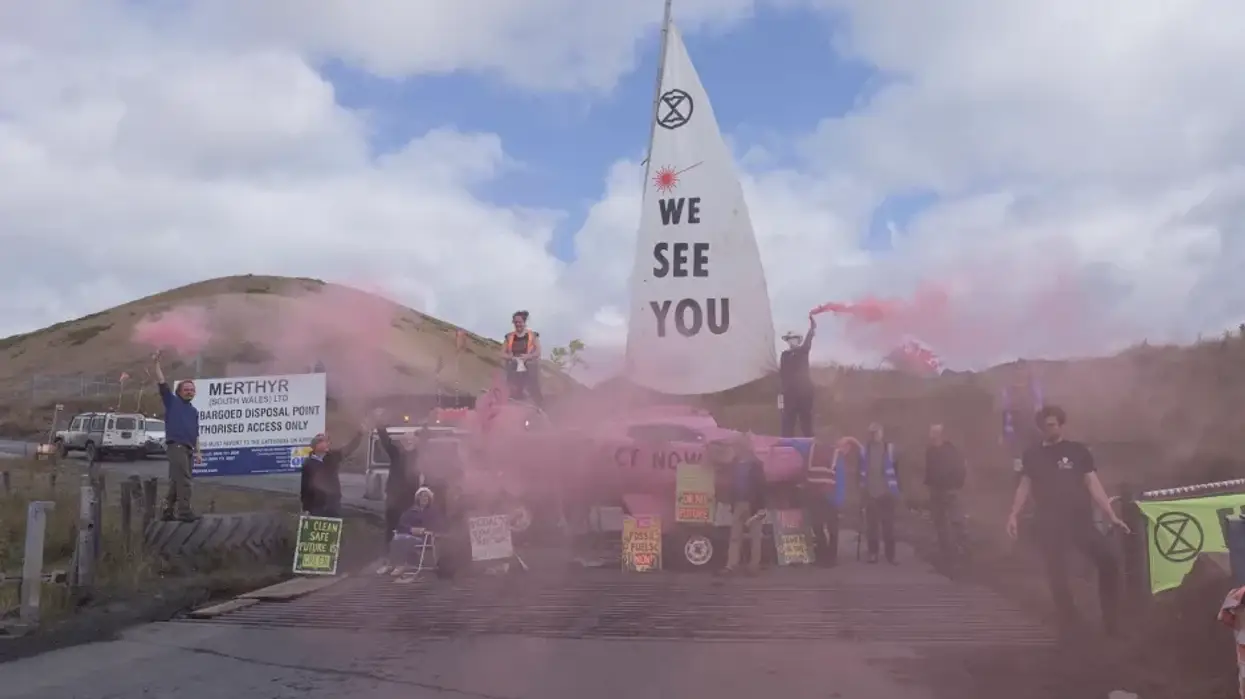
"The authorities are missing in action," said one campaigner. "If they won't step in to stop illegal, planet-wrecking coal mining, we will."
On the heels of the world's two hottest days on record, U.K. climate activists on Wednesday shut down an open-cast coal mine in Wales that has been operating without a license since last summer.
"We have today done what the Welsh government, the U.K. government, and the local council have failed to do—shut down the operations of the U.K.'s largest coal mine which has been operating without a license since September last year," Extinction Rebellion (XR) activist Marcus Bailie of Caerphilly said in a statement.
The 68-year-old is among Extinction Rebellion's Cymru/Wales and U.K. members who locked themselves to the group's pink boat, which was used to blockade the access road between the Ffos-y-Fran mine and its depot early Wednesday. Because of the new "Public Order Act," the activists face the threat of up to 51 weeks in jail.
"We aim to stop operations until at least the weekend and we are calling for as many people as possible to come down to support us and make this happen."
"We aim to stop operations until at least the weekend and we are calling for as many people as possible to come down to support us and make this happen," Bailie explained. "It would be crazy if the mine owner or the government instructed the police to move against us just so the mine owners can continue what is an illegal operation."
While sitting on top of the boat, Liz Pendleton of XR United Kingdom declared: "The authorities are missing in action. If they won't step in to stop illegal, planet-wrecking coal mining, we will."
Permission for coal mining at Ffos-y-Fran was initially granted in 2005. Merthyr (South Wales) Ltd., the company behind the mine, hoped to extend operations until March 2024 and push its promised restoration of the site to June 2026.
A local council in April rejected the proposed extension and in May issued a notice to end coal extraction at the mine. That notice took effect last week, giving Merthyr (South Wales) Ltd. 28 days to stop digging, but the company is now appealing.
As the BBC reported last week:
The Welsh government said on Wednesday morning it understood the company was appealing.
A spokesman added that it could not comment further as it may "jeopardize any future decision Welsh ministers may have to make on the matter."
Mining firm Merthyr (South Wales) Ltd confirmed an appeal had "been lodged with the Welsh ministers" and said it could not comment further while the appeal process was ongoing.
"We are extremely disappointed, and frustrated, to hear that the mining company has appealed the enforcement action," Chris Austin, who lives near the mine and has campaigned against it as part of the United Valleys Action Group, told the BBC. "If accepted, the appeal could take 12 months or more to resolve, so we again urge that a 'stop order' be put in place whilst this appeal is determined."
Mel Price, who also lives near the site and joined XR's action, said Wednesday that "the mine owners have drawn millions in dividends while local residents have to tolerate all the noise and pollution caused by an illegal mine. The carbon emissions continue and the scar on the landscape gets bigger."
"The government and the legal system are prepared to lock up peaceful protesters for trying to stop fossil fuel companies and investors from profiting from the destruction of our planet, yet they are not prepared to stop illegal mining, so we are making a stand," Price continued. "If the police decide to arrest us, they will be acting without probable cause and against their own interests as they are the ones who will have to rescue people from the floods and the fires—is this what we really want?"
"The law of aggravated trespass is quite clear in that it must be obstruction of a lawful activity and it is quite clear that this mine is operating illegally," Price added. "So, the decision will have to be made by the authorities about, 'Who are the criminals here?'"
In addition to XR's boat blockade, a group called No More Coal is organizing a peaceful march on the mine for Saturday morning.
Given that the mining company has kept operating for months and "no one seems able to stop them," Bailie said, "we've had to take matters into our own hands by coming here to demand they stop extracting and shipping coal immediately and for good."
"We encourage hundreds, even thousands, of people to come from all over the country to march on Ffos-y-Fran to tell them that we, the people, say no more," the activist added, pointing to Saturday's event.
The coal protest came after The Guardian reported Tuesday that the Conservative U.K. government plans to drop its £11.6 billion ($14.75 billion) international climate pledge. The newspaper noted Wednesday that "although the Foreign, Commonwealth, and Development Office (FCDO) said such claims were 'false,' a leaked briefing showed that ministers were being prepared for the target not being met because of government cuts to aid funding, underspending, and new commitments such as aid for Ukraine."
The reporting outraged climate campaigners, including branches of Extinction Rebellion. XR Islington charged that "this is murderous madness" while the Havering group tweeted that "'saving' money is a lie and a false economy when it comes to climate action. The cost is not just in money but in human suffering. Inaction will cost us and the rest of the world far more in the long run."
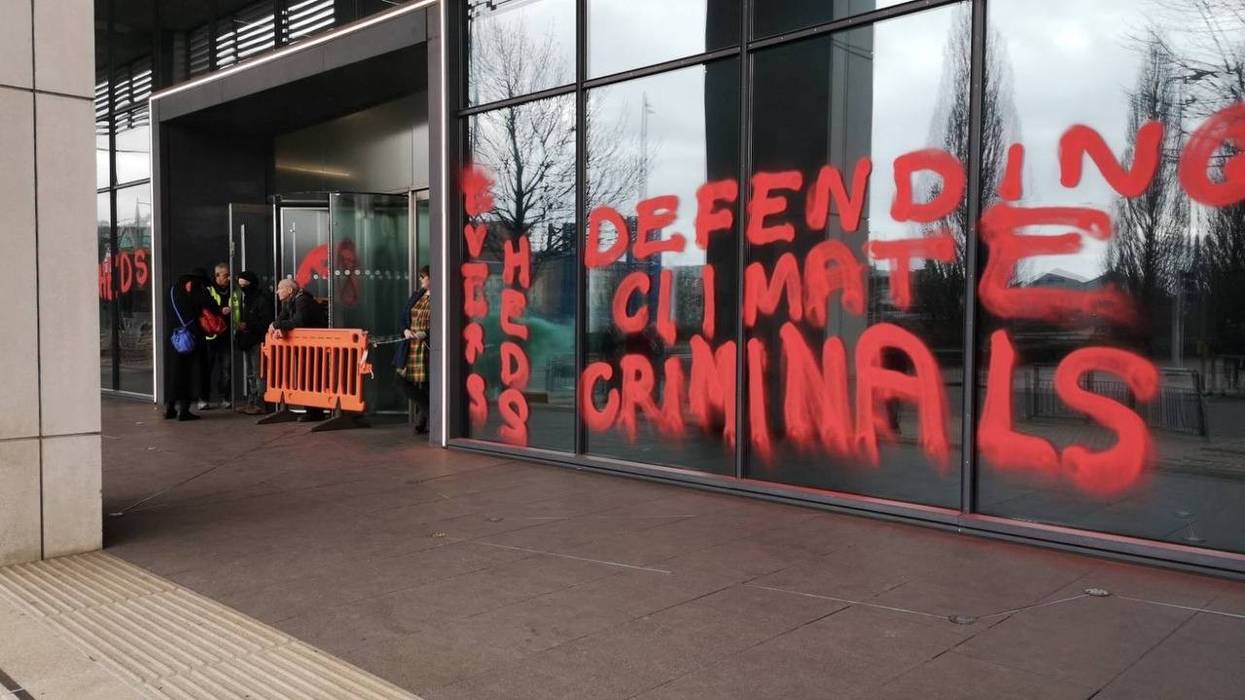
"We are taking this action against injunctions put in place by law firms like Eversheds which prevent peaceful protest," said a 70-year-old who joined the protest in London.
Dozens of protesters on Tuesday gathered at Eversheds Sutherland offices in four U.K. cities—Birmingham, Cardiff, London, and Nottingham—to call out the corporate law firm's work for major polluters fueling the climate emergency.
The activists "are protesting against the law firm's complicity in the destruction of the planet by facilitating injunctions for companies like Esso (ExxonMobil) and High Speed 2 (HS2)," Extinction Rebellion (XR) and HS2 Rebellion explained in a statement.
"I can't stand by while civil liberties are eroded and we drift towards a police state," declared Dorothea Hackma, a 70-year-old grandmother from Camden who participated in the London protest, where activists coated their hands in fake blood and held up inflatable Earths.
"We are taking this action against injunctions put in place by law firms like Eversheds which prevent peaceful protest," Hackma said. "Injunctions enable big oil companies like Exxon and developers like HS2 to continue their destruction of the planet and ecology through the reckless exploitation of fossil fuels."
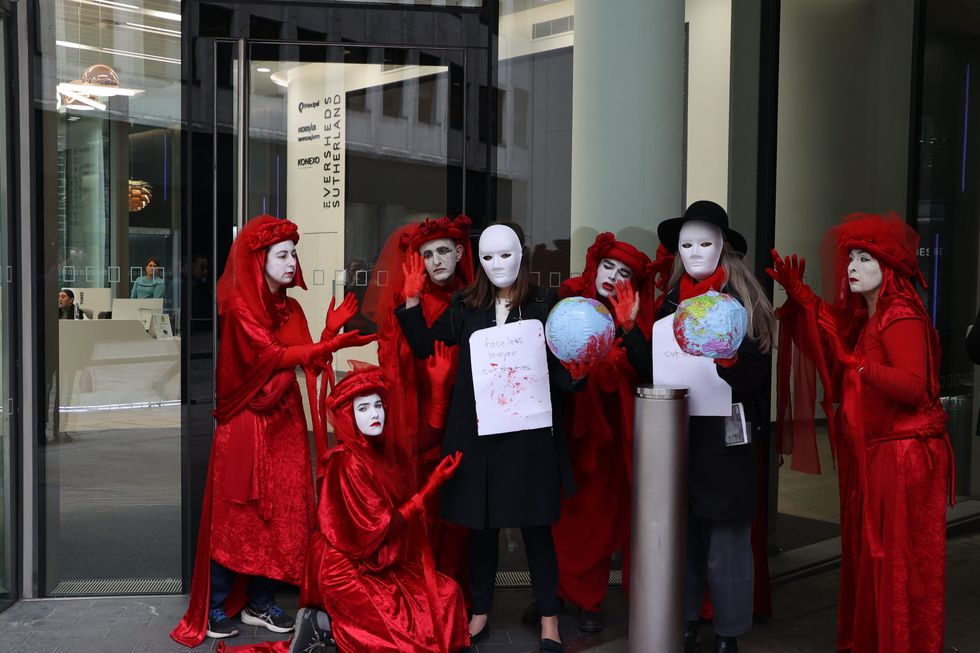 (Photo: Extinction Rebellion)
The demonstrators' statement pointed out that "these injunctions have been used on the activists protesting against the destruction of precious woodlands, meadows, and other crucial habitats by HS2 contractors for access to construction sites. The law firm also helped ban protesters from disrupting a new Esso oil pipeline transporting aviation fuel from Southampton to West London through the use of injunctions."
While XR is no longer using "public disruption as a primary tactic," Tuesday's actions were part of a "Cut the Ties" protest series launched in November targeting the "web of organizations propping up the fossil fuel economy." The series is leading up to "The Big One," a demonstration intended to bring together 100,000 people outside the U.K. Parliament in late April.
Climate campaigners in the English city of Birmingham on Tuesday left a message in spray paint: "Cut the Ties To Fossil Fuels."
In Cardiff, the capital of Wales, they poured fake oil outside the firm's Callaghan Square office, blocked an entrance, and wrote "Denfeding Climate Criminals" on the glass.
According to WalesOnline:
Earlier, the group delivered a coffin to the Welsh Parliament. Wearing hazmat suits and black masks, the protesters were making a stand against what they say have been a "glut of applications" to extend coal mining licences in Wales and the "Welsh government's failure to protect future generations."
South Wales Police confirmed one person has been arrested following the demonstration at Callaghan Square. A 68-year-old man from Caerphilly had been arrested on suspicion of criminal damage and remains in police custody.
"We live in a time when multinational corporations are ignoring the science and continuing to extract fossil fuels and cause widespread ecological damage contrary to everything that we are being told about the precarious state of nature and metrological systems," said Mel Price, a certified accountant from Swansea who joined the Cardiff action.
"It seems that the only way to resist the policies of these corporations is to take direct action, not just against them but against the firms that assist them and feed off their profits to suppress movements that seek to bring about the changes that are needed to protect people all over the world," added the 55-year-old. "We need to make the firms see that only by cutting the ties to fossil fuels will we maintain a sustainable future for our children and grandchildren."
In Nottingham, England, demonstrators donned hazmat suits while unfurling "Cut the Ties to Fossil Fuels" banners, setting off smoke flares, and spraying the firm's Canal Street building in fake oil.
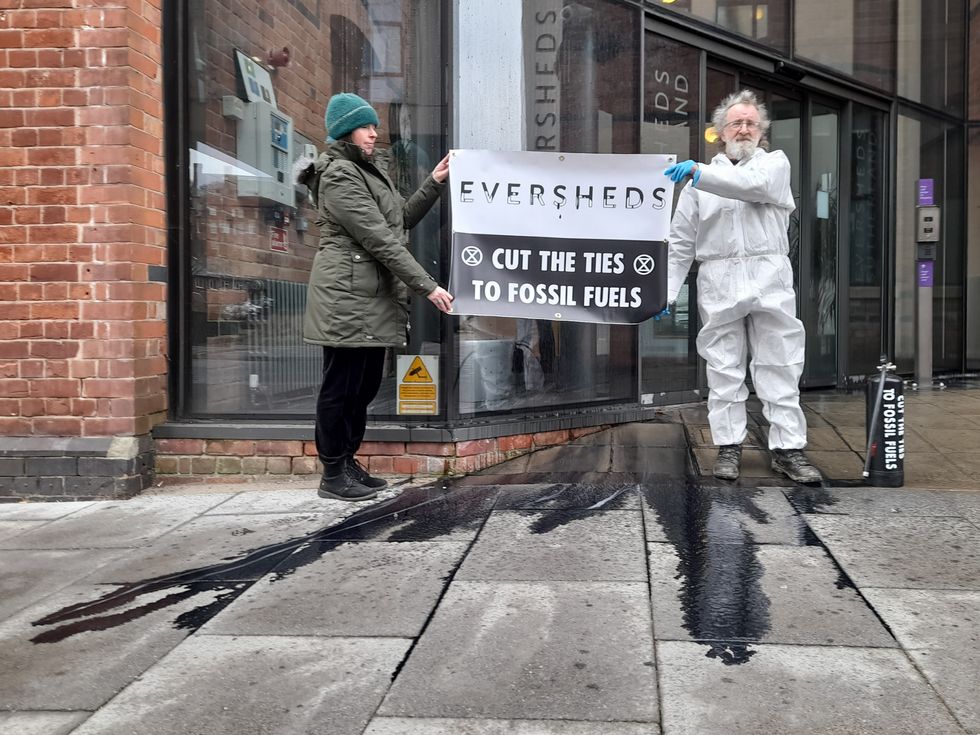 (Photo: Extinction Rebellion)
"I'm taking this action today because I'm so frightened by the climate crisis that I feel this is a necessary and appropriate response. Eversheds need to cut ties with the fossil fuel industry," said Eddie Francis, a 74-year-old retiree and father.
"Spraying nontoxic, washable fake oil on the offices of a firm that seeks to protect that destructive industry is trivial compared with the damage they're doing to our planet," Francis told the West Bridgford Wire. "They need calling out."

Human rights defenders and sports fans worldwide condemned a decision by the world football governing body FIFA to ban any shows of support for LGBTQ+ rights by players during the World Cup that kicked off in Qatar on Sunday.
"LGBTQ+ people are criminalized in Qatar just for being themselves."
The Associated Press reports seven World Cup teams--Belgium, Denmark, England, Germany, the Netherlands, Switzerland, and Wales--said their captains would not wear rainbow-colored armbands supporting the OneLove anti-discrimination campaign after FIFA warned they would immediately be shown yellow cards, two of which result in a player's expulsion from that and the following match.
"By threatening sporting sanctions and stopping players from wearing #OneLove armbands, FIFA are brushing criticism of human rights abuses under the carpet," the U.K. LGBTQ+ advocacy group Stonewall tweeted in response to the decision.
"LGBTQ+ people are criminalized in Qatar just for being themselves," the group added. "No country which abuses the human rights of its people in this way should have been awarded with the honor of hosting a major sporting tournament in the first place."
The seven teams--which had planned on wearing the armbands as a sign of support for LGBTQ+ people in a country in which they are criminalized and face up to seven years in prison for engaging in same-sex relations--said they were prepared to pay fines, but FIFA's clarification indicating on-field penalties forced them to reverse course.
"As national federations, we can't put our players in a position where they could face sporting sanctions, including bookings," the seven national soccer federations said in a joint statement. "We are very frustrated by the FIFA decision, which we believe is unprecedented."
Separately, the Royal Dutch Football Association said: "Our number one priority at the World Cup is to win the games. Then you don't want the captain to start the match with a yellow card."
The Football Association of Wales expressed disappointment in FIFA's decision, stating that "we remain with the belief that football is for everyone and stand with our LGBTQ+ members of the Welsh football family. Football for everyone."
FIFA regulations state that no uniforms or other clothing or equipment may be worn or used if it is "dangerous, offensive, or indecent" or has "political, religious, or personal slogans."
However, Article 3 of the FIFA Statutes bans "discrimination of any kind against a country, private person, or groups of people on account of ethnic origin, gender, language, religion, politics, or any other reason."
Qatar, a repressive monarchy ruled by the House of Al Thani for nearly two centuries, has faced criticism for its human rights record, including its treatment of women, LGBTQ+ people, political dissenters, and migrant workers--6,500 of whom have died in the country since it was awarded the World Cup in 2010, according to a Guardian analysis.
Mohammed bin Hammam, a prominent Qatari soccer official and former member of FIFA's executive committee, allegedly paid $5 million to bribe football officials to support Qatar's World Cup bid. An investigation by FIFA's ethics watchdog and Michael J. Garcia, a former U.S. federal prosecutor, found copious evidence of questionable behavior but no "smoking gun" proving vote-buying.
Referring to Saturday's deadly mass shooting at a gay nightclub in Colorado in the United States, the British LGBTQ+ fan network Pride in Football lamented that "now was the perfect opportunity for people with a massive platform--that of the World Cup--to stand in solidarity with the community. But it's fallen apart."
"Actions speak louder than words," the group added, "and these actions suggest the risk of a yellow card is more important than the rights of LGBTQ+ people in Qatar."

As millions of Britons and admirers the world over mourned Queen Elizabeth II's death Thursday, others--especially in nations formerly colonized by the British Empire--voiced reminders of the "horrendous cruelties" perpetrated against them during the monarch's reign.
"Her legacy is colonialism, slavery, racism, loot, and plundering."
"We do not mourn the death of Elizabeth, because to us her death is a reminder of a very tragic period in this country and Africa's history," declared Julius Malema, head of the left-wing Economic Freedom Fighters party in South Africa.
"Elizabeth ascended to the throne in 1952, reigning for 70 years as a head of an institution built up, sustained, and living off a brutal legacy of dehumanization of millions of people across the world," he continued.
"During her 70-year reign as queen, she never once acknowledged the atrocities that her family inflicted on native people that Britain invaded across the world," Malema noted. "She willingly benefited from the wealth that was attained from the exploitation and murder of millions of people across the world."
"The British royal family stands on the shoulders of millions of slaves who were shipped away from the continent to serve the interests of racist white capital accumulation, at the center of which lies the British royal family," Malema added.
Larry Madowo, a CNN International correspondent from Kenya, said during a Thursday broadcast that "the fairytale is that Queen Elizabeth went up the treetops here in Kenya a princess and came down a queen because it's when she was here in Kenya that she learned that her dad had died and she was to be the queen."
"But that also was the start of the eight years after that, that the... British colonial government cracked down brutally on the Mau Mau rebellion against the colonial administration," he continued. "They herded more than a million people into concentration camps, where they were tortured and dehumanized."
In addition to rampant torture--including the systemic castration of suspected rebels and sympathizers, often with pliers--British forces and their local allies massacred unarmed civilians, disappeared their children, sadistically raped women, and clubbed prisoners to death.
"And so," added Madowo, "across the African continent, there have been people who are saying, 'I will not mourn for Queen Elizabeth, because my ancestors suffered great atrocities under her people that she never fully acknowledged that."
Indeed, instead of apologizing for its crimes and compensating its victims, the British government launched Operation Legacy, a massive effort to erase evidence of colonial crimes during the period of rapid decolonization in the 1950s-'70s.
"If the queen had apologized for slavery, colonialism, and neocolonialism and urged the Crown to offer reparations for the millions of lives taken in her/their names, then perhaps I would do the human thing and feel bad," tweeted Cornell University professor Mukoma wa Ngugi. "As a Kenyan, I feel nothing. This theater is absurd."
Aldani Marki, an activist with the Organization of Solidarity with the Yemeni Struggle, asserted that "Queen Elizabeth is a colonizer and has blood on her hands."
"In 1963 the Yemeni people rebelled against British colonialism. In turn the Queen ordered her troops to violently suppress any and all dissent as fiercely as possible," he tweeted. "The main punitive measure of Queen Elizabeth's Aden colony was forced deportations of native Yemenis into Yemen's desert heartland."
"This is Queen Elizabeth's legacy," Marki continued. "A legacy of colonial violence and plunder. A legacy of racial segregation and institutionalized racism."
"The queen's England is today waging another war against Yemen together with the U.S., Saudi Arabia, and the UAE," he added.
Melissa Murray, a Jamaican-American professor at New York University School of Law, said that the queen's death "will accelerate debates about colonialism, reparations, and the future of the Commonwealth" as "the residue of colonialism shadows day-to-day life in Jamaica and other parts of the Caribbean."
Numerous observers noted how the British Empire plundered around $45 trillion from India over two centuries of colonialism that resulted in millions of deaths, and how the Kohinoor--one of the largest cut diamonds in the world, with an estimated value of $200 million--was stolen from India to be set in the queen mother's crown.
"Why are Indians mourning the death of Queen Elizabeth II?" asked Indian economist Manisha Kadyan on Twitter. "Her legacy is colonialism, slavery, racism, loot, and plundering. Despite having chances, she never apologized for [the] bloody history of her family. She reduced everything to a 'difficult past episode' on her visit to India. Evil."
An Indian historian tweeted, "there are only 22 countries that Britain never invaded throughout history."
"British ships transported a total of three million Africans to the New World as slaves," he wrote. "An empire that brought misery and famine to Asia and Africa. No tears for the queen. No tears for the British monarchy."
Negative reaction to the queen's passing was not limited to the Global South. Despite the historic reconciliation between Ireland and Britain this century, there were celebrations in Dublin--as a crowd singing "Lizzie's in a Box" at a Celtic FC football match attests--and among the Irish diaspora.
"I'm Irish," tweeted MSNBC contributor Katelyn Burns, "hating the queen is a family matter."
Welsh leftists got in on the action too. The Welsh Underground Network tweeted a litany of reasons why "we will not mourn."
"We will not mourn for royals who oversaw the protection of known child molesters in the family," the group said.
"We will not mourn for royals who oversaw the active destruction of the Welsh language, and the Welsh culture," the separatists added.
Summing up the sentiments of many denizens of the Global South and decolonization defenders worldwide, Assal Rad, research director at the National Iranian American Council, tweeted, "If you have more sympathy for colonizers and oppressors than the people they oppress, you may need to evaluate your priorities."

Residents of a Welsh coastal village are set to become the first climate refugees in the United Kingdom.
The 850 residents of Fairbourne will meet next month to discuss a plan that the local lawmaking body, Gwynedd Council, is developing to evacuate the town by 2054 at the latest, amid concerns about rising sea levels.
Gwynedd Council determined in 2013 that defending Fairbourne from the effects of the climate crisis would not be possible in the long term. The council, along with the national agency Natural Resources Wales, funded a $6 million flood management plan over the past four years.
According to Wales Online, "there will be no money spent on defending this community of around 400 homes and 850 people after 2054," leading the council to decide recently that decommissioning the town must be considered and that "relocating residents is a certainty."
A relocation scheme could go into effect as early as 2042. After the town is evacuated, all buildings, roads, and utilities will be dismantled, with Fairbourne converted into a tidal salt marsh, according to The Guardian.
" Climate change is happening, and it is unfortunately only a matter of time before it has a very real human impact on coastal communities like Fairbourne," councillor Catrin Wager told Wales Online.
"By talking to the community sooner rather than later, our aim is to work through these difficult issues together in order to give ourselves as much time as possible to come up with viable options and the best possible solutions," she added.
The possibility of compensation will likely be discussed at the town meeting planned for June 26. As The Guardian reported last week, Fairbourne residents are not expected to receive financial aid from the Welsh government when they are forced to leave, making them the U.K.'s first climate refugees.
A number of other coastal communities around the U.K. are likely to meet a similar fate. Both the British Parliament and Welsh lawmakers officially declared a climate emergency in recent weeks, under pressure from the global grassroots movement Extinction Rebellion--but campaigners responded promptly by ramping up pressure on government leaders to follow the declarations by taking meaningful action to solve the climate crisis and stop rising sea levels as well as other effects.
"This is a wake-up call for the country," Bev Wilkins, who moved to Fairbourne in 2002, told The Guardian. "This is going to happen elsewhere. Sometimes you have to see someone else go through it--we just happen to be the first."

The Welsh government on Monday declared a climate emergency in hopes that doing so would "trigger a wave of action at home and internationally."
The declaration comes a day after the Scottish first minister made a similar pronouncement.
"Tackling climate change is not an issue which can be left to individuals or to the free market," Welsh environment minister Lesley Griffiths said in a statement. "It requires collective action and the government has a central role to making that collective action possible."
"No nation in the world has yet fully grasped this challenge but just as Wales played a leading role in the first industrial revolution," said Griffiths, "I believe Wales can provide an example to others of what it means to achieve environmental growth."
"Our sustainable development and environmental legislation is already recognized as world-leading ," she added, "and now we must use that legislation to set a new pace of change."
The statement also "highlights the recent climate protests across the U.K."
The Welsh declaration drew the attention of Swedish climate protester Greta Thunberg, who catalyzed the school climate strikes. "Activism works. So act," she tweeted.
Others, like Shadow Minister for the Environment and Rural Affairs, Andrew R.T. Davies, expressed skepticism.
"Only recently Labour's environment minister set emissions targets that actually fell short of those demanded by the Paris Agreement," said Davies, "so we await to see what action will be taken to ensure this isn't just another empty pledge from a Welsh Labour government that has consistently failed to deliver on its promises during its twenty years in government."
Climate mobilization Extinction Rebellion gave the announcement a tepid welcome.
"This has seen them start to #TellTheTruth about some of the climate and ecological crisis," the group said. "They must now halt biodiversity loss, go net #ZeroCarbon2025, and create a #CitizensAssembly."
The U.K.-based Youth Strike for Climate, meanwhile, pointed to Wednesday as a possible turning point.
That's when Jeremy Corbyn's Labour Party will force a Commons vote on whether to declare a climate emergency, and put "Conservative MPs under pressure to back the plan, or explain why they refuse to do so," the Guardian reported.
"If our Parliament does the right thing and declares a climate emergency," said Corbyn, "it could trigger... [a]ctions that could save our planet."
Pointing to the kind of sustained actions young people like Thunberg have taken, Corbyn added, "The inspiring climate activism we've seen in recent weeks must serve as a massive and necessary wake up call for rapid and dramatic action."
Others, however, wonder whether Labour was ready to go beyond a climate declaration and really walk the climate walk.
Green Party MP Caroline Lucas welcomed the upcoming vote, but wrote that "with the clock ticking we must be honest about the need to go much further, about a bold vision that puts an end to the 'growth at all costs' economic model."
She added:
We cannot tackle climate change whilst at the same time backing new fossil fuel extraction. Britain's first new deep coal mine in 30 years has been given the go-ahead by Cumbria County Council--backed by Labour, Liberal Democrat, and Conservative councillors. This decision is a slap in the face for the young people striking for a future.
Corbyn, for his part, said the vote gives Parliament "the chance to be the first in the world to declare an environment and climate emergency, which we hope will trigger a wave of action from parliaments and governments around the world."

Climate action groups on Monday applauded the government of Wales for demonstrating that it is taking seriously the existential and planetary threat posed by fossil fuels by announcing that the country would end its extraction of coal.
Wales' new proposed plan to reject all future coal mining applications is set to be finalized by the end of the year, a government spokesperson told the BBC last week, as part of the country's new energy strategy which will aim to ensure that 70 percent of Wales' energy is derived from renewable sources by 2030.
"We applaud the Welsh government in taking these vital steps for a climate safe future. Their actions are in direct contrast to its English neighbor who this week has given the green light to start fracking and created an unfavorable environment for renewable energy," said Anna Vickerstaff, spokesperson for 350.org, referring to fracking operations which restarted in Blackpool, England recently--days before five small earthquakes were recorded in the area.
"It is a historic moment. This is the end of coal in Wales after a long association and history." --Haf Elgar, Friends of the Earth Cymru
The announcement came days weeks after the Intergovernmental Panel on Climate Change (IPCC) released a harrowing report on the steps the world's government must take immediately in order to avoid the catastrophic effects of the climate crisis which would come about by 2040 if the Earth warms more than 1.5 degrees Celsius (or 2.7 degrees Fahrenheit).
"We have to be aware of our global responsibility and the impact all of the coal has had over the years and to make sure that we really do play our part in Wales now to be globally responsible and to reduce our carbon emissions," Haf Elgar, director of Friends of the Earth Cymru, told the BBC.
Payal Parekh, program director for 350.org, praised Wales for heeding the call of the IPCC and expressed urgent hope that other countries follow in its footsteps.
"The IPCC report released last week should act as a wake-up call for leaders worldwide. More countries must rapidly follow the path of Wales in leaving fossil fuels in the ground and transitioning to renewables," said Parekh in a statement.
The government's decision was significant for a country which once counted the coal industry as its single biggest employer, producing 57 million tons of coal in one year at the beginning of the last century. Production has slowed significantly over the last 100 years, with the country extracting 2.5 million tons in 2014--but green groups expressed optimism about the plan to eliminate the fossil fuel from Wales' economy.
"It is a historic moment. This is the end of coal in Wales after a long association and history," said Elgar.
The announcement makes Wales one of a small but growing group of nations which have pledged to take bold action and abandon long relied-upon energy sources for the sake of the planet and future generations.
Earlier this year, Costa Rica announced it would shift to 100 percent renewable energy by 2021, and fracking has been banned in Uruguay, Scotland, Germany, Australia, and a number of U.S. states.
The IPCC's report noted that putting a stop to fossil fuel emissions could feasibly be achieved, but that successfully limiting global warming to 1.5 degrees Celsius "would require rapid and far-reaching transitions in energy, land, urban, and infrastructure (including transport and buildings), and industrial systems"--the kind of change to which the Welsh government has now committed.
City councilors of a small Welsh town on Wednesday unanimously rejected a company's bid to build a new open-pit coal mine, defying the developer's threats to sue them and attracting jubilant praise from residents and environmental organizations.
"This is a great day for democracy and people power," Friends of the Earth Cymru (Wales) director Gareth Clubb declared Wednesday.
The decision by representatives on the planning committee of Caerphilly county borough came in response to a sustained campaign from local residents who oppose Miller Argent's proposal for the Nant Llesg mine in the Rhymney valley, aimed at extracting six million tons of coal on 478 hectares of land.
The council initially opposed the mine proposal in June, but delayed the final decision until Wednesday.
Last week, Miller Argent threatened to sue the town if the bid was rejected. "We reiterate that in the event of a refusal and appeal, the substantial costs would be in no one's interest," the company wrote to the city. "Your officers have highlighted the potential for a substantial award of costs against the council. Miller Argent would seek to recover costs from the council."
However, the town's officials did not cave to the intimidation, and when councilors announced their vote to a packed meeting on Wednesday, the room erupted into cheers of "well done," the Caerphilly Observer reports.
Terry Evans, chair of United Valleys Action Group, told the Observer: "It's absolutely brilliant. They didn't bend and didn't crack in in the face of financial pressure from that company."
"The local community have fought long and hard against this opencast coal mine proposal, and its legacy of pollution, devastation and disruption," said Craig Bennett, chief executive of Friends of the Earth.
Friends of the Earth vowed to support the city councilors in the event of a lawsuit from the company. "If Miller Argent opt to appeal, be assured we will support the community to fight this all the way," declared Clubb.
Just one week after Scotland announced its moratorium on fracking, the Welsh government voted on Wednesday to block the toxic method of shale gas extraction until it is proven safe from environmental and public health standpoints.
The Plaid Cymru political party's motion calls for control over fracking to be fully devolved from Westminster--seat of the U.K. government--to the National Assembly for Wales. In addition, it "calls on the Welsh Government to do everything within its power to prevent fracking from taking place in Wales until it is proven to be safe in both an environmental and public health context."
"The Westminster Government needs to catch up with Scotland, Wales, and many other areas of the world and bring in a moratorium on controversial fracking."
--Donna Hume, Friends of the Earth
In advance of the vote, the Welsh government had confirmed it would support the opposition party's motion.
"It's a historic day," North Wales assembly member Llyr Gruffyd, of the Plaid Cymru party. "This is a clear statement from the National Assembly for Wales that we want a frack-free Wales."
Friends of the Earth UK has noted that fracking increases greenhouse gas emissions, risks environmental damage, and won't create the jobs in Wales that the industry promises.
Gareth Clubb, director of Friends of the Earth Cymru, said he was "delighted" by Wednesday's news. "We look forward to the Welsh government using all the powers it currently has under planning and environmental permitting to make sure that unconventional gas extraction does not take place in Wales," he said.
Last week, a Welsh official from Swansea called on the Council of Europe to support a moratorium on fracking across the continent.
"The world stands on the brink of environmental catastrophe," said Geraint Davies, Labor MP for Swansea West. "If just one fifth of the available fossil fuels is burnt, global temperatures will grow beyond the two degrees tipping point that could send the world into irreversible climate change, with storms, floods, tidal waves, major disruption to our future food and water supplies, forced migration and conflict as growing populations are displaced and compete for scarce resources."
"Yet the dash for shale gas continues, egged on by a hunger from austerity provoked by a financial crisis caused by the irresponsibility of unregulated bankers," he continued.
Davies added: "In the United States, President Bush's exclusion of fracking from the clean air and water regulations allowed the industry to power forward without counting the environmental costs, which might turn out to be astronomical."
Despite widespread public opposition to the practice, and evidence that fracking is incompatible with national climate change targets, the U.K. failed last month to pass a nationwide moratorium.
"The Westminster Government needs to catch up with Scotland, Wales and many other areas of the world and bring in a moratorium on controversial fracking," Friends of the Earth's energy campaigner Donna Hume said following Wednesday's vote. "Fracking in the U.K. is looking increasingly like a lame duck. It's time the Government stopped trying to get this damaging and unpopular industry off the ground and started prioritizing energy efficiency and renewable energy."
A Guardian analysis published Monday shows that, thanks to concessions made by U.K. ministers during last month's debate, fracking is set to be banned on two-fifths of the land in England being offered for shale gas exploration by the government.
"The shale industry's seemingly irresistible advance is now looking more and more resistible every day," Louise Hutchins of Greenpeace U.K. told the Guardian. "Unless ministers can explain why fracking is too risky for the South Downs but perfectly safe in the Lancashire countryside, the next obvious step is to ban this controversial technique from the whole of the UK."