SUBSCRIBE TO OUR FREE NEWSLETTER
Daily news & progressive opinion—funded by the people, not the corporations—delivered straight to your inbox.
5
#000000
#FFFFFF
To donate by check, phone, or other method, see our More Ways to Give page.
Daily news & progressive opinion—funded by the people, not the corporations—delivered straight to your inbox.
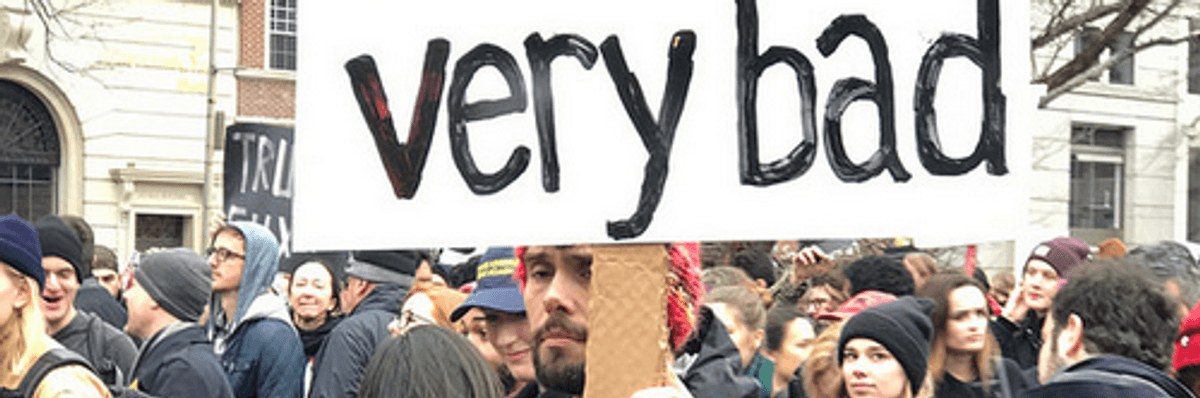
Fifty-nine percent of Americans surveyed in a new poll say the present-day is the lowest point in U.S. history, with many pointing to issues impacted by the Trump administration. (Photo: NoHoDamon/Flickr/cc)
A majority of Americans surveyed in a study of stress levels, released on Wednesday, said they consider the present day to be the lowest point in U.S. history, and indicated that the future of the nation is a major source of stress in their lives.
Out of 3,440 respondents surveyed in August by the American Psychological Association, fifty-nine percent said they can't remember a worse time in the nation's history. The people surveyed included Americans who had lived through World War II, the Vietnam War, the September 11 attacks, and the Cuban Missile Crisis.
Poll-takers asked respondents to describe the issues that have caused them to feel this way, and found that 59 percent were most anguished about "divisiveness" in U.S. society.
Forty-three percent named healthcare as their top source of stress, amid continued efforts by the Trump administration and the Republican Party to weaken the Affordable Care Act (ACA). The poll was taken just after Republicans' efforts to repeal the law failed, but President Donald Trump has continued to sabotage the ACA, which helped nearly 20 million Americans gain health coverage.
More than a third of those polled said the economy was their biggest worry. Trump has been pushing his tax plan in recent weeks, which is expected to hold the most benefits for wealthy Americans.
Another 32 percent said "trust in government" was their biggest concern and 31 percent said hate crimes or crime in general were their top source of stress regarding the nation.
Women who took the survey reported higher levels of stress than men, and black and Latino males had a higher average stress level than their white counterparts. Black respondents also expressed far less optimism about the path the country is on than white respondents; 72 percent disagreed that the country could have a strong future, while only 55 percent of whites disagreed with the sentiment.
More than half of respondents also said that their concerns over the political climate in the U.S. makes them feel conflicted about keeping up with the 24-hour news cycle.
"With 24-hour news networks and conversations with friends, family, and other connections on social media, it's hard to avoid the constant stream of stress around issues of national concern," said Dr. Arthur Evans, CEO of the APA.
On social media, some of Trump's critics said they related to the APA's findings.
Dear Common Dreams reader, It’s been nearly 30 years since I co-founded Common Dreams with my late wife, Lina Newhouser. We had the radical notion that journalism should serve the public good, not corporate profits. It was clear to us from the outset what it would take to build such a project. No paid advertisements. No corporate sponsors. No millionaire publisher telling us what to think or do. Many people said we wouldn't last a year, but we proved those doubters wrong. Together with a tremendous team of journalists and dedicated staff, we built an independent media outlet free from the constraints of profits and corporate control. Our mission has always been simple: To inform. To inspire. To ignite change for the common good. Building Common Dreams was not easy. Our survival was never guaranteed. When you take on the most powerful forces—Wall Street greed, fossil fuel industry destruction, Big Tech lobbyists, and uber-rich oligarchs who have spent billions upon billions rigging the economy and democracy in their favor—the only bulwark you have is supporters who believe in your work. But here’s the urgent message from me today. It's never been this bad out there. And it's never been this hard to keep us going. At the very moment Common Dreams is most needed, the threats we face are intensifying. We need your support now more than ever. We don't accept corporate advertising and never will. We don't have a paywall because we don't think people should be blocked from critical news based on their ability to pay. Everything we do is funded by the donations of readers like you. When everyone does the little they can afford, we are strong. But if that support retreats or dries up, so do we. Will you donate now to make sure Common Dreams not only survives but thrives? —Craig Brown, Co-founder |
A majority of Americans surveyed in a study of stress levels, released on Wednesday, said they consider the present day to be the lowest point in U.S. history, and indicated that the future of the nation is a major source of stress in their lives.
Out of 3,440 respondents surveyed in August by the American Psychological Association, fifty-nine percent said they can't remember a worse time in the nation's history. The people surveyed included Americans who had lived through World War II, the Vietnam War, the September 11 attacks, and the Cuban Missile Crisis.
Poll-takers asked respondents to describe the issues that have caused them to feel this way, and found that 59 percent were most anguished about "divisiveness" in U.S. society.
Forty-three percent named healthcare as their top source of stress, amid continued efforts by the Trump administration and the Republican Party to weaken the Affordable Care Act (ACA). The poll was taken just after Republicans' efforts to repeal the law failed, but President Donald Trump has continued to sabotage the ACA, which helped nearly 20 million Americans gain health coverage.
More than a third of those polled said the economy was their biggest worry. Trump has been pushing his tax plan in recent weeks, which is expected to hold the most benefits for wealthy Americans.
Another 32 percent said "trust in government" was their biggest concern and 31 percent said hate crimes or crime in general were their top source of stress regarding the nation.
Women who took the survey reported higher levels of stress than men, and black and Latino males had a higher average stress level than their white counterparts. Black respondents also expressed far less optimism about the path the country is on than white respondents; 72 percent disagreed that the country could have a strong future, while only 55 percent of whites disagreed with the sentiment.
More than half of respondents also said that their concerns over the political climate in the U.S. makes them feel conflicted about keeping up with the 24-hour news cycle.
"With 24-hour news networks and conversations with friends, family, and other connections on social media, it's hard to avoid the constant stream of stress around issues of national concern," said Dr. Arthur Evans, CEO of the APA.
On social media, some of Trump's critics said they related to the APA's findings.
A majority of Americans surveyed in a study of stress levels, released on Wednesday, said they consider the present day to be the lowest point in U.S. history, and indicated that the future of the nation is a major source of stress in their lives.
Out of 3,440 respondents surveyed in August by the American Psychological Association, fifty-nine percent said they can't remember a worse time in the nation's history. The people surveyed included Americans who had lived through World War II, the Vietnam War, the September 11 attacks, and the Cuban Missile Crisis.
Poll-takers asked respondents to describe the issues that have caused them to feel this way, and found that 59 percent were most anguished about "divisiveness" in U.S. society.
Forty-three percent named healthcare as their top source of stress, amid continued efforts by the Trump administration and the Republican Party to weaken the Affordable Care Act (ACA). The poll was taken just after Republicans' efforts to repeal the law failed, but President Donald Trump has continued to sabotage the ACA, which helped nearly 20 million Americans gain health coverage.
More than a third of those polled said the economy was their biggest worry. Trump has been pushing his tax plan in recent weeks, which is expected to hold the most benefits for wealthy Americans.
Another 32 percent said "trust in government" was their biggest concern and 31 percent said hate crimes or crime in general were their top source of stress regarding the nation.
Women who took the survey reported higher levels of stress than men, and black and Latino males had a higher average stress level than their white counterparts. Black respondents also expressed far less optimism about the path the country is on than white respondents; 72 percent disagreed that the country could have a strong future, while only 55 percent of whites disagreed with the sentiment.
More than half of respondents also said that their concerns over the political climate in the U.S. makes them feel conflicted about keeping up with the 24-hour news cycle.
"With 24-hour news networks and conversations with friends, family, and other connections on social media, it's hard to avoid the constant stream of stress around issues of national concern," said Dr. Arthur Evans, CEO of the APA.
On social media, some of Trump's critics said they related to the APA's findings.