

SUBSCRIBE TO OUR FREE NEWSLETTER
Daily news & progressive opinion—funded by the people, not the corporations—delivered straight to your inbox.
5
#000000
#FFFFFF
To donate by check, phone, or other method, see our More Ways to Give page.
Daily news & progressive opinion—funded by the people, not the corporations—delivered straight to your inbox.
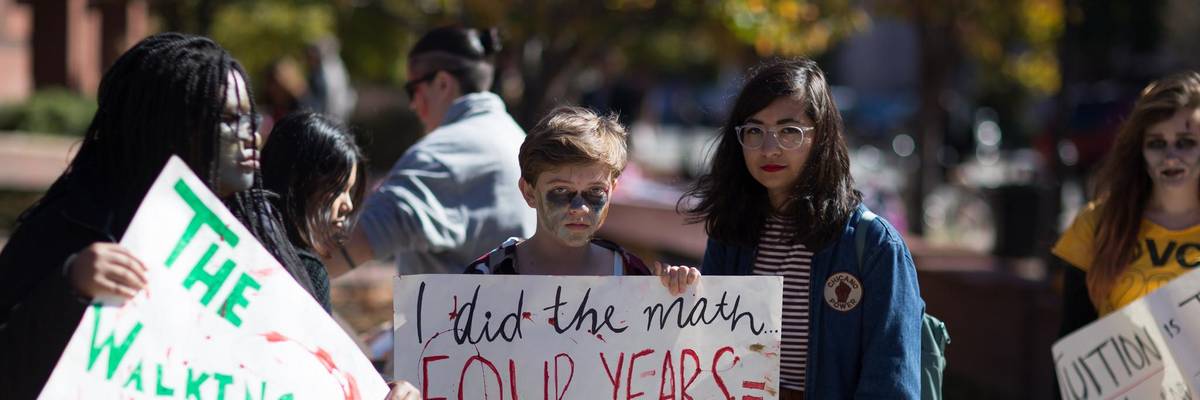
Student debt in the U.S. has reached more than $1.3 trillion. The Department of Education recently announced it would not work with the CFPB to hel students with complaints about their student loan servicers. (Photo: Tom Woodward/Flickr/cc)
Calling the move "outrageous and deeply troubling," consumer advocates and opponents of skyrocketing student debt spoke out Tuesday against the Trump administration's decision to end the working relationship between the Department of Education and the government watchdog tasked with helping oversee the federal student loan program and protect borrowers.
At the direction of Congress, under the Dodd-Frank financial reform act, the Department of Education has shared information with the Consumer Financial Protection Bureau (CFPB) since 2011 in order to provide assistance to borrowers with complaints about Federal student loans. But the Department, now run by Secretary Betsy DeVos, informed the Bureau in a letter last week that it was ending the relationship.
Especially at a time when federal student loan debt has reached over $1.3 trillion, critics condemned the decision.
The National Consumer Law Center (NCLC) says, "the CFPB has stood up for students and demonstrated the urgent need for an independent watch dog over student loan servicers and collectors," fighting "to ensure that struggling borrowers can access the repayment programs they are entitled to."
The Education Department accused the CFPB of "overreaching" by "unilaterally expanding its oversight role to include the Department's contracted federal loan servicers." Republican lawmakers have opposed the CFPB's involvement in monitoring student loan complaints, and the Trump administration has sought to weaken the Bureau.
In its statement, the NCLC said the accusation of an overreach by the Bureau is unfounded:
Congress gave the CFPB authority over those servicers and collectors and directed the CFPB to establish the agreement that Education has terminated 'to ensure coordination in providing assistance to and serving borrowers seeking to resolve complaints related to their private education or Federal student loans.'
Clare McCann, who worked in the Education Department under President Barack Obama and now directs federal higher education policy at New America, also condemned the decision.
"This is just another example of how collaborative, interagency work has fallen apart under the new administration, and it's bad news for borrowers," said McCann. "Ending its formal relationship with the CFPB is proof that the department is working to systematically dismantle those planned protections for borrowers."
The DOE's letter to the Bureau came days after the appointment of a former executive at the for-profit DeVry University to run the Department's unit combatting school fraud. Last year, DeVry paid $100 million in a settlement after it was accused of misleading students.
Sen. Elizabeth Warren (D-Mass.)--the leading figure in establishing the CFPB and a longtime critic of for-profit colleges and the federal student loan system--expressed shock at the DeVry official's appointment and DeVos's agenda.
Dear Common Dreams reader, It’s been nearly 30 years since I co-founded Common Dreams with my late wife, Lina Newhouser. We had the radical notion that journalism should serve the public good, not corporate profits. It was clear to us from the outset what it would take to build such a project. No paid advertisements. No corporate sponsors. No millionaire publisher telling us what to think or do. Many people said we wouldn't last a year, but we proved those doubters wrong. Together with a tremendous team of journalists and dedicated staff, we built an independent media outlet free from the constraints of profits and corporate control. Our mission has always been simple: To inform. To inspire. To ignite change for the common good. Building Common Dreams was not easy. Our survival was never guaranteed. When you take on the most powerful forces—Wall Street greed, fossil fuel industry destruction, Big Tech lobbyists, and uber-rich oligarchs who have spent billions upon billions rigging the economy and democracy in their favor—the only bulwark you have is supporters who believe in your work. But here’s the urgent message from me today. It's never been this bad out there. And it's never been this hard to keep us going. At the very moment Common Dreams is most needed, the threats we face are intensifying. We need your support now more than ever. We don't accept corporate advertising and never will. We don't have a paywall because we don't think people should be blocked from critical news based on their ability to pay. Everything we do is funded by the donations of readers like you. When everyone does the little they can afford, we are strong. But if that support retreats or dries up, so do we. Will you donate now to make sure Common Dreams not only survives but thrives? —Craig Brown, Co-founder |
Calling the move "outrageous and deeply troubling," consumer advocates and opponents of skyrocketing student debt spoke out Tuesday against the Trump administration's decision to end the working relationship between the Department of Education and the government watchdog tasked with helping oversee the federal student loan program and protect borrowers.
At the direction of Congress, under the Dodd-Frank financial reform act, the Department of Education has shared information with the Consumer Financial Protection Bureau (CFPB) since 2011 in order to provide assistance to borrowers with complaints about Federal student loans. But the Department, now run by Secretary Betsy DeVos, informed the Bureau in a letter last week that it was ending the relationship.
Especially at a time when federal student loan debt has reached over $1.3 trillion, critics condemned the decision.
The National Consumer Law Center (NCLC) says, "the CFPB has stood up for students and demonstrated the urgent need for an independent watch dog over student loan servicers and collectors," fighting "to ensure that struggling borrowers can access the repayment programs they are entitled to."
The Education Department accused the CFPB of "overreaching" by "unilaterally expanding its oversight role to include the Department's contracted federal loan servicers." Republican lawmakers have opposed the CFPB's involvement in monitoring student loan complaints, and the Trump administration has sought to weaken the Bureau.
In its statement, the NCLC said the accusation of an overreach by the Bureau is unfounded:
Congress gave the CFPB authority over those servicers and collectors and directed the CFPB to establish the agreement that Education has terminated 'to ensure coordination in providing assistance to and serving borrowers seeking to resolve complaints related to their private education or Federal student loans.'
Clare McCann, who worked in the Education Department under President Barack Obama and now directs federal higher education policy at New America, also condemned the decision.
"This is just another example of how collaborative, interagency work has fallen apart under the new administration, and it's bad news for borrowers," said McCann. "Ending its formal relationship with the CFPB is proof that the department is working to systematically dismantle those planned protections for borrowers."
The DOE's letter to the Bureau came days after the appointment of a former executive at the for-profit DeVry University to run the Department's unit combatting school fraud. Last year, DeVry paid $100 million in a settlement after it was accused of misleading students.
Sen. Elizabeth Warren (D-Mass.)--the leading figure in establishing the CFPB and a longtime critic of for-profit colleges and the federal student loan system--expressed shock at the DeVry official's appointment and DeVos's agenda.
Calling the move "outrageous and deeply troubling," consumer advocates and opponents of skyrocketing student debt spoke out Tuesday against the Trump administration's decision to end the working relationship between the Department of Education and the government watchdog tasked with helping oversee the federal student loan program and protect borrowers.
At the direction of Congress, under the Dodd-Frank financial reform act, the Department of Education has shared information with the Consumer Financial Protection Bureau (CFPB) since 2011 in order to provide assistance to borrowers with complaints about Federal student loans. But the Department, now run by Secretary Betsy DeVos, informed the Bureau in a letter last week that it was ending the relationship.
Especially at a time when federal student loan debt has reached over $1.3 trillion, critics condemned the decision.
The National Consumer Law Center (NCLC) says, "the CFPB has stood up for students and demonstrated the urgent need for an independent watch dog over student loan servicers and collectors," fighting "to ensure that struggling borrowers can access the repayment programs they are entitled to."
The Education Department accused the CFPB of "overreaching" by "unilaterally expanding its oversight role to include the Department's contracted federal loan servicers." Republican lawmakers have opposed the CFPB's involvement in monitoring student loan complaints, and the Trump administration has sought to weaken the Bureau.
In its statement, the NCLC said the accusation of an overreach by the Bureau is unfounded:
Congress gave the CFPB authority over those servicers and collectors and directed the CFPB to establish the agreement that Education has terminated 'to ensure coordination in providing assistance to and serving borrowers seeking to resolve complaints related to their private education or Federal student loans.'
Clare McCann, who worked in the Education Department under President Barack Obama and now directs federal higher education policy at New America, also condemned the decision.
"This is just another example of how collaborative, interagency work has fallen apart under the new administration, and it's bad news for borrowers," said McCann. "Ending its formal relationship with the CFPB is proof that the department is working to systematically dismantle those planned protections for borrowers."
The DOE's letter to the Bureau came days after the appointment of a former executive at the for-profit DeVry University to run the Department's unit combatting school fraud. Last year, DeVry paid $100 million in a settlement after it was accused of misleading students.
Sen. Elizabeth Warren (D-Mass.)--the leading figure in establishing the CFPB and a longtime critic of for-profit colleges and the federal student loan system--expressed shock at the DeVry official's appointment and DeVos's agenda.

