

SUBSCRIBE TO OUR FREE NEWSLETTER
Daily news & progressive opinion—funded by the people, not the corporations—delivered straight to your inbox.
5
#000000
#FFFFFF
To donate by check, phone, or other method, see our More Ways to Give page.
Daily news & progressive opinion—funded by the people, not the corporations—delivered straight to your inbox.
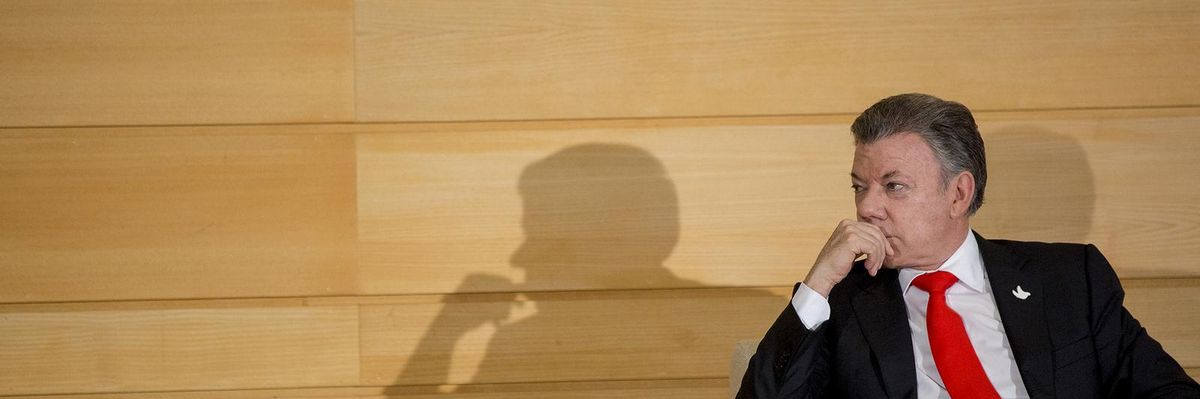
Colombian president Juan Manuel Santos urged President Donald Trump on Sunday to dial back his rhetoric on potential U.S. military intervention in Venezuela. (Photo: Headquarters Paris/Flickr/cc)
The Venezuelan opposition and Colombian President Juan Manuel Santos have both joined the growing chorus of voices in Latin America warning the Trump administration against any possibility of U.S. military intervention in Venezuela.
Vice President Mike Pence's trip to four countries in Latin America this week began with an unequivocal message for the Trump administration from Santos on Sunday.
"I've told Vice President Pence the possibility of military intervention shouldn't even be considered," Santos said in a joint press conference in Cartagena, Colombia. "A transition in the Venezuelan regime toward democracy must be a peaceful transition. It must be hopefully a democratic transition. And it must be done quickly."
President Donald Trump said last Friday that he would not rule out actions by the U.S. military in the South American country, where protests have broken out in recent weeks against the regime of President Nicolas Maduro.
Maduro was able to consolidate his power in a controversial election on July 30, when the opposition-led National Assembly was replaced with a new governing body filled with members of his party, giving the United Socialist Party the power to rewrite the country's constitution. A voting software company involved in the election has said the Venezuelan government lied about voter turnout, calling the election results into question. Millions have protested Maduro's power grab, and more than 120 people have died in demonstrations since April.
Pence distanced himself from Trump's comments while also appearing to leave the possibility of military action open, saying at his meeting with Santos, "We have many options for Venezuela, but President Trump also remains confident that working with all of our allies across Latin America, we can achieve a peaceable solution."
In an interview with MSNBC on Monday, Pence added, "The United States is not going to tolerate Venezuela collapsing into a dictatorship."
The Venezuelan opposition party, the Democratic Unity Roundtable (MUD), said Sunday that it rejected "the use of force, or the threat of applying such force, by whatever country against Venezuela." The statement followed emphatic denunciations of Trump's threats by the governments of Latin American countries including Argentina and Chile, both of which are strongly opposed to the Maduro regime's recent actions, and which Pence will be visiting this week.
Dear Common Dreams reader, It’s been nearly 30 years since I co-founded Common Dreams with my late wife, Lina Newhouser. We had the radical notion that journalism should serve the public good, not corporate profits. It was clear to us from the outset what it would take to build such a project. No paid advertisements. No corporate sponsors. No millionaire publisher telling us what to think or do. Many people said we wouldn't last a year, but we proved those doubters wrong. Together with a tremendous team of journalists and dedicated staff, we built an independent media outlet free from the constraints of profits and corporate control. Our mission has always been simple: To inform. To inspire. To ignite change for the common good. Building Common Dreams was not easy. Our survival was never guaranteed. When you take on the most powerful forces—Wall Street greed, fossil fuel industry destruction, Big Tech lobbyists, and uber-rich oligarchs who have spent billions upon billions rigging the economy and democracy in their favor—the only bulwark you have is supporters who believe in your work. But here’s the urgent message from me today. It's never been this bad out there. And it's never been this hard to keep us going. At the very moment Common Dreams is most needed, the threats we face are intensifying. We need your support now more than ever. We don't accept corporate advertising and never will. We don't have a paywall because we don't think people should be blocked from critical news based on their ability to pay. Everything we do is funded by the donations of readers like you. When everyone does the little they can afford, we are strong. But if that support retreats or dries up, so do we. Will you donate now to make sure Common Dreams not only survives but thrives? —Craig Brown, Co-founder |
The Venezuelan opposition and Colombian President Juan Manuel Santos have both joined the growing chorus of voices in Latin America warning the Trump administration against any possibility of U.S. military intervention in Venezuela.
Vice President Mike Pence's trip to four countries in Latin America this week began with an unequivocal message for the Trump administration from Santos on Sunday.
"I've told Vice President Pence the possibility of military intervention shouldn't even be considered," Santos said in a joint press conference in Cartagena, Colombia. "A transition in the Venezuelan regime toward democracy must be a peaceful transition. It must be hopefully a democratic transition. And it must be done quickly."
President Donald Trump said last Friday that he would not rule out actions by the U.S. military in the South American country, where protests have broken out in recent weeks against the regime of President Nicolas Maduro.
Maduro was able to consolidate his power in a controversial election on July 30, when the opposition-led National Assembly was replaced with a new governing body filled with members of his party, giving the United Socialist Party the power to rewrite the country's constitution. A voting software company involved in the election has said the Venezuelan government lied about voter turnout, calling the election results into question. Millions have protested Maduro's power grab, and more than 120 people have died in demonstrations since April.
Pence distanced himself from Trump's comments while also appearing to leave the possibility of military action open, saying at his meeting with Santos, "We have many options for Venezuela, but President Trump also remains confident that working with all of our allies across Latin America, we can achieve a peaceable solution."
In an interview with MSNBC on Monday, Pence added, "The United States is not going to tolerate Venezuela collapsing into a dictatorship."
The Venezuelan opposition party, the Democratic Unity Roundtable (MUD), said Sunday that it rejected "the use of force, or the threat of applying such force, by whatever country against Venezuela." The statement followed emphatic denunciations of Trump's threats by the governments of Latin American countries including Argentina and Chile, both of which are strongly opposed to the Maduro regime's recent actions, and which Pence will be visiting this week.
The Venezuelan opposition and Colombian President Juan Manuel Santos have both joined the growing chorus of voices in Latin America warning the Trump administration against any possibility of U.S. military intervention in Venezuela.
Vice President Mike Pence's trip to four countries in Latin America this week began with an unequivocal message for the Trump administration from Santos on Sunday.
"I've told Vice President Pence the possibility of military intervention shouldn't even be considered," Santos said in a joint press conference in Cartagena, Colombia. "A transition in the Venezuelan regime toward democracy must be a peaceful transition. It must be hopefully a democratic transition. And it must be done quickly."
President Donald Trump said last Friday that he would not rule out actions by the U.S. military in the South American country, where protests have broken out in recent weeks against the regime of President Nicolas Maduro.
Maduro was able to consolidate his power in a controversial election on July 30, when the opposition-led National Assembly was replaced with a new governing body filled with members of his party, giving the United Socialist Party the power to rewrite the country's constitution. A voting software company involved in the election has said the Venezuelan government lied about voter turnout, calling the election results into question. Millions have protested Maduro's power grab, and more than 120 people have died in demonstrations since April.
Pence distanced himself from Trump's comments while also appearing to leave the possibility of military action open, saying at his meeting with Santos, "We have many options for Venezuela, but President Trump also remains confident that working with all of our allies across Latin America, we can achieve a peaceable solution."
In an interview with MSNBC on Monday, Pence added, "The United States is not going to tolerate Venezuela collapsing into a dictatorship."
The Venezuelan opposition party, the Democratic Unity Roundtable (MUD), said Sunday that it rejected "the use of force, or the threat of applying such force, by whatever country against Venezuela." The statement followed emphatic denunciations of Trump's threats by the governments of Latin American countries including Argentina and Chile, both of which are strongly opposed to the Maduro regime's recent actions, and which Pence will be visiting this week.

