SUBSCRIBE TO OUR FREE NEWSLETTER
Daily news & progressive opinion—funded by the people, not the corporations—delivered straight to your inbox.
5
#000000
#FFFFFF
To donate by check, phone, or other method, see our More Ways to Give page.
Daily news & progressive opinion—funded by the people, not the corporations—delivered straight to your inbox.
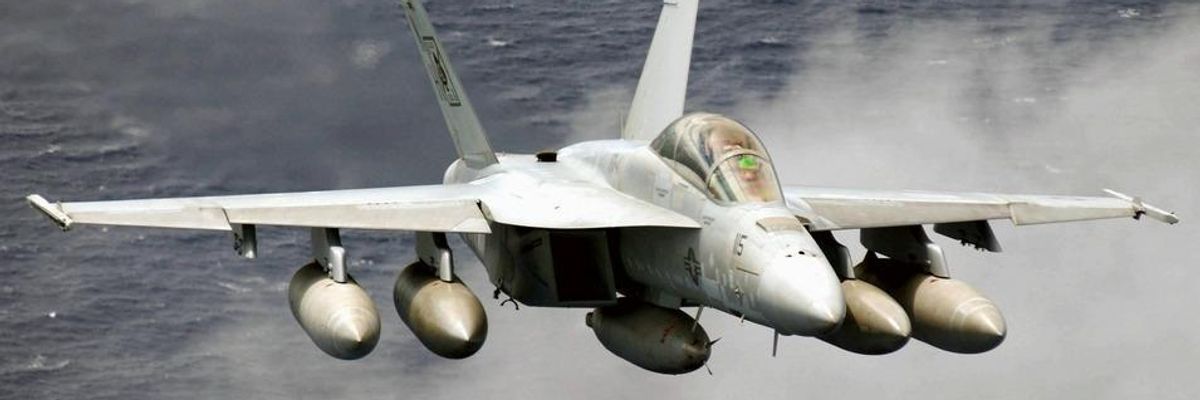
"In response to North Korea's second intercontinental ballistic missile (ICBM) test late last week, the U.S. on Sunday carried out what the Washington Post called a "show of force" by flying two B-1 bombers over the Korean Peninsula." (Photo: mashleymorgan/Flickr/cc)
As President Donald Trump foments tensions with world powers by behaving recklessly and pursuing aggressive action over diplomacy, developments in several major nations over the weekend sparked urgent concerns among peace groups, activists, and analysts that the world's largest militaries are inching dangerously close to war.
"Firing off a bunch of missiles does nothing to address the crisis. We need negotiation not posturing."
--Peace ActionIn response to North Korea's second intercontinental ballistic missile (ICBM) test late last week, the U.S. on Sunday carried out what the Washington Post called a "show of force" by flying two B-1 bombers over the Korean Peninsula. The Post noted that the move is "a sign that tensions are spiraling upward rapidly."
"The sense that time is running out in the confrontation with North Korea was reinforced as the day wore on," the Post added. "Nikki Haley, the U.S. ambassador to the United Nations, batted down rumors that the United States would seek an emergency meeting of the U.N. Security Council. It was pointless, she said, as long as China wouldn't commit to increasing the pressure on North Korea's leader, Kim Jong Un."
The bomber flights were in addition to the U.S. and South Korea's joint missile exercise on Friday immediately following Pyongyang's ICBM launch.
China also looked to put its military might on display Sunday, unveiling in a massive parade an assemblage of new weaponry and technology, including ICBMs "that can reach the U.S. in just 30 minutes" and a J-20 stealth fighter plane that "could potentially rival the F-22 or F-35."
These events were punctuated by the Russian government's response to a sanctions bill passed by the U.S. Congress last week, which Trump is expected to sign.
"President Vladimir V. Putin announced Sunday that the American diplomatic mission in Russia must reduce its staff by 755," the New York Times reported. The Times went on to characterize the response as one "ripped right from the Cold War playbook and sure to increase tensions between the two capitals."
Also raising alarms were reports last week indicating that the Trump administration is gearing up to challenge the legitimacy of the Iran nuclear deal by alleging that Iran has not lived up to its side of the agreement (Iran, for its part, has charged the U.S. with abdicating its responsibilities under the agreement).
Trump "desperately wants to cancel" the deal, according to the Associated Press, and he is "pushing for inspections of suspicious Iranian military sites in a bid to test" the agreement's strength.
Trita Parsi, founder and president of the National Iranian American Council, argued that such a move makes clear Trump's desire to "sabotage" the agreement. If he is successful in scrapping the deal, Parsi noted, the stage would be set for "a military confrontation."
"Rarely has a sinister plan to destroy an arms control agreement and pave the way for war been so openly telegraphed," Parsi wrote.
The rapid culmination of these factors--which come as Trump responds destructively to crises throughout the world, such as those ravaging Venezuela, Syria, and Yemen--have prompted warnings from activists and commentators that war could be on the horizon if measures are not taken to de-escalate tensions.
"There's an urgent need to hit the reset button on U.S.-Korean policy, before one of the players hits a much more catastrophic button that could lead us into a nuclear nightmare."
-- Medea Benjamin, CODEPINK"We need to step up sustained diplomacy," Peace Action said in response to the U.S.-South Korea joint missile exercise. "Firing off a bunch of missiles does nothing to address the crisis. We need negotiation, not posturing."
Writing for Common Dreams, CODEPINK co-founder Medea Benjamin argued that North Korea's missile tests, and the White House's response, are an "urgent warning" that U.S.-Korean policy "must be reset" if war is to be avoided.
"A war on the Korean Peninsula would likely draw in other nuclear armed states and major powers, including China, Russia, and Japan," Benjamin observed. "This region also has the largest militaries and economies in the world, the world's busiest commercial ports, and half the world's population."
With "the specter of nuclear war" looming, "the rational alternative policy is one of de-escalation and engagement," Benjamin concluded.
"Time has proven that coercion doesn't work," Benjamin wrote. "There's an urgent need to hit the reset button on U.S.-Korean policy, before one of the players hits a much more catastrophic button that could lead us into a nuclear nightmare."
Dear Common Dreams reader, It’s been nearly 30 years since I co-founded Common Dreams with my late wife, Lina Newhouser. We had the radical notion that journalism should serve the public good, not corporate profits. It was clear to us from the outset what it would take to build such a project. No paid advertisements. No corporate sponsors. No millionaire publisher telling us what to think or do. Many people said we wouldn't last a year, but we proved those doubters wrong. Together with a tremendous team of journalists and dedicated staff, we built an independent media outlet free from the constraints of profits and corporate control. Our mission has always been simple: To inform. To inspire. To ignite change for the common good. Building Common Dreams was not easy. Our survival was never guaranteed. When you take on the most powerful forces—Wall Street greed, fossil fuel industry destruction, Big Tech lobbyists, and uber-rich oligarchs who have spent billions upon billions rigging the economy and democracy in their favor—the only bulwark you have is supporters who believe in your work. But here’s the urgent message from me today. It's never been this bad out there. And it's never been this hard to keep us going. At the very moment Common Dreams is most needed, the threats we face are intensifying. We need your support now more than ever. We don't accept corporate advertising and never will. We don't have a paywall because we don't think people should be blocked from critical news based on their ability to pay. Everything we do is funded by the donations of readers like you. When everyone does the little they can afford, we are strong. But if that support retreats or dries up, so do we. Will you donate now to make sure Common Dreams not only survives but thrives? —Craig Brown, Co-founder |
As President Donald Trump foments tensions with world powers by behaving recklessly and pursuing aggressive action over diplomacy, developments in several major nations over the weekend sparked urgent concerns among peace groups, activists, and analysts that the world's largest militaries are inching dangerously close to war.
"Firing off a bunch of missiles does nothing to address the crisis. We need negotiation not posturing."
--Peace ActionIn response to North Korea's second intercontinental ballistic missile (ICBM) test late last week, the U.S. on Sunday carried out what the Washington Post called a "show of force" by flying two B-1 bombers over the Korean Peninsula. The Post noted that the move is "a sign that tensions are spiraling upward rapidly."
"The sense that time is running out in the confrontation with North Korea was reinforced as the day wore on," the Post added. "Nikki Haley, the U.S. ambassador to the United Nations, batted down rumors that the United States would seek an emergency meeting of the U.N. Security Council. It was pointless, she said, as long as China wouldn't commit to increasing the pressure on North Korea's leader, Kim Jong Un."
The bomber flights were in addition to the U.S. and South Korea's joint missile exercise on Friday immediately following Pyongyang's ICBM launch.
China also looked to put its military might on display Sunday, unveiling in a massive parade an assemblage of new weaponry and technology, including ICBMs "that can reach the U.S. in just 30 minutes" and a J-20 stealth fighter plane that "could potentially rival the F-22 or F-35."
These events were punctuated by the Russian government's response to a sanctions bill passed by the U.S. Congress last week, which Trump is expected to sign.
"President Vladimir V. Putin announced Sunday that the American diplomatic mission in Russia must reduce its staff by 755," the New York Times reported. The Times went on to characterize the response as one "ripped right from the Cold War playbook and sure to increase tensions between the two capitals."
Also raising alarms were reports last week indicating that the Trump administration is gearing up to challenge the legitimacy of the Iran nuclear deal by alleging that Iran has not lived up to its side of the agreement (Iran, for its part, has charged the U.S. with abdicating its responsibilities under the agreement).
Trump "desperately wants to cancel" the deal, according to the Associated Press, and he is "pushing for inspections of suspicious Iranian military sites in a bid to test" the agreement's strength.
Trita Parsi, founder and president of the National Iranian American Council, argued that such a move makes clear Trump's desire to "sabotage" the agreement. If he is successful in scrapping the deal, Parsi noted, the stage would be set for "a military confrontation."
"Rarely has a sinister plan to destroy an arms control agreement and pave the way for war been so openly telegraphed," Parsi wrote.
The rapid culmination of these factors--which come as Trump responds destructively to crises throughout the world, such as those ravaging Venezuela, Syria, and Yemen--have prompted warnings from activists and commentators that war could be on the horizon if measures are not taken to de-escalate tensions.
"There's an urgent need to hit the reset button on U.S.-Korean policy, before one of the players hits a much more catastrophic button that could lead us into a nuclear nightmare."
-- Medea Benjamin, CODEPINK"We need to step up sustained diplomacy," Peace Action said in response to the U.S.-South Korea joint missile exercise. "Firing off a bunch of missiles does nothing to address the crisis. We need negotiation, not posturing."
Writing for Common Dreams, CODEPINK co-founder Medea Benjamin argued that North Korea's missile tests, and the White House's response, are an "urgent warning" that U.S.-Korean policy "must be reset" if war is to be avoided.
"A war on the Korean Peninsula would likely draw in other nuclear armed states and major powers, including China, Russia, and Japan," Benjamin observed. "This region also has the largest militaries and economies in the world, the world's busiest commercial ports, and half the world's population."
With "the specter of nuclear war" looming, "the rational alternative policy is one of de-escalation and engagement," Benjamin concluded.
"Time has proven that coercion doesn't work," Benjamin wrote. "There's an urgent need to hit the reset button on U.S.-Korean policy, before one of the players hits a much more catastrophic button that could lead us into a nuclear nightmare."
As President Donald Trump foments tensions with world powers by behaving recklessly and pursuing aggressive action over diplomacy, developments in several major nations over the weekend sparked urgent concerns among peace groups, activists, and analysts that the world's largest militaries are inching dangerously close to war.
"Firing off a bunch of missiles does nothing to address the crisis. We need negotiation not posturing."
--Peace ActionIn response to North Korea's second intercontinental ballistic missile (ICBM) test late last week, the U.S. on Sunday carried out what the Washington Post called a "show of force" by flying two B-1 bombers over the Korean Peninsula. The Post noted that the move is "a sign that tensions are spiraling upward rapidly."
"The sense that time is running out in the confrontation with North Korea was reinforced as the day wore on," the Post added. "Nikki Haley, the U.S. ambassador to the United Nations, batted down rumors that the United States would seek an emergency meeting of the U.N. Security Council. It was pointless, she said, as long as China wouldn't commit to increasing the pressure on North Korea's leader, Kim Jong Un."
The bomber flights were in addition to the U.S. and South Korea's joint missile exercise on Friday immediately following Pyongyang's ICBM launch.
China also looked to put its military might on display Sunday, unveiling in a massive parade an assemblage of new weaponry and technology, including ICBMs "that can reach the U.S. in just 30 minutes" and a J-20 stealth fighter plane that "could potentially rival the F-22 or F-35."
These events were punctuated by the Russian government's response to a sanctions bill passed by the U.S. Congress last week, which Trump is expected to sign.
"President Vladimir V. Putin announced Sunday that the American diplomatic mission in Russia must reduce its staff by 755," the New York Times reported. The Times went on to characterize the response as one "ripped right from the Cold War playbook and sure to increase tensions between the two capitals."
Also raising alarms were reports last week indicating that the Trump administration is gearing up to challenge the legitimacy of the Iran nuclear deal by alleging that Iran has not lived up to its side of the agreement (Iran, for its part, has charged the U.S. with abdicating its responsibilities under the agreement).
Trump "desperately wants to cancel" the deal, according to the Associated Press, and he is "pushing for inspections of suspicious Iranian military sites in a bid to test" the agreement's strength.
Trita Parsi, founder and president of the National Iranian American Council, argued that such a move makes clear Trump's desire to "sabotage" the agreement. If he is successful in scrapping the deal, Parsi noted, the stage would be set for "a military confrontation."
"Rarely has a sinister plan to destroy an arms control agreement and pave the way for war been so openly telegraphed," Parsi wrote.
The rapid culmination of these factors--which come as Trump responds destructively to crises throughout the world, such as those ravaging Venezuela, Syria, and Yemen--have prompted warnings from activists and commentators that war could be on the horizon if measures are not taken to de-escalate tensions.
"There's an urgent need to hit the reset button on U.S.-Korean policy, before one of the players hits a much more catastrophic button that could lead us into a nuclear nightmare."
-- Medea Benjamin, CODEPINK"We need to step up sustained diplomacy," Peace Action said in response to the U.S.-South Korea joint missile exercise. "Firing off a bunch of missiles does nothing to address the crisis. We need negotiation, not posturing."
Writing for Common Dreams, CODEPINK co-founder Medea Benjamin argued that North Korea's missile tests, and the White House's response, are an "urgent warning" that U.S.-Korean policy "must be reset" if war is to be avoided.
"A war on the Korean Peninsula would likely draw in other nuclear armed states and major powers, including China, Russia, and Japan," Benjamin observed. "This region also has the largest militaries and economies in the world, the world's busiest commercial ports, and half the world's population."
With "the specter of nuclear war" looming, "the rational alternative policy is one of de-escalation and engagement," Benjamin concluded.
"Time has proven that coercion doesn't work," Benjamin wrote. "There's an urgent need to hit the reset button on U.S.-Korean policy, before one of the players hits a much more catastrophic button that could lead us into a nuclear nightmare."