SUBSCRIBE TO OUR FREE NEWSLETTER
Daily news & progressive opinion—funded by the people, not the corporations—delivered straight to your inbox.
5
#000000
#FFFFFF
To donate by check, phone, or other method, see our More Ways to Give page.
Daily news & progressive opinion—funded by the people, not the corporations—delivered straight to your inbox.
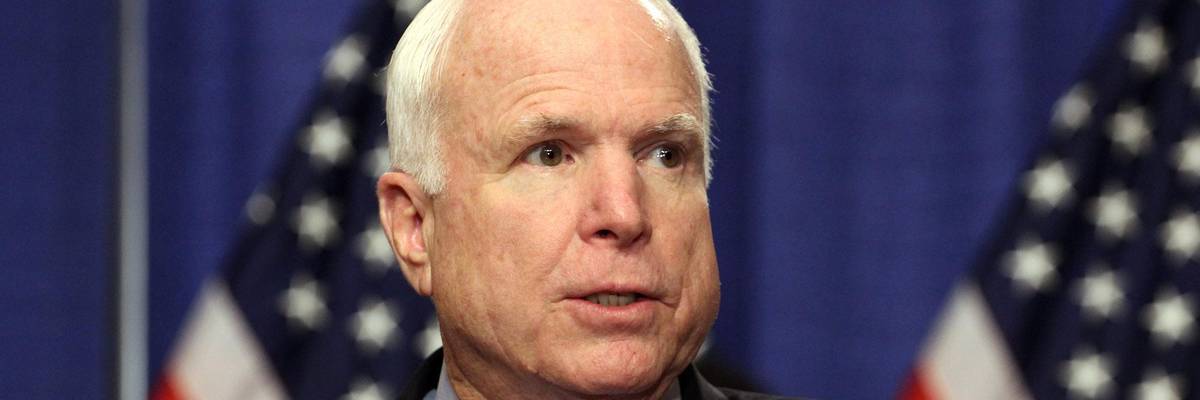
The Senate healthcare vote that was planned for Tuesday has been delayed due to Sen. John McCain's surgery. (Photo: Dong question/Flickr/cc)
The Trump Resistance is putting pressure on Senators to block the Republican healthcare bill--even as Senate Republicans announce that they'll delay a vote as Sen. John McCain of Arizona recovers from surgery he had on Friday to remove a blood clot from above his eye.
Majority Leader Mitch McConnell (R-Ky.) previously had to delay the vote until after the July 4th recess as Republicans searched within their ranks for enough votes to pass the deeply unpopular bill. McConnell had been pushing for a vote on Tuesday.
In recent weeks, many Americans have been contacting their Republican senators to demand "no" votes on the legislation. The national organization Indivisible is calling for a Day of Action on Tuesday, urging Americans to protest at the offices of Republicans who are undecided on the bill. And on Monday the group UltraViolet is holding demonstrations outside the offices of senators Bill Cassidy (R-La.) and Rob Portman (R-Ohio), two so-called moderates who are considered potential "no" votes.
While Republicans attempt to sway senators to vote "yes" on Trumpcare, the Trump administration is hard at work spreading misinformation about the bill. At the National Governors Association on Friday, Vice President Mike Pence urged governors from across the nation to back the bill, telling them, "President Trump and I believe the Senate healthcare bill strengthens and secures Medicaid for the neediest in our society, and this bill puts this vital American program on a path to long-term sustainability."
The non-partisan Congressional Budget Office (CBO) found that contrary to Pence's pitch, an earlier version of the bill would have taken away healthcare for 22 million citizens over the next decade, including 15 million Medicaid recipients. A CBO score of the new version will be released Monday, and experts say the analysis will likely be similar.
"I don't see a lot here that would meaningfully change the CBO score," said Cynthia Cox of the non-partisan Kaiser Family Foundation, a think-tank focusing on health policy, in an interview on Friday with Business Insider. "We're still likely to see many millions of people losing or going without coverage as a result of this bill. Although some of the taxes on wealthy people are retained, the bill doesn't appear to use much of that to cover low-income people."
As Sen. McCain, who's eligible for federal subsidies to pay for his healthcare, recovers from his surgery and the Republicans again stall the vote, many have noted the irony of the lawmaker's health needs holding up legislation that would leave many without healthcare.
Recent polls find that Americans' opposition to Trumpcare is growing. A Kaiser Family Foundation survey released on Friday shows that 61 percent of Americans disapprove of the Republicans' plans to replace the Affordable Care Act--up from 55 percent in June. The percentage of Americans with "very unfavorable" views of the Republican plan is now at 44 percent, up from 38 percent last month.
Dear Common Dreams reader, It’s been nearly 30 years since I co-founded Common Dreams with my late wife, Lina Newhouser. We had the radical notion that journalism should serve the public good, not corporate profits. It was clear to us from the outset what it would take to build such a project. No paid advertisements. No corporate sponsors. No millionaire publisher telling us what to think or do. Many people said we wouldn't last a year, but we proved those doubters wrong. Together with a tremendous team of journalists and dedicated staff, we built an independent media outlet free from the constraints of profits and corporate control. Our mission has always been simple: To inform. To inspire. To ignite change for the common good. Building Common Dreams was not easy. Our survival was never guaranteed. When you take on the most powerful forces—Wall Street greed, fossil fuel industry destruction, Big Tech lobbyists, and uber-rich oligarchs who have spent billions upon billions rigging the economy and democracy in their favor—the only bulwark you have is supporters who believe in your work. But here’s the urgent message from me today. It's never been this bad out there. And it's never been this hard to keep us going. At the very moment Common Dreams is most needed, the threats we face are intensifying. We need your support now more than ever. We don't accept corporate advertising and never will. We don't have a paywall because we don't think people should be blocked from critical news based on their ability to pay. Everything we do is funded by the donations of readers like you. When everyone does the little they can afford, we are strong. But if that support retreats or dries up, so do we. Will you donate now to make sure Common Dreams not only survives but thrives? —Craig Brown, Co-founder |
The Trump Resistance is putting pressure on Senators to block the Republican healthcare bill--even as Senate Republicans announce that they'll delay a vote as Sen. John McCain of Arizona recovers from surgery he had on Friday to remove a blood clot from above his eye.
Majority Leader Mitch McConnell (R-Ky.) previously had to delay the vote until after the July 4th recess as Republicans searched within their ranks for enough votes to pass the deeply unpopular bill. McConnell had been pushing for a vote on Tuesday.
In recent weeks, many Americans have been contacting their Republican senators to demand "no" votes on the legislation. The national organization Indivisible is calling for a Day of Action on Tuesday, urging Americans to protest at the offices of Republicans who are undecided on the bill. And on Monday the group UltraViolet is holding demonstrations outside the offices of senators Bill Cassidy (R-La.) and Rob Portman (R-Ohio), two so-called moderates who are considered potential "no" votes.
While Republicans attempt to sway senators to vote "yes" on Trumpcare, the Trump administration is hard at work spreading misinformation about the bill. At the National Governors Association on Friday, Vice President Mike Pence urged governors from across the nation to back the bill, telling them, "President Trump and I believe the Senate healthcare bill strengthens and secures Medicaid for the neediest in our society, and this bill puts this vital American program on a path to long-term sustainability."
The non-partisan Congressional Budget Office (CBO) found that contrary to Pence's pitch, an earlier version of the bill would have taken away healthcare for 22 million citizens over the next decade, including 15 million Medicaid recipients. A CBO score of the new version will be released Monday, and experts say the analysis will likely be similar.
"I don't see a lot here that would meaningfully change the CBO score," said Cynthia Cox of the non-partisan Kaiser Family Foundation, a think-tank focusing on health policy, in an interview on Friday with Business Insider. "We're still likely to see many millions of people losing or going without coverage as a result of this bill. Although some of the taxes on wealthy people are retained, the bill doesn't appear to use much of that to cover low-income people."
As Sen. McCain, who's eligible for federal subsidies to pay for his healthcare, recovers from his surgery and the Republicans again stall the vote, many have noted the irony of the lawmaker's health needs holding up legislation that would leave many without healthcare.
Recent polls find that Americans' opposition to Trumpcare is growing. A Kaiser Family Foundation survey released on Friday shows that 61 percent of Americans disapprove of the Republicans' plans to replace the Affordable Care Act--up from 55 percent in June. The percentage of Americans with "very unfavorable" views of the Republican plan is now at 44 percent, up from 38 percent last month.
The Trump Resistance is putting pressure on Senators to block the Republican healthcare bill--even as Senate Republicans announce that they'll delay a vote as Sen. John McCain of Arizona recovers from surgery he had on Friday to remove a blood clot from above his eye.
Majority Leader Mitch McConnell (R-Ky.) previously had to delay the vote until after the July 4th recess as Republicans searched within their ranks for enough votes to pass the deeply unpopular bill. McConnell had been pushing for a vote on Tuesday.
In recent weeks, many Americans have been contacting their Republican senators to demand "no" votes on the legislation. The national organization Indivisible is calling for a Day of Action on Tuesday, urging Americans to protest at the offices of Republicans who are undecided on the bill. And on Monday the group UltraViolet is holding demonstrations outside the offices of senators Bill Cassidy (R-La.) and Rob Portman (R-Ohio), two so-called moderates who are considered potential "no" votes.
While Republicans attempt to sway senators to vote "yes" on Trumpcare, the Trump administration is hard at work spreading misinformation about the bill. At the National Governors Association on Friday, Vice President Mike Pence urged governors from across the nation to back the bill, telling them, "President Trump and I believe the Senate healthcare bill strengthens and secures Medicaid for the neediest in our society, and this bill puts this vital American program on a path to long-term sustainability."
The non-partisan Congressional Budget Office (CBO) found that contrary to Pence's pitch, an earlier version of the bill would have taken away healthcare for 22 million citizens over the next decade, including 15 million Medicaid recipients. A CBO score of the new version will be released Monday, and experts say the analysis will likely be similar.
"I don't see a lot here that would meaningfully change the CBO score," said Cynthia Cox of the non-partisan Kaiser Family Foundation, a think-tank focusing on health policy, in an interview on Friday with Business Insider. "We're still likely to see many millions of people losing or going without coverage as a result of this bill. Although some of the taxes on wealthy people are retained, the bill doesn't appear to use much of that to cover low-income people."
As Sen. McCain, who's eligible for federal subsidies to pay for his healthcare, recovers from his surgery and the Republicans again stall the vote, many have noted the irony of the lawmaker's health needs holding up legislation that would leave many without healthcare.
Recent polls find that Americans' opposition to Trumpcare is growing. A Kaiser Family Foundation survey released on Friday shows that 61 percent of Americans disapprove of the Republicans' plans to replace the Affordable Care Act--up from 55 percent in June. The percentage of Americans with "very unfavorable" views of the Republican plan is now at 44 percent, up from 38 percent last month.