SUBSCRIBE TO OUR FREE NEWSLETTER
Daily news & progressive opinion—funded by the people, not the corporations—delivered straight to your inbox.
5
#000000
#FFFFFF
To donate by check, phone, or other method, see our More Ways to Give page.
Daily news & progressive opinion—funded by the people, not the corporations—delivered straight to your inbox.
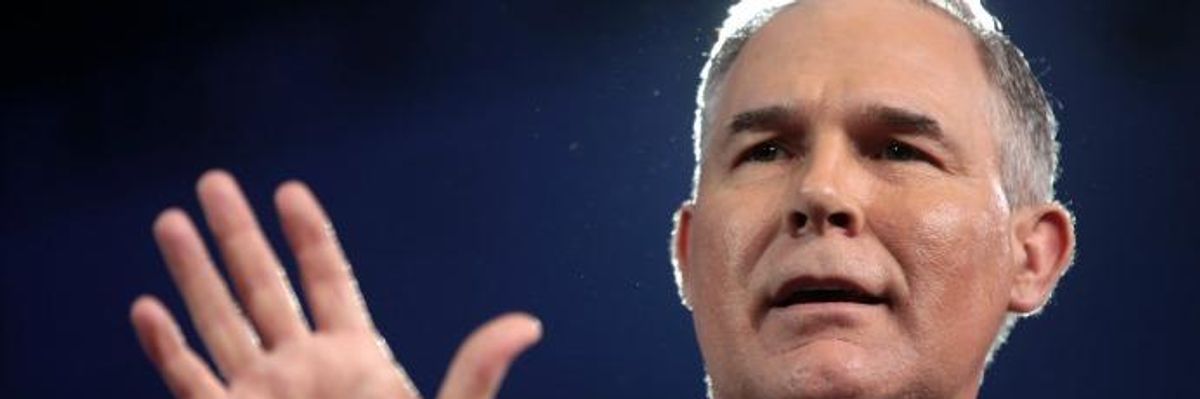
EPA Administrator Scott Pruitt rejected a proposed ban on chlorpyrifos, a pesticide made by Dow, on March 30. On March 9, according to records obtained by AP, Pruitt had a meeting with the CEO of Dow. (Photo: Gage Skidmore/flickr/cc)
The Trump administration's Environmental Protection Agency (EPA) head, Scott Pruitt, sparked outrage in March when he rejected his agency's proposed ban on a pesticide shown to harm children's brains.
New reporting by the Associated Press Wednesday prompts further question about his decisions to ignore the EPA's own science and then greenlight the Dow Chemical-manufactured pesticide, chlorpyrifos, as the company had requested.
Rep. Ted Lieu (D-Calif.), a frequent Trump critic, weighed in on the new reporting, tweeting: "I heard this pesticide helps growth in the swamp."
Records obtained by AP show that Pruitt had a 30-minute meeting with Dow CEO Andrew Liveris on March 9. That's just three weeks before he denied a petition from two environmental groups, initiated a decade ago, calling for a total ban on the harmful pesticide--a decision, wrote Kristin Schafer, program and policy director at Pesticide Action Network, that "clearly and publicly puts the interests of a chemical corporation above both scientific evidence and children's health."
AP's Michael Biesecker writes that the meeting took place in Houston at a hotel where Pruitt and Liveris were speakers at an energy industry conference. According to EPA spokeswoman Liz Bowman, the men were only "briefly introduced" and "did not discuss chlorpyrifos." (Bowman, for her part, came to the EPA from the American Chemistry Council, an industry group of which Dow is a member.)
Biesecker continues:
EPA released a copy of Pruitt's March meeting schedule earlier this month following several Freedom of Information Act requests. Though his schedule for the intervening months has not yet been released, Bowman said Pruitt has had no other meetings with the Dow CEO. There was a larger group meeting that Pruitt attended which also included two other Dow executives, but she said that didn't involve chlorpyrifos.
Liveris's coziness to the administration was on display in February when he stood beside Trump and was given the president's pen after he signed an executive order aimed at slashing regulations, and Biesecker points out that Dow "wrote a $1 million check to help underwrite Trump's inaugural festivities."
The new reporting comes a day after the American Academy for Pediatrics and advocacy organization Environmental Working Group (EWG) sent a letter to Pruitt urging him to ban the chemical, expressing "deep alarm" that the agency's "decision to allow the continued use of chlorpyrifos contradicts the agency's own science and puts developing fetuses, infants, children, and pregnant women at risk."
It also comes as the EPA "accelerates its purge of scientists."
ThinkProgress wrote:
According to an email sent to EPA scientists and obtained by the Washington Post, the EPA has decided not to renew the posts of any scientists working for the EPA's Board of Scientific Counselors (BOSC). The BOSC functions as an advisory board for the EPA's Office of Research and Development, and helps the office make sure that it is using sufficiently rigorous science in its research and development programs. [...]
The new wave of dismissals brings the total number of BOSC members who will be out of a job in August to 47, which will leave just 11 members serving on the BOSC and its five subcommittees. None of the subcommittees will have a chair or vice chair, and all committee meetings scheduled for late summer and fall have been cancelled.
"By sacking dozens of scientific counselors, Pruitt is showing that he doesn't value scientific input and the benefits it offers the public," said Ken Kimmell, president of the Union of Concerned Scientists.
Echoing some of the concerns raised when Pruitt rejected the chlorpyrifos ban, Kimmell continued: "The administrator has an important job to do--and this includes listening to the best independent science and to make decisions that protect our health, our safety, and our environment. Instead, he's delaying important public protections, denying the facts of climate change, and now, dismissing expert researchers who could help EPA do its best work. It's appalling to see an administrator so directly attack the effectiveness of his own agency," he said.
AP also reported in April that "Dow Chemical is pushing a Trump administration open to scrapping regulations to ignore the findings of federal scientists who point to a family of widely used pesticides [organophosphates] as harmful to about 1,800 critically threatened or endangered species."
Dear Common Dreams reader, It’s been nearly 30 years since I co-founded Common Dreams with my late wife, Lina Newhouser. We had the radical notion that journalism should serve the public good, not corporate profits. It was clear to us from the outset what it would take to build such a project. No paid advertisements. No corporate sponsors. No millionaire publisher telling us what to think or do. Many people said we wouldn't last a year, but we proved those doubters wrong. Together with a tremendous team of journalists and dedicated staff, we built an independent media outlet free from the constraints of profits and corporate control. Our mission has always been simple: To inform. To inspire. To ignite change for the common good. Building Common Dreams was not easy. Our survival was never guaranteed. When you take on the most powerful forces—Wall Street greed, fossil fuel industry destruction, Big Tech lobbyists, and uber-rich oligarchs who have spent billions upon billions rigging the economy and democracy in their favor—the only bulwark you have is supporters who believe in your work. But here’s the urgent message from me today. It's never been this bad out there. And it's never been this hard to keep us going. At the very moment Common Dreams is most needed, the threats we face are intensifying. We need your support now more than ever. We don't accept corporate advertising and never will. We don't have a paywall because we don't think people should be blocked from critical news based on their ability to pay. Everything we do is funded by the donations of readers like you. When everyone does the little they can afford, we are strong. But if that support retreats or dries up, so do we. Will you donate now to make sure Common Dreams not only survives but thrives? —Craig Brown, Co-founder |
The Trump administration's Environmental Protection Agency (EPA) head, Scott Pruitt, sparked outrage in March when he rejected his agency's proposed ban on a pesticide shown to harm children's brains.
New reporting by the Associated Press Wednesday prompts further question about his decisions to ignore the EPA's own science and then greenlight the Dow Chemical-manufactured pesticide, chlorpyrifos, as the company had requested.
Rep. Ted Lieu (D-Calif.), a frequent Trump critic, weighed in on the new reporting, tweeting: "I heard this pesticide helps growth in the swamp."
Records obtained by AP show that Pruitt had a 30-minute meeting with Dow CEO Andrew Liveris on March 9. That's just three weeks before he denied a petition from two environmental groups, initiated a decade ago, calling for a total ban on the harmful pesticide--a decision, wrote Kristin Schafer, program and policy director at Pesticide Action Network, that "clearly and publicly puts the interests of a chemical corporation above both scientific evidence and children's health."
AP's Michael Biesecker writes that the meeting took place in Houston at a hotel where Pruitt and Liveris were speakers at an energy industry conference. According to EPA spokeswoman Liz Bowman, the men were only "briefly introduced" and "did not discuss chlorpyrifos." (Bowman, for her part, came to the EPA from the American Chemistry Council, an industry group of which Dow is a member.)
Biesecker continues:
EPA released a copy of Pruitt's March meeting schedule earlier this month following several Freedom of Information Act requests. Though his schedule for the intervening months has not yet been released, Bowman said Pruitt has had no other meetings with the Dow CEO. There was a larger group meeting that Pruitt attended which also included two other Dow executives, but she said that didn't involve chlorpyrifos.
Liveris's coziness to the administration was on display in February when he stood beside Trump and was given the president's pen after he signed an executive order aimed at slashing regulations, and Biesecker points out that Dow "wrote a $1 million check to help underwrite Trump's inaugural festivities."
The new reporting comes a day after the American Academy for Pediatrics and advocacy organization Environmental Working Group (EWG) sent a letter to Pruitt urging him to ban the chemical, expressing "deep alarm" that the agency's "decision to allow the continued use of chlorpyrifos contradicts the agency's own science and puts developing fetuses, infants, children, and pregnant women at risk."
It also comes as the EPA "accelerates its purge of scientists."
ThinkProgress wrote:
According to an email sent to EPA scientists and obtained by the Washington Post, the EPA has decided not to renew the posts of any scientists working for the EPA's Board of Scientific Counselors (BOSC). The BOSC functions as an advisory board for the EPA's Office of Research and Development, and helps the office make sure that it is using sufficiently rigorous science in its research and development programs. [...]
The new wave of dismissals brings the total number of BOSC members who will be out of a job in August to 47, which will leave just 11 members serving on the BOSC and its five subcommittees. None of the subcommittees will have a chair or vice chair, and all committee meetings scheduled for late summer and fall have been cancelled.
"By sacking dozens of scientific counselors, Pruitt is showing that he doesn't value scientific input and the benefits it offers the public," said Ken Kimmell, president of the Union of Concerned Scientists.
Echoing some of the concerns raised when Pruitt rejected the chlorpyrifos ban, Kimmell continued: "The administrator has an important job to do--and this includes listening to the best independent science and to make decisions that protect our health, our safety, and our environment. Instead, he's delaying important public protections, denying the facts of climate change, and now, dismissing expert researchers who could help EPA do its best work. It's appalling to see an administrator so directly attack the effectiveness of his own agency," he said.
AP also reported in April that "Dow Chemical is pushing a Trump administration open to scrapping regulations to ignore the findings of federal scientists who point to a family of widely used pesticides [organophosphates] as harmful to about 1,800 critically threatened or endangered species."
The Trump administration's Environmental Protection Agency (EPA) head, Scott Pruitt, sparked outrage in March when he rejected his agency's proposed ban on a pesticide shown to harm children's brains.
New reporting by the Associated Press Wednesday prompts further question about his decisions to ignore the EPA's own science and then greenlight the Dow Chemical-manufactured pesticide, chlorpyrifos, as the company had requested.
Rep. Ted Lieu (D-Calif.), a frequent Trump critic, weighed in on the new reporting, tweeting: "I heard this pesticide helps growth in the swamp."
Records obtained by AP show that Pruitt had a 30-minute meeting with Dow CEO Andrew Liveris on March 9. That's just three weeks before he denied a petition from two environmental groups, initiated a decade ago, calling for a total ban on the harmful pesticide--a decision, wrote Kristin Schafer, program and policy director at Pesticide Action Network, that "clearly and publicly puts the interests of a chemical corporation above both scientific evidence and children's health."
AP's Michael Biesecker writes that the meeting took place in Houston at a hotel where Pruitt and Liveris were speakers at an energy industry conference. According to EPA spokeswoman Liz Bowman, the men were only "briefly introduced" and "did not discuss chlorpyrifos." (Bowman, for her part, came to the EPA from the American Chemistry Council, an industry group of which Dow is a member.)
Biesecker continues:
EPA released a copy of Pruitt's March meeting schedule earlier this month following several Freedom of Information Act requests. Though his schedule for the intervening months has not yet been released, Bowman said Pruitt has had no other meetings with the Dow CEO. There was a larger group meeting that Pruitt attended which also included two other Dow executives, but she said that didn't involve chlorpyrifos.
Liveris's coziness to the administration was on display in February when he stood beside Trump and was given the president's pen after he signed an executive order aimed at slashing regulations, and Biesecker points out that Dow "wrote a $1 million check to help underwrite Trump's inaugural festivities."
The new reporting comes a day after the American Academy for Pediatrics and advocacy organization Environmental Working Group (EWG) sent a letter to Pruitt urging him to ban the chemical, expressing "deep alarm" that the agency's "decision to allow the continued use of chlorpyrifos contradicts the agency's own science and puts developing fetuses, infants, children, and pregnant women at risk."
It also comes as the EPA "accelerates its purge of scientists."
ThinkProgress wrote:
According to an email sent to EPA scientists and obtained by the Washington Post, the EPA has decided not to renew the posts of any scientists working for the EPA's Board of Scientific Counselors (BOSC). The BOSC functions as an advisory board for the EPA's Office of Research and Development, and helps the office make sure that it is using sufficiently rigorous science in its research and development programs. [...]
The new wave of dismissals brings the total number of BOSC members who will be out of a job in August to 47, which will leave just 11 members serving on the BOSC and its five subcommittees. None of the subcommittees will have a chair or vice chair, and all committee meetings scheduled for late summer and fall have been cancelled.
"By sacking dozens of scientific counselors, Pruitt is showing that he doesn't value scientific input and the benefits it offers the public," said Ken Kimmell, president of the Union of Concerned Scientists.
Echoing some of the concerns raised when Pruitt rejected the chlorpyrifos ban, Kimmell continued: "The administrator has an important job to do--and this includes listening to the best independent science and to make decisions that protect our health, our safety, and our environment. Instead, he's delaying important public protections, denying the facts of climate change, and now, dismissing expert researchers who could help EPA do its best work. It's appalling to see an administrator so directly attack the effectiveness of his own agency," he said.
AP also reported in April that "Dow Chemical is pushing a Trump administration open to scrapping regulations to ignore the findings of federal scientists who point to a family of widely used pesticides [organophosphates] as harmful to about 1,800 critically threatened or endangered species."