SUBSCRIBE TO OUR FREE NEWSLETTER
Daily news & progressive opinion—funded by the people, not the corporations—delivered straight to your inbox.
5
#000000
#FFFFFF
To donate by check, phone, or other method, see our More Ways to Give page.
Daily news & progressive opinion—funded by the people, not the corporations—delivered straight to your inbox.
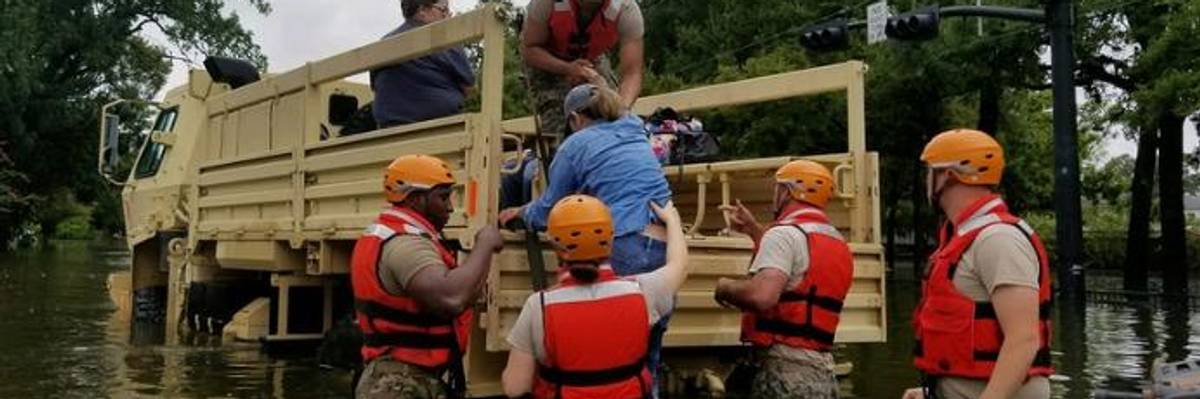
The records being broken year after year -- whether for drought, storm surges, wildfires or just heat -- are happening because the planet is markedly warmer than it has been since record-keeping began. (Photo: Texas National Guard/flickr/cc)
Now is exactly the time to talk about climate change, and all the other systemic injustices -- from racial profiling to economic austerity -- that turn disasters like Harvey into human catastrophes.
Turn on the coverage of the Hurricane Harvey and the Houston flooding and you'll hear lots of talk about how unprecedented this kind of rainfall is. How no one saw it coming so no one could adequately prepare.
Now is exactly the time to talk about climate change, and all the other systemic injustices -- from racial profiling to economic austerity -- that turn disasters like Harvey into human catastrophes.
Turn on the coverage of the Hurricane Harvey and the Houston flooding and you'll hear lots of talk about how unprecedented this kind of rainfall is. How no one saw it coming so no one could adequately prepare.
What you will hear very little about is why these kind of unprecedented, record-breaking weather events are happening with such regularity that "record-breaking" has become a meteorological cliche. In other words, you won't hear much, if any, talk about climate change.
This, we are told, is out of a desire not to "politicize" a still unfolding human tragedy, which is an understandable impulse. But here's the thing: every time we act as if an unprecedented weather event is hitting us out of the blue, as some sort of Act of God that no one foresaw, reporters are making a highly political decision. It's a decision to spare feelings and avoid controversy at the expense of telling the truth, however difficult. Because the truth is that these events have long been predicted by climate scientists. Warmer oceans throw up more powerful storms. Higher sea levels mean those storms surge into places they never reached before. Hotter weather leads to extremes of precipitation: long dry periods interrupted by massive snow or rain dumps, rather than the steadier predictable patterns most of us grew up with.
The records being broken year after year -- whether for drought, storm surges, wildfires or just heat -- are happening because the planet is markedly warmer than it has been since record-keeping began. Covering events like Harvey while ignoring those facts, failing to provide a platform to climate scientists who can make them plain, all while never mentioning Donald Trump's decision to withdraw from the Paris climate accords, fails in the most basic duty of journalism: to provide important facts and relevant context. It leaves the public with the false impression that these are disasters without root causes, which also means that nothing could have been done to prevent them (and that nothing can be done now to prevent them from getting much worse in the future).
It's also worth noting that the coverage of Harvey has been highly political since well before the storm made landfall. There has been endless talk about whether Trump was taking the storm seriously enough, endless speculation about whether this hurricane will be his "Katrina moment" and a great deal of (fair) point-scoring about how many Republicans voted against Sandy relief but have their hands out for Texas now. That's politics being made out of a disaster -- it's just the kind of partisan politics that is fully inside the comfort zone of conventional media, politics that conveniently skirts the reality that placing the interests of fossil fuel companies ahead of the need for decisive pollution control has been a deeply bipartisan affair.
Read the full article at The Intercept.
Dear Common Dreams reader, It’s been nearly 30 years since I co-founded Common Dreams with my late wife, Lina Newhouser. We had the radical notion that journalism should serve the public good, not corporate profits. It was clear to us from the outset what it would take to build such a project. No paid advertisements. No corporate sponsors. No millionaire publisher telling us what to think or do. Many people said we wouldn't last a year, but we proved those doubters wrong. Together with a tremendous team of journalists and dedicated staff, we built an independent media outlet free from the constraints of profits and corporate control. Our mission has always been simple: To inform. To inspire. To ignite change for the common good. Building Common Dreams was not easy. Our survival was never guaranteed. When you take on the most powerful forces—Wall Street greed, fossil fuel industry destruction, Big Tech lobbyists, and uber-rich oligarchs who have spent billions upon billions rigging the economy and democracy in their favor—the only bulwark you have is supporters who believe in your work. But here’s the urgent message from me today. It's never been this bad out there. And it's never been this hard to keep us going. At the very moment Common Dreams is most needed, the threats we face are intensifying. We need your support now more than ever. We don't accept corporate advertising and never will. We don't have a paywall because we don't think people should be blocked from critical news based on their ability to pay. Everything we do is funded by the donations of readers like you. When everyone does the little they can afford, we are strong. But if that support retreats or dries up, so do we. Will you donate now to make sure Common Dreams not only survives but thrives? —Craig Brown, Co-founder |
Now is exactly the time to talk about climate change, and all the other systemic injustices -- from racial profiling to economic austerity -- that turn disasters like Harvey into human catastrophes.
Turn on the coverage of the Hurricane Harvey and the Houston flooding and you'll hear lots of talk about how unprecedented this kind of rainfall is. How no one saw it coming so no one could adequately prepare.
What you will hear very little about is why these kind of unprecedented, record-breaking weather events are happening with such regularity that "record-breaking" has become a meteorological cliche. In other words, you won't hear much, if any, talk about climate change.
This, we are told, is out of a desire not to "politicize" a still unfolding human tragedy, which is an understandable impulse. But here's the thing: every time we act as if an unprecedented weather event is hitting us out of the blue, as some sort of Act of God that no one foresaw, reporters are making a highly political decision. It's a decision to spare feelings and avoid controversy at the expense of telling the truth, however difficult. Because the truth is that these events have long been predicted by climate scientists. Warmer oceans throw up more powerful storms. Higher sea levels mean those storms surge into places they never reached before. Hotter weather leads to extremes of precipitation: long dry periods interrupted by massive snow or rain dumps, rather than the steadier predictable patterns most of us grew up with.
The records being broken year after year -- whether for drought, storm surges, wildfires or just heat -- are happening because the planet is markedly warmer than it has been since record-keeping began. Covering events like Harvey while ignoring those facts, failing to provide a platform to climate scientists who can make them plain, all while never mentioning Donald Trump's decision to withdraw from the Paris climate accords, fails in the most basic duty of journalism: to provide important facts and relevant context. It leaves the public with the false impression that these are disasters without root causes, which also means that nothing could have been done to prevent them (and that nothing can be done now to prevent them from getting much worse in the future).
It's also worth noting that the coverage of Harvey has been highly political since well before the storm made landfall. There has been endless talk about whether Trump was taking the storm seriously enough, endless speculation about whether this hurricane will be his "Katrina moment" and a great deal of (fair) point-scoring about how many Republicans voted against Sandy relief but have their hands out for Texas now. That's politics being made out of a disaster -- it's just the kind of partisan politics that is fully inside the comfort zone of conventional media, politics that conveniently skirts the reality that placing the interests of fossil fuel companies ahead of the need for decisive pollution control has been a deeply bipartisan affair.
Read the full article at The Intercept.
Now is exactly the time to talk about climate change, and all the other systemic injustices -- from racial profiling to economic austerity -- that turn disasters like Harvey into human catastrophes.
Turn on the coverage of the Hurricane Harvey and the Houston flooding and you'll hear lots of talk about how unprecedented this kind of rainfall is. How no one saw it coming so no one could adequately prepare.
What you will hear very little about is why these kind of unprecedented, record-breaking weather events are happening with such regularity that "record-breaking" has become a meteorological cliche. In other words, you won't hear much, if any, talk about climate change.
This, we are told, is out of a desire not to "politicize" a still unfolding human tragedy, which is an understandable impulse. But here's the thing: every time we act as if an unprecedented weather event is hitting us out of the blue, as some sort of Act of God that no one foresaw, reporters are making a highly political decision. It's a decision to spare feelings and avoid controversy at the expense of telling the truth, however difficult. Because the truth is that these events have long been predicted by climate scientists. Warmer oceans throw up more powerful storms. Higher sea levels mean those storms surge into places they never reached before. Hotter weather leads to extremes of precipitation: long dry periods interrupted by massive snow or rain dumps, rather than the steadier predictable patterns most of us grew up with.
The records being broken year after year -- whether for drought, storm surges, wildfires or just heat -- are happening because the planet is markedly warmer than it has been since record-keeping began. Covering events like Harvey while ignoring those facts, failing to provide a platform to climate scientists who can make them plain, all while never mentioning Donald Trump's decision to withdraw from the Paris climate accords, fails in the most basic duty of journalism: to provide important facts and relevant context. It leaves the public with the false impression that these are disasters without root causes, which also means that nothing could have been done to prevent them (and that nothing can be done now to prevent them from getting much worse in the future).
It's also worth noting that the coverage of Harvey has been highly political since well before the storm made landfall. There has been endless talk about whether Trump was taking the storm seriously enough, endless speculation about whether this hurricane will be his "Katrina moment" and a great deal of (fair) point-scoring about how many Republicans voted against Sandy relief but have their hands out for Texas now. That's politics being made out of a disaster -- it's just the kind of partisan politics that is fully inside the comfort zone of conventional media, politics that conveniently skirts the reality that placing the interests of fossil fuel companies ahead of the need for decisive pollution control has been a deeply bipartisan affair.
Read the full article at The Intercept.