Richard Nixon's Authoritarian Loathing of the Media Lives On in Donald Trump
When things go wrong for the president, his administration in crisis mode and his approval rating down to a weekly average of 41%, he turns to the press, anger in his eyes. He pleads, cajoles, or mocks. That could describe either Donald J. Trump or Richard M. Nixon. Two men who needed the media and courted its favour, but who can't and couldn't resist denouncing and vilifying it in the harshest terms.
When things go wrong for the president, his administration in crisis mode and his approval rating down to a weekly average of 41%, he turns to the press, anger in his eyes. He pleads, cajoles, or mocks. That could describe either Donald J. Trump or Richard M. Nixon. Two men who needed the media and courted its favour, but who can't and couldn't resist denouncing and vilifying it in the harshest terms.
Trump has lately been on a tear. In a hastily arranged press conference that the New York Times headlined as "77 Chaotic Minutes", he embarked on a series of rambling harangues, and went on the defensive about the plague of "fake news".
Taking the stage in the White House's East Room, Trump ranted and raved. The press were unfair, misreporting or ignoring all the successes of his first glorious month. Every day "failing" newspapers run headlines about the growing list of crises that bedevil the administration, which in fact is "running like a fine-tuned machine".
There was no room for any other reality. Swimming against the tide, ABC's Jonathan Karl rose up to ask the president "to clarify this very important point".
Can you say definitively that nobody on your campaign had any contacts with the Russians during the campaign? And on the leaks, is it fake news or are these real leaks?"
Trump turned his head from side to side, squinted, and frowned.
"Well, the leaks are real," he snapped back. "You know what they said, you saw it and the leaks are absolutely real. The news is fake because so much of the news is fake."
It was like watching a snake eat itself. The circuitous sentences and close-looped, vague arguments sounded like a nightmare version of Donald Rumsfeld's accidental Zen poetry: "There are known knowns. There are things we know we know." But nonsense though it is, this all plays wonderfully to Trump's base. The president is stoking red-hot antipathy to the mainstream media for his own ends, and it seems to be working.
A September 2016 Gallup Poll showed that only 14% of self-identified Republicans surveyed thought the mass media was trustworthy, as opposed to 51% of Democrats. This wasn't always the case; in 2002, 49% of Republicans trusted the mass media. Some of Trump's predecessors would have been relieved to see those numbers - and none more so than the ignominious Richard Nixon.
Kicking Nixon around
Like Trump, Nixon also suffered mightily at the hands of the "unfair" and "biased" press. They were out to get him; editors and journalists, he huffed, were just like those snooty Harvard-educated elites who would never really accept his kind.
Nixon's first vice president, Spiro Agnew, was happy to be the chief executive's attack dog. Speaking to a gathering of California Republicans on September 11, 1970, he said of the media:
In the United States today, we have more than our share of the nattering nabobs of negativism. They have formed their own 4-H Club - the hopeless, hysterical hypochondriacs of history.
Beset by the nattering nabobs and other traitors, Nixon went so far as to create an enemies list, tallying up all the celebrities, politicians and journalists who had it in for him. The list included 56 television reporters, newspaper columnists, and others; the New York Times, Washington Post, NBC and CBS were all well represented. At the top was the syndicated columnist Jack Anderson. Nixon's conspirators, among them former FBI and CIA agents, actually considered putting LSD on Anderson's steering wheel or spiking one of his drinks with an undetectable poison.
Thanks to the Nixon White House's infamous taping system, the extent of the president's hostility to the press is recorded for posterity, the president railing against the press and liberal Hollywood in repeated anti-Semitic tirades.
In 1971, when military analyst Daniel Ellsberg leaked parts of a 7,000-page document on America's long involvement in Vietnam and the New York Times published excerpts, the Nixon administration tried and failed to stop them. Nixon was incensed that the New York Times and the Washington Post moved forward with publishing the classified materials. The president railed against Ellsberg, telling Henry Kissinger, "Let's get that son-of-a-bitch in jail."
When all else failed, Nixon's henchmen, "the plumbers", broke into the office of Ellsberg's psychiatrist, hoping to find something to discredit him. It didn't work - and then Watergate came along to bring Nixon's empire crashing down.
Like all power-hungry authoritarians, Nixon could not and Trump cannot put up with any significant political challenge. Enemies are to be shamed, called names and shouted down. Nixon was incredibly thin-skinned and could nurse a grudge in Shakespearean fashion; Trump, judging from his press conferences and campaign performances, needs to be adored and revered without challenge or impediment.
This can produce whiplash-inducing contradictions. Halfway through the chaotic 77-minute press conferenc, Trump attempted to ingratiate himself with the crowd, hungry as ever for acceptance: "I'm really not a bad person, by the way," he said - this just days after, Stephen Miller, one of his senior advisors, declared that the president's executive orders "will not be questioned".
Bard College professor Ian Buruma recently spoke about the "road to dictatorship". Authoritarian "movements usually pretend to represent the people," said Buruma, "as though the people speak with one voice and all those who disagree are not really part of the people." Then, as if on cue, in a post-presser tweet, Trump wrote:
The FAKE NEWS media (failing @nytimes, @NBCNews, @ABC, @CBS, @CNN) is not my enemy, it is the enemy of the American People!
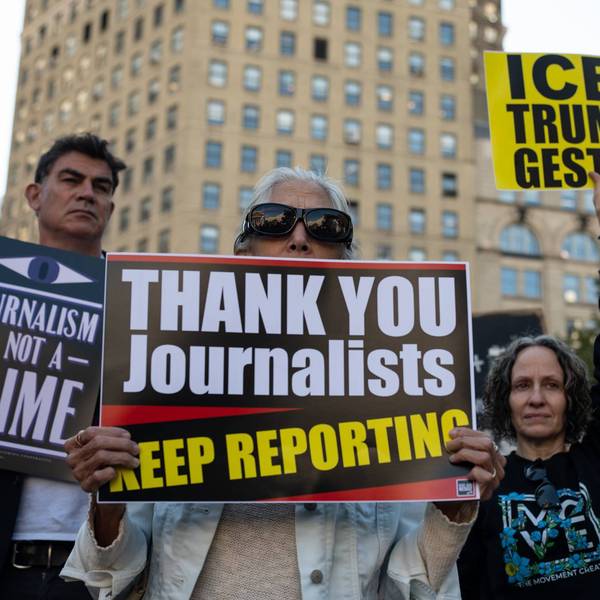
Who can hear this and not immediately think of the First Amendment: "Congress shall make no law ... abridging the freedom of speech, or of the press"? Just as in the age of Nixon and his "imperial presidency", so too in Trump's Bronze Age: Americans - and the world - need a strong and unfettered press. We need reporters who will call out corruption when they see it, challenge brazen lies when they hear them, and engage the public in the important work of democratic citizenship.
FINAL DAY! This is urgent.
Dear Common Dreams reader, It’s been nearly 30 years since I co-founded Common Dreams with my late wife, Lina Newhouser. We had the radical notion that journalism should serve the public good, not corporate profits. It was clear to us from the outset what it would take to build such a project. No paid advertisements. No corporate sponsors. No millionaire publisher telling us what to think or do. Many people said we wouldn't last a year, but we proved those doubters wrong. Together with a tremendous team of journalists and dedicated staff, we built an independent media outlet free from the constraints of profits and corporate control. Our mission from the outset was simple. To inform. To inspire. To ignite change for the common good. Building Common Dreams was not easy. Our survival was never guaranteed. When you take on the most powerful forces—Wall Street greed, fossil fuel industry destruction, Big Tech lobbyists, and uber-rich oligarchs who have spent billions upon billions rigging the economy and democracy in their favor—the only bulwark you have is supporters who believe in your work. But here’s the urgent message from me today. It’s never been this bad out there. And it’s never been this hard to keep us going. At the very moment Common Dreams is most needed and doing some of its best and most important work, the threats we face are intensifying. Right now, with just hours left in our Spring Campaign, we're still falling short of our make-or-break goal. When everyone does the little they can afford, we are strong. But if that support retreats or dries up, so do we. Can you make a gift right now to make sure Common Dreams not only survives but thrives? There is no backup plan or rainy day fund. There is only you. —Craig Brown, Co-founder |
When things go wrong for the president, his administration in crisis mode and his approval rating down to a weekly average of 41%, he turns to the press, anger in his eyes. He pleads, cajoles, or mocks. That could describe either Donald J. Trump or Richard M. Nixon. Two men who needed the media and courted its favour, but who can't and couldn't resist denouncing and vilifying it in the harshest terms.
Trump has lately been on a tear. In a hastily arranged press conference that the New York Times headlined as "77 Chaotic Minutes", he embarked on a series of rambling harangues, and went on the defensive about the plague of "fake news".
Taking the stage in the White House's East Room, Trump ranted and raved. The press were unfair, misreporting or ignoring all the successes of his first glorious month. Every day "failing" newspapers run headlines about the growing list of crises that bedevil the administration, which in fact is "running like a fine-tuned machine".
There was no room for any other reality. Swimming against the tide, ABC's Jonathan Karl rose up to ask the president "to clarify this very important point".
Can you say definitively that nobody on your campaign had any contacts with the Russians during the campaign? And on the leaks, is it fake news or are these real leaks?"
Trump turned his head from side to side, squinted, and frowned.
"Well, the leaks are real," he snapped back. "You know what they said, you saw it and the leaks are absolutely real. The news is fake because so much of the news is fake."
It was like watching a snake eat itself. The circuitous sentences and close-looped, vague arguments sounded like a nightmare version of Donald Rumsfeld's accidental Zen poetry: "There are known knowns. There are things we know we know." But nonsense though it is, this all plays wonderfully to Trump's base. The president is stoking red-hot antipathy to the mainstream media for his own ends, and it seems to be working.
A September 2016 Gallup Poll showed that only 14% of self-identified Republicans surveyed thought the mass media was trustworthy, as opposed to 51% of Democrats. This wasn't always the case; in 2002, 49% of Republicans trusted the mass media. Some of Trump's predecessors would have been relieved to see those numbers - and none more so than the ignominious Richard Nixon.
Kicking Nixon around
Like Trump, Nixon also suffered mightily at the hands of the "unfair" and "biased" press. They were out to get him; editors and journalists, he huffed, were just like those snooty Harvard-educated elites who would never really accept his kind.
Nixon's first vice president, Spiro Agnew, was happy to be the chief executive's attack dog. Speaking to a gathering of California Republicans on September 11, 1970, he said of the media:
In the United States today, we have more than our share of the nattering nabobs of negativism. They have formed their own 4-H Club - the hopeless, hysterical hypochondriacs of history.
Beset by the nattering nabobs and other traitors, Nixon went so far as to create an enemies list, tallying up all the celebrities, politicians and journalists who had it in for him. The list included 56 television reporters, newspaper columnists, and others; the New York Times, Washington Post, NBC and CBS were all well represented. At the top was the syndicated columnist Jack Anderson. Nixon's conspirators, among them former FBI and CIA agents, actually considered putting LSD on Anderson's steering wheel or spiking one of his drinks with an undetectable poison.
Thanks to the Nixon White House's infamous taping system, the extent of the president's hostility to the press is recorded for posterity, the president railing against the press and liberal Hollywood in repeated anti-Semitic tirades.
In 1971, when military analyst Daniel Ellsberg leaked parts of a 7,000-page document on America's long involvement in Vietnam and the New York Times published excerpts, the Nixon administration tried and failed to stop them. Nixon was incensed that the New York Times and the Washington Post moved forward with publishing the classified materials. The president railed against Ellsberg, telling Henry Kissinger, "Let's get that son-of-a-bitch in jail."
When all else failed, Nixon's henchmen, "the plumbers", broke into the office of Ellsberg's psychiatrist, hoping to find something to discredit him. It didn't work - and then Watergate came along to bring Nixon's empire crashing down.
Like all power-hungry authoritarians, Nixon could not and Trump cannot put up with any significant political challenge. Enemies are to be shamed, called names and shouted down. Nixon was incredibly thin-skinned and could nurse a grudge in Shakespearean fashion; Trump, judging from his press conferences and campaign performances, needs to be adored and revered without challenge or impediment.
This can produce whiplash-inducing contradictions. Halfway through the chaotic 77-minute press conferenc, Trump attempted to ingratiate himself with the crowd, hungry as ever for acceptance: "I'm really not a bad person, by the way," he said - this just days after, Stephen Miller, one of his senior advisors, declared that the president's executive orders "will not be questioned".
Bard College professor Ian Buruma recently spoke about the "road to dictatorship". Authoritarian "movements usually pretend to represent the people," said Buruma, "as though the people speak with one voice and all those who disagree are not really part of the people." Then, as if on cue, in a post-presser tweet, Trump wrote:
The FAKE NEWS media (failing @nytimes, @NBCNews, @ABC, @CBS, @CNN) is not my enemy, it is the enemy of the American People!
Who can hear this and not immediately think of the First Amendment: "Congress shall make no law ... abridging the freedom of speech, or of the press"? Just as in the age of Nixon and his "imperial presidency", so too in Trump's Bronze Age: Americans - and the world - need a strong and unfettered press. We need reporters who will call out corruption when they see it, challenge brazen lies when they hear them, and engage the public in the important work of democratic citizenship.
When things go wrong for the president, his administration in crisis mode and his approval rating down to a weekly average of 41%, he turns to the press, anger in his eyes. He pleads, cajoles, or mocks. That could describe either Donald J. Trump or Richard M. Nixon. Two men who needed the media and courted its favour, but who can't and couldn't resist denouncing and vilifying it in the harshest terms.
Trump has lately been on a tear. In a hastily arranged press conference that the New York Times headlined as "77 Chaotic Minutes", he embarked on a series of rambling harangues, and went on the defensive about the plague of "fake news".
Taking the stage in the White House's East Room, Trump ranted and raved. The press were unfair, misreporting or ignoring all the successes of his first glorious month. Every day "failing" newspapers run headlines about the growing list of crises that bedevil the administration, which in fact is "running like a fine-tuned machine".
There was no room for any other reality. Swimming against the tide, ABC's Jonathan Karl rose up to ask the president "to clarify this very important point".
Can you say definitively that nobody on your campaign had any contacts with the Russians during the campaign? And on the leaks, is it fake news or are these real leaks?"
Trump turned his head from side to side, squinted, and frowned.
"Well, the leaks are real," he snapped back. "You know what they said, you saw it and the leaks are absolutely real. The news is fake because so much of the news is fake."
It was like watching a snake eat itself. The circuitous sentences and close-looped, vague arguments sounded like a nightmare version of Donald Rumsfeld's accidental Zen poetry: "There are known knowns. There are things we know we know." But nonsense though it is, this all plays wonderfully to Trump's base. The president is stoking red-hot antipathy to the mainstream media for his own ends, and it seems to be working.
A September 2016 Gallup Poll showed that only 14% of self-identified Republicans surveyed thought the mass media was trustworthy, as opposed to 51% of Democrats. This wasn't always the case; in 2002, 49% of Republicans trusted the mass media. Some of Trump's predecessors would have been relieved to see those numbers - and none more so than the ignominious Richard Nixon.
Kicking Nixon around
Like Trump, Nixon also suffered mightily at the hands of the "unfair" and "biased" press. They were out to get him; editors and journalists, he huffed, were just like those snooty Harvard-educated elites who would never really accept his kind.
Nixon's first vice president, Spiro Agnew, was happy to be the chief executive's attack dog. Speaking to a gathering of California Republicans on September 11, 1970, he said of the media:
In the United States today, we have more than our share of the nattering nabobs of negativism. They have formed their own 4-H Club - the hopeless, hysterical hypochondriacs of history.
Beset by the nattering nabobs and other traitors, Nixon went so far as to create an enemies list, tallying up all the celebrities, politicians and journalists who had it in for him. The list included 56 television reporters, newspaper columnists, and others; the New York Times, Washington Post, NBC and CBS were all well represented. At the top was the syndicated columnist Jack Anderson. Nixon's conspirators, among them former FBI and CIA agents, actually considered putting LSD on Anderson's steering wheel or spiking one of his drinks with an undetectable poison.
Thanks to the Nixon White House's infamous taping system, the extent of the president's hostility to the press is recorded for posterity, the president railing against the press and liberal Hollywood in repeated anti-Semitic tirades.
In 1971, when military analyst Daniel Ellsberg leaked parts of a 7,000-page document on America's long involvement in Vietnam and the New York Times published excerpts, the Nixon administration tried and failed to stop them. Nixon was incensed that the New York Times and the Washington Post moved forward with publishing the classified materials. The president railed against Ellsberg, telling Henry Kissinger, "Let's get that son-of-a-bitch in jail."
When all else failed, Nixon's henchmen, "the plumbers", broke into the office of Ellsberg's psychiatrist, hoping to find something to discredit him. It didn't work - and then Watergate came along to bring Nixon's empire crashing down.
Like all power-hungry authoritarians, Nixon could not and Trump cannot put up with any significant political challenge. Enemies are to be shamed, called names and shouted down. Nixon was incredibly thin-skinned and could nurse a grudge in Shakespearean fashion; Trump, judging from his press conferences and campaign performances, needs to be adored and revered without challenge or impediment.
This can produce whiplash-inducing contradictions. Halfway through the chaotic 77-minute press conferenc, Trump attempted to ingratiate himself with the crowd, hungry as ever for acceptance: "I'm really not a bad person, by the way," he said - this just days after, Stephen Miller, one of his senior advisors, declared that the president's executive orders "will not be questioned".
Bard College professor Ian Buruma recently spoke about the "road to dictatorship". Authoritarian "movements usually pretend to represent the people," said Buruma, "as though the people speak with one voice and all those who disagree are not really part of the people." Then, as if on cue, in a post-presser tweet, Trump wrote:
The FAKE NEWS media (failing @nytimes, @NBCNews, @ABC, @CBS, @CNN) is not my enemy, it is the enemy of the American People!
Who can hear this and not immediately think of the First Amendment: "Congress shall make no law ... abridging the freedom of speech, or of the press"? Just as in the age of Nixon and his "imperial presidency", so too in Trump's Bronze Age: Americans - and the world - need a strong and unfettered press. We need reporters who will call out corruption when they see it, challenge brazen lies when they hear them, and engage the public in the important work of democratic citizenship.