SUBSCRIBE TO OUR FREE NEWSLETTER
Daily news & progressive opinion—funded by the people, not the corporations—delivered straight to your inbox.
5
#000000
#FFFFFF
To donate by check, phone, or other method, see our More Ways to Give page.
"Discussions about government spending are inherently bogus because the elephant in the room, big business, is absent."
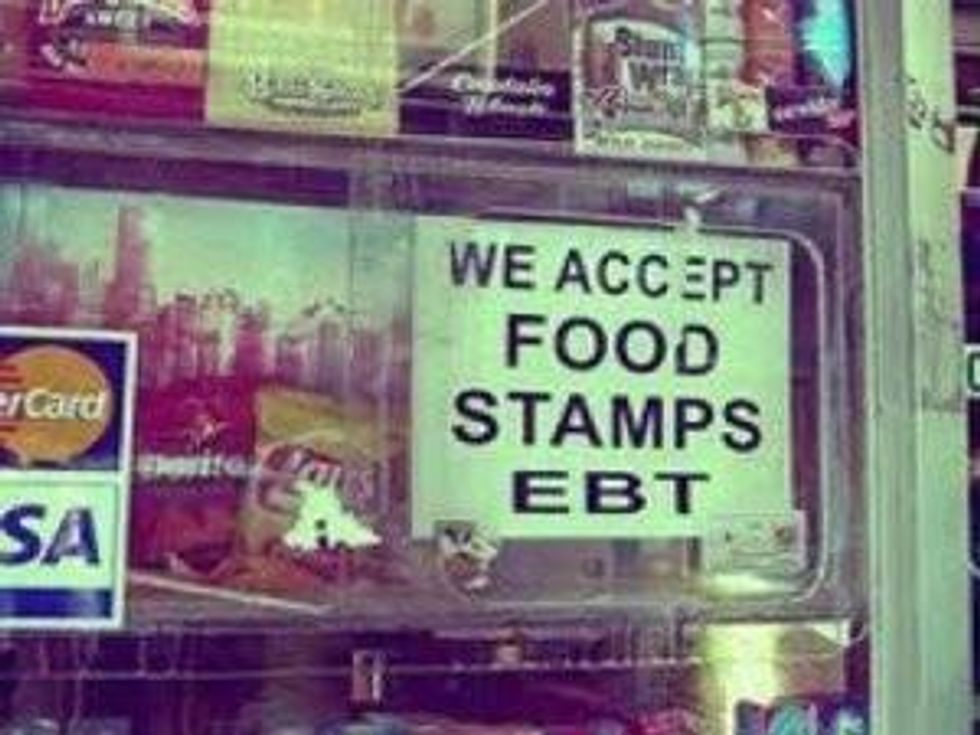
When the Republicans demanded cuts to the Supplemental Nutrition Assistance Program (SNAP), better known as food stamps, the debate revolved around human need versus the call for fiscal austerity. Scarcely anyone mentioned that JPMorgan Chase, Xerox and eFunds Corporation make millions of dollars off of this system meant to help the poor.
It all came to light on October 12th, when many SNAP recipients in the states of Alabama, California, Georgia, Iowa, Illinois, Louisiana, Maine, Massachusetts, Maryland, Mississippi, New Jersey, Oklahoma, Pennsylvania, Texas and Virginia were unable to make purchases with their Electronic Benefits Transfer (EBT) cards because of a computer system malfunction at Xerox.
It may at first have seemed odd for a Fortune 500 corporation to have anything to do with the SNAP program, but Xerox, JPMorgan Chase and eFunds Corporation have all successfully turned poverty into a profit center. Food stamps were once literally stamps until the 1996 welfare reform act required all state SNAP benefits to be digitized. At that point JPMorgan, Xerox and eFunds were quite literally in the money. Only the state of Montana administers its own SNAP program. Every other state pays one of these three corporations millions of dollars in fees to do what they could do themselves. Since 2007, Florida has paid JP Morgan $90 million, Pennsylvania's seven-year contract totaled $112 million and New York's seven-year contract totaled $126 million.
"Every policy decision in state capitols and Washington DC is made with the needs of big business in mind."
Food stamps are not the only government program that is administered by private corporations. WIC payments and child support collections are also moneymakers for Xerox and the rest of the financial services industry.
Like so many other debates in America, discussions about government spending are inherently bogus because the elephant in the room, big business, is absent. Millions of Americans are angry because food stamp recipients can use their benefits to buy junk food but don't realize that they are able to do so because corporate America wouldn't have it any other way.
Coca Cola, Kroger, Walmart, Kelloggs and other corporations have all lobbied the United States Department of Agriculture and congress to prevent any measures being put in place that would restrict SNAP use to healthy food choices. It isn't difficult to understand why this is the case. They want to make as much money as possible and won't abide anything that impedes their ability to keep turning huge profits. In just one year, nine Walmart Supercenters in Massachusetts received more than $33 million in SNAP revenues, which is more than four times the amount of SNAP benefits received at all farmers' markets nationwide.
The recent congressional fracas about food stamp expenditures was like the shutdown debate, all for show. The Republican right wing advocates the most extreme anti-government positions in order to satisfy their base. Democrats rightly complain about cruelty to the poor but while the drama goes on the real welfare cheats keep cashing in, unlikely to be disadvantaged by either side after the dust settles.
If Americans knew that tasks easily carried out by their states were contracted out to big business, they would be very angry. That explains why no one tells them the truth. Governors, state legislators, and members of Congress are unlikely to expose their own timidity and corruption and the corporate media do as little reporting on serious issues as they can possibly get away with.
It is no exaggeration to say that every policy decision in state capitols and Washington DC is made with the needs of big business in mind. Wars against drugs and dead beat dads may resonate with the public, but the end result always includes a means of increasing corporate profits.
No matter what happens after the shut down kabuki theater ends, Walmart will not lose one penny of its food stamp revenues. No one on Capitol Hill will mess with the 1%. The business of America is still business.
"Discussions about government spending are inherently bogus because the elephant in the room, big business, is absent."
When the Republicans demanded cuts to the Supplemental Nutrition Assistance Program (SNAP), better known as food stamps, the debate revolved around human need versus the call for fiscal austerity. Scarcely anyone mentioned that JPMorgan Chase, Xerox and eFunds Corporation make millions of dollars off of this system meant to help the poor.
It all came to light on October 12th, when many SNAP recipients in the states of Alabama, California, Georgia, Iowa, Illinois, Louisiana, Maine, Massachusetts, Maryland, Mississippi, New Jersey, Oklahoma, Pennsylvania, Texas and Virginia were unable to make purchases with their Electronic Benefits Transfer (EBT) cards because of a computer system malfunction at Xerox.
It may at first have seemed odd for a Fortune 500 corporation to have anything to do with the SNAP program, but Xerox, JPMorgan Chase and eFunds Corporation have all successfully turned poverty into a profit center. Food stamps were once literally stamps until the 1996 welfare reform act required all state SNAP benefits to be digitized. At that point JPMorgan, Xerox and eFunds were quite literally in the money. Only the state of Montana administers its own SNAP program. Every other state pays one of these three corporations millions of dollars in fees to do what they could do themselves. Since 2007, Florida has paid JP Morgan $90 million, Pennsylvania's seven-year contract totaled $112 million and New York's seven-year contract totaled $126 million.
"Every policy decision in state capitols and Washington DC is made with the needs of big business in mind."
Food stamps are not the only government program that is administered by private corporations. WIC payments and child support collections are also moneymakers for Xerox and the rest of the financial services industry.
Like so many other debates in America, discussions about government spending are inherently bogus because the elephant in the room, big business, is absent. Millions of Americans are angry because food stamp recipients can use their benefits to buy junk food but don't realize that they are able to do so because corporate America wouldn't have it any other way.
Coca Cola, Kroger, Walmart, Kelloggs and other corporations have all lobbied the United States Department of Agriculture and congress to prevent any measures being put in place that would restrict SNAP use to healthy food choices. It isn't difficult to understand why this is the case. They want to make as much money as possible and won't abide anything that impedes their ability to keep turning huge profits. In just one year, nine Walmart Supercenters in Massachusetts received more than $33 million in SNAP revenues, which is more than four times the amount of SNAP benefits received at all farmers' markets nationwide.
The recent congressional fracas about food stamp expenditures was like the shutdown debate, all for show. The Republican right wing advocates the most extreme anti-government positions in order to satisfy their base. Democrats rightly complain about cruelty to the poor but while the drama goes on the real welfare cheats keep cashing in, unlikely to be disadvantaged by either side after the dust settles.
If Americans knew that tasks easily carried out by their states were contracted out to big business, they would be very angry. That explains why no one tells them the truth. Governors, state legislators, and members of Congress are unlikely to expose their own timidity and corruption and the corporate media do as little reporting on serious issues as they can possibly get away with.
It is no exaggeration to say that every policy decision in state capitols and Washington DC is made with the needs of big business in mind. Wars against drugs and dead beat dads may resonate with the public, but the end result always includes a means of increasing corporate profits.
No matter what happens after the shut down kabuki theater ends, Walmart will not lose one penny of its food stamp revenues. No one on Capitol Hill will mess with the 1%. The business of America is still business.
"Discussions about government spending are inherently bogus because the elephant in the room, big business, is absent."
When the Republicans demanded cuts to the Supplemental Nutrition Assistance Program (SNAP), better known as food stamps, the debate revolved around human need versus the call for fiscal austerity. Scarcely anyone mentioned that JPMorgan Chase, Xerox and eFunds Corporation make millions of dollars off of this system meant to help the poor.
It all came to light on October 12th, when many SNAP recipients in the states of Alabama, California, Georgia, Iowa, Illinois, Louisiana, Maine, Massachusetts, Maryland, Mississippi, New Jersey, Oklahoma, Pennsylvania, Texas and Virginia were unable to make purchases with their Electronic Benefits Transfer (EBT) cards because of a computer system malfunction at Xerox.
It may at first have seemed odd for a Fortune 500 corporation to have anything to do with the SNAP program, but Xerox, JPMorgan Chase and eFunds Corporation have all successfully turned poverty into a profit center. Food stamps were once literally stamps until the 1996 welfare reform act required all state SNAP benefits to be digitized. At that point JPMorgan, Xerox and eFunds were quite literally in the money. Only the state of Montana administers its own SNAP program. Every other state pays one of these three corporations millions of dollars in fees to do what they could do themselves. Since 2007, Florida has paid JP Morgan $90 million, Pennsylvania's seven-year contract totaled $112 million and New York's seven-year contract totaled $126 million.
"Every policy decision in state capitols and Washington DC is made with the needs of big business in mind."
Food stamps are not the only government program that is administered by private corporations. WIC payments and child support collections are also moneymakers for Xerox and the rest of the financial services industry.
Like so many other debates in America, discussions about government spending are inherently bogus because the elephant in the room, big business, is absent. Millions of Americans are angry because food stamp recipients can use their benefits to buy junk food but don't realize that they are able to do so because corporate America wouldn't have it any other way.
Coca Cola, Kroger, Walmart, Kelloggs and other corporations have all lobbied the United States Department of Agriculture and congress to prevent any measures being put in place that would restrict SNAP use to healthy food choices. It isn't difficult to understand why this is the case. They want to make as much money as possible and won't abide anything that impedes their ability to keep turning huge profits. In just one year, nine Walmart Supercenters in Massachusetts received more than $33 million in SNAP revenues, which is more than four times the amount of SNAP benefits received at all farmers' markets nationwide.
The recent congressional fracas about food stamp expenditures was like the shutdown debate, all for show. The Republican right wing advocates the most extreme anti-government positions in order to satisfy their base. Democrats rightly complain about cruelty to the poor but while the drama goes on the real welfare cheats keep cashing in, unlikely to be disadvantaged by either side after the dust settles.
If Americans knew that tasks easily carried out by their states were contracted out to big business, they would be very angry. That explains why no one tells them the truth. Governors, state legislators, and members of Congress are unlikely to expose their own timidity and corruption and the corporate media do as little reporting on serious issues as they can possibly get away with.
It is no exaggeration to say that every policy decision in state capitols and Washington DC is made with the needs of big business in mind. Wars against drugs and dead beat dads may resonate with the public, but the end result always includes a means of increasing corporate profits.
No matter what happens after the shut down kabuki theater ends, Walmart will not lose one penny of its food stamp revenues. No one on Capitol Hill will mess with the 1%. The business of America is still business.