SUBSCRIBE TO OUR FREE NEWSLETTER
Daily news & progressive opinion—funded by the people, not the corporations—delivered straight to your inbox.
5
#000000
#FFFFFF
To donate by check, phone, or other method, see our More Ways to Give page.
The logic for the tax is indisputable:
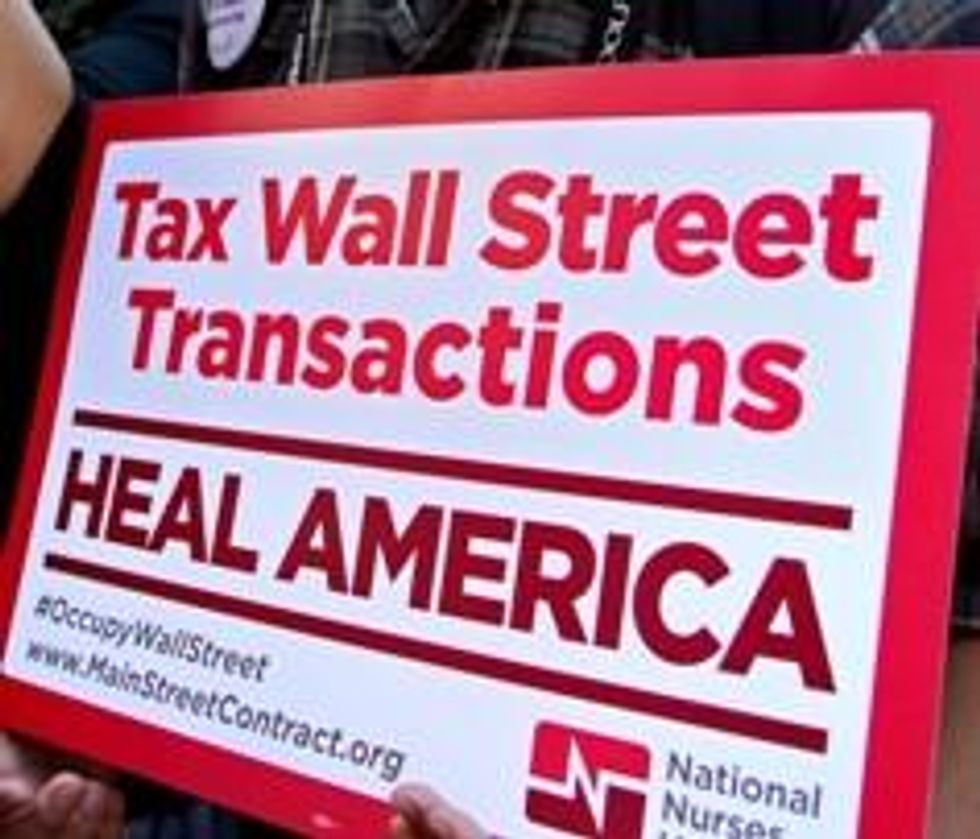
1. Financial industry speculation devastated middle-class homeowner wealth.
2. U.S. investors pay zero tax on their speculative transactions.
3. The tax is easy to implement, and is very successful in other countries.
The emotional appeal reaches most of America:
Why should the rest of us pay up to 10% on the necessities of life while risky derivative purchases aren't taxed at all?
Why should kids around the country lose their arts programs while trillions of dollars flow, untaxed, to Wall Street?
On July 8th, 2013, Chicago Political Economy Group (CPEG) member Bill Barclay and Illinois Green Party Chair Rich Whitney presented arguments for the Financial Transaction Tax (FTT) in front of the Illinois Pension Reform Committee. The video is available here (01:29:40), and the slideshow here. Much of the following derives from their work.
The Tax Works in Countries with the 'Freest' Economies
A good place to start is Singapore. Or Hong Kong or Switzerland. These are three of the top five countries on the Heritage Foundation's Index of Economic Freedom, and they all have FTTs. Critics who might argue that non-FTT taxes are lower in Singapore and Hong Kong should look at World Bank and CIA World Factbook datasets, both of which show the U.S. with lower tax revenues as a percentage of GDP. The U.S. is clearly undertaxed across a wide range of taxes.
Unimaginable Amounts are being Traded in the U.S., with zero tax
Unfortunately, in our country, discussions about pension reform and education and infrastructure usually lead to talk about further cutbacks, as if that were the only solution. But pension funds and schools lost money because of financial industry malfeasance. And yet the financial industry keeps surging ahead. The 2012 trading volume for the Chicago Mercantile Group (CME) alone was $806 trillion, about 12 times more than the entire world GDP. In 2011 it was over $1,000 trillion -- that's a mind-dizzying $1 quadrillion.
There's no sales tax on all that, just a tiny administrative fee. We've had to look elsewhere for our education funds. As Whitney noted, "Our tax system taxes poverty far more than it taxes wealth."
A Tiny Tax Would Pay the Entire 2013 Federal Education Budget
A bill sponsored by Illinois Representative Mary Flowers would impose a modest .01% tax on CME stock and derivative trades. It would not include transactions involving securities held in retirement or mutual fund accounts. With this little tax, at current trading levels, up to $80 billion would be realized annually. Chicago-area trading alone would pay the entire federal education bill.
It's Easy to Administer -- Especially for One of the Most Profitable Companies in America.
What are the objections? Administrative cost and inconvenience? No, the FTT is easy to administer, and difficult to evade. Clearing houses already review all trades, and serve as collection agencies for transaction fees.
How about the threat of a move to another state or country to avoid new taxes? It's hard to imagine that from the CME Group, made up of the Chicago Mercantile Exchange and the Chicago Board of Trade. From 2008 to 2010 the company had a profit margin higher than any of the top 100 companies in the nation.
Big Revenues, Little Risk
Objections to the FTT seem superficial in light of the two main benefits: (1) The massive revenue potential; and (2) the likelihood of limiting the speculative trading that contributed to the financial meltdown in 2008. Informed Americans are in agreement on this. The tax is simple and effective and fair and long-overdue, and obvious to everyone except the business-friendly members of Congress.
The logic for the tax is indisputable:
1. Financial industry speculation devastated middle-class homeowner wealth.
2. U.S. investors pay zero tax on their speculative transactions.
3. The tax is easy to implement, and is very successful in other countries.
The emotional appeal reaches most of America:
Why should the rest of us pay up to 10% on the necessities of life while risky derivative purchases aren't taxed at all?
Why should kids around the country lose their arts programs while trillions of dollars flow, untaxed, to Wall Street?
On July 8th, 2013, Chicago Political Economy Group (CPEG) member Bill Barclay and Illinois Green Party Chair Rich Whitney presented arguments for the Financial Transaction Tax (FTT) in front of the Illinois Pension Reform Committee. The video is available here (01:29:40), and the slideshow here. Much of the following derives from their work.
The Tax Works in Countries with the 'Freest' Economies
A good place to start is Singapore. Or Hong Kong or Switzerland. These are three of the top five countries on the Heritage Foundation's Index of Economic Freedom, and they all have FTTs. Critics who might argue that non-FTT taxes are lower in Singapore and Hong Kong should look at World Bank and CIA World Factbook datasets, both of which show the U.S. with lower tax revenues as a percentage of GDP. The U.S. is clearly undertaxed across a wide range of taxes.
Unimaginable Amounts are being Traded in the U.S., with zero tax
Unfortunately, in our country, discussions about pension reform and education and infrastructure usually lead to talk about further cutbacks, as if that were the only solution. But pension funds and schools lost money because of financial industry malfeasance. And yet the financial industry keeps surging ahead. The 2012 trading volume for the Chicago Mercantile Group (CME) alone was $806 trillion, about 12 times more than the entire world GDP. In 2011 it was over $1,000 trillion -- that's a mind-dizzying $1 quadrillion.
There's no sales tax on all that, just a tiny administrative fee. We've had to look elsewhere for our education funds. As Whitney noted, "Our tax system taxes poverty far more than it taxes wealth."
A Tiny Tax Would Pay the Entire 2013 Federal Education Budget
A bill sponsored by Illinois Representative Mary Flowers would impose a modest .01% tax on CME stock and derivative trades. It would not include transactions involving securities held in retirement or mutual fund accounts. With this little tax, at current trading levels, up to $80 billion would be realized annually. Chicago-area trading alone would pay the entire federal education bill.
It's Easy to Administer -- Especially for One of the Most Profitable Companies in America.
What are the objections? Administrative cost and inconvenience? No, the FTT is easy to administer, and difficult to evade. Clearing houses already review all trades, and serve as collection agencies for transaction fees.
How about the threat of a move to another state or country to avoid new taxes? It's hard to imagine that from the CME Group, made up of the Chicago Mercantile Exchange and the Chicago Board of Trade. From 2008 to 2010 the company had a profit margin higher than any of the top 100 companies in the nation.
Big Revenues, Little Risk
Objections to the FTT seem superficial in light of the two main benefits: (1) The massive revenue potential; and (2) the likelihood of limiting the speculative trading that contributed to the financial meltdown in 2008. Informed Americans are in agreement on this. The tax is simple and effective and fair and long-overdue, and obvious to everyone except the business-friendly members of Congress.
The logic for the tax is indisputable:
1. Financial industry speculation devastated middle-class homeowner wealth.
2. U.S. investors pay zero tax on their speculative transactions.
3. The tax is easy to implement, and is very successful in other countries.
The emotional appeal reaches most of America:
Why should the rest of us pay up to 10% on the necessities of life while risky derivative purchases aren't taxed at all?
Why should kids around the country lose their arts programs while trillions of dollars flow, untaxed, to Wall Street?
On July 8th, 2013, Chicago Political Economy Group (CPEG) member Bill Barclay and Illinois Green Party Chair Rich Whitney presented arguments for the Financial Transaction Tax (FTT) in front of the Illinois Pension Reform Committee. The video is available here (01:29:40), and the slideshow here. Much of the following derives from their work.
The Tax Works in Countries with the 'Freest' Economies
A good place to start is Singapore. Or Hong Kong or Switzerland. These are three of the top five countries on the Heritage Foundation's Index of Economic Freedom, and they all have FTTs. Critics who might argue that non-FTT taxes are lower in Singapore and Hong Kong should look at World Bank and CIA World Factbook datasets, both of which show the U.S. with lower tax revenues as a percentage of GDP. The U.S. is clearly undertaxed across a wide range of taxes.
Unimaginable Amounts are being Traded in the U.S., with zero tax
Unfortunately, in our country, discussions about pension reform and education and infrastructure usually lead to talk about further cutbacks, as if that were the only solution. But pension funds and schools lost money because of financial industry malfeasance. And yet the financial industry keeps surging ahead. The 2012 trading volume for the Chicago Mercantile Group (CME) alone was $806 trillion, about 12 times more than the entire world GDP. In 2011 it was over $1,000 trillion -- that's a mind-dizzying $1 quadrillion.
There's no sales tax on all that, just a tiny administrative fee. We've had to look elsewhere for our education funds. As Whitney noted, "Our tax system taxes poverty far more than it taxes wealth."
A Tiny Tax Would Pay the Entire 2013 Federal Education Budget
A bill sponsored by Illinois Representative Mary Flowers would impose a modest .01% tax on CME stock and derivative trades. It would not include transactions involving securities held in retirement or mutual fund accounts. With this little tax, at current trading levels, up to $80 billion would be realized annually. Chicago-area trading alone would pay the entire federal education bill.
It's Easy to Administer -- Especially for One of the Most Profitable Companies in America.
What are the objections? Administrative cost and inconvenience? No, the FTT is easy to administer, and difficult to evade. Clearing houses already review all trades, and serve as collection agencies for transaction fees.
How about the threat of a move to another state or country to avoid new taxes? It's hard to imagine that from the CME Group, made up of the Chicago Mercantile Exchange and the Chicago Board of Trade. From 2008 to 2010 the company had a profit margin higher than any of the top 100 companies in the nation.
Big Revenues, Little Risk
Objections to the FTT seem superficial in light of the two main benefits: (1) The massive revenue potential; and (2) the likelihood of limiting the speculative trading that contributed to the financial meltdown in 2008. Informed Americans are in agreement on this. The tax is simple and effective and fair and long-overdue, and obvious to everyone except the business-friendly members of Congress.