

SUBSCRIBE TO OUR FREE NEWSLETTER
Daily news & progressive opinion—funded by the people, not the corporations—delivered straight to your inbox.
5
#000000
#FFFFFF
To donate by check, phone, or other method, see our More Ways to Give page.
Daily news & progressive opinion—funded by the people, not the corporations—delivered straight to your inbox.
"Oil companies know that protest works," said Greenpeace USA's leader.
With cleanup efforts still underway in rural North Dakota on Friday after yet another Keystone crude oil pipeline spill, Greenpeace USA interim executive director Sushma Raman said that the incident "shows exactly why we need to protect protest, free speech, and the right to speak up against harm."
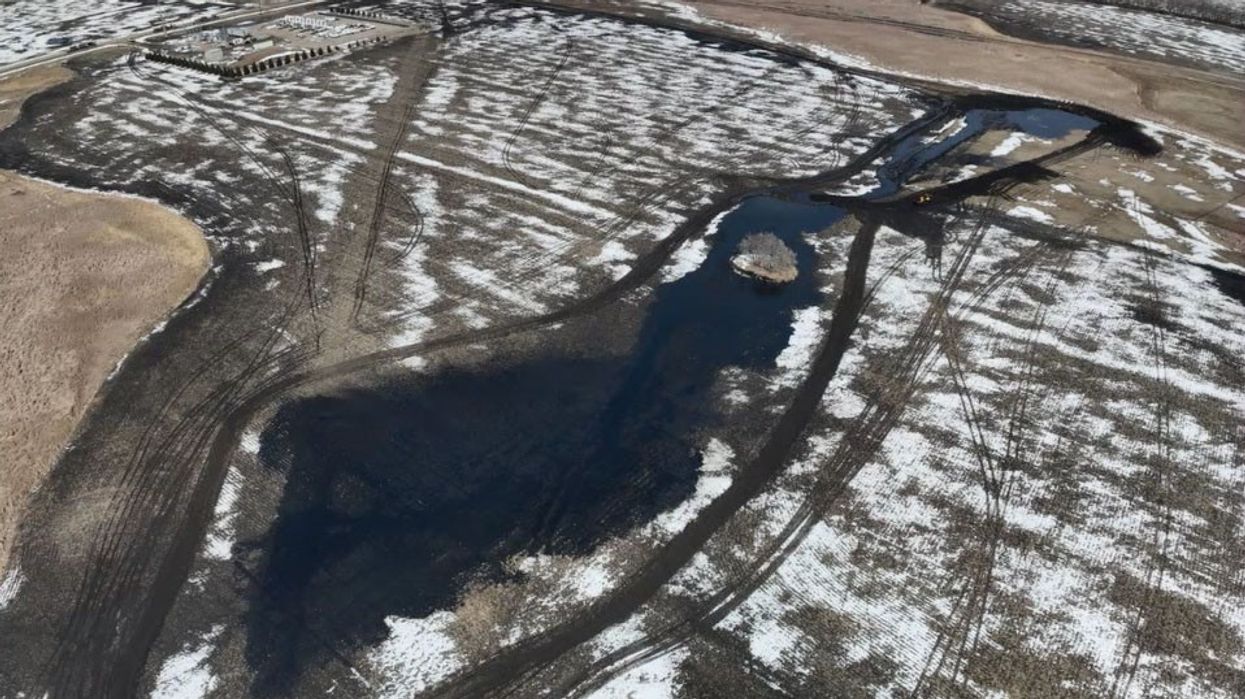
Keystone ruptured on Tuesday, spilling an estimated 3,500 barrels of oil into an agricultural field, according to the Pipeline and Hazardous Materials Safety Administration (PHMSA). That came just weeks after a North Dakota jury awarded Energy Transfer and its subsidiary more than $660 million in a case targeting Greenpeace for protests against the Dakota Access oil pipeline.
"We know fossil fuels are unhealthy at every stage of their life cycle. There is no fail-safe way to transport oil and gas, and the risks unfairly fall on the people who live near the route, while the company reaps the benefits," Raman said in a Friday statement. "Everyday people, public watchdogs, and advocacy groups have a right to raise their voices and criticize a corporation when their health and livelihoods are on the line."
"Yet this type of ordinary advocacy is exactly what is under attack in the more than $660 million jury verdict against Greenpeace entities in a lawsuit brought by pipeline company Energy Transfer," added Raman, whose group is appealing the March decision. "Oil companies know that protest works—which is why they're trying to make the stakes so high no one will be willing to take the risk."
"There is no fail-safe way to transport oil and gas, and the risks unfairly fall on the people who live near the route, while the company reaps the benefits."
Environmentalist David Suzuki and co-writer Ian Hanington similarly wrote last week that while Greenpeace argues that it assisted with the protests against Dakota Access "at the request of the Standing Rock Sioux, the environmental group is clearly seen as a threat to oil and gas interests and is a high-profile target for increasingly common efforts to silence opposition."
"From Standing Rock to Wet'suwet'en territory in British Columbia and beyond, militarized law enforcement agencies are relying more often on use of force against land and water defenders, and companies are resorting to tactics such as SLAPPs ("strategic lawsuits against public participation" designed to silence opponents through costly, time-consuming legal processes)," they noted. "Those working to protect land, air, water, plants and animals, and our future face an increasingly uphill battle."
The pair stressed that "the lawsuit against Greenpeace is an attack on the right to protest and speak freely. It won't be the last. We should all stand with Standing Rock, and with organizations such as Greenpeace that are working for people and the planet and holding the line against the destructive fossil fuel industry."
One expert detailed some of the industry's destruction in comments to The Associated Press about the Keystone spill earlier this week:
The spill is not a minor one, said Paul Blackburn, a policy analyst with Bold Alliance, an environmental and landowners group that fought the pipeline's extension, called Keystone XL.
The estimated volume of 3,500 barrels, or 147,000 gallons of crude oil, is equal to 16 tanker trucks of oil, he said. That estimate could increase over time, he added.
Blackburn said the bigger picture is what he called the Keystone pipeline's history of spills at a higher rate than other pipelines. He compared Keystone to the Dakota Access oil pipeline since the latter came online in June 2017. In that period, Keystone's system has spilled nearly 1.2 million gallons (4.5 million liters) of oil, while Dakota Access spilled 1,282 gallons (4,853 liters), Blackburn said.
PHMSA said Thursday that it "has dispatched a total of eight inspectors to investigate the pipeline rupture," and Keystone's operator is "voluntarily committing to full cooperation with our investigation and pledging a series of corrective measures," including "a commitment not to restart the pipeline without prior approval."
The federal agency added Friday that as of 1:00 am local time, "five vacuum trucks have recovered and removed 1,170 barrels of crude oil. Cleanup operations are ongoing. PHMSA will continue to provide updated information as we receive it."
While Republican President Donald Trump aims to revive the Keystone XL project and boost the fossil fuel industry in general, one climate champion on Capitol Hill pointed to the spill as further proof of the need to phase out planet-wrecking oil and gas.
U.S. Sen. Ed Markey (D-Mass.), the chamber's lead sponsor of Green New Deal legislation, said on social media this week: "The Keystone oil pipeline has ruptured and spilled—again. We must continue to fight for strong pipeline safety requirements and get rid of dirty fossil fuels once and for all."

Ultimately, we do not want a drone company that manufactures weapons that commit war crimes to operate in North Dakota.
Correction: An earlier version of this article said that the Hermes 450 can carry and deploy up to two medium-range missiles. It has been updated to reflect the fact that it can actually carry four.
Recently, Aviation International published a conversation between the Department of Commerce Commissioner of North Dakota and a director at Thales group. The article, titled “North Dakota: The Silicon Valley of Drone Innovation,” makes the case that North Dakota is the go-to state for drone technology.
North Dakota’s strong ties with the drone industry formed a few years ago, with the state’s goal of transforming the state into ground zero for drone technology. By taking advantage of the state, its resources, and its people, the mission to turn North Dakota into a silicon valley for drones has already produced a vast network of unmanned aircraft system (UAS) technological hubs. However, in doing so it has also entangled North Dakotans into a deep relationship with Elbit Systems of America, a subsidiary of the Israeli company. This relationship is not comprehensively understood by North Dakotans nor our lawmakers.
Vantis is an aerospace company founded in North Dakota with an investment from the state five years ago. It helps facilitate commercial and private drone use by “utilizing North Dakota Department of Transportation (NDDOT) towers to deploy radars and other network technology around the state, lowering development costs by utilizing existing infrastructure.” Drone technology also helps monitor flooding, which is an issue in North Dakota on an annual basis. Thus, Vantis isn’t inherently a poor investment, and investing in drone technology for farming and environmental reasons isn’t necessarily a bad idea. However, three years ago, Vantis partnered with Thales, the 11th-largest weapons manufacturer in the world. Thales has long partnered with Israeli weapons manufacturer Elbit Systems to develop drone technology for various militaries around the world. Since this initial investment by the state of North Dakota into UAS, the state’s relationship with Elbit Systems started to cement itself as well.
North Dakota’s evolving relationship with drone technology presents both significant opportunities and serious ethical concerns.
In 2016, a researcher at North Dakota State University launched an initiative to bring an Elbit drone to help with agricultural research. The project was funded by North Dakota and Elbit Systems, which planned on selling the imagery from the research. The idea was that using a larger drone, the Hermes 450, would be a more cost-effective way to use drone technology for farming. But the Hermes drone isn’t just for farming; it’s also one of Elbit’s most deployed weapons by the Israeli army in Gaza. It’s been used to surveil and target Palestinians ever since it joined the Israeli air force fleet. It can carry and deploy up to four medium-range missiles. When the conversation about slaughtered civilians in Gaza comes up, many point fingers at the weapons giant Elbit.
On February 7, CODEPINK North Dakota visited our legislators in Bismarck to talk to them about Elbit. We sought clarity regarding the extent of the collaboration between North Dakota and Elbit Systems as North Dakotans concerned about our complicity in Israel’s war crimes in Gaza. What we learned was that our legislators knew—at best—about as much as we did or—at worst, and most commonly—nothing at all. State Sen. Bob Paulson (R-3) admitted to not knowing anything about Elbit Systems.
We delineated North Dakota’s disturbing relationship to Elbit—highlighting the atrocities that Elbit’s drones, particularly the Hermes 450, have been used to commit. One such atrocity was the well-documented attack on the World Central Kitchen in April 2024—widely considered to be a flagrant war crime under international law. However, Sen. Paulson denied the magnitude of Israel’s atrocities, dismissing our concerns and minimizing Israel’s responsibility with statements like: “That’s just war.” He also regurgitated Israeli propaganda, parroting the claim that Hamas uses “human shields” and put “babies in ovens” on October 7, 2023. We had to repeatedly rein in our conversation to get back to our main concern: Elbit Systems operations in North Dakota.
Our secondary concern was HB 1038, a bill to allocate $15 million in funding for the replacement of Chinese drones used by North Dakota state agencies and public institutions. Our worry is that, if passed, this bill could open up another avenue for North Dakota to deepen its relationship with Elbit Systems. We met with several other legislators over the course of the day. Some, like Sen. Randy Burckhard (R-5), were adamant that China “is out to get us,” while others, like Sen. Kathy Hogan (D-21) and Rep. Gretchen Dobervich (D-11), were far more sympathetic to our cause.
Ultimately, we do not want a drone company that manufactures weapons that commit war crimes to operate in North Dakota.
Northern Plains UAS Test Site (NPUASTS) in Grand Forks has voiced concerns about how overreliance on foreign technology could lead to disruptions if geopolitical tensions escalate. Geospatial data collected by a North Dakota drone could be hacked into and leveraged by foreign adversaries for intelligence or even used to disrupt infrastructure. If North Dakota is indeed worried about data from our UAS being hacked by a foreign adversary as a result of geopolitical tensions in the region of the technology’s origin, then we should be especially wary of sourcing our UAS from Israel.
Thankfully, HB 1038 was divided up into two separate parts in the North Dakota Senate. One part, “Division A,” included the allocation of $15 million to replace Chinese drones in North Dakota agencies and institutions. “Division B” had more to do with implementing a data management program, including an $11 million allocation to enable Vantis to ensure that data collected in North Dakota remains under state control. Division A ultimately failed in the Senate, whereas Division B passed and was signed into law by Gov. Kelly Armstrong on February 24, 2025.
Yet the reality remains. North Dakota’s evolving relationship with drone technology presents both significant opportunities and serious ethical concerns. While the state’s investment in UAS has the potential to enhance agricultural and environmental monitoring, it also links North Dakota with Elbit Systems, a company directly responsible for war crimes. The lack of transparency and awareness among state legislators about this relationship highlights the need for more informed discussions on the role of foreign technology in our state.
North Dakotans should consider the ethical implications of its partnerships and ensure that state resources are not connected to companies that are blowing up innocent men, women, and children, thereby making taxpayers complicit in such war crimes.
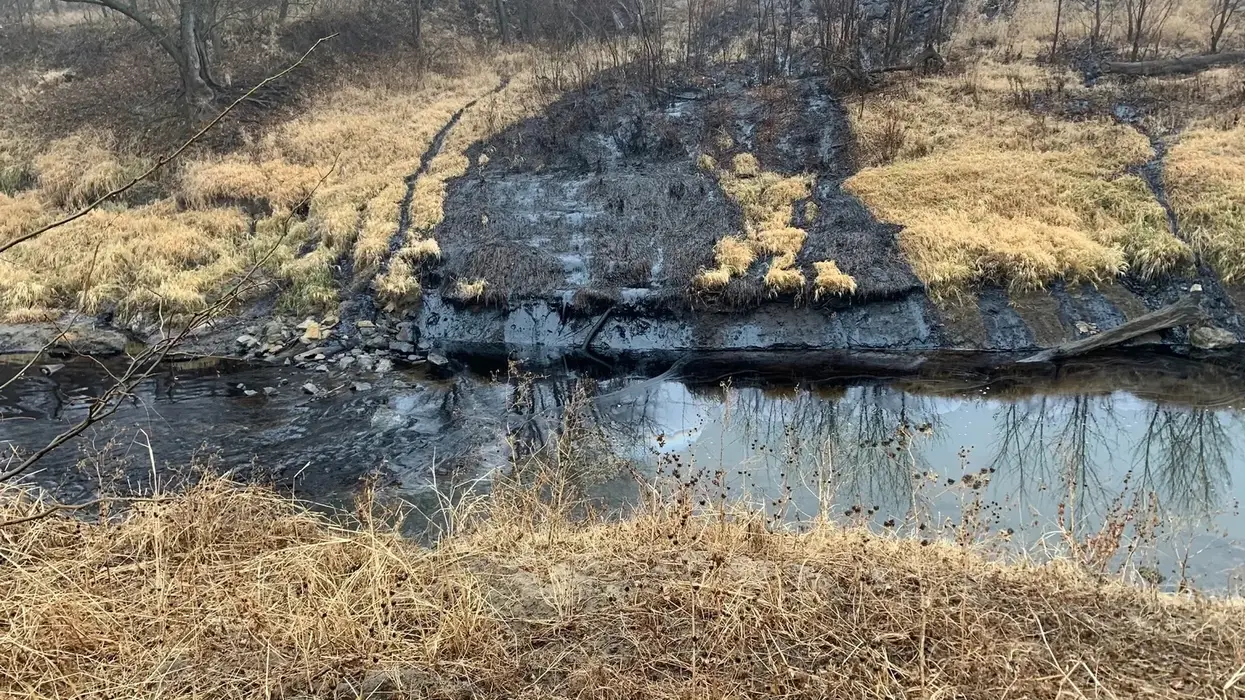
President Donald Trump wants to revive Keystone XL, a highly controversial extension of the tar sands pipeline system, despite three massive leaks over the past eight years.
This is a developing story... Please check back for possible updates...
The Keystone pipeline—which carries hundreds of thousands of barrels of crude oil nearly 2,700 miles from the Alberta tar sands to refineries in Illinois and Oklahoma daily—was abruptly shut down Tuesday morning following a rupture in North Dakota, marking yet another accident along what proponents have called the "safest pipeline in the world."
South Bow, the Canadian company that manages the Keystone system, said it shut down the pipeline—which transports an average of around 624,000 barrels of crude oil per day—after detection systems sounded the alarm on a pressure drop. The company said the spill is confined to an agricultural field about 60 miles southwest of Fargo.
"The affected segment has been isolated, and operations and containment resources have been mobilized to site," the company said, according to The Associated Press. "Our primary focus right now is the safety of onsite personnel and mitigating risk to the environment."
As the AP reported:
It wasn't clear what caused the rupture of the underground pipeline or the amount of crude oil released into the field. An employee working at the site near Fort Ransom heard a "mechanical bang" and shut down the pipeline within about two minutes, said Bill Suess, spill investigation program manager with the North Dakota Department of Environmental Quality. Oil surfaced about 300 yards (274 meters) south of the pump station in a field and emergency personnel responded, Suess said.
A proposed extension known as Keystone XL would have carried more tar sands oil—widely considered the world's dirtiest fuel—to refineries along the Gulf of Mexico. Opponents warned of the danger of leaks, with a 2021 report from the nonpartisan Government Accountability Office noting that there were 22 accidents along the conduit between 2010 and 2020. These include leaks of more than 100,000 gallons per spill in 2017, 2019, and 2022.
"Keystone's incident history illustrates the problematic pipeline's systemic issues," Bill Caram, executive director of the Pipeline Safety Trust, said in a statement Tuesday. "The Keystone pipeline appears to be on track to hit its average of about a significant failure every year. It's time to address this pipeline's shortcomings."
Following more than a decade of pressure from climate, environmental, Indigenous, and other groups, then-President Joe Biden revoked Keystone XL's permit on his first day in office in January 2021. President Donald Trump, who campaigned on a "drill, baby, drill" platform, now wants to revive Keystone XL.
"We will not be silenced," the green group said in response to the verdict.
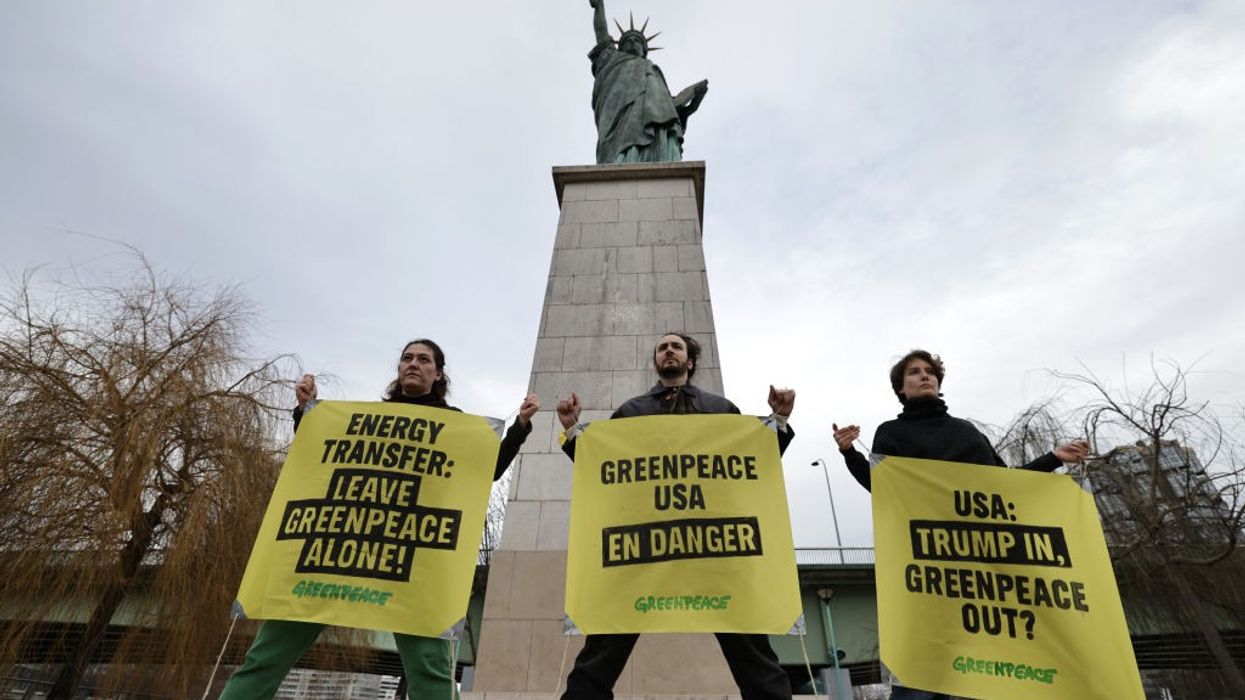
Climate campaigners swiftly sounded the alarm on Wednesday after a North Dakota jury awarded Energy Transfer and its subsidiary more than $660 million in the fossil fuel giant's case targeting Greenpeace for protests against the Dakota Access crude oil pipeline.
While Energy Transfer called the verdict a "win... for the people of Mandan and throughout North Dakota," environmentalist Jon Hinck condemned it as a "travesty of justice."
Hinck and others argue the case against Greenpeace International and two of its entities in the United States is a strategic lawsuit against public participation (SLAPP) intended to intimidate opponents of climate-wrecking fossil fuel projects.
OUTRAGE: A Big Oil-stacked jury just sided with corporate power, slapping Greenpeace with millions in damages for standing with Indigenous water protectors against DAPL. This is a dangerous attack on the right to protest, but the fight is not over. apnews.com/article/gree...
[image or embed]
— Center for Constitutional Rights ( @ccrjustice.org) March 19, 2025 at 6:04 PM
"This case should alarm everyone, no matter their political inclinations," said Sushma Raman, interim executive director of Greenpeace's U.S. entities, in a statement. "It's part of a renewed push by corporations to weaponize our courts to silence dissent. We should all be concerned about the future of the First Amendment, and lawsuits like this aimed at destroying our rights to peaceful protest and free speech. These rights are critical for any work toward ensuring justice—and that's why we will continue fighting back together, in solidarity. While Big Oil bullies can try to stop a single group, they can't stop a movement."
As The New York Times reported Wednesday:
Greenpeace had maintained that it played only a minor part in demonstrations led by the Standing Rock Sioux Tribe. It had portrayed the lawsuit as an attempt to stifle oil industry critics, but a jury apparently disagreed.
The nine-person jury in the Morton County courthouse in Mandan, North Dakota, about 45 minutes north of where the protests took place, returned the verdict after roughly two days of deliberating.
Addressing the legal loss on social media, Greenpeace International vowed that "we will not be silenced."
🚨BREAKING🚨 The trial verdict is in. A jury in the Morton County courthouse found Greenpeace International and two Greenpeace entities in the United States liable for over US$ 660 million combined in Energy Transfer’s meritless SLAPP lawsuit. #WeWillNotBeSilenced
[image or embed]
— Greenpeace International 🌍 ( @greenpeace.org) March 19, 2025 at 5:39 PM
Greenpeace International executive director Mads Christensen echoed that sentiment and pointed to U.S. President Donald Trump's second term as a danger to people and the planet. As the advocacy leader put it: "We are witnessing a disastrous return to the reckless behavior that fueled the climate crisis, deepened environmental racism, and put fossil fuel profits over public health and a livable planet. The previous Trump administration spent four years dismantling protections for clean air, water, and Indigenous sovereignty, and now along with its allies wants to finish the job by silencing protest."
Asked by The Associated Press if Greenpeace plans to appeal just after the verdict, senior legal adviser Deepa Padmanabha said, "We know that this fight is not over."
While the case has sparked fears that a loss in court could end Greenpeace, Padmanabha told AP that the globally known group's work "is never going stop." The adviser added, "That's the really important message today, and we're just walking out and we're going to get together and figure out what our next steps are."
I hate it here. www.nytimes.com/2025/03/19/c...
[image or embed]
— Dr. Genevieve Guenther (she/they) (@doctorvive.bsky.social) March 19, 2025 at 4:19 PM
An independent trial monitoring committee said in a statement that the verdict "reflects a deeply flawed trial with multiple due process violations that denied Greenpeace the ability to present anything close to a full defense."
Marty Garbus, a longtime First Amendment lawyer who is part of the committee, said: "In my six decades of legal practice, I have never witnessed a trial as unfair as the one against Greenpeace that just ended in the courts of North Dakota. This is one of the most important cases in American history."
"The law that can come down in this case can affect any demonstration, religious or political. It's far bigger than the environmental movement. Yet the court in North Dakota abdicated its sacred duty to conduct a fair and public trial and instead let Energy Transfer run roughshod over the rule of law," he added. "Greenpeace has a very strong case on appeal. I believe there is a good chance it ultimately will win both in court and in the court of public opinion."
Greenpeace International general counsel Kristin Casper later said in a statement that "Energy Transfer hasn't heard the last of us in this fight. We're just getting started with our anti-SLAPP lawsuit against Energy Transfer's attacks on free speech and peaceful protest. We will see Energy Transfer in court this July in the Netherlands."
As the
Times detailed, the global group "this year had countersued Energy Transfer in the Netherlands, invoking a new European Union directive against SLAPP suits as well as Dutch law."

"This fight is bigger than Greenpeace. This lawsuit is a blatant attempt to silence critics and hide destructive practices," said the campaign director of Greenpeace USA.
With a high-stakes court trial between the environmental organization Greenpeace and the developer of the Dakota Access Pipeline, Energy Transfer, set to begin Monday, the green group earlier this month lit up multiple locations in both Dallas and Washington, D.C. with giant projections that displayed messages such as, "You Can't Put a Movement on Trial" and, "Big Oil Is Suing Greenpeace."
The Dallas-based oil and gas company Energy Transfer—whose executive chairman Warren Kelcy is a donor to U.S President Donald Trump, according to the The Guardian—has accused Greenpeace and other activists of inciting protests that took place against the Dakota Access Pipeline in 2016 and 2017, as well as spreading misinformation about and vandalizing the project.
The lawsuit names Greenpeace International and two U.S. Greenpeace entities. Greenpeace maintains that the protests were directed by Indigenous leaders, not Greenpeace.
The Standing Rock Sioux tribe and its allies said the pipeline, which has been in operation since 2017 and carries crude oil from the Brakken oil fields in North Dakota to Illinois, would endanger the water supply for the reservation and violate the tribe's right to its land.
If successful, the $300 million lawsuit could inflict "financial ruin" on the group, according to Greenpeace. This would have a chilling effect on the organization's work, but leaders within the group have also cast it as an attack on the environmental movement and free speech more broadly.
"This fight is bigger than Greenpeace. This lawsuit is a blatant attempt to silence critics and hide destructive practices," said Rolf Skar, the campaign director of Greenpeace USA, in a Tuesday statement.
Of the projections in D.C. and Dallas, Skar said they "are a testament to that resilience, shining a light on the truth and reminding everyone fighting for a just and livable future that we will not back down."
In a similar vein, Deepa Padmanabha, Greenpeace's deputy general counsel, told The Guardian that "Energy Transfer and the fossil fuel industry do not understand the difference between entities and movements. You can't bankrupt the movement. You can't silence the movement. There will be a backlash and a price to pay when you pursue these kinds of tactics."
" People power is more powerful," she added.
The case has also been decried as an example of what are known as "Strategic Lawsuits Against Public Participation"—or "SLAPP" lawsuits, meritless cases whose goal it to bankrupt civil society groups and nonprofits with years of litigation and legal fees.
Greenpeace International, which is based in Amsterdam, has been the first group to initiate a lawsuit under the European Union's new anti-SLAPP directive. The group has sued in a Dutch court to recoup losses it has incurred as a result of its legal fight with Energy Transfer.
Of its bid under the anti-SLAPP directive, Daniel Simons, senior legal counsel at Greenpeace International, said in early February that "if we prevail, it will send a message to corporate bullies that the age of impunity is ending. That would be a boost for civil society in the E.U., and point to solutions for those battling the SLAPP phenomenon elsewhere."
There is no federal anti-SLAPP law on the books in the United States.
There has also been intrigue surrounding the circumstances of the upcoming trial in North Dakota. Greenpeace unsuccessfully sought to have the case moved to a different court over concerns of potential jury bias. The Guardian and the local outlet the North Dakota Monitor have reported on mysterious mailers that were sent to local residents that contain written material slanted against Dakota Access Pipeline protestors and in favor of Energy Transfer.
"They may have imprisoned me but they never took my spirit!" said Peltier. "I am finally going home."
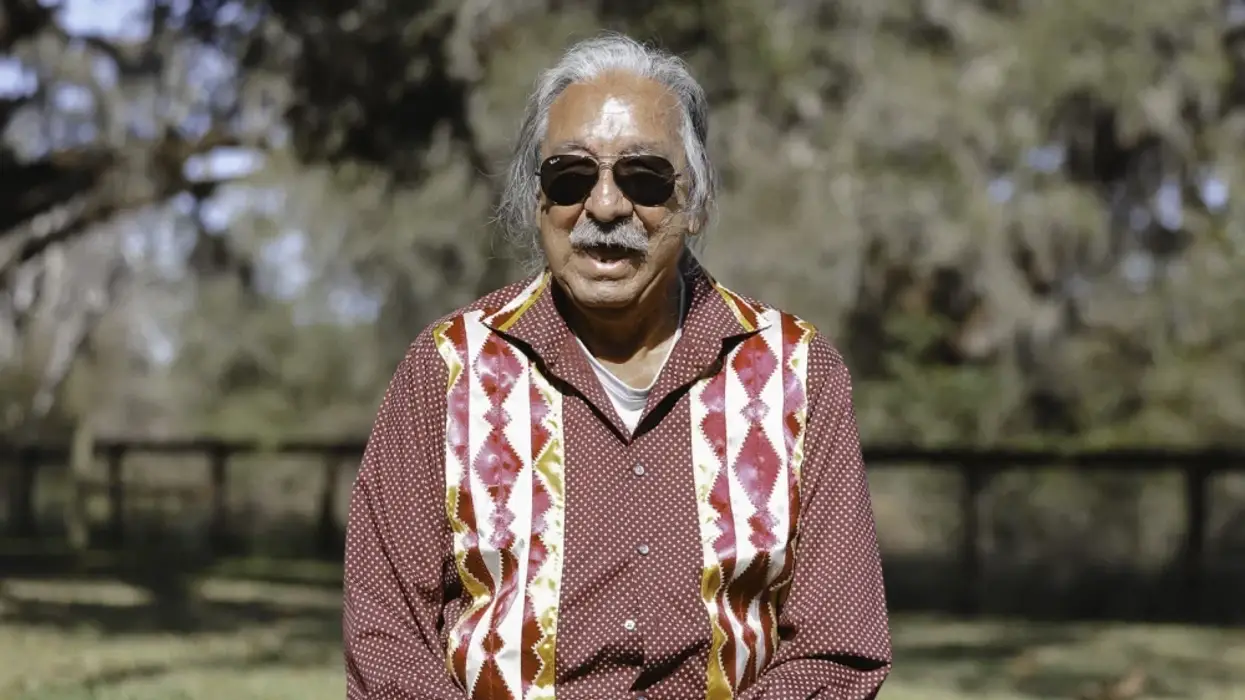
Indigenous rights and criminal justice reform advocates on Tuesday celebrated as Native American political activist Leonard Peltier, who has maintained his innocence for nearly 50 years since being sentenced to life in prison for the killing of two FBI agents, walked out of a high-security prison in Florida and headed home to North Dakota.
"Today I am finally free," said Peltier in a statement to the Native news outlet Indianz.com. "They may have imprisoned me but they never took my spirit! Thank you to all my supporters throughout the world who fought for my freedom. I am finally going home. I look forward to seeing my friends, my family, and my community. It's a good day today."
Advocates for Peltier, who is 80 years old, have long called for a presidential pardon and celebrated in January when former President Joe Biden announced he was commuting Peltier's sentence. He will serve out the rest of his sentence in home confinement.
Nick Tilsen, CEO of the advocacy group NDN Collective, noted that before his conviction Peltier was one of thousands of Indigenous children who were taken from their families and sent to boarding schools, where many suffered abuse.
"He hasn't really had a home since he was taken away to boarding school," Tilsen told The Associated Press. "So he is excited to be at home and paint and have grandkids running around."
"Leonard's step outside the prison walls today marks a step toward his long overdue freedom and a step toward reconciliation with Native Americans."
Peltier, an enrolled member of the Turtle Mountain Band of Chippewa Indians in North Dakota, was convicted of two counts of first-degree murder and given two consecutive life sentences after prosecutors accused him of shooting two FBI agents at point-blank range during a confrontation at the Oglala Sioux Indian Reservation in Pine Ridge, South Dakota in 1975.
Peltier has always maintained that he did fire a gun during the confrontation, but from a distance and in self-defense. A witness who claimed that she saw Peltier shoot the agents later said she had been coerced into testifying and recanted her testimony.
Lynn Crooks, the federal chief prosecutor in the case, later admitted that the government "knew we hadn't proved" that Peltier was guilty.
The American Indian Movement, which fought for Native American treaty rights and tribal self-determination and in which Peltier was active, was subject to FBI surveillance and harassment when the shooting took place.
Kevin Sharp, an attorney and former federal judge who has represented Peltier and filed numerous clemency petitions for him, said the violent confrontation in 1975 was "unquestionably" a tragedy that was "only further compounded by the nearly 50 years of wrongful incarceration for Leonard Peltier."
"Misconduct by the government in the investigation and prosecution of Mr. Peltier has been a stain on our system of justice," said Sharp. "Leonard's step outside the prison walls today marks a step toward his long overdue freedom and a step toward reconciliation with Native Americans."
The AP reported that Peltier left USP Coleman in Sumterville, Florida in an SUV on Tuesday morning and didn't stop to speak to members of the press who were gathered outside.
Amnesty International, which has long campaigned for Peltier and considers him a political prisoner, applauded his release.
"Leonard Peltier's release is the right thing to do given the serious and ongoing human rights concerns about the fairness of his trial, his nearly 50 years behind bars, his health, and his age," Paul O'Brien, executive director of Amnesty International USA, said in a statement. "While we welcome his release from prison, he should not be restricted to home confinement."
Tilsen said that Peltier's "wrongful incarceration represented the oppression of Indigenous Peoples everywhere."
"Peltier's liberation is invaluable in and of itself," said Tilsen. "His release today is a symbol of our collective power and inherent freedom."
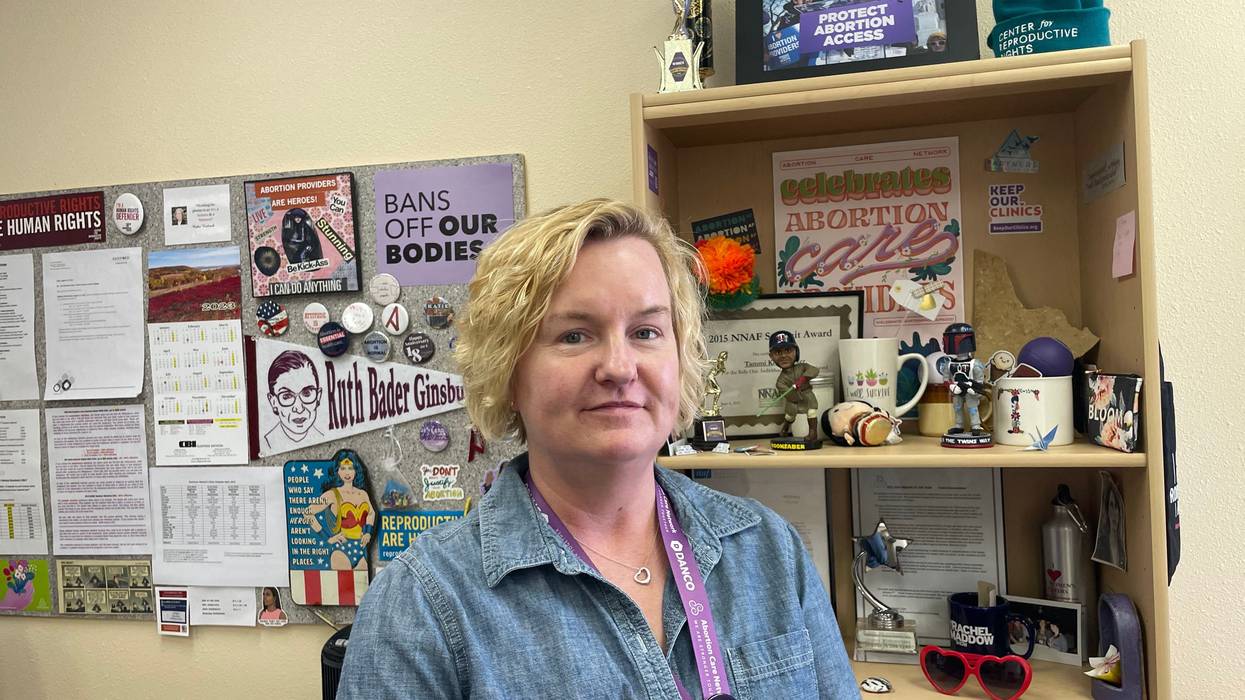
"I look forward to a new future in North Dakota and hope our lawmakers will finally give up on their crusade to force pregnancy on people against their will," said one advocate.
Two days after Republican presidential candidate Donald Trump claimed that "every Democrat, every Republican, liberal, conservative" wanted the federal right to abortion care to be overturned by the U.S. Supreme Court, a North Dakota judge became the latest on Thursday to strike down a state-level abortion ban, saying it violated residents' constitutional rights.
"The North Dakota Constitution guarantees each individual, including women, the fundamental right to make medical judgments affecting his or her bodily integrity, health, and autonomy, in consultation with a chosen healthcare provider free from government interference," wrote Judge Bruce Romanick, a District Court judge. "This section necessarily and more specifically protects a woman's right to procreative autonomy—including to seek and obtain a previability abortion."
The near-total ban on abortion care will be officially blocked in the coming days, in a move that the Center for Reproductive Rights (CRR) said could ultimately help restore access for people across the Midwest, as abortion care is currently banned in South Dakota and heavily restricted in nearby states including Nebraska and Iowa.
Meetra Mehdizadeh, a staff attorney at CRR, which filed a lawsuit against North Dakota's ban in 2023, said the ruling "is a win for reproductive freedom, and means it is now much safer to be pregnant in North Dakota," but warned that Republican lawmakers who passed the law have already done damage to pregnant people in the state that will take time to reverse.
"The damage that North Dakota's extreme abortion bans have done cannot be repaired overnight," said Mehdizadeh. "There are no abortion clinics left in North Dakota. That means most people seeking an abortion still won't be able to get one, even though it is legal. Clinics are medical facilities that need to acquire doctors, staff, equipment—they can take years to open, like most healthcare centers. The destructive impacts of abortion bans are felt long after they are struck down."
CRR argued in the case that the ban was too vague for medical providers to determine when an exception would be allowed for a pregnant patient whose life or health was at risk.
"This left physicians who provided abortions with the threat of having to defend their decision in court if someone were to question the provider's judgment," said the group. "Violating the ban was considered a class C felony, punishable by a maximum of five years of imprisonment, a fine of $10,000, or both."
Among the plaintiffs represented by CRR was Red River Women's Clinic, which was North Dakota's sole abortion care provider until a prior ban forced it to relocate from Fargo to Moorhead, Minnesota, where abortion has remained legal following the U.S. Supreme Court's overturning of Roe v. Wade.
"Today's decision gives me hope. I feel like the court heard us when we raised our voices against a law that not only ran counter to our state constitution, but was too vague for physicians to interpret and which prevented them from providing the high quality care that our communities are entitled to," said Tammi Kromenaker, director of the clinic. "Abortion is lifesaving healthcare; it should not be a crime. I look forward to a new future in North Dakota and hope our lawmakers will finally give up on their crusade to force pregnancy on people against their will."
Since Roe was overturned in 2022, numerous women have shared stories of being denied abortion care after suffering complications—including some that were life-threatening.
Judges in states including Wyoming, Utah, and Montana have blocked abortion bans in recent years, and voters have rejected anti-abortion ballot measures and approved ones that support the right to abortion in states including Kentucky, Kansas, Ohio, and Michigan.
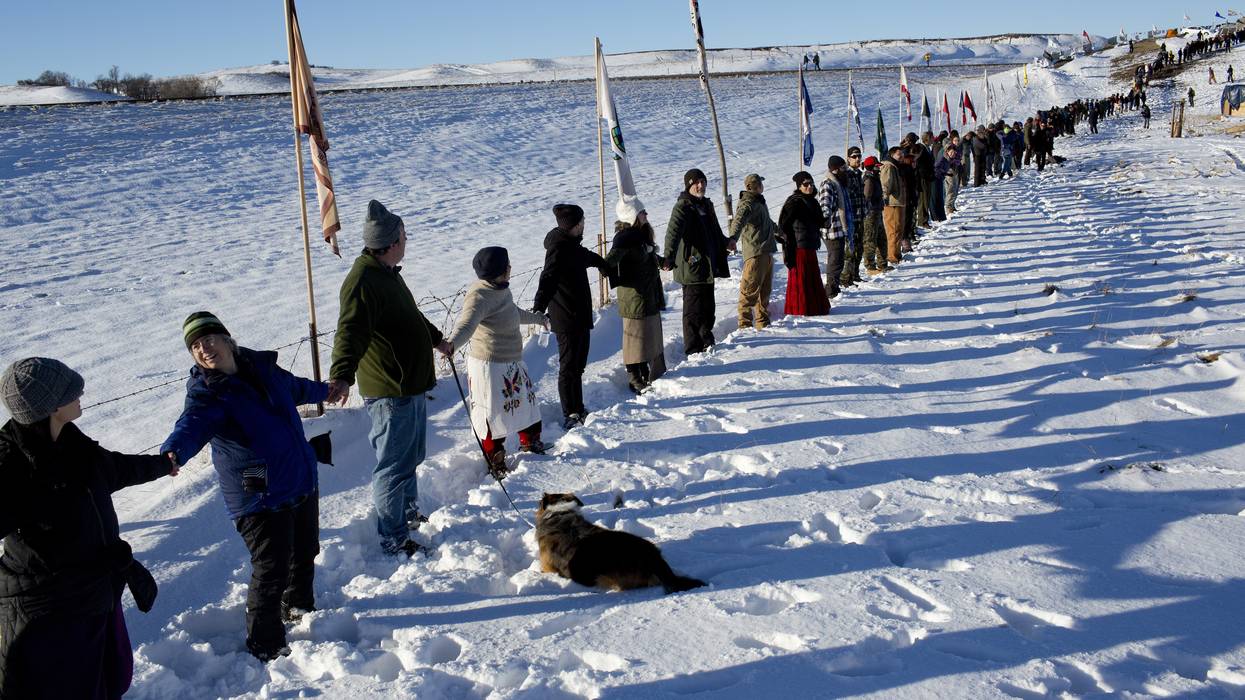
"Energy Transfer's lawsuit is a perfect prototype of what the E.U. Directive aims to end: wealthy players using towering legal claims and costs to muzzle criticism," said a senior legal counsel for Greenpeace.
With "the future of advocacy and peaceful protest" on the line, as one leader of Greenpeace USA said, the international environmental group has become the first entity to use a new European Union law aimed at stopping powerful corporations from filing meritless legal challenges.
Greenpeace International is among the defendants in a $300 million lawsuit originally filed in 2017 by Energy Transfer (ET), the Texas-based oil company that has accused Greenpeace of inciting protests against the firm's Dakota Access Pipeline in North Dakota, and of vandalizing property and delaying the pipeline project.
Greenpeace's home base of Amsterdam allows it to apply the E.U.'s Anti-SLAPP Directive, which was adopted in April with the goal of stopping legal challenges that are deemed to be "Strategic Lawsuits Against Public Participation"—lawsuits that are meant to bankrupt civil society groups and nonprofits with years of litigation and legal fees.
As The New York Times reported Tuesday, Greenpeace International last month sent a Notice of Liability to ET, which is headed by a close ally of Republican presidential nominee Donald Trump, saying it will use the Anti-SLAPP Directive to counter-sue the company in the Netherlands.
The group said it aims to recover all damages and costs it has suffered as a result of ET's lawsuit unless the company withdraws the case and pays Greenpeace back for the fees it has incurred fighting the litigation so far.
"Energy Transfer's lawsuit is a perfect prototype of what the E.U. Directive aims to end: wealthy players using towering legal claims and costs to muzzle criticism. Thanks to a concerted civil society campaign, there is now a strong tool to stop these cases at the E.U. border and to fight back against them," said Daniel Simons, senior legal counsel for strategic defense for Greenpeace International.
Greenpeace has argued it did not organize protests that included a huge encampment near the Standing Rock Sioux Reservation from 2016-17, where Indigenous tribes and environmental advocates protested ET's construction of the 1,170-mile crude oil pipeline. It has said it did not participate in any violence or property destruction at the protests.
"From the outset, this has been an attempt by ET to bury nonprofits and activists in legal fees, push them towards bankruptcy, and ultimately silence dissent," said Greenpeace.
The group's chapter in the United Kingdom spoke out on Wednesday, saying the lawsuit represents an "existential threat" to Greenpeace.
The Standing Rock Sioux tribe and its allies said the pipeline would endanger the water supply for the reservation and violate the tribe's right to its land. The pipeline began operating in 2017 after Trump issued an executive order, but it has yet to receive federal approval.
ET's lawsuit against Greenpeace is scheduled to go before a jury in Morton County, North Dakota next February.
Anna Myers, executive director of the Whistleblowing International Network and member of the steering committee for the Coalition Against SLAPPs in Europe, said Greenpeace is applying the Anti-SLAPP Directive to confront a growing threat posed by powerful corporations, including fossil fuel firms.
"The Coalition Against SLAPPs in Europe was set up in response to build solidarity and advance the case for anti-SLAPP legislation, including the E.U. Anti-SLAPP Directive published in April 2024," said Myers. "Energy Transfer's lawsuit—and the Notice of Liability issued by Greenpeace International—represents a crucial test of this new law."

"Mandating birth is state responsibility. Helping feed those kids is not," is how Democratic California Gov. Gavin Newsom summarized the Republican position.
Republican Gov. Doug Burgum of North Dakota on Monday signed one of the nation's most draconian abortion bans into law, just weeks after the state's GOP lawmakers shot down a proposal to provide free school lunches to low-income students.
The new forced pregnancy law, which takes immediate effect, prohibits abortion care in nearly all cases. Abortion is allowed in cases of rape or incest, but only during the first six weeks of pregnancy—before many people realize they are pregnant. Abortion is also allowed without gestational limits if terminating a pregnancy could prevent the pregnant person's "death or a serious health risk."
North Dakota is one of several states where dormant abortion bans took immediate effect last June when the U.S. Supreme Court's reactionary majority overturned Roe v. Wade, the 1973 decision that had legalized the healthcare procedure nationwide.
However, "North Dakota's trigger ban was blocked last year by a district judge, after its sole abortion provider, the Red River Women's Clinic, filed a lawsuit against the law," The New York Times reported Monday. "The state Supreme Court upheld the lower court's ruling last month and said the state constitution protected abortion rights in some situations."
Burgum, a former vice president at Microsoft, said in a statement that North Dakota's new forced pregnancy law "clarifies and refines" the existing abortion ban that has been blocked by courts.
As the Times noted:
Under the earlier ban, providers who performed an abortion to save the life of a mother could face felony prosecution. The provider would need to offer an "affirmative defense" proving that the abortion was medically necessary within the confines of the state law.
Under the new version of the law, the exceptions do not require an affirmative defense from providers. But providers could still face criminal charges if they violate the exceptions detailed in the law.
Elisabeth Smith, director of state policy and advocacy at the Center for Reproductive Rights, accused North Dakota lawmakers of "attempting to bypass the state constitution and court system with this total ban."
"They made the exceptions a little bit less narrow but essentially tried to repackage the trigger ban," she told the Times.
North Dakota has been completely bereft of abortion clinics since August, when the Fargo-based Red River Women's Clinic moved its operations a short distance across the border to Moorhead, Minnesota. But as the Times reported, Center for Reproductive Rights attorneys representing the clinic "say it is important to ensure that the ban does not take effect, so that patients facing medical emergencies can receive abortions in hospitals and from their doctors."
As the lawsuit opposing North Dakota's currently enjoined abortion ban proceeds, fresh legal challenges to the state's new forced pregnancy law are expected.
"I don't think women in North Dakota are going to accept this, and there will be action in the future to get our rights back," state Rep. Liz Conmy (D-11) told The Associated Press. "Our Legislature is overwhelmingly pro-pregnancy, but I think women in the state would like to make their own decisions."
Burgum, who also signed a bill prohibiting gender-affirming healthcare for trans youth last week, argued that the new abortion ban "reaffirms North Dakota as a pro-life state."
Democratic California Gov. Gavin Newsom, however, contrasted North Dakota Republicans' willingness to enact a forced pregnancy law with their refusal last month to expand access to free school lunches.
Condemning GOP lawmakers and officials, Newsom summarized their position as follows: "Mandating birth is state responsibility. Helping feed those kids is not."
Just 10 days after North Dakota Republicans rejected a bill that would have broadened eligibility for free school lunches, they voted in early April to increase their own daily meal reimbursements from $35 to $45, adding insult to injury.
"I'm beyond enraged at these cruel backward MAGA extremist politicians," tweeted human rights lawyer Qasim Rashid. "A special place in hell."
In sharp contrast to their counterparts in Bismarck, North Dakota, lawmakers in St. Paul recently made Minnesota the fourth state to guarantee universal free school meals.
Meanwhile, a first-of-its-kind lawsuit filed last month by five Texas women whose lives were endangered by that state's near-total abortion ban underscores the spurious nature of so-called "abortion exceptions," as Common Dreams reported.
With its new law, North Dakota became at least the 14th state with an active ban on nearly all abortions. Additional states have slightly less restrictive prohibitions in place.
The U.S. Supreme Court's 6-3 opinion last summer in Dobbs v. Jackson Women's Health Organization ended the constitutional right to abortion and turned regulation of the procedure over to individual states, leaving tens of millions of people without access to lifesaving reproductive healthcare.
The ruling's elimination of federal protections has enabled right-wing lawmakers to prohibit or restrict abortion in more than half of the states, unleashing a life-threatening crisis that human rights advocates consider a violation of U.S. obligations under international law.

"This ruling readily bows to the forces in this country that have been trying for years to gut the Clean Water Act."
While Big Ag cheered Wednesday's ruling by a federal judge in North Dakota temporarily blocking a key Biden administration clean water rule, Indigenous and environmental groups decried the decision—which critics said threatens critical protections for waterways in over two dozen affected states.
Reuters reports U.S. District Court Judge Daniel Hovland—an appointee of former President George W. Bush—issued a preliminary injunction against the Environmental Protection Agency's (EPA) Waters of the United States (WOTUS) rule after 24 states sued the Biden administration.
"This ruling readily bows to the forces in this country that have been trying for years to gut the Clean Water Act, throwing science under the bus and disregarding water safeguards for downstream communities and tribes," Janette Brimmer, an attorney for the green legal advocacy group Earthjustice who is defending the WOTUS rule on behalf of four Indigenous tribes, said in a statement.
"We will not give in to these forces; we will double down and fight along with our partners to ensure the law and science prevail and the will of the vast majority of citizens for clean water is carried out," Brimmer added.
Last month, Texas and Idaho were granted a separate injunction against the rule by U.S. District Court Judge Jeffrey Brown, who was appointed by former President Donald Trump.
According to Progressive Farmer, Hovland's ruling means that the WOTUS rule—which establishes protections for wetlands and seasonal streams—is now on hold in 24 more states: Alabama, Alaska, Arkansas, Florida, Georgia, Indiana, Iowa, Kansas, Louisiana, Mississippi, Missouri, Montana, Nebraska, New Hampshire, North Dakota, Ohio, Oklahoma, South Carolina, South Dakota, Tennessee, Utah, Virginia, West Virginia, and Wyoming.
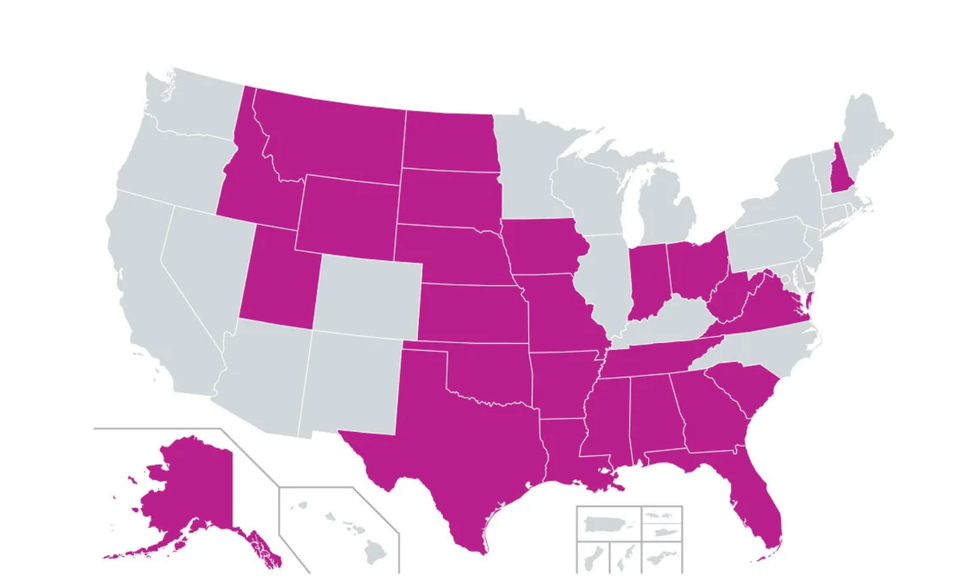 States shaded in red will be affected by a federal judge's temporary injunction against the Waters of the United States (WOTUS) rule. (Image: Earthjustice)
In 2020, the Trump administration rolled back WOTUS, which originated during the tenure of former President Barack Obama. The Biden administration revived the rule and last December it was finalized by the EPA.
Earlier this month, President Joe Biden vetoed legislation passed by Republicans and corporate Democrats in Congress that would have eviscerated the administration's ability to enforce WOTUS.
Hovland stopped short of issuing the nationwide injunction against WOTUS sought by the American Farm Bureau Federation and other agriculture industry interest groups. Still, Big Ag and Republican politicians in affected states overwhelmingly welcomed the injunction against what they say is a major act of government overreach.
Indigenous leaders, however, slammed Wednesday's ruling.
"Clean water is essential to tribal citizens' spiritual, physical, mental well-being, and survival."
"Clean water is essential to tribal citizens' spiritual, physical, mental well-being, and survival" Gary Harrison, traditional chief of the Chickaloon Native Village in Alaska, said in a statement. "Removing vital clean water safeguards will harm wetlands and streams that sustain tribal citizens, including myself."
G. Anne Richardson, chief of the Rappahannock tribe in Virginia, said that "the court's order threatens to strip vital protections from the network of waters that have been the lifeblood of the Rappahannock Tribe since time immemorial."
"Without the Clean Water Act," she added, "projects that would destroy important wetlands and streams could get rammed through without any opportunity for the tribe to object."