SUBSCRIBE TO OUR FREE NEWSLETTER
Daily news & progressive opinion—funded by the people, not the corporations—delivered straight to your inbox.
5
#000000
#FFFFFF
To donate by check, phone, or other method, see our More Ways to Give page.
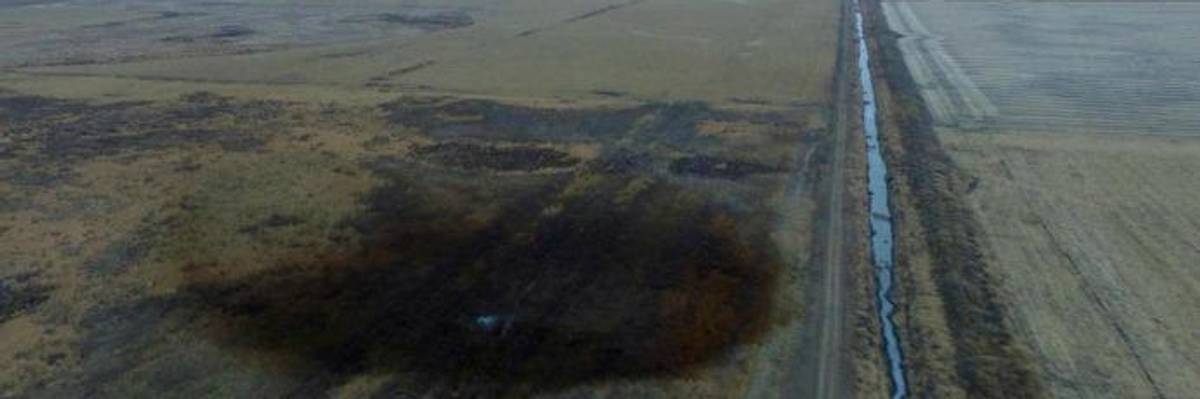
Climate justice groups and local pipeline opponents in Nebraska are condemning an announcement by the state's Public Service Commission (PSC) which indicated late Friday that a massive underground spill of the existing Keystone pipeline in South Dakota this week will have no bearing on a pivotal approval decision to build the Keystone XL pipeline scheduled for Monday.
"This spill puts an exclamation point on the need to reject Keystone XL, but it doesn't tell us anything we didn't already know about pipelines. They spill, and if Keystone XL is built, we can only expect more of the world's dirtiest oil spewing across farms, treaty lands, and throughout the Great Plains." --Sara Shor, 350.org
PSC spokesperson Deb Collins, citing a state law passed in 2011 which prevents the commission from factoring pipeline safety or the possibility of leaks into its decisions, said the panel's decision "will be based on the evidence in the record."
Local opponents of the project, as the Lincoln Journal Star notes, were "incensed" by the announcement.
"There is a reason TransCanada and the big oil lobby did not want this information on the record," said Jane Kleeb, director of the Bold Alliance, a coalition of state-level groups that have opposed the Keystone XL for nearly a decade.
"That the Nebraska commissioners won't consider safety in their decision on Keystone XL should alarm everyone," said Sara Shor, a spokesperson for 350.org, one of the key national opponents of the pipeline. "This spill puts an exclamation point on the need to reject Keystone XL, but it doesn't tell us anything we didn't already know about pipelines. They spill, and if Keystone XL is built, we can only expect more of the world's dirtiest oil spewing across farms, treaty lands, and throughout the Great Plains."
Kelly Martin, the Beyond Dirty Fuels campaign director at the Sierra Club, added, "We've always said it's not a question of whether a pipeline will spill, but when, and today TransCanada is making our case for us. This is not the first time TransCanada's pipeline has spilled toxic tar sands, and it won't be the last. The PSC must take note: there is no such thing as a safe tar sands pipeline, and the only way to protect Nebraska communities from more tar sands spills is to say no to Keystone XL."
For those unclear about the difference between the existing Keystone pipeline and Keystone XL, 350.org offered this helpful explainer via Twitter:
Echoing a message shared by the many groups--local, nation, and international--350.org's Shor says this week's spill is just the most recent proof that a move away from fossil fuel and towards renewable, less damaging energy energy is urgently needed.
"We need a transition to a renewable energy future that doesn't pollute our communities and wreck our climate," she said. "If the PSC truly has Nebraska's interests at heart, they'll reject Keystone XL."
In newspapers across Nebraska over the weekend, Kleeb's group is placing full-page ads against the pipeline and urging people to attend a rally outisde the PSC hearing on Monday.
Here's the ad, which promotes solar power in the state over the new fossil fuel projects like Keystone XL:

Climate justice groups and local pipeline opponents in Nebraska are condemning an announcement by the state's Public Service Commission (PSC) which indicated late Friday that a massive underground spill of the existing Keystone pipeline in South Dakota this week will have no bearing on a pivotal approval decision to build the Keystone XL pipeline scheduled for Monday.
"This spill puts an exclamation point on the need to reject Keystone XL, but it doesn't tell us anything we didn't already know about pipelines. They spill, and if Keystone XL is built, we can only expect more of the world's dirtiest oil spewing across farms, treaty lands, and throughout the Great Plains." --Sara Shor, 350.org
PSC spokesperson Deb Collins, citing a state law passed in 2011 which prevents the commission from factoring pipeline safety or the possibility of leaks into its decisions, said the panel's decision "will be based on the evidence in the record."
Local opponents of the project, as the Lincoln Journal Star notes, were "incensed" by the announcement.
"There is a reason TransCanada and the big oil lobby did not want this information on the record," said Jane Kleeb, director of the Bold Alliance, a coalition of state-level groups that have opposed the Keystone XL for nearly a decade.
"That the Nebraska commissioners won't consider safety in their decision on Keystone XL should alarm everyone," said Sara Shor, a spokesperson for 350.org, one of the key national opponents of the pipeline. "This spill puts an exclamation point on the need to reject Keystone XL, but it doesn't tell us anything we didn't already know about pipelines. They spill, and if Keystone XL is built, we can only expect more of the world's dirtiest oil spewing across farms, treaty lands, and throughout the Great Plains."
Kelly Martin, the Beyond Dirty Fuels campaign director at the Sierra Club, added, "We've always said it's not a question of whether a pipeline will spill, but when, and today TransCanada is making our case for us. This is not the first time TransCanada's pipeline has spilled toxic tar sands, and it won't be the last. The PSC must take note: there is no such thing as a safe tar sands pipeline, and the only way to protect Nebraska communities from more tar sands spills is to say no to Keystone XL."
For those unclear about the difference between the existing Keystone pipeline and Keystone XL, 350.org offered this helpful explainer via Twitter:
Echoing a message shared by the many groups--local, nation, and international--350.org's Shor says this week's spill is just the most recent proof that a move away from fossil fuel and towards renewable, less damaging energy energy is urgently needed.
"We need a transition to a renewable energy future that doesn't pollute our communities and wreck our climate," she said. "If the PSC truly has Nebraska's interests at heart, they'll reject Keystone XL."
In newspapers across Nebraska over the weekend, Kleeb's group is placing full-page ads against the pipeline and urging people to attend a rally outisde the PSC hearing on Monday.
Here's the ad, which promotes solar power in the state over the new fossil fuel projects like Keystone XL:
Climate justice groups and local pipeline opponents in Nebraska are condemning an announcement by the state's Public Service Commission (PSC) which indicated late Friday that a massive underground spill of the existing Keystone pipeline in South Dakota this week will have no bearing on a pivotal approval decision to build the Keystone XL pipeline scheduled for Monday.
"This spill puts an exclamation point on the need to reject Keystone XL, but it doesn't tell us anything we didn't already know about pipelines. They spill, and if Keystone XL is built, we can only expect more of the world's dirtiest oil spewing across farms, treaty lands, and throughout the Great Plains." --Sara Shor, 350.org
PSC spokesperson Deb Collins, citing a state law passed in 2011 which prevents the commission from factoring pipeline safety or the possibility of leaks into its decisions, said the panel's decision "will be based on the evidence in the record."
Local opponents of the project, as the Lincoln Journal Star notes, were "incensed" by the announcement.
"There is a reason TransCanada and the big oil lobby did not want this information on the record," said Jane Kleeb, director of the Bold Alliance, a coalition of state-level groups that have opposed the Keystone XL for nearly a decade.
"That the Nebraska commissioners won't consider safety in their decision on Keystone XL should alarm everyone," said Sara Shor, a spokesperson for 350.org, one of the key national opponents of the pipeline. "This spill puts an exclamation point on the need to reject Keystone XL, but it doesn't tell us anything we didn't already know about pipelines. They spill, and if Keystone XL is built, we can only expect more of the world's dirtiest oil spewing across farms, treaty lands, and throughout the Great Plains."
Kelly Martin, the Beyond Dirty Fuels campaign director at the Sierra Club, added, "We've always said it's not a question of whether a pipeline will spill, but when, and today TransCanada is making our case for us. This is not the first time TransCanada's pipeline has spilled toxic tar sands, and it won't be the last. The PSC must take note: there is no such thing as a safe tar sands pipeline, and the only way to protect Nebraska communities from more tar sands spills is to say no to Keystone XL."
For those unclear about the difference between the existing Keystone pipeline and Keystone XL, 350.org offered this helpful explainer via Twitter:
Echoing a message shared by the many groups--local, nation, and international--350.org's Shor says this week's spill is just the most recent proof that a move away from fossil fuel and towards renewable, less damaging energy energy is urgently needed.
"We need a transition to a renewable energy future that doesn't pollute our communities and wreck our climate," she said. "If the PSC truly has Nebraska's interests at heart, they'll reject Keystone XL."
In newspapers across Nebraska over the weekend, Kleeb's group is placing full-page ads against the pipeline and urging people to attend a rally outisde the PSC hearing on Monday.
Here's the ad, which promotes solar power in the state over the new fossil fuel projects like Keystone XL: