

SUBSCRIBE TO OUR FREE NEWSLETTER
Daily news & progressive opinion—funded by the people, not the corporations—delivered straight to your inbox.
5
#000000
#FFFFFF
To donate by check, phone, or other method, see our More Ways to Give page.
Daily news & progressive opinion—funded by the people, not the corporations—delivered straight to your inbox.

Ian Illuminato, Friends of the Earth, 250-478-7135, iilluminato@foe.org
George Kimbrell, International Center
for Technology Assessment (ICTA), 571-527-8618, gkimbrell@icta.org
Michael Hansen, Consumers Union, 914-378-2452, hansmi@consumer.org
Friends of the Earth, Consumers Union, and the
International Center for Technology Assessment (ICTA)
released a report
today detailing why consumers should be wary of sunscreens that contain
nanomaterials.
Engineered nanomaterials are widely used in sunscreens to
make sun-blocking ingredients like titanium dioxide and zinc oxide rub on clear
instead of white. These materials have been shown to exhibit different
fundamental physical, biological, and chemical properties than their larger
counterparts. The report indicates that very few nanomaterials have been
adequately tested, though the limited data that is available shows that their
small size makes them more able to enter the lungs, pass through cell
membranes, and possibly penetrate damaged or sun-burnt skin.
"Nano-sunscreens are being promoted as safe sun
protection, but the evidence of potential risk we've collected shows
otherwise," said Friends of the Earth's Health and Environment
Campaigner Ian Illuminato, one of the report's authors. "Consumers
must be aware that nanomaterials are being put into sunscreens with very little
evidence about their safety and relative efficacy."
In 2007 Consumer Reports (published by Consumers Union)
tested sunscreens containing nanomaterials and found no correlation between
their presence and sun protection. Consumer Reports testing found neither
nanoscale zinc nor titanium oxides provide a clear and consistent performance
advantage over other active ingredients.
"Adding nanoparticles to sunscreens means adding an
unnecessary potential risk to our health and to the environment, with no
significant gain. Why take the chance?" asked Michael Hansen, PhD,
co-author of the report and senior scientist at Consumers Union.
Studies have raised red flags about the environmental
impacts that may stem from the release of nanomaterials into broader ecosystems.
Once released into the environment, many nanomaterials may persist and
accumulate as pollutants in air, soil or water. A 2006 study demonstrated that
some forms of titanium dioxide nanoparticles (popular ingredients in nano
sunscreens) are toxic to algae and water fleas, especially after exposure to UV
light. Algae and water fleas are a vital part of marine ecosystems.
"No labeling is required for any product that
contains nanomaterials, including sunscreens," said George Kimbrell,
Staff Attorney at ICTA. "Nor are nano sunscreens assessed and approved
before being allowed on markets. We need the government to regulate these
novel products, including requiring labeling if they are approved so that
consumers can make informed choices about what they place on their bodies and
their families."
Nanomaterials reflect a convergence of chemistry, physics,
and engineering at the nanoscale to take advantage of unique physical
properties associated with chemicals in this small size range.
Nanoparticles are measured in nanometers (nm); one nanometer is billionth of a
meter. One nanometer is roughly 100,000 times smaller than the width of a human
hair.
The report can be viewed at https://www.foe.org/nano-sunscreens-not-worth-risk.
Friends of the Earth fights for a more healthy and just world. Together we speak truth to power and expose those who endanger the health of people and the planet for corporate profit. We organize to build long-term political power and campaign to change the rules of our economic and political systems that create injustice and destroy nature.
(202) 783-7400
Cuban Chargé d'Affaires Lianys Torres Rivera said her government is willing to negotiate with the US, but "the only exception is our sovereignty, independence, and right to self-determination."
Cuba's top diplomat in the United States on Friday underscored the inviolability of her country's sovereignty amid tenuous negotiations with the Trump administration and mounting fears that the US is planning to criminally indict a former Cuban president and possibly invade the island to abduct him.
Cuban Chargé d'Affaires Lianys Torres Rivera told The Hill that her country's socialist government is open to negotiating with the US, but that "the only exception is our sovereignty, independence, and right to self-determination," adding that "those are the red lines."
Torres Rivera acknowledged that ramped-up US pressure—including President Donald Trump's invasion threats and tightening of the internationally condemned 65-year economic embargo—is inflicting tremendous suffering on the Cuban people.
“It’s difficult. What the Cuban people are enduring these days is difficult," she said. "They are under a collective punishment from the US."
The Cuban government said Thursday that Trump's oil blockade has left the island and its 11 million people without fuel—a situation United Nations experts last week described as illegal "energy starvation."
“We have reorganized the whole country, the healthcare system, the education system, the transportation system, to keep the basic services running," Torres Rivera told The Hill. "But it doesn’t mean that they are running normally. They are running under huge stress.”
Still, "a serious country that respects yourself... won’t put on the table your political system or your internal order that the people of our country decide in a sovereign way," she stressed.
The delicate balancing act Cuba is being forced to perform was on stark display on Thursday as Central Intelligence Agency Director John Ratcliffe traveled to Havana for talks aimed at pressuring Cuban officials into complying with demands that critics say would inrfinge upon the nation's sovereignty. These likely include political and economic reforms, releasing political prisoners, and ending or weakening Cuba's alliances with US adversaries including China, Iran, Russia, and Venezuela.
It was a bitter pill to swallow for Cubans, as the CIA was behind myriad efforts to topple their government, from assassination attempts against revolutionary leader Fidel Castro to the failed Bay of Pigs invasion to supporting Cuban exile terrorists who carried out deadly attacks that Havana says killed thousands of people.
Further stoking fears of aggression from the Trump administration,r unidentified US officials told CBS News that the Department of Justice is preparing to criminally indict 94-year-old former Cuban President Raúl Castro for the 1996 shoot-down of planes belonging to the subversive US-based group Brothers to the Rescue after they violated Cuban airspace.
Some observers noted the 1976 midair bombing by US-based anti-Castro militants of Cubana de Aviacion Flight 455, a commercial airliner carrying 73 passengers and crew. The CIA, under then-Director George H.W. Bush, knew that Cuban exiles were plotting to blow up a Cubana plane, but did not warn Havana. The perpetrators of the bombing eventually made their way back to Florida, where they were welcomed as heroes.
Others surmised that the reported planned indictment is a pretext for a US invasion and arrest of Castro similar to January's abduction of Venezuelan President Nicolás Maduro on dubious—and partially retracted—narco-terrorism allegations.Thirty-two Cubans, including military and police officers providing security for Maduro, were killed by US forces during the abduction operation.
"To me, this signals that the Pirate State could be planning another kidnapping operation against Cuba like they did in Venezuela," British journalist Richard Medhurst said in response to the reporting, referring to the US. "This is the lawless behavior they want to normalize around the world."
ACLU head of digital engagement Stefan Smith said on social media: "Remember Maduro and Venezuela? If you’re a foreign leader indicted in American courts, we claim the right to send the military to kidnap you. Indictment is permission to invade."
Following his visit to Cuba, Ratcliffe said that negotiations "will not stay open indefinitely," remarks that followed numerous threats by Trump to "take" Cuba.
"Whether I free it, take it—I think I can do anything I want," the president said in March as his fuel embargo caused blackouts that brought deadly suffering to the most vulnerable Cubans, including sick people and children.
Torres Rivera insisted that protests over the blackouts don't mean Cubans won't rally in defense of their homeland.
“When they are enduring 20 hours of blackouts, they have grievances, and they express it,” she told The Hill, cautioning US officials against a "wrong reading" of the demonstrations.
"We are preparing to defend ourselves," Torres Rivera said, adding that a US invasion "could be a big mistake. It could be a bloodbath."
"We don’t want Cubans dying in Cuba,” she stressed, nor “any American soldier.”
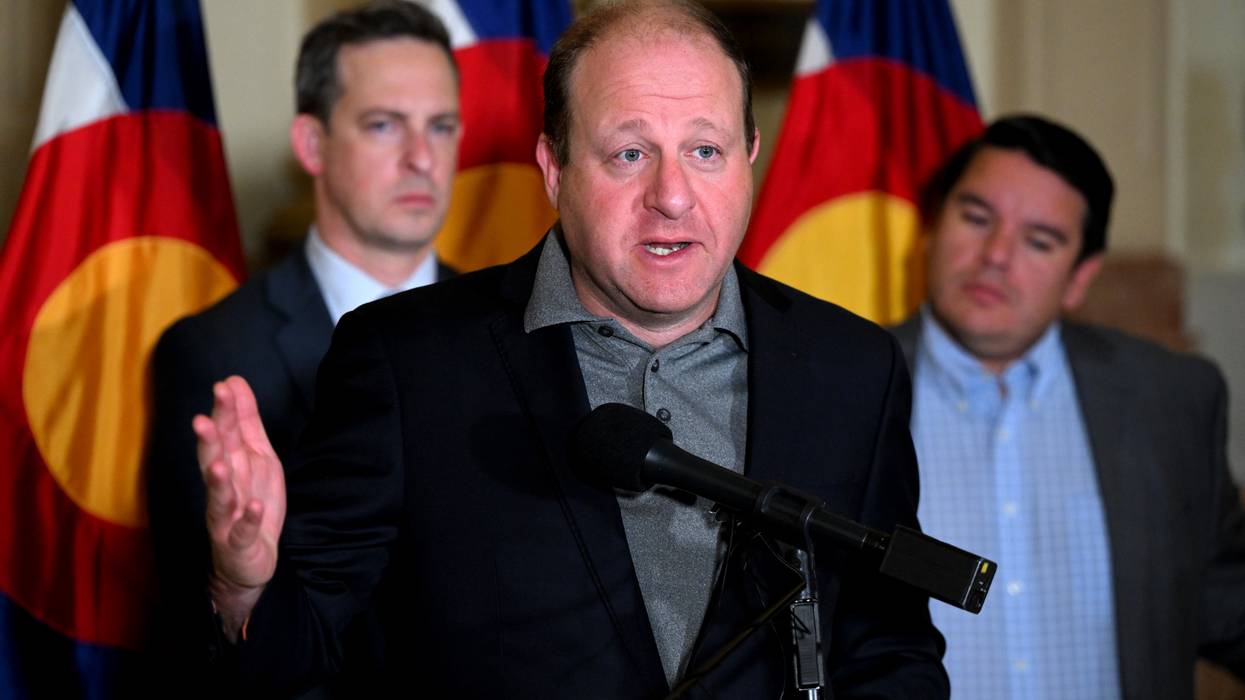
"Reducing her sentence sends the wrong message to those seeking to undermine trust in our elections, and it will do nothing to deter Donald Trump's illegal attacks on Colorado," said US Sen. John Hickenlooper.
Top Colorado Democrats and democracy advocates were among those expressing concern on Friday after Democratic Gov. Jared Polis commuted the sentence of Tina Peters, a former county clerk and 2020 election denier backed by President Donald Trump.
"Today, Gov. Polis delivered a victory to every person urging President Trump to seize control of elections in 2026," said Aly Belknap, executive director of the advocacy group Common Cause Colorado, in a statement. "By commuting Tina Peters' sentence, Gov. Polis dealt a massive blow to Colorado's ability to run its own elections and uphold its own judicial system."
"This decision sends a dangerous message that Colorado will tolerate criminal meddling in election systems and equipment when it is done to make a political statement," Belknap warned. "Authoritarians create martyrs out of people like Tina Peters to fuel outrage, mobilize supporters, and excuse lawbreaking in service of their agenda."
"But authoritarians cannot dismantle democracy on their own. They need powerful people to give them consent. Today, Gov. Polis gave President Trump that consent. This is a shameful day for Colorado," she added. "Gov. Polis' decision undermines election security, weakens accountability, and permanently stains his legacy."
Since returning to office last year, Trump has pardoned his supporters who stormed the US Capitol on January 6, 2021, fought for access to state voter rolls, said that Republicans "ought to nationalize the voting" in direct defiance of the Constitution, generated fear that he'll have federal agents surround polling sites in November, and even repeatedly suggested that the 2026 elections shouldn't be held at all.
Trump also gave Peters a symbolic federal pardon and pressured Polis—who is term-limited and set to leave office next January—to act on her case. The president was not able to free Peters from her nine-year sentence himself because a jury convicted her of state felonies and misdemeanors for her role in breaching election equipment in 2021.
After the governor's decision, which was announced alongside dozens of other pardons and commutations, and sets up Peters to be released from prison on June 1, the president wrote on his Truth Social platform, "FREE TINA!"
Peters also turned to social media on Friday, thanking Polis, apologizing for her "mistakes," and writing that "upon release, I plan to do my best through legal means to support election integrity and, based on my own personal experiences, to elevate the cause of prison reform."
In an interview with The New York Times, Polis denied trying to placate the president by freeing the former clerk. He said that "she committed a crime; she deserves to be a convicted felon," but "she was given an unusually harsh sentence."
As the newspaper detailed:
The governor's decision came after Mr. Trump cut hundreds of millions of dollars in federal money for Colorado, moved to dismantle a leading climate and weather research center in Boulder, rejected disaster relief for rural counties in the state that had been hammered by floods and fire, and vetoed an urgently needed water pipeline for rural Colorado.
In the interview, Mr. Polis pointed out that Mr. Trump had other grievances against Colorado, such as its mail-in voting system, and said he was not making his commutation decision with the expectation that Mr. Trump would undo his actions against Colorado.
"That's not something I ever considered," he said.
Meanwhile, Colorado Secretary of State Jena Griswold declared that "this clemency grant to Tina Peters is an affront to our democracy, the people of Colorado, and election officials across the country. The governor's actions today will validate and embolden the election denial movement, and leave a dark, dangerous imprint on American democracy for years to come."
US Sen. John Hickenlooper (D-Colo.) said that "Tina Peters is guilty as sin and a disgrace to Colorado. She tried to undermine Colorado's free and fair election system. When she was caught red-handed, she was prosecuted by a Republican district attorney and rightfully convicted by a jury of her peers. Reducing her sentence sends the wrong message to those seeking to undermine trust in our elections, and it will do nothing to deter Donald Trump's illegal attacks on Colorado. I strongly disagree with this decision."
Fellow US Senate Democrat Michael Bennet, who is running for governor, was similarly critical, saying: "I vehemently disagree with Gov. Polis' decision to commute Tina Peters' sentence. She broke the law, undermined our elections, and was convicted by a jury of her peers. With Trump continuing to attack Colorado, we must stand strong for our institutions and the rule of law."
David Becker, executive director of the Center for Election Innovation and Research, told Democracy Docket that "it's unfortunate to see the governor of Colorado succumbing to the bullying tactics of election conspiracy theorists. He has thrown state and county election officials, Republicans and Democrats, under the bus after they resisted the corruption Ms. Peters engaged in and withstood attacks for many years as a result."
Even another former Republican clerk—Matt Crane, who's now executive director of the Colorado County Clerks Association—sounded the alarm, arguing that "Tina Peters' actions have made life harder, not only for election officials here in Colorado, but make no mistake, for election officials all across the country. Her conduct became a rallying point for election conspiracy movements that fueled hostility and distrust towards the very people responsible for administering free and fair elections."
"Rather than standing with public service servants and defending one of our nation’s most cherished rights, the right to vote, Gov. Polis is bending the knee to the same political forces and conspiracy movements that are actively undermining confidence in our democratic institutions," Crane said. "That choice carries consequences far beyond this single case."
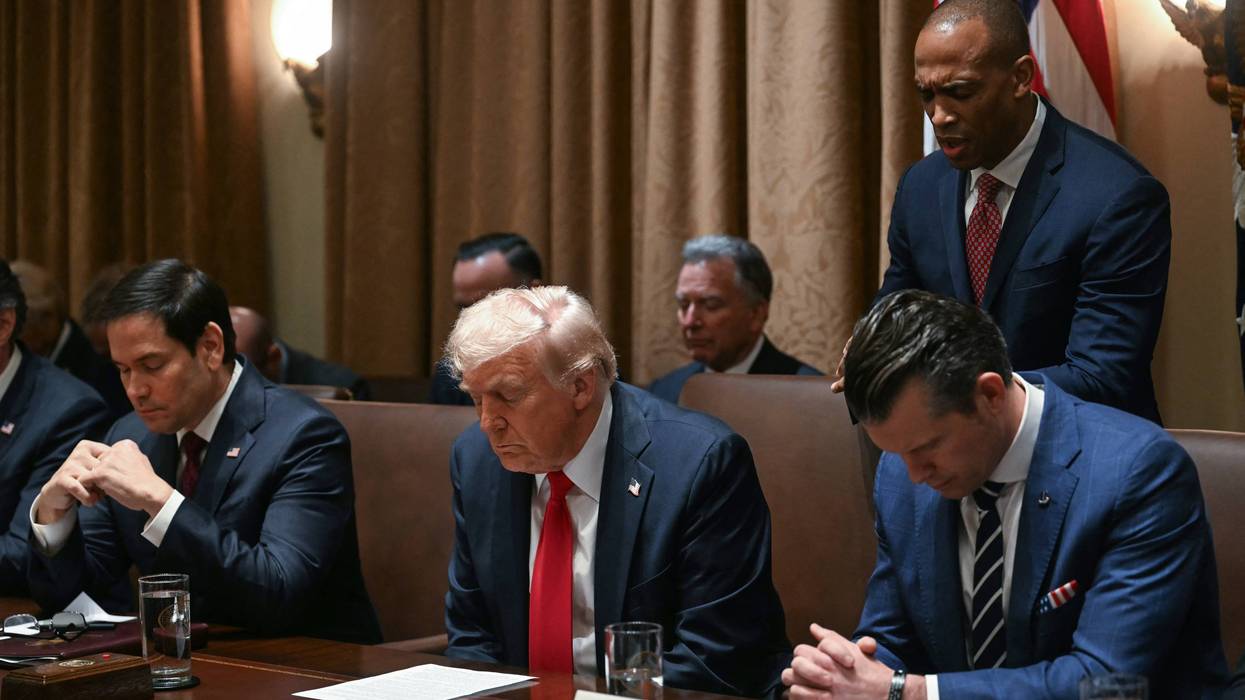
“If President Trump and his allies truly cared about America’s legacy of religious freedom, they would be celebrating church-state separation as the unique American invention that has allowed religious diversity to flourish."
An all-day prayer event scheduled for Sunday on the National Mall is set to feature evangelical Protestant leaders as well as top White House and Republican Party officials as speakers, and is being promoted as a celebration of "thanksgiving" as well as an opportunity for participants to learn about the founding of the nation as the 250th anniversary of its independence approaches.
In reality, said Rachel Laser, president and CEO of Americans United for Separation of Church and State, the "National Jubilee of Prayer, Praise, and Thanksgiving" appears to be a "Jubilee of Christian Nationalism"—with evangelical Christians making up three-quarters of the scheduled speakers, despite the fact that they account for just a quarter of Americans overall.
“If President Trump and his allies truly cared about America’s legacy of religious freedom, they would be celebrating church-state separation as the unique American invention that has allowed religious diversity to flourish in our country," said Laser. "Instead, they continue to threaten this foundational principle by advancing a Christian nationalist crusade to impose one narrow version of Christianity on all Americans."
The event, which is partly funded by taxpayer dollars earmarked for the nation's 250th anniversary, will feature Christian musical performers organized around three "pillars" that are labeled as "miracles" a Christian God bestowed on America, “personal testimonies of God’s healing,” and a "unified moment of rededication."
At a webinar last month, Rev. Paula White-Cain, who serves as a faith adviser to the White House, said the event is "really truly rededicating the country to God.”
The idea that the founders of the United States intended the country to be a Christian one has long been a fixation of evangelical Christian leaders, despite the lack of evidence for such a claim.
“Look at the document," Princeton University history professor Kevin Kruse told The Washington Post, referring to the Constitution. "The only rules they wrote about religion were ones that keep religion at arm’s length. No establishment, no limits on free exercise, no religious test for office... There’s a difference between saying America is a nation with many Christians in it and that America is a nation dedicated to Christianity and defined by it."
Robert Jones, president of the Public Religion Research Institute, told the Post that about a third of Americans currently report that they have no religious affiliation, making the US more religiously diverse than it's ever been.
“We proudly celebrate 250 years of American independence from kings who ruled over both church and state," said Laser. "For 250 years, America has been marching toward the promise of a country where all people can be free to live as themselves and believe as they choose, as long as they don’t harm others. Christian nationalists threaten that promise by undermining church-state separation, a pillar of our democracy."
The jubilee, which will also feature an 18-wheeler "Freedom Truck" featuring educational content made by the right-wing group PragerU and the Christian school Hillsdale College, comes after numerous displays of religiosity from the Trump administration.
Even many of the president's supporters on the Christian right were aghast at an artificial intelligence-generated image he posted last month on social media, appearing to depict him as a Christ figure. Defense Secretary Pete Hegseth, who is set to speak at the jubilee, has spoken about the US-Israeli war on Iran as Christian crusade and has hosted evangelical worship services at the Pentagon, while Agriculture Secretary Brooke Rollins wrote, "He is Risen indeed!" in an Easter email to federal employees that recounted the biblical story of the resurrection.
Robert Weissman, co-president of government watchdog Public Citizen, noted that the corporate sponsors of Freedom 250, the public-private partnership that's organizing the 250th anniversary, "may want to curry favor with the Trump administration."
The sponsors, including John Deere, Oracle, and Lockheed Martin, "should be forced to answer whether they support the extreme agenda they are celebrating," he said.
“This outrageous event makes a mockery of a core constitutional tenet of American life, the separation of church and state, essentially promoting a particular flavor of white evangelical protestantism as state-sponsored religion,” said Weissman. “This self-proclaimed day of thanksgiving torpedoes the best of American traditions—inclusivity and diversity—and has no place being connected to the US government."