SUBSCRIBE TO OUR FREE NEWSLETTER
Daily news & progressive opinion—funded by the people, not the corporations—delivered straight to your inbox.
5
#000000
#FFFFFF
To donate by check, phone, or other method, see our More Ways to Give page.
Daily news & progressive opinion—funded by the people, not the corporations—delivered straight to your inbox.
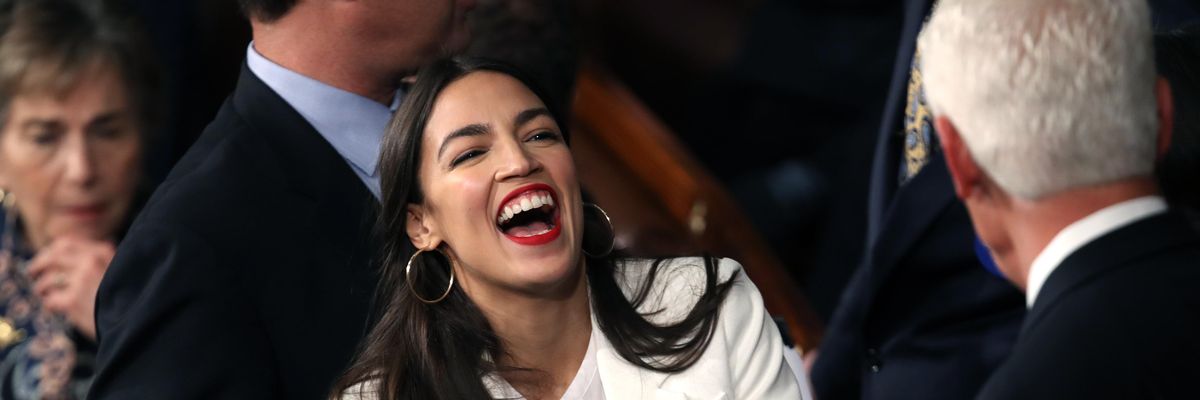
Rep. Alexandria Ocasio-Cortez (D-NY) talks to fellow members of Congress during the first session of the 116th Congress at the U.S. Capitol January 03, 2019 in Washington, DC. (Photo: Win McNamee/Getty Images)
As many historians, economists, and informed citizens were forced to point out in the wake of the freak-out over a proposal by Rep. Alexandria Ocasio-Cortez to raise the current tax rate on the very wealthiest Americans to 70 percent, such a rate is not at all unprecedented and higher rates were the norm for a large portion of last century.
And one of the reasons that much higher rates were once very popular was because they were able to generate lots of revenue that was then put to good use. And, since most people are not extremely rich, there was popular support for such progressive taxation.
What Ocasio-Cortez is actually suggesting, said economist and New York Times columnist Paul Krugman, is "what top public finance economists have been saying for some time" and "not at all outlandish."
So while the newly-seat New York Democrat embraced the idea that "radical" ideas might be needed to help pay for essential policies like the Green New Deal or Medicare for All, many of her allies pointed out that there's nothing necessarily radical about much higher tax rates on the rich and powerful.
"The top tax rate was above 90 percent during the 1950s, and while it has slowly descended," noted the Washington Post's Jeff Stein on Saturday, "it remained as high as 50 percent for much of President Ronald Reagan's tenure in the 1980s."
After talking with several economic experts from across the political spectrum, Stein's reporting found that the 70 percent rate--if applied to the top .05 percent of income earners in the U.S. today--could generate an estimated $72 billion a year, or $720 over ten years. From the reporting:
This $720 billion in a decade is not nearly enough to fund Medicare for all, which has been estimated to increase government outlays by about $30 trillion over a decade (while also zeroing out premiums and deductibles paid by Americans).
Still, it could fund a number of other measures. It could come close to funding the entirety of Sanders's free college tuition plan ($800 billion), fund President Barack Obama's plan to get close to universal prekindergarten ($75 billion over a decade), forgive more than half the student debt in America ($1.4 trillion), cover Democratic leaders' plan for boosting teacher pay and school funding ($100 billion), or come close to funding a $1 trillion infrastructure plan.
As Stein details in his reporting, as you increase the top rate or broaden the number of people you include in that upper-most bracket, of course the revenue rises as well. Using different scenarios, he explains that "a 1 percent wealth tax on the wealthiest 1 percent of households above $10 million could raise about $200 billion a year, or $2 trillion over 10 years." Separately, "a 0.5 percent wealth tax on the top 1 percent could raise at most $3 trillion over 10 years."
Edward Wolff, a tax expert at New York University, put it this way to the Post: "You can get a hell of a lot of a money from taxing the 1 percent."
In his column on the subject of Ocasio-Cortez's comments, New York Magazine's Eric Levitz called the proposal "a moderate, evidence-based policy." He wrote:
it would not be extreme in its redistributive implications, relative to our country's past tax practices, or to other nations' current ones. And a significant number of highly respected economists have endorsed top tax rates roughly as high as the one floated by the congresswoman, while [French economist Thomas] Piketty has advocated for an 80 percent top rate.
Meanwhile, in terms of public opinion, Ocasio-Cortez's view on tax policy for the rich is much more mainstream than Susan Collins's.
According to Krugman, while the GOP continue to claim the lower marginal tax rates on the wealthy help the economy, that claim has "no basis in research or in evidence." Meanwhile, he noted in a tweeted, the economic growth rate has declined alongside the falling tax rates on high-income earners:
"So even as [Republicans] dunk on AOC as stupid or ignorant," Krugman concluded, "she's talking sense based on reputable economic research, while the whole GOP is talking nonsense from charlatans and cranks."
Dear Common Dreams reader, It’s been nearly 30 years since I co-founded Common Dreams with my late wife, Lina Newhouser. We had the radical notion that journalism should serve the public good, not corporate profits. It was clear to us from the outset what it would take to build such a project. No paid advertisements. No corporate sponsors. No millionaire publisher telling us what to think or do. Many people said we wouldn't last a year, but we proved those doubters wrong. Together with a tremendous team of journalists and dedicated staff, we built an independent media outlet free from the constraints of profits and corporate control. Our mission has always been simple: To inform. To inspire. To ignite change for the common good. Building Common Dreams was not easy. Our survival was never guaranteed. When you take on the most powerful forces—Wall Street greed, fossil fuel industry destruction, Big Tech lobbyists, and uber-rich oligarchs who have spent billions upon billions rigging the economy and democracy in their favor—the only bulwark you have is supporters who believe in your work. But here’s the urgent message from me today. It's never been this bad out there. And it's never been this hard to keep us going. At the very moment Common Dreams is most needed, the threats we face are intensifying. We need your support now more than ever. We don't accept corporate advertising and never will. We don't have a paywall because we don't think people should be blocked from critical news based on their ability to pay. Everything we do is funded by the donations of readers like you. When everyone does the little they can afford, we are strong. But if that support retreats or dries up, so do we. Will you donate now to make sure Common Dreams not only survives but thrives? —Craig Brown, Co-founder |
As many historians, economists, and informed citizens were forced to point out in the wake of the freak-out over a proposal by Rep. Alexandria Ocasio-Cortez to raise the current tax rate on the very wealthiest Americans to 70 percent, such a rate is not at all unprecedented and higher rates were the norm for a large portion of last century.
And one of the reasons that much higher rates were once very popular was because they were able to generate lots of revenue that was then put to good use. And, since most people are not extremely rich, there was popular support for such progressive taxation.
What Ocasio-Cortez is actually suggesting, said economist and New York Times columnist Paul Krugman, is "what top public finance economists have been saying for some time" and "not at all outlandish."
So while the newly-seat New York Democrat embraced the idea that "radical" ideas might be needed to help pay for essential policies like the Green New Deal or Medicare for All, many of her allies pointed out that there's nothing necessarily radical about much higher tax rates on the rich and powerful.
"The top tax rate was above 90 percent during the 1950s, and while it has slowly descended," noted the Washington Post's Jeff Stein on Saturday, "it remained as high as 50 percent for much of President Ronald Reagan's tenure in the 1980s."
After talking with several economic experts from across the political spectrum, Stein's reporting found that the 70 percent rate--if applied to the top .05 percent of income earners in the U.S. today--could generate an estimated $72 billion a year, or $720 over ten years. From the reporting:
This $720 billion in a decade is not nearly enough to fund Medicare for all, which has been estimated to increase government outlays by about $30 trillion over a decade (while also zeroing out premiums and deductibles paid by Americans).
Still, it could fund a number of other measures. It could come close to funding the entirety of Sanders's free college tuition plan ($800 billion), fund President Barack Obama's plan to get close to universal prekindergarten ($75 billion over a decade), forgive more than half the student debt in America ($1.4 trillion), cover Democratic leaders' plan for boosting teacher pay and school funding ($100 billion), or come close to funding a $1 trillion infrastructure plan.
As Stein details in his reporting, as you increase the top rate or broaden the number of people you include in that upper-most bracket, of course the revenue rises as well. Using different scenarios, he explains that "a 1 percent wealth tax on the wealthiest 1 percent of households above $10 million could raise about $200 billion a year, or $2 trillion over 10 years." Separately, "a 0.5 percent wealth tax on the top 1 percent could raise at most $3 trillion over 10 years."
Edward Wolff, a tax expert at New York University, put it this way to the Post: "You can get a hell of a lot of a money from taxing the 1 percent."
In his column on the subject of Ocasio-Cortez's comments, New York Magazine's Eric Levitz called the proposal "a moderate, evidence-based policy." He wrote:
it would not be extreme in its redistributive implications, relative to our country's past tax practices, or to other nations' current ones. And a significant number of highly respected economists have endorsed top tax rates roughly as high as the one floated by the congresswoman, while [French economist Thomas] Piketty has advocated for an 80 percent top rate.
Meanwhile, in terms of public opinion, Ocasio-Cortez's view on tax policy for the rich is much more mainstream than Susan Collins's.
According to Krugman, while the GOP continue to claim the lower marginal tax rates on the wealthy help the economy, that claim has "no basis in research or in evidence." Meanwhile, he noted in a tweeted, the economic growth rate has declined alongside the falling tax rates on high-income earners:
"So even as [Republicans] dunk on AOC as stupid or ignorant," Krugman concluded, "she's talking sense based on reputable economic research, while the whole GOP is talking nonsense from charlatans and cranks."
As many historians, economists, and informed citizens were forced to point out in the wake of the freak-out over a proposal by Rep. Alexandria Ocasio-Cortez to raise the current tax rate on the very wealthiest Americans to 70 percent, such a rate is not at all unprecedented and higher rates were the norm for a large portion of last century.
And one of the reasons that much higher rates were once very popular was because they were able to generate lots of revenue that was then put to good use. And, since most people are not extremely rich, there was popular support for such progressive taxation.
What Ocasio-Cortez is actually suggesting, said economist and New York Times columnist Paul Krugman, is "what top public finance economists have been saying for some time" and "not at all outlandish."
So while the newly-seat New York Democrat embraced the idea that "radical" ideas might be needed to help pay for essential policies like the Green New Deal or Medicare for All, many of her allies pointed out that there's nothing necessarily radical about much higher tax rates on the rich and powerful.
"The top tax rate was above 90 percent during the 1950s, and while it has slowly descended," noted the Washington Post's Jeff Stein on Saturday, "it remained as high as 50 percent for much of President Ronald Reagan's tenure in the 1980s."
After talking with several economic experts from across the political spectrum, Stein's reporting found that the 70 percent rate--if applied to the top .05 percent of income earners in the U.S. today--could generate an estimated $72 billion a year, or $720 over ten years. From the reporting:
This $720 billion in a decade is not nearly enough to fund Medicare for all, which has been estimated to increase government outlays by about $30 trillion over a decade (while also zeroing out premiums and deductibles paid by Americans).
Still, it could fund a number of other measures. It could come close to funding the entirety of Sanders's free college tuition plan ($800 billion), fund President Barack Obama's plan to get close to universal prekindergarten ($75 billion over a decade), forgive more than half the student debt in America ($1.4 trillion), cover Democratic leaders' plan for boosting teacher pay and school funding ($100 billion), or come close to funding a $1 trillion infrastructure plan.
As Stein details in his reporting, as you increase the top rate or broaden the number of people you include in that upper-most bracket, of course the revenue rises as well. Using different scenarios, he explains that "a 1 percent wealth tax on the wealthiest 1 percent of households above $10 million could raise about $200 billion a year, or $2 trillion over 10 years." Separately, "a 0.5 percent wealth tax on the top 1 percent could raise at most $3 trillion over 10 years."
Edward Wolff, a tax expert at New York University, put it this way to the Post: "You can get a hell of a lot of a money from taxing the 1 percent."
In his column on the subject of Ocasio-Cortez's comments, New York Magazine's Eric Levitz called the proposal "a moderate, evidence-based policy." He wrote:
it would not be extreme in its redistributive implications, relative to our country's past tax practices, or to other nations' current ones. And a significant number of highly respected economists have endorsed top tax rates roughly as high as the one floated by the congresswoman, while [French economist Thomas] Piketty has advocated for an 80 percent top rate.
Meanwhile, in terms of public opinion, Ocasio-Cortez's view on tax policy for the rich is much more mainstream than Susan Collins's.
According to Krugman, while the GOP continue to claim the lower marginal tax rates on the wealthy help the economy, that claim has "no basis in research or in evidence." Meanwhile, he noted in a tweeted, the economic growth rate has declined alongside the falling tax rates on high-income earners:
"So even as [Republicans] dunk on AOC as stupid or ignorant," Krugman concluded, "she's talking sense based on reputable economic research, while the whole GOP is talking nonsense from charlatans and cranks."