

SUBSCRIBE TO OUR FREE NEWSLETTER
Daily news & progressive opinion—funded by the people, not the corporations—delivered straight to your inbox.
5
#000000
#FFFFFF
To donate by check, phone, or other method, see our More Ways to Give page.
Daily news & progressive opinion—funded by the people, not the corporations—delivered straight to your inbox.
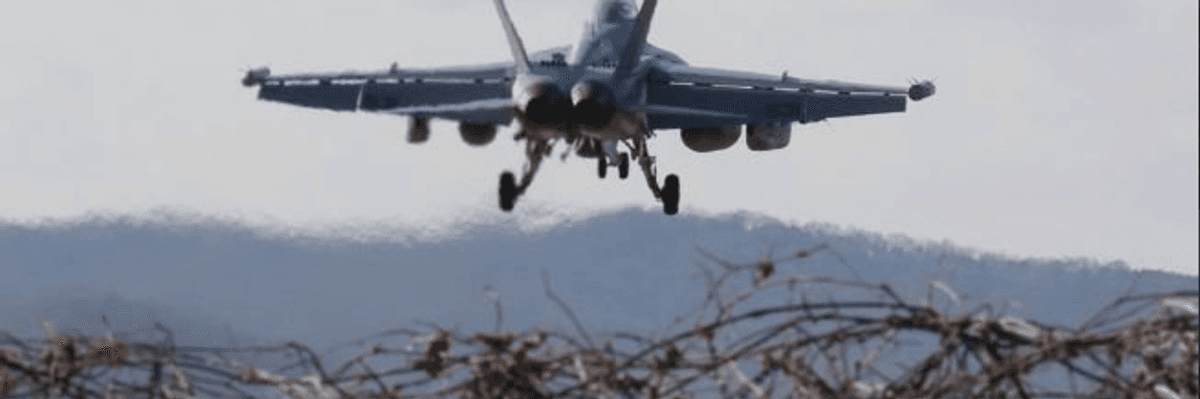
The U.S. and South Korea began military drills this week, days after North Korea ran its latest missile test. The war games were seen by Pyongyang as a new provocation. (Photo: @TPM/Twitter)
The North Korean government called the latest military drills by the U.S. and South Korea a "grave provocation" on Monday, adding to regional and global fears that President Donald Trump's aggressive actions at a time of heightened tensions could endanger civilian lives.
The U.S. Air Force, Navy, and Marines are participating in war games involving more than 200 American planes and 12,000 military personnel this week, days after North Korea tested its most powerful intercontinental ballistic missile (ICBM) to date.
In commentary published in North Korea's state-run newspaper Rodung Sinmun on Sunday, the government of Kim Jong-un warned that the drills would bring tensions "to the brink of nuclear war."
In a separate statement, they said "insane President Trump is running wild," and added, "The U.S. and South Korean puppet warmongers would be well advised to bear in mind that their DPRK-targeted military drill will be as foolish as an act precipitating their self-destruction."
North Korea offered a "dual suspension" deal earlier this year, saying it would freeze its nuclear development in exchange for an end to military drills by the U.S. and South Korea, a possibility South Korea, China, and several foreign policy experts supported but which the Trump administration, backed by Secretary of State Rex Tillerson rejected.
"It is regrettable that all parties did not grasp the window of opportunity China had previously appealed for," said Chinese Foreign Minister Wang Yi as the military exercises began.
China has also expressed doubts about the increasingly severe sanctions the U.S. has proposed for North Korea. The sanctions have impacted the isolated country's coal exports and other industries, limiting its trade capacity and leading to concerns about humanitarian impacts.
"China has a bottom line: 'Don't affect the life of the North Korean people, on humanitarian principles,'" Song Xiaojun, a former Chinese government officer, told the Washington Post last week after Trump announced plans for new sanctions.
"Measures that don't abide by or are outside the U.N. Security Council resolutions lack basis in international law and damage the rights of United Nations members," Wang said of imposing harsher sanctions.
In light of the renewed threats from North Korea, Sen. Lindsey Graham (R-S.C.) called on the Pentagon to bring home the families of more than 28,000 U.S. military personnel who are stationed in South Korea, to remove family members' from harm's way if North Korea takes military action.
The heightened concerns echo those of anti-nuclear advocates that have warned against further escalation of tensions between Washington and Pyongyang. Pope Francis in recent weeks has advocated for serious consideration of abolishing all nuclear weapons, as a U.N. treaty signed by 53 countries put forth last summer. The treaty was not signed by the U.S. or any other nations with nuclear arsenals.
Over the weekend, Pope Francis told reporters that the possession of nuclear weapons by any nation, including the U.S., is "irrational," saying, "We're at the limit of licitly having and using nuclear arms. Why? Because today, such sophisticated nuclear arsenals risk destroying humanity or at least a great part of it."
Dear Common Dreams reader, It’s been nearly 30 years since I co-founded Common Dreams with my late wife, Lina Newhouser. We had the radical notion that journalism should serve the public good, not corporate profits. It was clear to us from the outset what it would take to build such a project. No paid advertisements. No corporate sponsors. No millionaire publisher telling us what to think or do. Many people said we wouldn't last a year, but we proved those doubters wrong. Together with a tremendous team of journalists and dedicated staff, we built an independent media outlet free from the constraints of profits and corporate control. Our mission has always been simple: To inform. To inspire. To ignite change for the common good. Building Common Dreams was not easy. Our survival was never guaranteed. When you take on the most powerful forces—Wall Street greed, fossil fuel industry destruction, Big Tech lobbyists, and uber-rich oligarchs who have spent billions upon billions rigging the economy and democracy in their favor—the only bulwark you have is supporters who believe in your work. But here’s the urgent message from me today. It's never been this bad out there. And it's never been this hard to keep us going. At the very moment Common Dreams is most needed, the threats we face are intensifying. We need your support now more than ever. We don't accept corporate advertising and never will. We don't have a paywall because we don't think people should be blocked from critical news based on their ability to pay. Everything we do is funded by the donations of readers like you. When everyone does the little they can afford, we are strong. But if that support retreats or dries up, so do we. Will you donate now to make sure Common Dreams not only survives but thrives? —Craig Brown, Co-founder |
The North Korean government called the latest military drills by the U.S. and South Korea a "grave provocation" on Monday, adding to regional and global fears that President Donald Trump's aggressive actions at a time of heightened tensions could endanger civilian lives.
The U.S. Air Force, Navy, and Marines are participating in war games involving more than 200 American planes and 12,000 military personnel this week, days after North Korea tested its most powerful intercontinental ballistic missile (ICBM) to date.
In commentary published in North Korea's state-run newspaper Rodung Sinmun on Sunday, the government of Kim Jong-un warned that the drills would bring tensions "to the brink of nuclear war."
In a separate statement, they said "insane President Trump is running wild," and added, "The U.S. and South Korean puppet warmongers would be well advised to bear in mind that their DPRK-targeted military drill will be as foolish as an act precipitating their self-destruction."
North Korea offered a "dual suspension" deal earlier this year, saying it would freeze its nuclear development in exchange for an end to military drills by the U.S. and South Korea, a possibility South Korea, China, and several foreign policy experts supported but which the Trump administration, backed by Secretary of State Rex Tillerson rejected.
"It is regrettable that all parties did not grasp the window of opportunity China had previously appealed for," said Chinese Foreign Minister Wang Yi as the military exercises began.
China has also expressed doubts about the increasingly severe sanctions the U.S. has proposed for North Korea. The sanctions have impacted the isolated country's coal exports and other industries, limiting its trade capacity and leading to concerns about humanitarian impacts.
"China has a bottom line: 'Don't affect the life of the North Korean people, on humanitarian principles,'" Song Xiaojun, a former Chinese government officer, told the Washington Post last week after Trump announced plans for new sanctions.
"Measures that don't abide by or are outside the U.N. Security Council resolutions lack basis in international law and damage the rights of United Nations members," Wang said of imposing harsher sanctions.
In light of the renewed threats from North Korea, Sen. Lindsey Graham (R-S.C.) called on the Pentagon to bring home the families of more than 28,000 U.S. military personnel who are stationed in South Korea, to remove family members' from harm's way if North Korea takes military action.
The heightened concerns echo those of anti-nuclear advocates that have warned against further escalation of tensions between Washington and Pyongyang. Pope Francis in recent weeks has advocated for serious consideration of abolishing all nuclear weapons, as a U.N. treaty signed by 53 countries put forth last summer. The treaty was not signed by the U.S. or any other nations with nuclear arsenals.
Over the weekend, Pope Francis told reporters that the possession of nuclear weapons by any nation, including the U.S., is "irrational," saying, "We're at the limit of licitly having and using nuclear arms. Why? Because today, such sophisticated nuclear arsenals risk destroying humanity or at least a great part of it."
The North Korean government called the latest military drills by the U.S. and South Korea a "grave provocation" on Monday, adding to regional and global fears that President Donald Trump's aggressive actions at a time of heightened tensions could endanger civilian lives.
The U.S. Air Force, Navy, and Marines are participating in war games involving more than 200 American planes and 12,000 military personnel this week, days after North Korea tested its most powerful intercontinental ballistic missile (ICBM) to date.
In commentary published in North Korea's state-run newspaper Rodung Sinmun on Sunday, the government of Kim Jong-un warned that the drills would bring tensions "to the brink of nuclear war."
In a separate statement, they said "insane President Trump is running wild," and added, "The U.S. and South Korean puppet warmongers would be well advised to bear in mind that their DPRK-targeted military drill will be as foolish as an act precipitating their self-destruction."
North Korea offered a "dual suspension" deal earlier this year, saying it would freeze its nuclear development in exchange for an end to military drills by the U.S. and South Korea, a possibility South Korea, China, and several foreign policy experts supported but which the Trump administration, backed by Secretary of State Rex Tillerson rejected.
"It is regrettable that all parties did not grasp the window of opportunity China had previously appealed for," said Chinese Foreign Minister Wang Yi as the military exercises began.
China has also expressed doubts about the increasingly severe sanctions the U.S. has proposed for North Korea. The sanctions have impacted the isolated country's coal exports and other industries, limiting its trade capacity and leading to concerns about humanitarian impacts.
"China has a bottom line: 'Don't affect the life of the North Korean people, on humanitarian principles,'" Song Xiaojun, a former Chinese government officer, told the Washington Post last week after Trump announced plans for new sanctions.
"Measures that don't abide by or are outside the U.N. Security Council resolutions lack basis in international law and damage the rights of United Nations members," Wang said of imposing harsher sanctions.
In light of the renewed threats from North Korea, Sen. Lindsey Graham (R-S.C.) called on the Pentagon to bring home the families of more than 28,000 U.S. military personnel who are stationed in South Korea, to remove family members' from harm's way if North Korea takes military action.
The heightened concerns echo those of anti-nuclear advocates that have warned against further escalation of tensions between Washington and Pyongyang. Pope Francis in recent weeks has advocated for serious consideration of abolishing all nuclear weapons, as a U.N. treaty signed by 53 countries put forth last summer. The treaty was not signed by the U.S. or any other nations with nuclear arsenals.
Over the weekend, Pope Francis told reporters that the possession of nuclear weapons by any nation, including the U.S., is "irrational," saying, "We're at the limit of licitly having and using nuclear arms. Why? Because today, such sophisticated nuclear arsenals risk destroying humanity or at least a great part of it."

