

As the Trump administration and Republicans in power in Congress set to work destroying environmental regulations, scientists have added urgency to the resistance with a simple new equation that shows the staggering effect human activity has had on the climate.
Their findings? Humans have altered the climate 170 times faster than natural forces. In fact, the equation revealed that industrial societies pack the same climate punch as an asteroid strike.
Professor Will Steffen of the Australian National University and Owen Gaffney of the Stockholm Resilience Centre devised the "Anthropocene equation" and published their findings in The Anthropocene Review Friday.
The equation demonstrates that while natural forces dominated the climate for 4.5 billion years, in only the past six decades, humans have become the main drivers of climate change, as the Guardian notes.
Perhaps the researchers' most frightening conclusion was that at a time when top Trump aides refer to climate activism as a "threat," the equation shows that the actions of industrialized societies during the next several years may impact the planet for millenia to come.
Gaffney explained his and Steffen's findings in an op-ed in New Scientist on Friday:
Homo sapiens now rivals the great forces of nature. Humanity is a prime driver of change of the Earth system. Industrialized societies alter the planet on a scale equivalent to an asteroid impact. This is how the Anthropocene--the proposed new geological period in which human activity profoundly shapes the environment--is often described in soundbites.
But is it possible to formalize such statements mathematically? I think so, and believe doing this creates an unequivocal statement of the risks industrialized societies are taking at a time when action is vital.
Following the maxim of keeping everything as simple as possible, but not simpler, Will Steffen from the Australian National University and I drew up an Anthropocene equation by homing in on the rate of change of Earth's life support system: the atmosphere, oceans, forests and wetlands, waterways and ice sheets and fabulous diversity of life.
"For four billion years, the rate of change of the Earth system (E) has been a complex function of astronomical (A) and geophysical (G) forces plus internal dynamics (I): Earth's orbit around the sun, gravitational interactions with other planets, the sun's heat output, colliding continents, volcanoes and evolution, among others," Gaffney added.
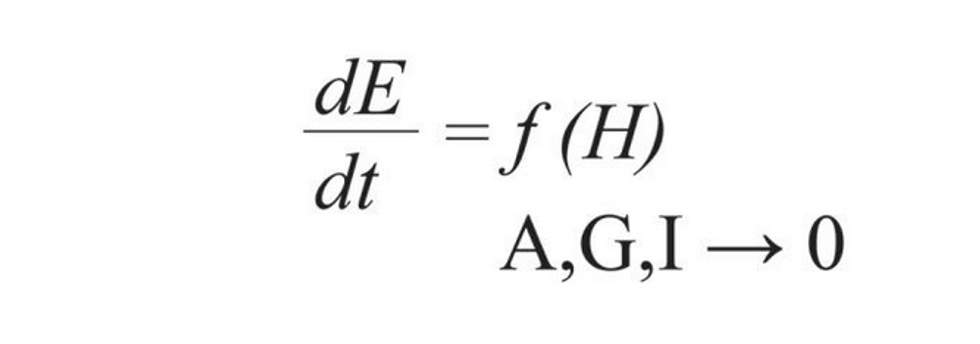
The equation warns of huge risks for human society, Gaffney argued, and that warning comes at a time when the U.S. government seems most prepared to ignore those risks entirely.
As author and journalist Cynthia Barnett observed in the Los Angeles Times: "Regardless of alternative facts, fake news or scientific censorship, nature tells the truth."
"While the rate of change of the Earth system needs to drop to zero as soon as possible, the next few years may determine the trajectory for millennia," wrote Gaffney. "Yet the dominant neoliberal economic systems still assume Holocene-like boundary conditions--endless resources on an infinite planet. Instead, we need 'biosphere positive' Anthropocene economics, where economic development stores carbon not releases it, enhances biodiversity not destroys it and purifies waters and soils not pollutes them."
"While it would seem imprudent to ignore the huge body of evidence pointing to profound risks, it comes at a challenging time geopolitically," Gaffney continued, "when both fact-based world views and even international cooperation are questioned. Nowhere has this been clearer than in the U.S. in recent weeks."
As the Trump administration and Republicans in power in Congress set to work destroying environmental regulations, scientists have added urgency to the resistance with a simple new equation that shows the staggering effect human activity has had on the climate.
Their findings? Humans have altered the climate 170 times faster than natural forces. In fact, the equation revealed that industrial societies pack the same climate punch as an asteroid strike.
Professor Will Steffen of the Australian National University and Owen Gaffney of the Stockholm Resilience Centre devised the "Anthropocene equation" and published their findings in The Anthropocene Review Friday.
The equation demonstrates that while natural forces dominated the climate for 4.5 billion years, in only the past six decades, humans have become the main drivers of climate change, as the Guardian notes.
Perhaps the researchers' most frightening conclusion was that at a time when top Trump aides refer to climate activism as a "threat," the equation shows that the actions of industrialized societies during the next several years may impact the planet for millenia to come.
Gaffney explained his and Steffen's findings in an op-ed in New Scientist on Friday:
Homo sapiens now rivals the great forces of nature. Humanity is a prime driver of change of the Earth system. Industrialized societies alter the planet on a scale equivalent to an asteroid impact. This is how the Anthropocene--the proposed new geological period in which human activity profoundly shapes the environment--is often described in soundbites.
But is it possible to formalize such statements mathematically? I think so, and believe doing this creates an unequivocal statement of the risks industrialized societies are taking at a time when action is vital.
Following the maxim of keeping everything as simple as possible, but not simpler, Will Steffen from the Australian National University and I drew up an Anthropocene equation by homing in on the rate of change of Earth's life support system: the atmosphere, oceans, forests and wetlands, waterways and ice sheets and fabulous diversity of life.
"For four billion years, the rate of change of the Earth system (E) has been a complex function of astronomical (A) and geophysical (G) forces plus internal dynamics (I): Earth's orbit around the sun, gravitational interactions with other planets, the sun's heat output, colliding continents, volcanoes and evolution, among others," Gaffney added.
The equation warns of huge risks for human society, Gaffney argued, and that warning comes at a time when the U.S. government seems most prepared to ignore those risks entirely.
As author and journalist Cynthia Barnett observed in the Los Angeles Times: "Regardless of alternative facts, fake news or scientific censorship, nature tells the truth."
"While the rate of change of the Earth system needs to drop to zero as soon as possible, the next few years may determine the trajectory for millennia," wrote Gaffney. "Yet the dominant neoliberal economic systems still assume Holocene-like boundary conditions--endless resources on an infinite planet. Instead, we need 'biosphere positive' Anthropocene economics, where economic development stores carbon not releases it, enhances biodiversity not destroys it and purifies waters and soils not pollutes them."
"While it would seem imprudent to ignore the huge body of evidence pointing to profound risks, it comes at a challenging time geopolitically," Gaffney continued, "when both fact-based world views and even international cooperation are questioned. Nowhere has this been clearer than in the U.S. in recent weeks."
As the Trump administration and Republicans in power in Congress set to work destroying environmental regulations, scientists have added urgency to the resistance with a simple new equation that shows the staggering effect human activity has had on the climate.
Their findings? Humans have altered the climate 170 times faster than natural forces. In fact, the equation revealed that industrial societies pack the same climate punch as an asteroid strike.
Professor Will Steffen of the Australian National University and Owen Gaffney of the Stockholm Resilience Centre devised the "Anthropocene equation" and published their findings in The Anthropocene Review Friday.
The equation demonstrates that while natural forces dominated the climate for 4.5 billion years, in only the past six decades, humans have become the main drivers of climate change, as the Guardian notes.
Perhaps the researchers' most frightening conclusion was that at a time when top Trump aides refer to climate activism as a "threat," the equation shows that the actions of industrialized societies during the next several years may impact the planet for millenia to come.
Gaffney explained his and Steffen's findings in an op-ed in New Scientist on Friday:
Homo sapiens now rivals the great forces of nature. Humanity is a prime driver of change of the Earth system. Industrialized societies alter the planet on a scale equivalent to an asteroid impact. This is how the Anthropocene--the proposed new geological period in which human activity profoundly shapes the environment--is often described in soundbites.
But is it possible to formalize such statements mathematically? I think so, and believe doing this creates an unequivocal statement of the risks industrialized societies are taking at a time when action is vital.
Following the maxim of keeping everything as simple as possible, but not simpler, Will Steffen from the Australian National University and I drew up an Anthropocene equation by homing in on the rate of change of Earth's life support system: the atmosphere, oceans, forests and wetlands, waterways and ice sheets and fabulous diversity of life.
"For four billion years, the rate of change of the Earth system (E) has been a complex function of astronomical (A) and geophysical (G) forces plus internal dynamics (I): Earth's orbit around the sun, gravitational interactions with other planets, the sun's heat output, colliding continents, volcanoes and evolution, among others," Gaffney added.
The equation warns of huge risks for human society, Gaffney argued, and that warning comes at a time when the U.S. government seems most prepared to ignore those risks entirely.
As author and journalist Cynthia Barnett observed in the Los Angeles Times: "Regardless of alternative facts, fake news or scientific censorship, nature tells the truth."
"While the rate of change of the Earth system needs to drop to zero as soon as possible, the next few years may determine the trajectory for millennia," wrote Gaffney. "Yet the dominant neoliberal economic systems still assume Holocene-like boundary conditions--endless resources on an infinite planet. Instead, we need 'biosphere positive' Anthropocene economics, where economic development stores carbon not releases it, enhances biodiversity not destroys it and purifies waters and soils not pollutes them."
"While it would seem imprudent to ignore the huge body of evidence pointing to profound risks, it comes at a challenging time geopolitically," Gaffney continued, "when both fact-based world views and even international cooperation are questioned. Nowhere has this been clearer than in the U.S. in recent weeks."