SUBSCRIBE TO OUR FREE NEWSLETTER
Daily news & progressive opinion—funded by the people, not the corporations—delivered straight to your inbox.
5
#000000
#FFFFFF
To donate by check, phone, or other method, see our More Ways to Give page.
Daily news & progressive opinion—funded by the people, not the corporations—delivered straight to your inbox.
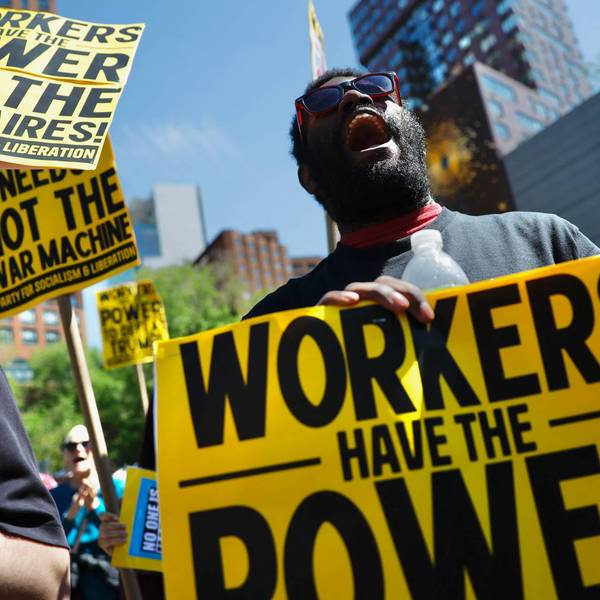
A nationwide day of action and disruption is set to take place on Tuesday, as workers from around the country and across industries are set to take part in strikes to show their refusal to back down in the face of an incoming rightwing political agenda.
The actions, organized by the Fight for $15 collective, will see airport baggage handlers, Uber drivers, fast-food cooks, cashiers, hospital workers, and others strike to disrupt the U.S. service economy. It marks the first time that Uber drivers will be joining in a Fight for $15 action, showing that the labor collective is growing, with gig workers protesting side by side with more traditional labor.
Protests are scheduled at 20 major airports and outside McDonald's franchises throughout the country to "underscore that any efforts to block wage increases, gut workers' rights or healthcare, deport immigrants, or support racism or racist policies, will be met with unrelenting opposition by workers in the Fight for $15," the organization said Monday.
In addition to showing solidarity with immigrants, people of color, and workers nationwide, the actions will also take on Uber, a central figure in critiques of the U.S. "gig economy"--which many say exploits workers under the guise of offering them flexibility and autonomy.
"Workers in the Fight for $15 have created a powerful movement that boldly proclaims everyone who puts in a hard day's work should receive a fair day's pay," said Adam Shahim, a driver from Pittsburgh, Calif., who says he struggles to keep up with his bills despite driving for Uber 40 hours a week. "I'd like a fair day's pay for my hard work, and so I'm joining with the fast-food, airport, home care, child care, and higher education workers who are leading the way and showing the country how to build an economy that works for everyone, not just the few at the top."
Fight for $15 has helped make critical gains for workers since the movement launched four years ago. Striking workers have won minimum wage increases for 22 million people throughout the country.
"When I walked off the job November 29, 2012, there were 200 of us and everyone said we were dreaming," said Naquasia LeGrand, a McDonald's worker from North Carolina who took part in the movement's first strike in New York City. "It turns out a lot of people had that same dream. We are now tens of thousands, across industries. We've won raises for 22 million workers and today we're more powerful than ever with Uber drivers joining us."
Dear Common Dreams reader, It’s been nearly 30 years since I co-founded Common Dreams with my late wife, Lina Newhouser. We had the radical notion that journalism should serve the public good, not corporate profits. It was clear to us from the outset what it would take to build such a project. No paid advertisements. No corporate sponsors. No millionaire publisher telling us what to think or do. Many people said we wouldn't last a year, but we proved those doubters wrong. Together with a tremendous team of journalists and dedicated staff, we built an independent media outlet free from the constraints of profits and corporate control. Our mission has always been simple: To inform. To inspire. To ignite change for the common good. Building Common Dreams was not easy. Our survival was never guaranteed. When you take on the most powerful forces—Wall Street greed, fossil fuel industry destruction, Big Tech lobbyists, and uber-rich oligarchs who have spent billions upon billions rigging the economy and democracy in their favor—the only bulwark you have is supporters who believe in your work. But here’s the urgent message from me today. It's never been this bad out there. And it's never been this hard to keep us going. At the very moment Common Dreams is most needed, the threats we face are intensifying. We need your support now more than ever. We don't accept corporate advertising and never will. We don't have a paywall because we don't think people should be blocked from critical news based on their ability to pay. Everything we do is funded by the donations of readers like you. When everyone does the little they can afford, we are strong. But if that support retreats or dries up, so do we. Will you donate now to make sure Common Dreams not only survives but thrives? —Craig Brown, Co-founder |
A nationwide day of action and disruption is set to take place on Tuesday, as workers from around the country and across industries are set to take part in strikes to show their refusal to back down in the face of an incoming rightwing political agenda.
The actions, organized by the Fight for $15 collective, will see airport baggage handlers, Uber drivers, fast-food cooks, cashiers, hospital workers, and others strike to disrupt the U.S. service economy. It marks the first time that Uber drivers will be joining in a Fight for $15 action, showing that the labor collective is growing, with gig workers protesting side by side with more traditional labor.
Protests are scheduled at 20 major airports and outside McDonald's franchises throughout the country to "underscore that any efforts to block wage increases, gut workers' rights or healthcare, deport immigrants, or support racism or racist policies, will be met with unrelenting opposition by workers in the Fight for $15," the organization said Monday.
In addition to showing solidarity with immigrants, people of color, and workers nationwide, the actions will also take on Uber, a central figure in critiques of the U.S. "gig economy"--which many say exploits workers under the guise of offering them flexibility and autonomy.
"Workers in the Fight for $15 have created a powerful movement that boldly proclaims everyone who puts in a hard day's work should receive a fair day's pay," said Adam Shahim, a driver from Pittsburgh, Calif., who says he struggles to keep up with his bills despite driving for Uber 40 hours a week. "I'd like a fair day's pay for my hard work, and so I'm joining with the fast-food, airport, home care, child care, and higher education workers who are leading the way and showing the country how to build an economy that works for everyone, not just the few at the top."
Fight for $15 has helped make critical gains for workers since the movement launched four years ago. Striking workers have won minimum wage increases for 22 million people throughout the country.
"When I walked off the job November 29, 2012, there were 200 of us and everyone said we were dreaming," said Naquasia LeGrand, a McDonald's worker from North Carolina who took part in the movement's first strike in New York City. "It turns out a lot of people had that same dream. We are now tens of thousands, across industries. We've won raises for 22 million workers and today we're more powerful than ever with Uber drivers joining us."
A nationwide day of action and disruption is set to take place on Tuesday, as workers from around the country and across industries are set to take part in strikes to show their refusal to back down in the face of an incoming rightwing political agenda.
The actions, organized by the Fight for $15 collective, will see airport baggage handlers, Uber drivers, fast-food cooks, cashiers, hospital workers, and others strike to disrupt the U.S. service economy. It marks the first time that Uber drivers will be joining in a Fight for $15 action, showing that the labor collective is growing, with gig workers protesting side by side with more traditional labor.
Protests are scheduled at 20 major airports and outside McDonald's franchises throughout the country to "underscore that any efforts to block wage increases, gut workers' rights or healthcare, deport immigrants, or support racism or racist policies, will be met with unrelenting opposition by workers in the Fight for $15," the organization said Monday.
In addition to showing solidarity with immigrants, people of color, and workers nationwide, the actions will also take on Uber, a central figure in critiques of the U.S. "gig economy"--which many say exploits workers under the guise of offering them flexibility and autonomy.
"Workers in the Fight for $15 have created a powerful movement that boldly proclaims everyone who puts in a hard day's work should receive a fair day's pay," said Adam Shahim, a driver from Pittsburgh, Calif., who says he struggles to keep up with his bills despite driving for Uber 40 hours a week. "I'd like a fair day's pay for my hard work, and so I'm joining with the fast-food, airport, home care, child care, and higher education workers who are leading the way and showing the country how to build an economy that works for everyone, not just the few at the top."
Fight for $15 has helped make critical gains for workers since the movement launched four years ago. Striking workers have won minimum wage increases for 22 million people throughout the country.
"When I walked off the job November 29, 2012, there were 200 of us and everyone said we were dreaming," said Naquasia LeGrand, a McDonald's worker from North Carolina who took part in the movement's first strike in New York City. "It turns out a lot of people had that same dream. We are now tens of thousands, across industries. We've won raises for 22 million workers and today we're more powerful than ever with Uber drivers joining us."