

SUBSCRIBE TO OUR FREE NEWSLETTER
Daily news & progressive opinion—funded by the people, not the corporations—delivered straight to your inbox.
5
#000000
#FFFFFF
To donate by check, phone, or other method, see our More Ways to Give page.
Describing the fight over the Dakota Access Pipeline (DAPL) as "a national crisis and an international scandal," a coalition of 26 environmental organizations on Monday called on leading banks to stop funding the project.
"Citibank's leading role in financing the pipeline makes it complicit in gross violations of Indigenous and human rights."
--Lindsey Allen, Rainforest Action Network
In an open letter to the Equator Principles Association, a consortium of global banks ostensibly committed to responsible environmental and social practices, the groups say they "have been astonished to learn" that more than a dozen member institutions are involved in a $2.5 billion credit agreement with Dakota Access LLC and Energy Transfer Crude Oil Company LLC to construct the controversial pipeline. Signatories to the letter included Greenpeace, Sierra Club, Friends of the Earth, and Food & Water Watch.
"The world is closely watching how all actors involved will deal with the situation, including the banks that provide financial support to the project," the letter reads. "Given the presumed Indigenous rights commitments of [Equator Principles Financial Institutions, or EPFIs], it is for us inexplicable that gross violations of Native land titles, threats to water sources, and the desecration of burial grounds have not been identified early on as reasons for EPFIs to not provide funding for this project. However, this unfortunately fits into a documented and consistent pattern of disrespect of local communities and Indigenous rights by EPFI-backed projects worldwide."
The letter then calls on the association, which holds its annual meeting in London on Monday and Tuesday, to direct its institutions to "take swift action to stop the ongoing violation of the rights of Native Americans."
"This for now requires that all further loan disbursements to the project are put on hold," says the letter, coordinated by Netherlands-based BankTrack, "and that the EPFIs involved demand from the project sponsors an immediate halt to the construction of the pipeline and all associated structures, until all outstanding issues are resolved to the full satisfaction of the Standing Rock Sioux Tribe."
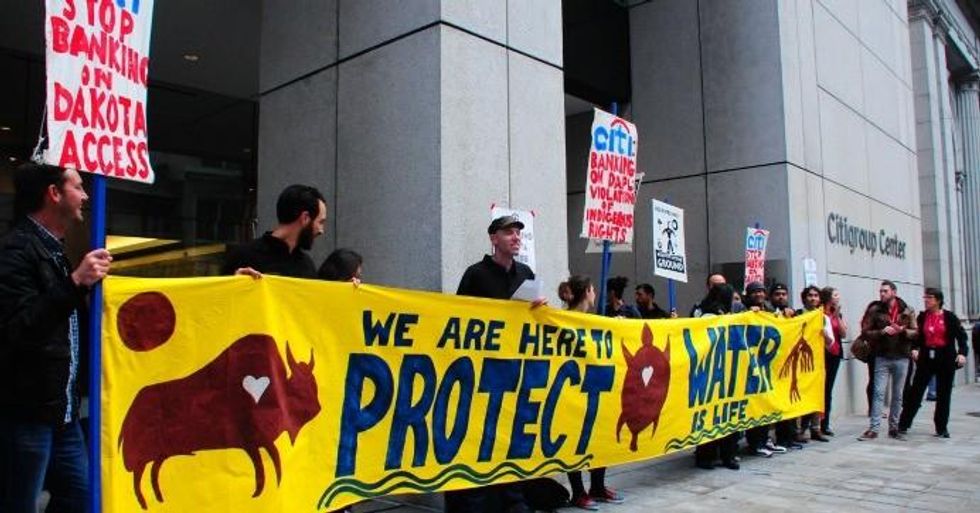
Meanwhile, in a separate statement Monday, Rainforest Action Network--another signatory to the BankTrack letter--zeroed in on Citigroup's DAPL financing in particular, pointing out that the bank's own Statement on Human Rights declares: "Citi seeks to do business with clients who share our values with respect to human rights." Citigroup, which is the agent for the $2.5 billion loan, as well as co-lead arranger, is also a member of the Equator Principles Association.
"It's clear that the Dakota Access pipeline project has violated the sovereignty of the Standing Rock Sioux and their right to determine the future of their lands," said the group's executive director Lindsey Allen. "Citibank's leading role in financing the pipeline makes it complicit in gross violations of Indigenous and human rights. Citi can demonstrate its leadership by responding to the demands made by the Standing Rock Sioux to end support for the Dakota Access pipeline."
The New York Times notes that "[i]n campaigning to reduce the world's carbon emissions, environmentalists have increasingly focused on the financiers behind the fossil fuel industry--highlighting their role in financing coal, oil, and gas projects. It is an expansion of traditional protest efforts, and it has met with some early success."
Indeed, Norwegian bank DNB issued a statement on Sunday saying it "is concerned about how the situation surrounding [DAPL] has developed."
The bank, which is reportedly backing the pipeline with $342.36 million in loans--about 10 percent of the project's costs--said it "will therefore use its position as lender to the project to encourage a more constructive process to find solutions to the conflict that has arisen. If these initiatives do not provide DNB with the necessary comfort, DNB will evaluate its further participation in the financing of the project."
Describing the fight over the Dakota Access Pipeline (DAPL) as "a national crisis and an international scandal," a coalition of 26 environmental organizations on Monday called on leading banks to stop funding the project.
"Citibank's leading role in financing the pipeline makes it complicit in gross violations of Indigenous and human rights."
--Lindsey Allen, Rainforest Action Network
In an open letter to the Equator Principles Association, a consortium of global banks ostensibly committed to responsible environmental and social practices, the groups say they "have been astonished to learn" that more than a dozen member institutions are involved in a $2.5 billion credit agreement with Dakota Access LLC and Energy Transfer Crude Oil Company LLC to construct the controversial pipeline. Signatories to the letter included Greenpeace, Sierra Club, Friends of the Earth, and Food & Water Watch.
"The world is closely watching how all actors involved will deal with the situation, including the banks that provide financial support to the project," the letter reads. "Given the presumed Indigenous rights commitments of [Equator Principles Financial Institutions, or EPFIs], it is for us inexplicable that gross violations of Native land titles, threats to water sources, and the desecration of burial grounds have not been identified early on as reasons for EPFIs to not provide funding for this project. However, this unfortunately fits into a documented and consistent pattern of disrespect of local communities and Indigenous rights by EPFI-backed projects worldwide."
The letter then calls on the association, which holds its annual meeting in London on Monday and Tuesday, to direct its institutions to "take swift action to stop the ongoing violation of the rights of Native Americans."
"This for now requires that all further loan disbursements to the project are put on hold," says the letter, coordinated by Netherlands-based BankTrack, "and that the EPFIs involved demand from the project sponsors an immediate halt to the construction of the pipeline and all associated structures, until all outstanding issues are resolved to the full satisfaction of the Standing Rock Sioux Tribe."
Meanwhile, in a separate statement Monday, Rainforest Action Network--another signatory to the BankTrack letter--zeroed in on Citigroup's DAPL financing in particular, pointing out that the bank's own Statement on Human Rights declares: "Citi seeks to do business with clients who share our values with respect to human rights." Citigroup, which is the agent for the $2.5 billion loan, as well as co-lead arranger, is also a member of the Equator Principles Association.
"It's clear that the Dakota Access pipeline project has violated the sovereignty of the Standing Rock Sioux and their right to determine the future of their lands," said the group's executive director Lindsey Allen. "Citibank's leading role in financing the pipeline makes it complicit in gross violations of Indigenous and human rights. Citi can demonstrate its leadership by responding to the demands made by the Standing Rock Sioux to end support for the Dakota Access pipeline."
The New York Times notes that "[i]n campaigning to reduce the world's carbon emissions, environmentalists have increasingly focused on the financiers behind the fossil fuel industry--highlighting their role in financing coal, oil, and gas projects. It is an expansion of traditional protest efforts, and it has met with some early success."
Indeed, Norwegian bank DNB issued a statement on Sunday saying it "is concerned about how the situation surrounding [DAPL] has developed."
The bank, which is reportedly backing the pipeline with $342.36 million in loans--about 10 percent of the project's costs--said it "will therefore use its position as lender to the project to encourage a more constructive process to find solutions to the conflict that has arisen. If these initiatives do not provide DNB with the necessary comfort, DNB will evaluate its further participation in the financing of the project."
Describing the fight over the Dakota Access Pipeline (DAPL) as "a national crisis and an international scandal," a coalition of 26 environmental organizations on Monday called on leading banks to stop funding the project.
"Citibank's leading role in financing the pipeline makes it complicit in gross violations of Indigenous and human rights."
--Lindsey Allen, Rainforest Action Network
In an open letter to the Equator Principles Association, a consortium of global banks ostensibly committed to responsible environmental and social practices, the groups say they "have been astonished to learn" that more than a dozen member institutions are involved in a $2.5 billion credit agreement with Dakota Access LLC and Energy Transfer Crude Oil Company LLC to construct the controversial pipeline. Signatories to the letter included Greenpeace, Sierra Club, Friends of the Earth, and Food & Water Watch.
"The world is closely watching how all actors involved will deal with the situation, including the banks that provide financial support to the project," the letter reads. "Given the presumed Indigenous rights commitments of [Equator Principles Financial Institutions, or EPFIs], it is for us inexplicable that gross violations of Native land titles, threats to water sources, and the desecration of burial grounds have not been identified early on as reasons for EPFIs to not provide funding for this project. However, this unfortunately fits into a documented and consistent pattern of disrespect of local communities and Indigenous rights by EPFI-backed projects worldwide."
The letter then calls on the association, which holds its annual meeting in London on Monday and Tuesday, to direct its institutions to "take swift action to stop the ongoing violation of the rights of Native Americans."
"This for now requires that all further loan disbursements to the project are put on hold," says the letter, coordinated by Netherlands-based BankTrack, "and that the EPFIs involved demand from the project sponsors an immediate halt to the construction of the pipeline and all associated structures, until all outstanding issues are resolved to the full satisfaction of the Standing Rock Sioux Tribe."
Meanwhile, in a separate statement Monday, Rainforest Action Network--another signatory to the BankTrack letter--zeroed in on Citigroup's DAPL financing in particular, pointing out that the bank's own Statement on Human Rights declares: "Citi seeks to do business with clients who share our values with respect to human rights." Citigroup, which is the agent for the $2.5 billion loan, as well as co-lead arranger, is also a member of the Equator Principles Association.
"It's clear that the Dakota Access pipeline project has violated the sovereignty of the Standing Rock Sioux and their right to determine the future of their lands," said the group's executive director Lindsey Allen. "Citibank's leading role in financing the pipeline makes it complicit in gross violations of Indigenous and human rights. Citi can demonstrate its leadership by responding to the demands made by the Standing Rock Sioux to end support for the Dakota Access pipeline."
The New York Times notes that "[i]n campaigning to reduce the world's carbon emissions, environmentalists have increasingly focused on the financiers behind the fossil fuel industry--highlighting their role in financing coal, oil, and gas projects. It is an expansion of traditional protest efforts, and it has met with some early success."
Indeed, Norwegian bank DNB issued a statement on Sunday saying it "is concerned about how the situation surrounding [DAPL] has developed."
The bank, which is reportedly backing the pipeline with $342.36 million in loans--about 10 percent of the project's costs--said it "will therefore use its position as lender to the project to encourage a more constructive process to find solutions to the conflict that has arisen. If these initiatives do not provide DNB with the necessary comfort, DNB will evaluate its further participation in the financing of the project."

