SUBSCRIBE TO OUR FREE NEWSLETTER
Daily news & progressive opinion—funded by the people, not the corporations—delivered straight to your inbox.
5
#000000
#FFFFFF
To donate by check, phone, or other method, see our More Ways to Give page.
Daily news & progressive opinion—funded by the people, not the corporations—delivered straight to your inbox.
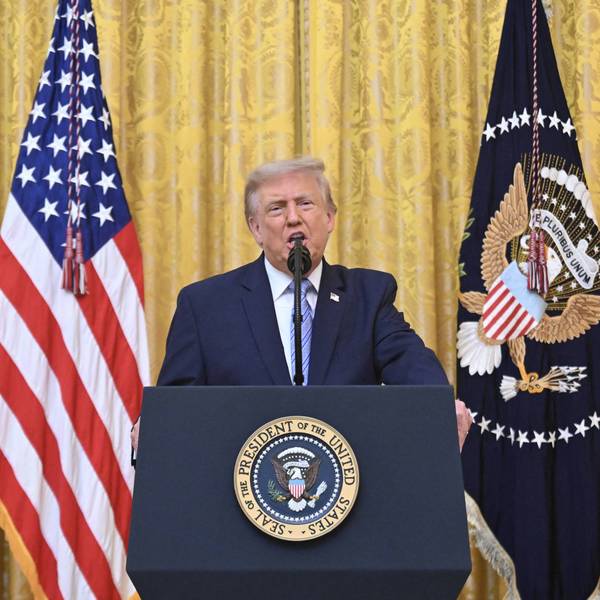
As Republican presidential nominee Donald Trump and some of his top surrogates push a narrative that the U.S. election is "rigged" against him, observers warn that the controversial rhetoric is dangerous and divisive--and possibly self-serving.
Politico wrote Sunday that the real estate mogul "is laying the groundwork to lose on Nov. 8, refuse to concede the election, and teeter the country into an unprecedented crisis of faith in government. Republicans and Democrats, in Washington and beyond, fear that the aftermath of the 2016 election will create a festering infection in the already deep and lasting wound that the campaign is leaving on America."
Amid slipping poll numbers last week, Trump called the presidential election "one big fix" and "one big, ugly lie." He doubled down on his efforts to delegitimize the election outcome in tweets on Sunday and Monday:
As the New York Times reported Sunday:
He made his incendiary claim just hours after his running mate, Indiana Gov. Mike Pence, had tried to play down the Republican nominee's increasingly heated questions about the fairness of the election. Pence said on NBC's "Meet the Press" that he and Trump "will absolutely accept the result of the election."
The governor, in a series of Sunday TV interviews, sought to portray Republican criticism of the electoral process as relating entirely to what he described as unfair media coverage. He was attempting to not only stir conservative partisans but also reassure Republican officials and others nervous about Trump's comments that they were not going outside the boundaries of mainstream American political discourse.
But former New York City mayor and Trump supporter Rudy Giuliani was apparently spreading a different message, telling CNN's Jake Tapper on Sunday: "I'm sorry, dead people generally vote for Democrats rather than Republicans. You want me to [say] that I think the election in Philadelphia and Chicago is going to be fair? I would have to be a moron to say that."
Though pundits, election officials (many of them Republican), and democracy experts alike have downplayed and denounced such claims, they seem to be landing with voters.
A new Politico/Morning Consult poll taken October 13-15 showed (pdf) that a full 81 percent of Trump supporters (and 41 percent of registered voters overall) believe that the 2016 election could be "stolen" from Trump as a result of widespread voter fraud.
This is cause for concern, Kim Lane Scheppele, an election law expert and professor at Princeton, told NBC News. "The problem is his supporters believe this, and if he loses the election and he's already teed up this argument and it could have really massive, serious effects," she said.
Princeton University presidential scholar Julian Zelizer added to the Boston Globe: "If Clinton is elected, as it looks like she will be, they will be convinced she should not be president because the Republican nominee has confirmed their own fears, anxieties, and conspiratorial outlook. It will make governing more difficult."
Indeed, one Trump supporter told the Globe of Clinton: "If she's in office, I hope we can start a coup. She should be in prison or shot. That's how I feel about it. We're going to have a revolution and take them out of office if that's what it takes. There's going to be a lot of bloodshed. But that's what it's going to take...I would do whatever I can for my country."
Meanwhile, reporting by the Financial Times on Monday hinted at how Trump might capitalize on such post-election anger: by launching a Trump television network. His son-in-law Jared Kushner has reportedly contacted "one of the media industry's top dealmakers" about the prospect.
Author and commentator Peter Dreier similarly predicted back in August:
After Trump loses, don't be surprised to see [campaign CEO Stephen] Bannon join forces with Trump and Roger Ailes (the former Fox News guru deposed for engaging in sexual harassment of employees who recently jumped aboard Trump's sinking ship) to create a new right-wing media conglomerate--Trump TV or Trump Media--linking Breitbart News to a new cable network that will almost make Fox News look tame and responsible. Together, Trump, Ailes, and Bannon would run their media empire to advance their common goals: gaining political influence, massaging their massive egos, moving the Republican Party further to the right, attacking Democrats and liberal ideas, and promoting a neo-fascist agenda combining xenophobia, racism, sexism, government-bashing, and anti-immigrant nativism.
Perhaps, then, the election is being "rigged"--just not in the way Trump claims, Jonathan Chait argued at New York magazine on Monday.
"[I]t is hard to confidently analyze any Trump decision--you can't game out his logic if you're not sure what his goal is or if he is even capable of pursuing a goal at all," Chait wrote.
However, he continued: "If you do assume that Trump is acting rationally, then it is very hard to explain his campaign moves as steps in a considered plan to get elected president, and much easier to explain them as steps toward monetizing his audience through a media empire. This theory would explain why Trump handed control of his campaign to a media mogul (Steve Bannon), why he has needlessly attacked fellow members of his party, and why he has risked demoralizing his own voters by repeatedly calling the election rigged. These are logical decisions if his end goal is to wrest the intense loyalty of a large minority of the country away from other conservative organs and center it around a media brand he can control."
Dear Common Dreams reader, It’s been nearly 30 years since I co-founded Common Dreams with my late wife, Lina Newhouser. We had the radical notion that journalism should serve the public good, not corporate profits. It was clear to us from the outset what it would take to build such a project. No paid advertisements. No corporate sponsors. No millionaire publisher telling us what to think or do. Many people said we wouldn't last a year, but we proved those doubters wrong. Together with a tremendous team of journalists and dedicated staff, we built an independent media outlet free from the constraints of profits and corporate control. Our mission has always been simple: To inform. To inspire. To ignite change for the common good. Building Common Dreams was not easy. Our survival was never guaranteed. When you take on the most powerful forces—Wall Street greed, fossil fuel industry destruction, Big Tech lobbyists, and uber-rich oligarchs who have spent billions upon billions rigging the economy and democracy in their favor—the only bulwark you have is supporters who believe in your work. But here’s the urgent message from me today. It's never been this bad out there. And it's never been this hard to keep us going. At the very moment Common Dreams is most needed, the threats we face are intensifying. We need your support now more than ever. We don't accept corporate advertising and never will. We don't have a paywall because we don't think people should be blocked from critical news based on their ability to pay. Everything we do is funded by the donations of readers like you. When everyone does the little they can afford, we are strong. But if that support retreats or dries up, so do we. Will you donate now to make sure Common Dreams not only survives but thrives? —Craig Brown, Co-founder |
As Republican presidential nominee Donald Trump and some of his top surrogates push a narrative that the U.S. election is "rigged" against him, observers warn that the controversial rhetoric is dangerous and divisive--and possibly self-serving.
Politico wrote Sunday that the real estate mogul "is laying the groundwork to lose on Nov. 8, refuse to concede the election, and teeter the country into an unprecedented crisis of faith in government. Republicans and Democrats, in Washington and beyond, fear that the aftermath of the 2016 election will create a festering infection in the already deep and lasting wound that the campaign is leaving on America."
Amid slipping poll numbers last week, Trump called the presidential election "one big fix" and "one big, ugly lie." He doubled down on his efforts to delegitimize the election outcome in tweets on Sunday and Monday:
As the New York Times reported Sunday:
He made his incendiary claim just hours after his running mate, Indiana Gov. Mike Pence, had tried to play down the Republican nominee's increasingly heated questions about the fairness of the election. Pence said on NBC's "Meet the Press" that he and Trump "will absolutely accept the result of the election."
The governor, in a series of Sunday TV interviews, sought to portray Republican criticism of the electoral process as relating entirely to what he described as unfair media coverage. He was attempting to not only stir conservative partisans but also reassure Republican officials and others nervous about Trump's comments that they were not going outside the boundaries of mainstream American political discourse.
But former New York City mayor and Trump supporter Rudy Giuliani was apparently spreading a different message, telling CNN's Jake Tapper on Sunday: "I'm sorry, dead people generally vote for Democrats rather than Republicans. You want me to [say] that I think the election in Philadelphia and Chicago is going to be fair? I would have to be a moron to say that."
Though pundits, election officials (many of them Republican), and democracy experts alike have downplayed and denounced such claims, they seem to be landing with voters.
A new Politico/Morning Consult poll taken October 13-15 showed (pdf) that a full 81 percent of Trump supporters (and 41 percent of registered voters overall) believe that the 2016 election could be "stolen" from Trump as a result of widespread voter fraud.
This is cause for concern, Kim Lane Scheppele, an election law expert and professor at Princeton, told NBC News. "The problem is his supporters believe this, and if he loses the election and he's already teed up this argument and it could have really massive, serious effects," she said.
Princeton University presidential scholar Julian Zelizer added to the Boston Globe: "If Clinton is elected, as it looks like she will be, they will be convinced she should not be president because the Republican nominee has confirmed their own fears, anxieties, and conspiratorial outlook. It will make governing more difficult."
Indeed, one Trump supporter told the Globe of Clinton: "If she's in office, I hope we can start a coup. She should be in prison or shot. That's how I feel about it. We're going to have a revolution and take them out of office if that's what it takes. There's going to be a lot of bloodshed. But that's what it's going to take...I would do whatever I can for my country."
Meanwhile, reporting by the Financial Times on Monday hinted at how Trump might capitalize on such post-election anger: by launching a Trump television network. His son-in-law Jared Kushner has reportedly contacted "one of the media industry's top dealmakers" about the prospect.
Author and commentator Peter Dreier similarly predicted back in August:
After Trump loses, don't be surprised to see [campaign CEO Stephen] Bannon join forces with Trump and Roger Ailes (the former Fox News guru deposed for engaging in sexual harassment of employees who recently jumped aboard Trump's sinking ship) to create a new right-wing media conglomerate--Trump TV or Trump Media--linking Breitbart News to a new cable network that will almost make Fox News look tame and responsible. Together, Trump, Ailes, and Bannon would run their media empire to advance their common goals: gaining political influence, massaging their massive egos, moving the Republican Party further to the right, attacking Democrats and liberal ideas, and promoting a neo-fascist agenda combining xenophobia, racism, sexism, government-bashing, and anti-immigrant nativism.
Perhaps, then, the election is being "rigged"--just not in the way Trump claims, Jonathan Chait argued at New York magazine on Monday.
"[I]t is hard to confidently analyze any Trump decision--you can't game out his logic if you're not sure what his goal is or if he is even capable of pursuing a goal at all," Chait wrote.
However, he continued: "If you do assume that Trump is acting rationally, then it is very hard to explain his campaign moves as steps in a considered plan to get elected president, and much easier to explain them as steps toward monetizing his audience through a media empire. This theory would explain why Trump handed control of his campaign to a media mogul (Steve Bannon), why he has needlessly attacked fellow members of his party, and why he has risked demoralizing his own voters by repeatedly calling the election rigged. These are logical decisions if his end goal is to wrest the intense loyalty of a large minority of the country away from other conservative organs and center it around a media brand he can control."
As Republican presidential nominee Donald Trump and some of his top surrogates push a narrative that the U.S. election is "rigged" against him, observers warn that the controversial rhetoric is dangerous and divisive--and possibly self-serving.
Politico wrote Sunday that the real estate mogul "is laying the groundwork to lose on Nov. 8, refuse to concede the election, and teeter the country into an unprecedented crisis of faith in government. Republicans and Democrats, in Washington and beyond, fear that the aftermath of the 2016 election will create a festering infection in the already deep and lasting wound that the campaign is leaving on America."
Amid slipping poll numbers last week, Trump called the presidential election "one big fix" and "one big, ugly lie." He doubled down on his efforts to delegitimize the election outcome in tweets on Sunday and Monday:
As the New York Times reported Sunday:
He made his incendiary claim just hours after his running mate, Indiana Gov. Mike Pence, had tried to play down the Republican nominee's increasingly heated questions about the fairness of the election. Pence said on NBC's "Meet the Press" that he and Trump "will absolutely accept the result of the election."
The governor, in a series of Sunday TV interviews, sought to portray Republican criticism of the electoral process as relating entirely to what he described as unfair media coverage. He was attempting to not only stir conservative partisans but also reassure Republican officials and others nervous about Trump's comments that they were not going outside the boundaries of mainstream American political discourse.
But former New York City mayor and Trump supporter Rudy Giuliani was apparently spreading a different message, telling CNN's Jake Tapper on Sunday: "I'm sorry, dead people generally vote for Democrats rather than Republicans. You want me to [say] that I think the election in Philadelphia and Chicago is going to be fair? I would have to be a moron to say that."
Though pundits, election officials (many of them Republican), and democracy experts alike have downplayed and denounced such claims, they seem to be landing with voters.
A new Politico/Morning Consult poll taken October 13-15 showed (pdf) that a full 81 percent of Trump supporters (and 41 percent of registered voters overall) believe that the 2016 election could be "stolen" from Trump as a result of widespread voter fraud.
This is cause for concern, Kim Lane Scheppele, an election law expert and professor at Princeton, told NBC News. "The problem is his supporters believe this, and if he loses the election and he's already teed up this argument and it could have really massive, serious effects," she said.
Princeton University presidential scholar Julian Zelizer added to the Boston Globe: "If Clinton is elected, as it looks like she will be, they will be convinced she should not be president because the Republican nominee has confirmed their own fears, anxieties, and conspiratorial outlook. It will make governing more difficult."
Indeed, one Trump supporter told the Globe of Clinton: "If she's in office, I hope we can start a coup. She should be in prison or shot. That's how I feel about it. We're going to have a revolution and take them out of office if that's what it takes. There's going to be a lot of bloodshed. But that's what it's going to take...I would do whatever I can for my country."
Meanwhile, reporting by the Financial Times on Monday hinted at how Trump might capitalize on such post-election anger: by launching a Trump television network. His son-in-law Jared Kushner has reportedly contacted "one of the media industry's top dealmakers" about the prospect.
Author and commentator Peter Dreier similarly predicted back in August:
After Trump loses, don't be surprised to see [campaign CEO Stephen] Bannon join forces with Trump and Roger Ailes (the former Fox News guru deposed for engaging in sexual harassment of employees who recently jumped aboard Trump's sinking ship) to create a new right-wing media conglomerate--Trump TV or Trump Media--linking Breitbart News to a new cable network that will almost make Fox News look tame and responsible. Together, Trump, Ailes, and Bannon would run their media empire to advance their common goals: gaining political influence, massaging their massive egos, moving the Republican Party further to the right, attacking Democrats and liberal ideas, and promoting a neo-fascist agenda combining xenophobia, racism, sexism, government-bashing, and anti-immigrant nativism.
Perhaps, then, the election is being "rigged"--just not in the way Trump claims, Jonathan Chait argued at New York magazine on Monday.
"[I]t is hard to confidently analyze any Trump decision--you can't game out his logic if you're not sure what his goal is or if he is even capable of pursuing a goal at all," Chait wrote.
However, he continued: "If you do assume that Trump is acting rationally, then it is very hard to explain his campaign moves as steps in a considered plan to get elected president, and much easier to explain them as steps toward monetizing his audience through a media empire. This theory would explain why Trump handed control of his campaign to a media mogul (Steve Bannon), why he has needlessly attacked fellow members of his party, and why he has risked demoralizing his own voters by repeatedly calling the election rigged. These are logical decisions if his end goal is to wrest the intense loyalty of a large minority of the country away from other conservative organs and center it around a media brand he can control."