SUBSCRIBE TO OUR FREE NEWSLETTER
Daily news & progressive opinion—funded by the people, not the corporations—delivered straight to your inbox.
5
#000000
#FFFFFF
To donate by check, phone, or other method, see our More Ways to Give page.
Human rights and land defenders face unprecedented levels of violence, torture, abductions, and murder across Latin America, according to a report published Tuesday by the Center for International and Environmental Law (CIEL)--and the situation is even worse for Indigenous people.
The findings echoed an earlier report from human rights group Global Witness that showed an increasing number of land defenders being murdered worldwide.
"Numerous organizations confirm a steady deterioration of the situation, highlighting the fact that Latin America has become the most dangerous region in the world for environmental activists."
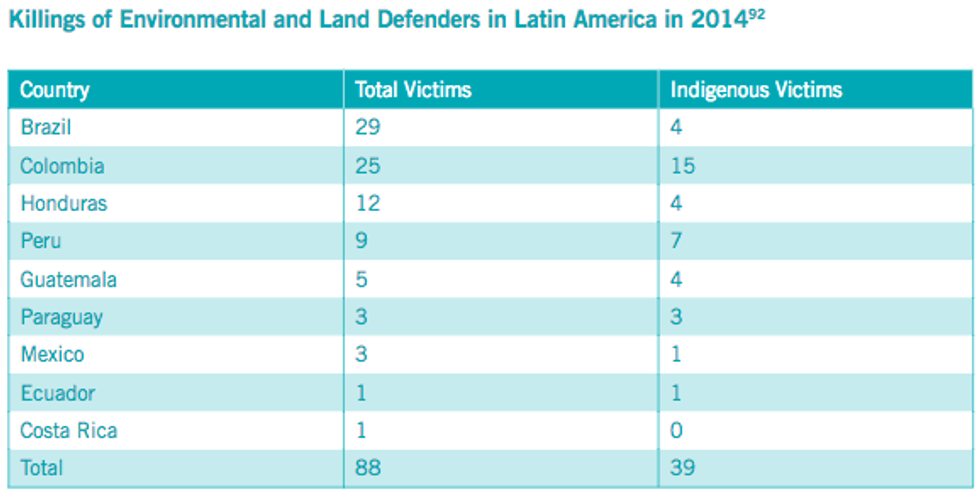
--Michael Forst, the United NationsThe new report, A Deadly Shade of Green: Threats to Environmental Human Rights Defenders in Latin America (pdf), observes that "Indigenous peoples are the most vulnerable because many development projects are located on their land. When States disregard appropriate consultation procedures, the result is often conflict, forceful displacement, environmental degradation, and human rights violations. Killings of environmental activists and journalists are increasing and members of indigenous communities comprise over 40% of the deaths."
"The lack of effective guarantees of human rights protection in Latin American States has created this dire situation," the report authors write. "The absence of effective safeguards is worsened by the weak rule of law in most Latin American countries, by worrying trends of impunity that corrode the fabric of society, and by the fact that environmental movements usually concern major development projects involving powerful governmental and corporate interests."
Since the murder of Indigenous land defender Berta Caceres in March this year, international observers have called for greater protections for activists in Latin America--particularly Indigenous people fighting extractive industries.
Indeed, the report finds that mining corporations are responsible for much of the violence and killings threatening environmental human rights defenders (EHRDs).
The report goes into detail:
The persistent human rights violations targeting EHRDs are caused by resource exploitation, and increasing numbers of large-scale and mega-development projects in Latin American countries. For example, Honduras currently has 837 mining concessions, of which 411 have already been granted covering an area of 6,630 km. In Colombia, coal extraction between 2000 and 2010 nearly doubled and the number of mining concessions has similarly maintained an accelerated pace. This has resulted in a substantial increase in attacks across the region. According to the Guatemalan Human Rights Commission/USA, in the decade between 2000 and 2010, 118 environmental human rights defenders in Guatemala were murdered and over 2,000 assaults occurred against groups of protesters. The November 2014 Global Witness report, Peru's Deadly Environment, revealed that the majority of environmental killings in Peru were being perpetrated by the State and private security forces, and most were related to extractive sector projects.
The report authors also find legal protections sorely lacking: "The Organisation of American States (OAS) General Assembly has been issuing annual resolutions since 1999," the report notes, "calling on member States to guarantee defenders' rights. The Inter-American Court of Human Rights has ruled, in numerous cases, that EHRDs must be protected. These have had little effect."
Michel Forst, the United Nations' special rapporteur on the situation of rights defenders, writes in the report's introduction that "numerous organizations confirm a steady deterioration of the situation, highlighting the fact that Latin America has become the most dangerous region in the world for environmental activists."
As a result, defenders are being killed, abducted, tortured, and targeted through anti-terrorism laws that subject them to surveillance and restrict their use of funds.
"Unfounded charges and prosecution for criminal conduct are a recurrent issue in Latin America," the report found. "Complicit governments, and the lack of an independent judiciary system, work to further the interests of large corporations in the area, often favouring this tactic of abuse as means of targeting environmental defenders."
Moreover, "press releases and news articles indicate that the use of impermissible surveillance techniques by private corporations and government actors is widespread throughout Latin America."
The report authors appeal for widespread reforms, enforcement of existing laws, and an end to the ability for private forces to act with impunity against environmental and rights defenders. As Forst writes, "Environmental campaigners demonstrate that states' economic development cannot be addressed without integrating respect for human rights, particularly economic, social and cultural rights."
"In order to fulfil human rights, we must combine perspectives and develop an all-encompassing vision," Forst adds. "[T]he rights of indigenous peoples, the right to health, and the right to water are not isolated rights but form a complex and complementary whole."
Human rights and land defenders face unprecedented levels of violence, torture, abductions, and murder across Latin America, according to a report published Tuesday by the Center for International and Environmental Law (CIEL)--and the situation is even worse for Indigenous people.
The findings echoed an earlier report from human rights group Global Witness that showed an increasing number of land defenders being murdered worldwide.
"Numerous organizations confirm a steady deterioration of the situation, highlighting the fact that Latin America has become the most dangerous region in the world for environmental activists."
--Michael Forst, the United NationsThe new report, A Deadly Shade of Green: Threats to Environmental Human Rights Defenders in Latin America (pdf), observes that "Indigenous peoples are the most vulnerable because many development projects are located on their land. When States disregard appropriate consultation procedures, the result is often conflict, forceful displacement, environmental degradation, and human rights violations. Killings of environmental activists and journalists are increasing and members of indigenous communities comprise over 40% of the deaths."
"The lack of effective guarantees of human rights protection in Latin American States has created this dire situation," the report authors write. "The absence of effective safeguards is worsened by the weak rule of law in most Latin American countries, by worrying trends of impunity that corrode the fabric of society, and by the fact that environmental movements usually concern major development projects involving powerful governmental and corporate interests."
Since the murder of Indigenous land defender Berta Caceres in March this year, international observers have called for greater protections for activists in Latin America--particularly Indigenous people fighting extractive industries.
Indeed, the report finds that mining corporations are responsible for much of the violence and killings threatening environmental human rights defenders (EHRDs).
The report goes into detail:
The persistent human rights violations targeting EHRDs are caused by resource exploitation, and increasing numbers of large-scale and mega-development projects in Latin American countries. For example, Honduras currently has 837 mining concessions, of which 411 have already been granted covering an area of 6,630 km. In Colombia, coal extraction between 2000 and 2010 nearly doubled and the number of mining concessions has similarly maintained an accelerated pace. This has resulted in a substantial increase in attacks across the region. According to the Guatemalan Human Rights Commission/USA, in the decade between 2000 and 2010, 118 environmental human rights defenders in Guatemala were murdered and over 2,000 assaults occurred against groups of protesters. The November 2014 Global Witness report, Peru's Deadly Environment, revealed that the majority of environmental killings in Peru were being perpetrated by the State and private security forces, and most were related to extractive sector projects.
The report authors also find legal protections sorely lacking: "The Organisation of American States (OAS) General Assembly has been issuing annual resolutions since 1999," the report notes, "calling on member States to guarantee defenders' rights. The Inter-American Court of Human Rights has ruled, in numerous cases, that EHRDs must be protected. These have had little effect."
Michel Forst, the United Nations' special rapporteur on the situation of rights defenders, writes in the report's introduction that "numerous organizations confirm a steady deterioration of the situation, highlighting the fact that Latin America has become the most dangerous region in the world for environmental activists."
As a result, defenders are being killed, abducted, tortured, and targeted through anti-terrorism laws that subject them to surveillance and restrict their use of funds.
"Unfounded charges and prosecution for criminal conduct are a recurrent issue in Latin America," the report found. "Complicit governments, and the lack of an independent judiciary system, work to further the interests of large corporations in the area, often favouring this tactic of abuse as means of targeting environmental defenders."
Moreover, "press releases and news articles indicate that the use of impermissible surveillance techniques by private corporations and government actors is widespread throughout Latin America."
The report authors appeal for widespread reforms, enforcement of existing laws, and an end to the ability for private forces to act with impunity against environmental and rights defenders. As Forst writes, "Environmental campaigners demonstrate that states' economic development cannot be addressed without integrating respect for human rights, particularly economic, social and cultural rights."
"In order to fulfil human rights, we must combine perspectives and develop an all-encompassing vision," Forst adds. "[T]he rights of indigenous peoples, the right to health, and the right to water are not isolated rights but form a complex and complementary whole."
Human rights and land defenders face unprecedented levels of violence, torture, abductions, and murder across Latin America, according to a report published Tuesday by the Center for International and Environmental Law (CIEL)--and the situation is even worse for Indigenous people.
The findings echoed an earlier report from human rights group Global Witness that showed an increasing number of land defenders being murdered worldwide.
"Numerous organizations confirm a steady deterioration of the situation, highlighting the fact that Latin America has become the most dangerous region in the world for environmental activists."
--Michael Forst, the United NationsThe new report, A Deadly Shade of Green: Threats to Environmental Human Rights Defenders in Latin America (pdf), observes that "Indigenous peoples are the most vulnerable because many development projects are located on their land. When States disregard appropriate consultation procedures, the result is often conflict, forceful displacement, environmental degradation, and human rights violations. Killings of environmental activists and journalists are increasing and members of indigenous communities comprise over 40% of the deaths."
"The lack of effective guarantees of human rights protection in Latin American States has created this dire situation," the report authors write. "The absence of effective safeguards is worsened by the weak rule of law in most Latin American countries, by worrying trends of impunity that corrode the fabric of society, and by the fact that environmental movements usually concern major development projects involving powerful governmental and corporate interests."
Since the murder of Indigenous land defender Berta Caceres in March this year, international observers have called for greater protections for activists in Latin America--particularly Indigenous people fighting extractive industries.
Indeed, the report finds that mining corporations are responsible for much of the violence and killings threatening environmental human rights defenders (EHRDs).
The report goes into detail:
The persistent human rights violations targeting EHRDs are caused by resource exploitation, and increasing numbers of large-scale and mega-development projects in Latin American countries. For example, Honduras currently has 837 mining concessions, of which 411 have already been granted covering an area of 6,630 km. In Colombia, coal extraction between 2000 and 2010 nearly doubled and the number of mining concessions has similarly maintained an accelerated pace. This has resulted in a substantial increase in attacks across the region. According to the Guatemalan Human Rights Commission/USA, in the decade between 2000 and 2010, 118 environmental human rights defenders in Guatemala were murdered and over 2,000 assaults occurred against groups of protesters. The November 2014 Global Witness report, Peru's Deadly Environment, revealed that the majority of environmental killings in Peru were being perpetrated by the State and private security forces, and most were related to extractive sector projects.
The report authors also find legal protections sorely lacking: "The Organisation of American States (OAS) General Assembly has been issuing annual resolutions since 1999," the report notes, "calling on member States to guarantee defenders' rights. The Inter-American Court of Human Rights has ruled, in numerous cases, that EHRDs must be protected. These have had little effect."
Michel Forst, the United Nations' special rapporteur on the situation of rights defenders, writes in the report's introduction that "numerous organizations confirm a steady deterioration of the situation, highlighting the fact that Latin America has become the most dangerous region in the world for environmental activists."
As a result, defenders are being killed, abducted, tortured, and targeted through anti-terrorism laws that subject them to surveillance and restrict their use of funds.
"Unfounded charges and prosecution for criminal conduct are a recurrent issue in Latin America," the report found. "Complicit governments, and the lack of an independent judiciary system, work to further the interests of large corporations in the area, often favouring this tactic of abuse as means of targeting environmental defenders."
Moreover, "press releases and news articles indicate that the use of impermissible surveillance techniques by private corporations and government actors is widespread throughout Latin America."
The report authors appeal for widespread reforms, enforcement of existing laws, and an end to the ability for private forces to act with impunity against environmental and rights defenders. As Forst writes, "Environmental campaigners demonstrate that states' economic development cannot be addressed without integrating respect for human rights, particularly economic, social and cultural rights."
"In order to fulfil human rights, we must combine perspectives and develop an all-encompassing vision," Forst adds. "[T]he rights of indigenous peoples, the right to health, and the right to water are not isolated rights but form a complex and complementary whole."