SUBSCRIBE TO OUR FREE NEWSLETTER
Daily news & progressive opinion—funded by the people, not the corporations—delivered straight to your inbox.
5
#000000
#FFFFFF
To donate by check, phone, or other method, see our More Ways to Give page.
The Chinese government on Tuesday denounced as "provocative" and a threat to "regional peace and stability" the passage of a U.S. warship through disputed territorial waters in the South China Sea.
Quoted by state television, the China's Vice-Foreign Minister Zhang Yesui said the behavior of the USS Lassen--a U.S. Navy destroyer which passed within 12 nautical miles of a pair of artificial islands under construction by China--was both "illegal" and "extremely irresponsible."
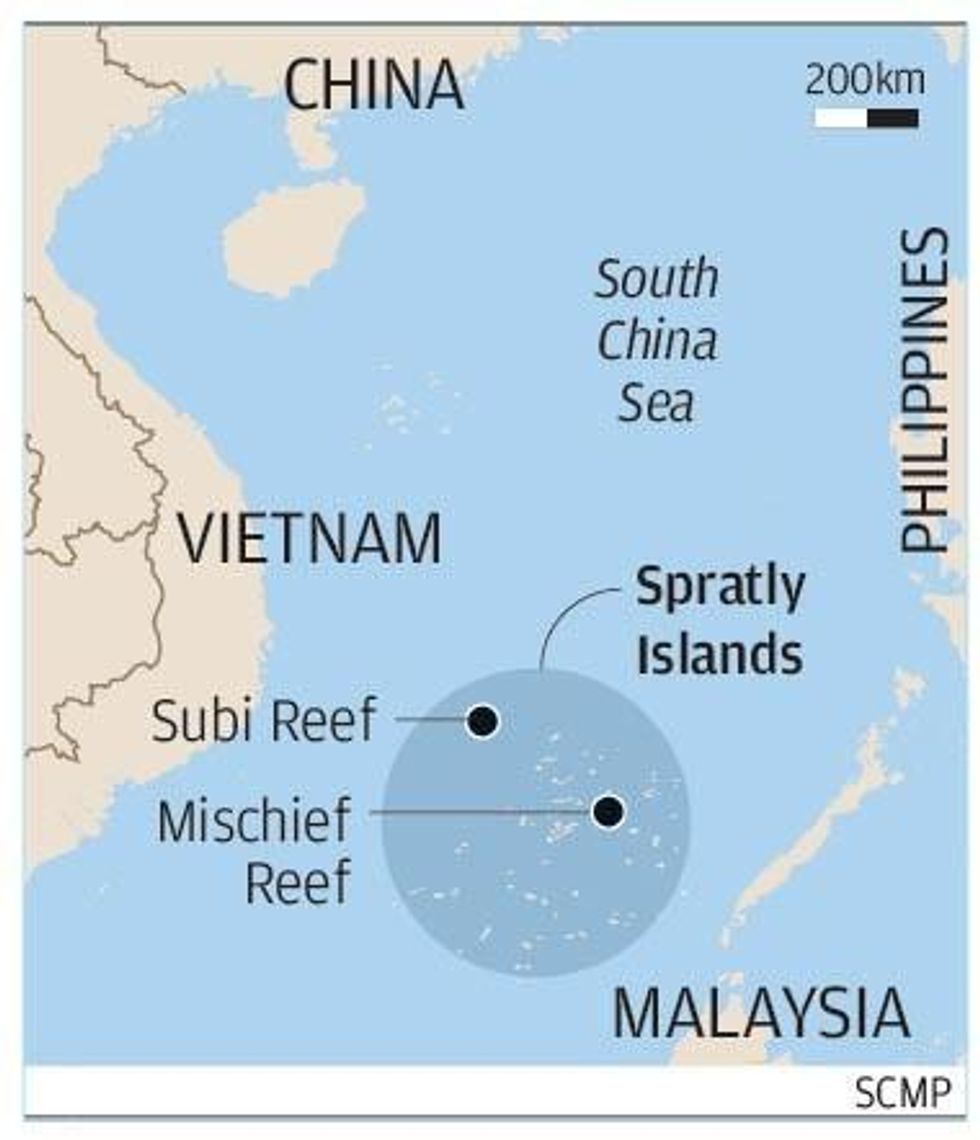
According to the South China Morning Post, Yesui summoned U.S. Ambassador to China Max Baucus to discuss the matter in person.
"The action by the U.S. warship has threatened China's sovereignty and security interests, endangered the safety of personnel and facilities on the islands and damaged regional peace and stability," said Lu Kang, a spokesperson for the foreign ministry. Kang urged the U.S. government to "correct its wrongdoing immediately" and to avoid further "dangerous and provocative actions."
According to the Associated Press:
The sail-past fits a U.S. policy of pushing back against China's growing assertiveness in the South China Sea. U.S. ally the Philippines welcomed the move as a way of helping maintain "a balance of power."
Since 2013, China has accelerated the creation of new outposts by piling sand atop reefs and atolls then adding buildings, ports and airstrips big enough to handle bombers and fighter jets -- activities seen as an attempt to change the territorial status quo by changing the geography.
Navy officials had said the sail-past was necessary to assert the U.S. position that China's manmade islands cannot be considered sovereign territory with the right to surrounding territorial waters.
Despite support for this kind of U.S. military action by some of its regional allies who dispute Beijing's claims and worry about a larger Chinese footprint in the South China Sea, experts warn that the U.S. is playing a very dangerous game by trying to assert itself militarily so far from home.
Speaking from Beijing, retired Rear Admiral Yang Yi, a researcher at the Institute of Strategic Studies of the People's Liberation Army National Defense University, told the Washington Post that such provocations could seriously damage U.S.-China relations and may encourage China to speed up construction on the islands, and possibly also their militarization.
"The act is reckless, dangerous and irresponsible," Yi said. "It shows the United States has the mentality of the big brother but the temper of a child. If it becomes a regular thing, military conflict in the region is inevitable and the U.S. would be the one who started it."
And Ian Storey, a South China Sea expert at Singapore's Institute of South East Asian Studies, explained that Washington's decision to deploy a large warship armed with cruise missiles and other advanced weaponry, as opposed to a smaller vessel, was designed to send a strong signal to Beijing.
"They've gone in heavy," Storey told the Guardian. "There is not much else heavier than that except an aircraft carrier. They want to send a very clear message to China that they are serious about this."
But, he added, China is not at all likely to respond kindly.
"This is why the U.S. has had to consider these operations very carefully," he added. "They'd have to take into account how China would respond. And if China does move to challenge these operations using coastguard operations or naval ships then that raises the risk of a collision or worse."
As the Guardian reports, what's predominantly at play is the role of trade routes and the U.S. military's role in making sure the highly-trafficked South China Sea remains under the influence of U.S. power:
Pentagon officials have spent months lobbying for the White House to take a harder line on China's actions in the South China Sea, which is a key global shipping lane, through which more than $5tn of world trade passes every year.
"There are billions of dollars of commerce that float through that region of the world," White House spokesman Josh Earnest told a news briefing. "Ensuring that free flow of commerce ... is critical to the global economy."
Ashton Carter, the US defence secretary, has accused Beijing of constructing "massive outposts" in the South China Sea that increase "the risk of miscalculation or conflict" in the region.
"Make no mistake, we will fly, sail and operate wherever international law permits," Carter said this month. "We will do that in the time and place of our choosing."
The Chinese government on Tuesday denounced as "provocative" and a threat to "regional peace and stability" the passage of a U.S. warship through disputed territorial waters in the South China Sea.
Quoted by state television, the China's Vice-Foreign Minister Zhang Yesui said the behavior of the USS Lassen--a U.S. Navy destroyer which passed within 12 nautical miles of a pair of artificial islands under construction by China--was both "illegal" and "extremely irresponsible."
According to the South China Morning Post, Yesui summoned U.S. Ambassador to China Max Baucus to discuss the matter in person.
"The action by the U.S. warship has threatened China's sovereignty and security interests, endangered the safety of personnel and facilities on the islands and damaged regional peace and stability," said Lu Kang, a spokesperson for the foreign ministry. Kang urged the U.S. government to "correct its wrongdoing immediately" and to avoid further "dangerous and provocative actions."
According to the Associated Press:
The sail-past fits a U.S. policy of pushing back against China's growing assertiveness in the South China Sea. U.S. ally the Philippines welcomed the move as a way of helping maintain "a balance of power."
Since 2013, China has accelerated the creation of new outposts by piling sand atop reefs and atolls then adding buildings, ports and airstrips big enough to handle bombers and fighter jets -- activities seen as an attempt to change the territorial status quo by changing the geography.
Navy officials had said the sail-past was necessary to assert the U.S. position that China's manmade islands cannot be considered sovereign territory with the right to surrounding territorial waters.
Despite support for this kind of U.S. military action by some of its regional allies who dispute Beijing's claims and worry about a larger Chinese footprint in the South China Sea, experts warn that the U.S. is playing a very dangerous game by trying to assert itself militarily so far from home.
Speaking from Beijing, retired Rear Admiral Yang Yi, a researcher at the Institute of Strategic Studies of the People's Liberation Army National Defense University, told the Washington Post that such provocations could seriously damage U.S.-China relations and may encourage China to speed up construction on the islands, and possibly also their militarization.
"The act is reckless, dangerous and irresponsible," Yi said. "It shows the United States has the mentality of the big brother but the temper of a child. If it becomes a regular thing, military conflict in the region is inevitable and the U.S. would be the one who started it."
And Ian Storey, a South China Sea expert at Singapore's Institute of South East Asian Studies, explained that Washington's decision to deploy a large warship armed with cruise missiles and other advanced weaponry, as opposed to a smaller vessel, was designed to send a strong signal to Beijing.
"They've gone in heavy," Storey told the Guardian. "There is not much else heavier than that except an aircraft carrier. They want to send a very clear message to China that they are serious about this."
But, he added, China is not at all likely to respond kindly.
"This is why the U.S. has had to consider these operations very carefully," he added. "They'd have to take into account how China would respond. And if China does move to challenge these operations using coastguard operations or naval ships then that raises the risk of a collision or worse."
As the Guardian reports, what's predominantly at play is the role of trade routes and the U.S. military's role in making sure the highly-trafficked South China Sea remains under the influence of U.S. power:
Pentagon officials have spent months lobbying for the White House to take a harder line on China's actions in the South China Sea, which is a key global shipping lane, through which more than $5tn of world trade passes every year.
"There are billions of dollars of commerce that float through that region of the world," White House spokesman Josh Earnest told a news briefing. "Ensuring that free flow of commerce ... is critical to the global economy."
Ashton Carter, the US defence secretary, has accused Beijing of constructing "massive outposts" in the South China Sea that increase "the risk of miscalculation or conflict" in the region.
"Make no mistake, we will fly, sail and operate wherever international law permits," Carter said this month. "We will do that in the time and place of our choosing."
The Chinese government on Tuesday denounced as "provocative" and a threat to "regional peace and stability" the passage of a U.S. warship through disputed territorial waters in the South China Sea.
Quoted by state television, the China's Vice-Foreign Minister Zhang Yesui said the behavior of the USS Lassen--a U.S. Navy destroyer which passed within 12 nautical miles of a pair of artificial islands under construction by China--was both "illegal" and "extremely irresponsible."
According to the South China Morning Post, Yesui summoned U.S. Ambassador to China Max Baucus to discuss the matter in person.
"The action by the U.S. warship has threatened China's sovereignty and security interests, endangered the safety of personnel and facilities on the islands and damaged regional peace and stability," said Lu Kang, a spokesperson for the foreign ministry. Kang urged the U.S. government to "correct its wrongdoing immediately" and to avoid further "dangerous and provocative actions."
According to the Associated Press:
The sail-past fits a U.S. policy of pushing back against China's growing assertiveness in the South China Sea. U.S. ally the Philippines welcomed the move as a way of helping maintain "a balance of power."
Since 2013, China has accelerated the creation of new outposts by piling sand atop reefs and atolls then adding buildings, ports and airstrips big enough to handle bombers and fighter jets -- activities seen as an attempt to change the territorial status quo by changing the geography.
Navy officials had said the sail-past was necessary to assert the U.S. position that China's manmade islands cannot be considered sovereign territory with the right to surrounding territorial waters.
Despite support for this kind of U.S. military action by some of its regional allies who dispute Beijing's claims and worry about a larger Chinese footprint in the South China Sea, experts warn that the U.S. is playing a very dangerous game by trying to assert itself militarily so far from home.
Speaking from Beijing, retired Rear Admiral Yang Yi, a researcher at the Institute of Strategic Studies of the People's Liberation Army National Defense University, told the Washington Post that such provocations could seriously damage U.S.-China relations and may encourage China to speed up construction on the islands, and possibly also their militarization.
"The act is reckless, dangerous and irresponsible," Yi said. "It shows the United States has the mentality of the big brother but the temper of a child. If it becomes a regular thing, military conflict in the region is inevitable and the U.S. would be the one who started it."
And Ian Storey, a South China Sea expert at Singapore's Institute of South East Asian Studies, explained that Washington's decision to deploy a large warship armed with cruise missiles and other advanced weaponry, as opposed to a smaller vessel, was designed to send a strong signal to Beijing.
"They've gone in heavy," Storey told the Guardian. "There is not much else heavier than that except an aircraft carrier. They want to send a very clear message to China that they are serious about this."
But, he added, China is not at all likely to respond kindly.
"This is why the U.S. has had to consider these operations very carefully," he added. "They'd have to take into account how China would respond. And if China does move to challenge these operations using coastguard operations or naval ships then that raises the risk of a collision or worse."
As the Guardian reports, what's predominantly at play is the role of trade routes and the U.S. military's role in making sure the highly-trafficked South China Sea remains under the influence of U.S. power:
Pentagon officials have spent months lobbying for the White House to take a harder line on China's actions in the South China Sea, which is a key global shipping lane, through which more than $5tn of world trade passes every year.
"There are billions of dollars of commerce that float through that region of the world," White House spokesman Josh Earnest told a news briefing. "Ensuring that free flow of commerce ... is critical to the global economy."
Ashton Carter, the US defence secretary, has accused Beijing of constructing "massive outposts" in the South China Sea that increase "the risk of miscalculation or conflict" in the region.
"Make no mistake, we will fly, sail and operate wherever international law permits," Carter said this month. "We will do that in the time and place of our choosing."