SUBSCRIBE TO OUR FREE NEWSLETTER
Daily news & progressive opinion—funded by the people, not the corporations—delivered straight to your inbox.
5
#000000
#FFFFFF
To donate by check, phone, or other method, see our More Ways to Give page.
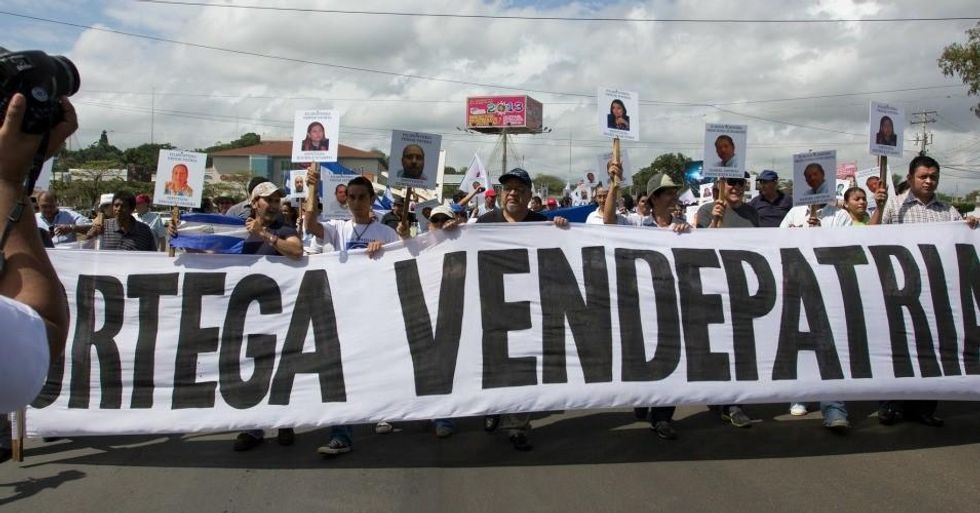
One day ahead of the groundbreaking ceremony, dozens of furious Nicaraguans blockaded roads, stopping workers with the Hong Kong-based firm Hong Kong Nicaragua Development (HKND) from accessing the construction site.
In videos shared online by an activist group, protesters shouted "Viva Nicaragua!" while they blocked streets with a banner reading: "No to the canal."
"This project will bring no benefit to the people of Nicaragua, it will only benefit the Chinese," the South China Morning Post quoted 24-year-old protest leader Danilo Lorio as saying. "The compensation offer for our lands is ridiculous."
There have been 17 such demonstrations against the canal in recent months with the largest on December 10 drawing a crowd of 5,000 to the capital Managua. Nicaraguans are angry over what they charge are illegal land seizures by the Nicaraguan government in order to pave the way for the massive and controversial infrastructure project.
The proposed canal is set to intersect Lake Nicaragua, known locally as Lake Cocibolca, sending cargo ships and tankers straight through the largest source of freshwater in Central America. Further, the canal is expected to displace tens of thousands of mostly rural and indigenous landholders and would likely devastate over 400,000 acres of rainforests and wetlands, which scientists say are critical to local and regional biodiversity conservation efforts.
According to Ohio State University doctoral candidate Chris Hartmann writing for Foreign Policy in Focus, "Farmers and residents near the lake are concerned that the proposed canal will disrupt subsistence agricultural practices, further pollute the lake, and decrease water for personal consumption and irrigation. Both farmers and residents worry they will be evicted from their lands, and many will refuse to leave willingly."
Azahalea Solis, an activist lawyer with the Women's Autonomous Movement, told the South China Morning Post that she was particularly concerned about how the police and military would enforce the land seizures and crack down on protesters.
"We are working to avoid violent confrontations," said Solis. "Our country has had a long history of violence which we don't want to see again."
The proposed canal, Hartmann says, disregards several of Nicaragua's constitutional mandates--including indigenous peoples' rights to autonomy and self-determination, and the right to collective ownership of communal and indivisible lands. Several indigenous groups have filed suit against the Ortega administration, alleging violations of constitutional and international rights, including the United Nations Declaration of the Rights of Indigenous Peoples.
More troubling, according to critics, is that local supporters of the canal were unaware of its environmental and social costs.
Execution of the project has been veiled under a "shroud of secrecy," according to the UK-based Geographical magazine, as construction is set to proceed without public consultation or parliamentary debate and prior to the release of both an environmental impact study and a social impact assessment.
"This massive engineering scheme will impact the country and the region on such a gargantuan scale that one wonders why there was no national referendum presented to the Nicaraguan populace in advance; either to determine the degree of support for the project or to lend an air of public inclusion to create the desired support," Dr. Jorge Huete-Perez, Director of the Molecular Biology Center at the University of Central America (MBC-UCA) told Geographical.
Huete-Perez continued: "Plans for the canal are constantly changing. Sub-projects are added and subtracted, or simply disappear from the HKND Group website without explanation. Considering the enormous technical, geological, social and financial challenges facing the project-including plans to begin operations within just five years from the initial date of construction-this project appears to be rushed and lacking in responsible planning."
The official groundbreaking ceremony will be held Monday evening in Managua.
One day ahead of the groundbreaking ceremony, dozens of furious Nicaraguans blockaded roads, stopping workers with the Hong Kong-based firm Hong Kong Nicaragua Development (HKND) from accessing the construction site.
In videos shared online by an activist group, protesters shouted "Viva Nicaragua!" while they blocked streets with a banner reading: "No to the canal."
"This project will bring no benefit to the people of Nicaragua, it will only benefit the Chinese," the South China Morning Post quoted 24-year-old protest leader Danilo Lorio as saying. "The compensation offer for our lands is ridiculous."
There have been 17 such demonstrations against the canal in recent months with the largest on December 10 drawing a crowd of 5,000 to the capital Managua. Nicaraguans are angry over what they charge are illegal land seizures by the Nicaraguan government in order to pave the way for the massive and controversial infrastructure project.
The proposed canal is set to intersect Lake Nicaragua, known locally as Lake Cocibolca, sending cargo ships and tankers straight through the largest source of freshwater in Central America. Further, the canal is expected to displace tens of thousands of mostly rural and indigenous landholders and would likely devastate over 400,000 acres of rainforests and wetlands, which scientists say are critical to local and regional biodiversity conservation efforts.
According to Ohio State University doctoral candidate Chris Hartmann writing for Foreign Policy in Focus, "Farmers and residents near the lake are concerned that the proposed canal will disrupt subsistence agricultural practices, further pollute the lake, and decrease water for personal consumption and irrigation. Both farmers and residents worry they will be evicted from their lands, and many will refuse to leave willingly."
Azahalea Solis, an activist lawyer with the Women's Autonomous Movement, told the South China Morning Post that she was particularly concerned about how the police and military would enforce the land seizures and crack down on protesters.
"We are working to avoid violent confrontations," said Solis. "Our country has had a long history of violence which we don't want to see again."
The proposed canal, Hartmann says, disregards several of Nicaragua's constitutional mandates--including indigenous peoples' rights to autonomy and self-determination, and the right to collective ownership of communal and indivisible lands. Several indigenous groups have filed suit against the Ortega administration, alleging violations of constitutional and international rights, including the United Nations Declaration of the Rights of Indigenous Peoples.
More troubling, according to critics, is that local supporters of the canal were unaware of its environmental and social costs.
Execution of the project has been veiled under a "shroud of secrecy," according to the UK-based Geographical magazine, as construction is set to proceed without public consultation or parliamentary debate and prior to the release of both an environmental impact study and a social impact assessment.
"This massive engineering scheme will impact the country and the region on such a gargantuan scale that one wonders why there was no national referendum presented to the Nicaraguan populace in advance; either to determine the degree of support for the project or to lend an air of public inclusion to create the desired support," Dr. Jorge Huete-Perez, Director of the Molecular Biology Center at the University of Central America (MBC-UCA) told Geographical.
Huete-Perez continued: "Plans for the canal are constantly changing. Sub-projects are added and subtracted, or simply disappear from the HKND Group website without explanation. Considering the enormous technical, geological, social and financial challenges facing the project-including plans to begin operations within just five years from the initial date of construction-this project appears to be rushed and lacking in responsible planning."
The official groundbreaking ceremony will be held Monday evening in Managua.
One day ahead of the groundbreaking ceremony, dozens of furious Nicaraguans blockaded roads, stopping workers with the Hong Kong-based firm Hong Kong Nicaragua Development (HKND) from accessing the construction site.
In videos shared online by an activist group, protesters shouted "Viva Nicaragua!" while they blocked streets with a banner reading: "No to the canal."
"This project will bring no benefit to the people of Nicaragua, it will only benefit the Chinese," the South China Morning Post quoted 24-year-old protest leader Danilo Lorio as saying. "The compensation offer for our lands is ridiculous."
There have been 17 such demonstrations against the canal in recent months with the largest on December 10 drawing a crowd of 5,000 to the capital Managua. Nicaraguans are angry over what they charge are illegal land seizures by the Nicaraguan government in order to pave the way for the massive and controversial infrastructure project.
The proposed canal is set to intersect Lake Nicaragua, known locally as Lake Cocibolca, sending cargo ships and tankers straight through the largest source of freshwater in Central America. Further, the canal is expected to displace tens of thousands of mostly rural and indigenous landholders and would likely devastate over 400,000 acres of rainforests and wetlands, which scientists say are critical to local and regional biodiversity conservation efforts.
According to Ohio State University doctoral candidate Chris Hartmann writing for Foreign Policy in Focus, "Farmers and residents near the lake are concerned that the proposed canal will disrupt subsistence agricultural practices, further pollute the lake, and decrease water for personal consumption and irrigation. Both farmers and residents worry they will be evicted from their lands, and many will refuse to leave willingly."
Azahalea Solis, an activist lawyer with the Women's Autonomous Movement, told the South China Morning Post that she was particularly concerned about how the police and military would enforce the land seizures and crack down on protesters.
"We are working to avoid violent confrontations," said Solis. "Our country has had a long history of violence which we don't want to see again."
The proposed canal, Hartmann says, disregards several of Nicaragua's constitutional mandates--including indigenous peoples' rights to autonomy and self-determination, and the right to collective ownership of communal and indivisible lands. Several indigenous groups have filed suit against the Ortega administration, alleging violations of constitutional and international rights, including the United Nations Declaration of the Rights of Indigenous Peoples.
More troubling, according to critics, is that local supporters of the canal were unaware of its environmental and social costs.
Execution of the project has been veiled under a "shroud of secrecy," according to the UK-based Geographical magazine, as construction is set to proceed without public consultation or parliamentary debate and prior to the release of both an environmental impact study and a social impact assessment.
"This massive engineering scheme will impact the country and the region on such a gargantuan scale that one wonders why there was no national referendum presented to the Nicaraguan populace in advance; either to determine the degree of support for the project or to lend an air of public inclusion to create the desired support," Dr. Jorge Huete-Perez, Director of the Molecular Biology Center at the University of Central America (MBC-UCA) told Geographical.
Huete-Perez continued: "Plans for the canal are constantly changing. Sub-projects are added and subtracted, or simply disappear from the HKND Group website without explanation. Considering the enormous technical, geological, social and financial challenges facing the project-including plans to begin operations within just five years from the initial date of construction-this project appears to be rushed and lacking in responsible planning."
The official groundbreaking ceremony will be held Monday evening in Managua.