

SUBSCRIBE TO OUR FREE NEWSLETTER
Daily news & progressive opinion—funded by the people, not the corporations—delivered straight to your inbox.
5
#000000
#FFFFFF
To donate by check, phone, or other method, see our More Ways to Give page.
Daily news & progressive opinion—funded by the people, not the corporations—delivered straight to your inbox.
In the Americas, the Trump tsunami has swept across both continents and the "pink tide" of progressivism has all but disappeared from the southern half of the hemisphere. In Europe, with the recent exception of Spain, the left has been banished to the political margins. In Africa and Asia, socialism has devolved into nationalism, authoritarianism, or just plain corruption. And forget about the Middle East.
In this planet-wide rising tide of right-wing populism, the liberal left commands only a few disconnected islands -- Iceland, Mexico, New Zealand, South Korea, Spain, Uruguay. In so many other places, increasingly illiberal leaders are in charge. Add up the numbers and significantly more than half the world's population currently lives under some form of right-wing populist or authoritarian rule, courtesy of Donald Trump in the United States, Jair Bolsonaro in Brazil, Narendra Modi in India, Recep Tayyip Erdogan in Turkey, Vladimir Putin in Russia, and Xi Jinping in China, among others
Optimists cling to the pendulum theory of politics: conservatives are now basking in the limelight, but the day will come when the right inevitably falls on its face and the left swings back into action; witness the results of the 2018 mid-term elections in the United States.
"Bolsonaro, Erdogan, Putin, Trump, and their ilk should indeed be understood as the political equivalent of global warming. Instead of deadly carbon, they spew hateful invective and show a remarkable determination to destroy a far-from-perfect status quo."In addition, pragmatists point out that many of these latter-day autocrats, for all their anti-democratic tendencies, came to power through elections. Yes, they have since sought to change constitutions, pack courts, muzzle the media, and crack down on civil society, but they remain constrained by the guardrails of the more-or-less liberal political systems they still run. In the end, so goes such thinking, democracy will prevail. Look at how, over time, some right-wing populists have been dislodged at the polls (Vladimir Meciar in Slovakia), brought down by corruption scandals (Alberto Fujimori in Peru), or forced to resign in disgrace (Silvio Berlusconi in Italy).
Optimists and pragmatists alike ultimately have faith that democracies are self-regulating organisms, not unlike the Earth's ecosystem. The planet has managed to survive countless asteroid strikes, solar flares, and extreme weather conditions. Democracy, too, will outlast Hurricane Donald and all the other examples of extreme political weather, thanks, sooner or later, to woke voters and resilient mechanisms of checks and balances.
Unfortunately, given the malign impact humans are having on the planet, this analogy is far less reassuring than it once might have been. Only the willfully ignorant expect that some natural oscillation in global temperature or the Earth's own adjustments to its climate feedback loops will arrive in time to save us. Humankind has clearly thrown a spanner into the works and now faces a distinctly difficult, if not disastrous, future. Similarly, across the globe, the electoral pendulum appears to be stuck on the side of reaction and the new generation of right-wing populists could well be on the verge of changing the political playing field, just as humans are in the process of irrevocably transforming the planet.
Bolsonaro, Erdogan, Putin, Trump, and their ilk should indeed be understood as the political equivalent of global warming. Instead of deadly carbon, they spew hateful invective and show a remarkable determination to destroy a far-from-perfect status quo. Moreover, they are the product not of farting livestock or extraterrestrial events but of the self-interested acts of blinkered humans. In an increasingly restrictive political space, liberals and progressives are looking ever more like so many polar bears on ever fewer ice floes, with diminishing room for maneuver.
Don't bet on politics as usual to lower the temperature and put a stop to this moment's tidal surge of ugly intolerance. Because the nature of the game has changed, those who oppose the global New Right must engage in a strategic rethink -- or we'll all drown in the rising waters.
The Game Changers
Today's autocrats are, at first glance, a diverse band of brothers.
In the Philippines, Rodrigo Duterte has attacked the Catholic Church for defending the sanctity of human life and challenging his campaign of extrajudicial murder. In Nicaragua, one-time revolutionary Daniel Ortega has courted the Catholic Church as a pillar of his undemocratic rule. Vladimir Putin presents himself and his country as saviors of Christianity, while Turkey's Recep Tayyip Erdogan continues to promote his own brand of political Islam, Narendra Modi has ridden to power thanks to Hindu nationalism, and Xi Jinping eschews religion altogether. Some right-wing nationalists like Bolsonaro have ambitious plans to privatize state assets, while others, like those in Italy's current leadership, want to nationalize major properties. Hungary's Viktor Orban is concerned about climate change, but most right-wing populists like Donald Trump insist that the threat doesn't exist and want to extract ever more fossil fuels.
Don't be fooled, though. While these leaders may not rhyme, they all dance to the same rhythm.
These illiberal politicians have uniformly come to power by attacking globalization. They have criticized the neo-liberal transformations of the recent past that enriched the few at the expense of the many, while challenging the major political parties of the center left and center right that implemented the economicreforms that unleashed such forces. They have taken aim at the corruption that has metastasized in political systems already ill equipped to handle a massive uptick in cross-border financial transactions. When politically useful, they have demonized immigrants and refugees who are one side effect of, as well as victims of, that very burgeoning globalization movement. They have championed national sovereignty against the interventions of multilateral organizations, while blasting multicultural values and the human-rights groups that promote them. And they have taken advantage of social media like Facebook and Twitter that promote a version of participatory totalitarianism in which individuals can freely relinquish their privacy and abandon conventional news media for daily dispatches from their favorite celebrity autocrat.
Election results in the world's most populous democracies suggest that liberalism -- in its free-market economic form and its more tolerant, inclusive, and statist political version - has become discredited at a popular level. A quick glance at the titles of some recent books (Why Liberalism Failed, The Retreat of Western Liberalism, How Democracies Die, What Was Liberalism) reveals that the chattering classes, too, have noticed this global trend.
The Trumps of this world have cannily identified a fundamental shift in the political playing field, rushing into the gap created by the declining popularity of liberal values. Viktor Orban set an early example of such opportunism when, in the 1990s, he jettisoned his liberal past and opted instead for the right side of the Hungarian political spectrum. In the aftermath of the collapse of communism in Eastern Europe, the left and right had alternated in power as voters became disgusted with whatever party controlled the levers of state. By successfully linking all the ills facing the country to liberals and their follies, however, Orban became the one to preside over a genuine transformation of the political landscape. The premier liberal party, the Alliance of Free Democrats, effectively disappeared when he became prime minister in 2010 -- and formally dissolved three years later. Almost a decade after he first took office, the only serious opposition to Orban is to his right.
"The Trumps of this world have cannily identified a fundamental shift in the political playing field, rushing into the gap created by the declining popularity of liberal values."
The last time globalization transformed the world so thoroughly, in the early twentieth century, the ensuing backlash led to liberalism's first catastrophic fail. In those years, liberals consistently failed to understand that the ground had shifted under them. In Russia, Bolsheviks took power from the weak crew of potential democratic reformers that had overthrown the tsar, inspiring a handful of movements in Europe that attempted something similar. In Germany, illiberal politicians took aim at the cosmopolitan values of the Weimar Republic. In Italy and Spain, leaders adopted virulent nationalism, challenging incipient global institutions like the League of Nations. In the wake of the Great Depression, Japanese ultra-militarists easily dispatched the weak Taisho democracy. Meanwhile, in the United States, right-wing demagogues like Father Charles Coughlin built large followings by railing on the radio against communists, Wall Street, and "the international money-changers in the temple," though they failed to take power in the era of a charismatic liberal president, Franklin Delano Roosevelt.
Where liberalism survived, it did so largely by absorbing some of the strategies of the illiberal communists and fascists, namely relying on the state to keep the economy afloat, as Roosevelt did with his New Deal policies. This lesson carried over into the post-World War II-era in which American liberals continued to embrace New Deal principles that would culminate in President Lyndon Johnson's Great Society programs and European liberals embraced the compromises that would eventually produce the European Union. At the global level, nations of various ideological dispositions came together to create a set of institutions -- the United Nations, the World Bank, the International Monetary Fund -- meant to ensure some degree of permanent stability. Economic globalization resumed, but this time in a regulatory environment that, initially, seemed to spread the benefits more equally.
That all changed in the 1970s when, in one country after another, a new generation of liberals and conservatives began to dismantle those very regulations in hopes that an unfettered market would jump-start growth globally. However, only after China embraced capitalism and the Soviet Union collapseddideconomic globalization take a quantum leap to true globalization. With it the world returned to Gilded Age levels of concentrated wealth and inequality. No surprise, then, that the instability and intolerance of that long-gone era has returned as well.
Leaders like Putin, Erdogan, and Trump aren't just politically savvy, nor have they simply been lucky or unusually ruthless. Instead, they sensed the changing mood of a moment and were able to capitalize on a profound discontent with the status quo that liberals had built, a discontent that won't disappear simply because right-wing populists are exposed as frauds, incompetents, or cheats. Worse, crafty operators with even more ambitious agendas stand ready to destroy the liberal status quo once and for all.
The Bannon Archipelago
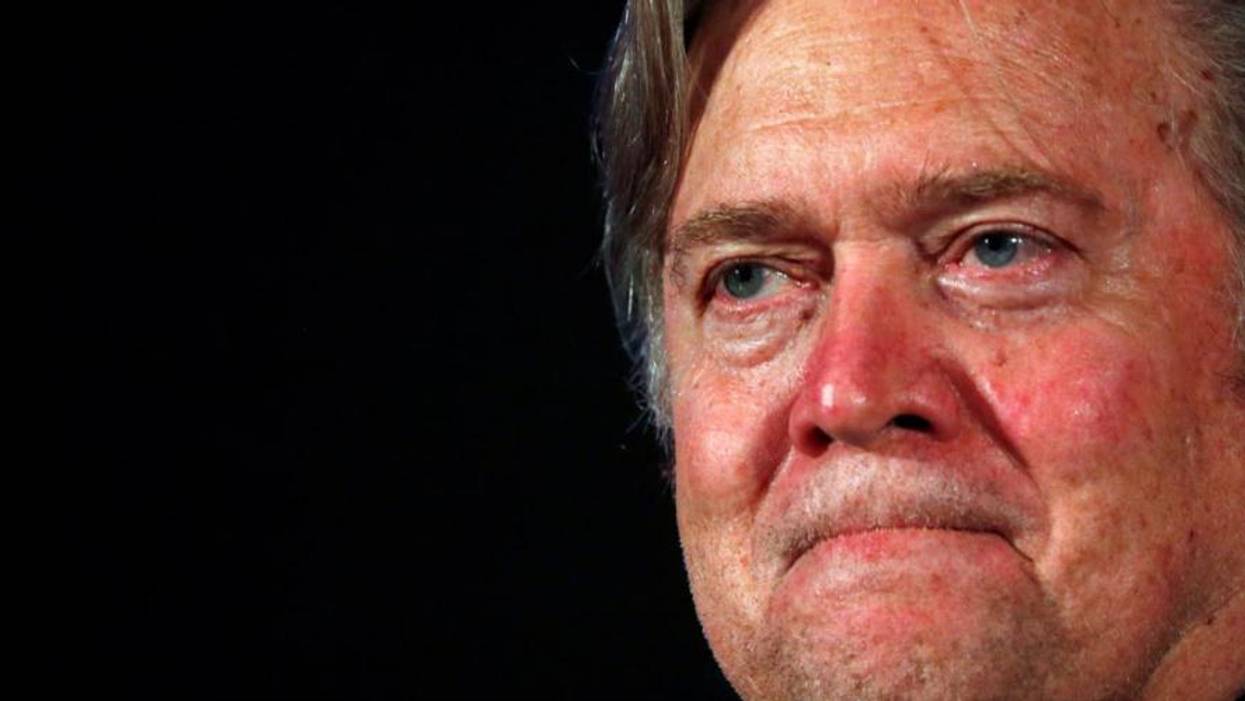
A Nationalist International should be a contradiction in terms, but that hasn't stopped Steve Bannon from trying to create one. The erstwhile publisher and moviemaker, darling of the alt-right, and one-time Trump whisperer is on an extended world tour aimed at building a loose network of right-wing populists that he calls the Movement. It's centered in -- of all places -- Brussels, the home of the European Union.
Bannon hopes to take advantage of post-Brexit Euroskepticism to roll his Trojan horse of a movement into the very heart of the enemy's camp. With the encouragement of various right-wing oligarchs, he's already met with neo-fascists associated with groups like the Belgian Vlaams Belong, France's National Rally (the rebranded National Front), and Sweden's Democratic Party, as well as more conventional right-wing populists in Italy and Hungary. He's out to take the EU from the social democrats and pallid conservatives, the Vatican from the too-permissive Pope Francis, and the West from the clutches of immigrants and multiculturalists.
Elections for the European Parliament at the end of May should prove a testing ground for Bannon's Movement. Right now, if the polling is accurate and the Euroskeptic, populist, and far-right parties combine their efforts, they could, staggeringly enough, become the largest coalition in that body. True, some prominent right-wing parties, like Poland's Law and Justice, remain unseduced by Bannon. But it's a mistake to underestimate him, just as it was a mistake to dismiss Trump in 2016. Success can be very persuasive, as The Donald proved in his takeover of a Republican Party whose leaders initially and almost universally despised him.
But Europe is only part of Bannon's plan. For someone who has vented so much spleen at "globalists" like financier and philanthropist George Soros, Bannon is quite the internationalist. In Latin America, he's already appointed Jair Bolsonaro's youngest son as his regional representative to help build on the right's electoral successes in Brazil, Colombia, Guatemala, Honduras, and Paraguay. Bannon has also partnered with a Chinese billionaire to create a Rule of Law Fund that's meant to be the point of a spear aimed at the regime in Beijing.
In search of a stable of princes, that would-be Machiavelli has also visited Japan at the invitation of the fanatical Happiness Realization Party, a political cult that embraces Japanese militarism. Israel, too, is to be part of Bannon's alt-right archipelago because the self-professed "Christian Zionist" sees Prime Minister Benjamin Netanyahu as a key link in a future anti-Islamic front. Also figuring prominently in his thinking is Russia, a vast, mostly white country led by a critic of Western liberalism and "radical Islam," though Bannon acknowledges that the Mueller report has temporarily set back his efforts.
Bannon didn't create the new right-wing populist wave, but he's been clever enough to grab a surfboard, dive into the waters, and try to guide the swell further to the right. Toward that end, he's creating what he calls a "war room." He says:
"It's what we did for Trump in the U.S.: writing op-eds, booking people on media, surrogate media -- all that. The last part of it is to do with grassroots social media and getting organized physically and getting out the vote."
This isn't, however, just a global version of Richard Nixon's "Southern strategy," an opportunistic attempt to solidify a political realignment. Bannon and his ilk have a much more ambitious project in mind. Having dismissed the current resident of the Vatican as far too liberal, Bannon has put himself forward as the pope of a new movement to fight the barbarians (as he defines them).
A lifelong Catholic and former military man, he harkens back to a much earlier papal tradition, that of Pope Urban II, who launched the First Crusade to retake Jerusalem at the end of the eleventh century. Bannon wants to recreate a pre-EU, whiter, more martial and nationalistic Europe. Like the popes and princes of the eleventh century, the right-wing populists in Europe have already been conjuring up external enemies to unify the like-minded. Islam remains a suitable adversary, whether in the form of ordinary immigrants or extraordinary terrorists. But there's China, too, which poses the greatest challenge to the West since the Middle Kingdom last ruled the world of commerce, innovation, and culture so many centuries ago. Finally, there's the enemy within: the globalists who have no patience for nationalism, the secularists who want to hold religion at arm's length, and the multiculturalists who campaign against white privilege.
This crusade of Bannon's and the far right is a last-ditch effort to maintain the United States and a large swath of Eurasia as bastions of white Christendom. For decades, those who held such views populated the extremes where they belonged. However, the economic failures of globalization, a huge uptick in refugee flows, and a general decline in faith in democratic institutions have proved fertile ground for such a new crusade to take shape.
Movement vs. Movement
In the United States, organizations like Indivisible, a progressive group created by former congressional staffers in the wake of the 2016 elections that now has 5,000 local chapters, are not waiting for the political pendulum to swing by itself. They're already working hard to push politics back to the left -- and their organizing produced results in the 2018 midterm elections when the Democratic Party retook the House of Representatives.
The 2020 presidential election, however, is a different matter. Trump now has the incumbent's advantage and, for the time being, the tailwind of a strong economy. In fact, some economic forecasters predict a landslide for him as long as the economy doesn't tank. The president's team has also made sure that areas of the country where his base is strong are experiencing greater job growth than in Democratic Party strongholds.
In addition, Trump and his minions are hard at work eroding the foundations of a democratic society -- demonizing the media, working to suppress voter turnout, chipping away at the barriers between church and state, and packing the courts with ideologues who support their agenda. The vast majority of the groups mobilizing to defeat Trump in 2020 are working with traditional tools to effect political change. Having learned from past masters of populism like Orban and Erdogan, Team Trump is instead busy changing the playing field.
That's what makes the current political moment different. The pendulum theory of political change only applies if the major electoral actors play by the same rules. The right-wing populists have, however, been busy transforming the rules of the game so that they can stay in power as long as possible, while using the levers of the state to enrich themselves and their cronies. Putin has ruled Russia for two decades. Erdogan has held onto power for 16 years. Orban is closing in on a decade in office. Even in an undemocratic country like China, Xi Jinping has altered the collective rules of succession to ensure that he will remain leader for life.
One possible response to right-wing populism would, of course, be to ramp up left-wing populism. This was a winning strategy in 2015 for the Greek political party Syriza, which has been in charge of that country for four years now. It also worked for Evo Morales, who has captained Bolivia for more than a dozen years. And, of course, Bernie Sanders came close to being the Democratic Party's standard bearer in the 2016 election while promoting his version of left-wing populism, which capitalizes on an essential political reality: passion often moves people more effectively than policy.
But it's hard to see left-wing populism as a long-term answer to the New Right. It either fails electorally, as Jean-Luc Melenchon, the standard bearer for the movement France Unbowed, discovered in that country's last presidential election; or it faces the kind of "economic realities" that forced Syriza to accommodate the austerity demands of European bureaucrats and banks; or, as Morales has demonstrated in Bolivia, it ends up presiding over the same erosion of democratic practices as its right-wing counterparts.
Yes, the nuts-and-bolts organizing of groups like Indivisible is indispensable. Yes, the passion of left-wing populists is essential. But such politicking and the mirror-image populism that sometimes goes with it are mere life preservers. They may keep us afloat, but they won't rescue us. The New Right requires a far more original kind of response.
After all, the forces that gave rise to this tidal wave of right-wing populism remain in place: widening economic inequality, surging migrant flows, ballooning corruption scandals. Parties of the center remain discredited, and liberals have not come up with convincing alternatives to the policies and institutions of globalization they created. Trying to nudge the political pendulum out of the emergency zone is a necessary but ultimately insufficient approach. It's the equivalent of expecting that a conventional fix like a gasoline tax will stop climate change. Environmentalists understand that unprecedented change requires an unprecedented response. To deal with the threat of political climate change, a similarly international, broad-based, and fundamentally new approach is called for.
So don't wait for the pendulum to swing. Don't put your faith in the guardrails. It's not time for a manifesto or a 10-point plan. It's time for a movement to counteract Bannon's Movement, a global coalition that joins people and politicians in a united, international effort to respond to the true global problems -- climate change, endless war, and economic inequality -- that threaten to overwhelm us all. Absent such a movement, the rising tide of populism will sink all boats, life preservers and all.
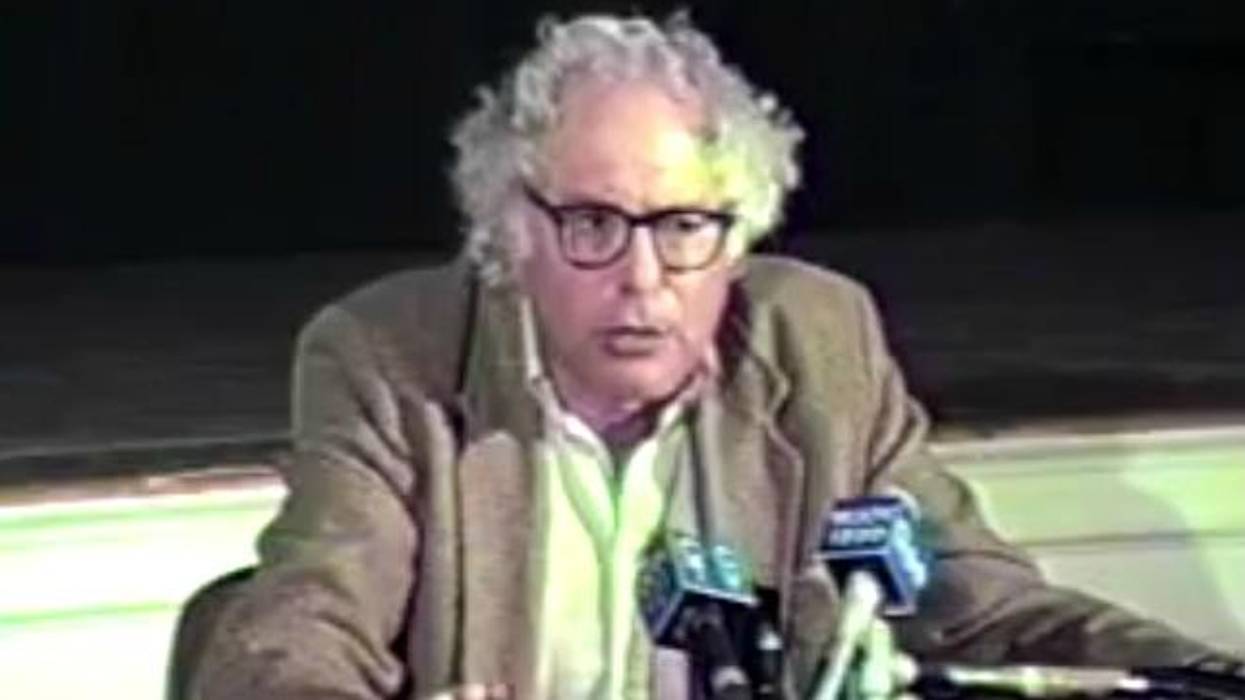
Politico magazine (5/3/19) took a deep dig into Sen. Bernie Sanders' "bizarre, charming and, at times, startling cable-access TV show," Bernie Speaks With the Community--produced in the 1980s when Sanders was mayor of Burlington, Vermont. While the article and accompanying video are relatively friendly to the senator--remarking on his humor ("who knew?") and other agreeable personality quirks--writer Holly Otterbein's description of certain clips as "startling" was more eye-opening than anything Sanders actually said.
Rather than explicitly condemning any of Sanders' statements from the episodes, the piece used the dodge that other people (not us!) might use them against the presidential hopeful. Even though Politico literally paid for all 51 tapes of the show to be digitized, the piece disingenuously noted:
Whatever good it did for Bernie Sanders at the time, Bernie Speaks With the Community is now 1,667 minutes of material for opposition researchers, healthcare insurance companies and Trump's reelection campaign to pick through.
In other words: We're just gonna leave this here, with absolutely no motives, after spending hundreds, maybe thousands of dollars digitizing it for anyone who wants to watch. People are using it to attack a Democratic 2020 candidate we just happen to red-bait? Oops! So sorry, Bernie!
Otterbein went on to construct a road map of Sanders' apparently damaging statements for a hypothetical "30-second" attack ad by "his opponents":
The Nicaraguan Sandinista leader Daniel Ortega "happens not to be a Communist." Nora Astorga, the Nicaraguan ambassador to the United Nations who had recently visited Sanders, might have gotten cancer because of the "tremendous grief and suffering that's going on in her own country" caused by the war. The Soviet Union's economy is being "devastated" by military spending. And perhaps, as he proposed to a classroom of small children, Burlington should develop an exchange program with communist and socialist countries around the world. "I would like to see families--your mothers and dads and yourselves maybe--go to the Soviet Union and learn about that country, and people from there come to here," he says. "If you actually had kids here who were from Nicaragua or from the Soviet Union, and they could tell you what's going on in their own country, boy, you could learn a whole lot. And then if kids from Vermont or Burlington were in those countries, they could tell those people what was going on in their hometown."
Is it a coincidence that all of the things Politico picked out in their "short, and surely incomplete," list of supposedly damning Sanders quotes have to do with improving relations with countries the US government and corporate media have stopped at nothing to divide and conquer?
That Nicaraguan President Daniel Ortega "happens not to be Communist"...happens to be true. As Jim Naureckas noted in Extra! (6/05), "Nicaragua under the Sandinistas had a mixed economy, multiple opposition parties and a vocal opposition press, features that were not found in actual Communist countries." If you actually watch the clip, Sanders' larger point is that corporate media repeat endless lies about Nicaragua--like the claim that Ortega is a dictator, regurgitated tirelessly by corporate media from the '80s unto the present day, despite his repeated victories in internationally recognized elections (Extra!, 10-11/87, 1-2/07; FAIR.org, 11/17/08, 8/23/18).
The article might have flagged Sanders' comment that "grief and suffering" could cause cancer for being a bit wacky. (Can stress cause cancer? Evidence is "weak," says the National Cancer Institute.) But there's also a suggestion that it's absurd, or at least impolitic, to suggest that the US could be responsible for said grief or suffering; a similar suggestion is made elsewhere when Otterbein puts scare quotes around Sanders' reference to the "immorality" of the US-backed Contra war. FAIR (4/11/16, 3/5/19) has previously shown how corporate media performatively frame Sanders as a red menace for defending--and refusing to denounce--leftist countries targeted by US imperialism.
In this case, Sanders was defending the Nicaraguan people, who suffered immeasurable harm in the Contra war to oust the Sandinista government--the product of a popular revolution that overthrew the murderous US-backed dictator Anastasio Somoza. The "immorality" Sanders was talking about, and Politico calls into question, is the tens of thousands of Nicaraguans killed by US-trained, armed and financed Contra death squads. Maybe Politico has an editorial rule against referring without irony to war crimes as immoral when the perpetrators are backed by Washington.
And because you can't do a proper red-bait without a Russia connection, Otterbein includes Sanders' contention that military spending "devastated" the Soviet economy in the list of no-nos. Oddly, the position that Sanders is being attacked for is the conventional wisdom on why the Cold War ended with the collapse of the USSR. As AP (6/5/04) reported when Ronald Reagan died in 2004:
His famed "Star Wars" program drew the Soviets into a costly arms race it couldn't afford.... He is vividly remembered in Russia today as the force that precipitated the Soviet collapse.
"Reagan bolstered the US military might to ruin the Soviet economy, and he achieved his goal," said Gennady Gerasimov, who served as top spokesman for the Soviet Foreign Ministry during the 1980s....
Even though Reagan's "Star Wars" never led to the deployment of an actual missile shield, it drew the Soviets into a costly effort to mount a response. Many analysts agree that the race drained Soviet coffers and triggered the economic difficulties that sped up the Soviet collapse in 1991.
But underscoring the US's hand in another country's economic demise conflicts with the narrative of the natural collapse of socialism, in which corporate media are heavily invested. Corporate outlets systematically overlook the fact that when the United States wages economic warfare, for whatever reason, it produces catastrophic effects on the economies and people of its "enemy" targets.
Regarding Sanders' more lighthearted desire for leftist/capitalist nation exchange programs, as Branko Marcetic pointed out, they already existed long before the 1987 clip. Even if they didn't, though, what's so scandalous about cultural exchanges that ameliorate interactions between hostile nations? If anything, exchanges might humanize foreigners who the US government and media have often dehumanized, and dispel the lies they push about nations to justify imperial aggression.
Let's sum up the fresh dirt Politico so helpfully prepared for anti-Sanders campaign consultants:
Now, I haven't watched all the tapes. It's very possible that Bernie Sanders said something "startling" in the 51 episodes of Bernie Speaks--but if he did, Politico didn't find it. Instead, the publication showed us its own failure to dislodge from the corporate media's anti-Communist, neo-Cold War worldview. In a Sanders story that tried to play nice--a rare find in establishment outlets--Politico nonetheless gave us a peek at US media jingoism that was past its sell-by date nearly three decades ago.
Anyway, thanks for the funny tapes, Politico.
Less than a month ago, the candidate leading in the polls in the Brazilian presidential election was a jailed ex-politician who technically couldn't even run for office.
It gets even weirder. Brazilian voters have put corruption near the top of the list of their concerns this political season. Yet Luiz Inacio Lula da Silva, the country's most popular politician, has been jailed on corruption charges. And because of a law that Lula himself signed into law, politicians charged with crimes upheld by an appeals court can't run again for eight years.
Weirder still, in a country where only 14 percent of the population has any confidence at all in Donald Trump's global leadership, the voters have rallied around a candidate who's often tagged the Trump of the Tropics.
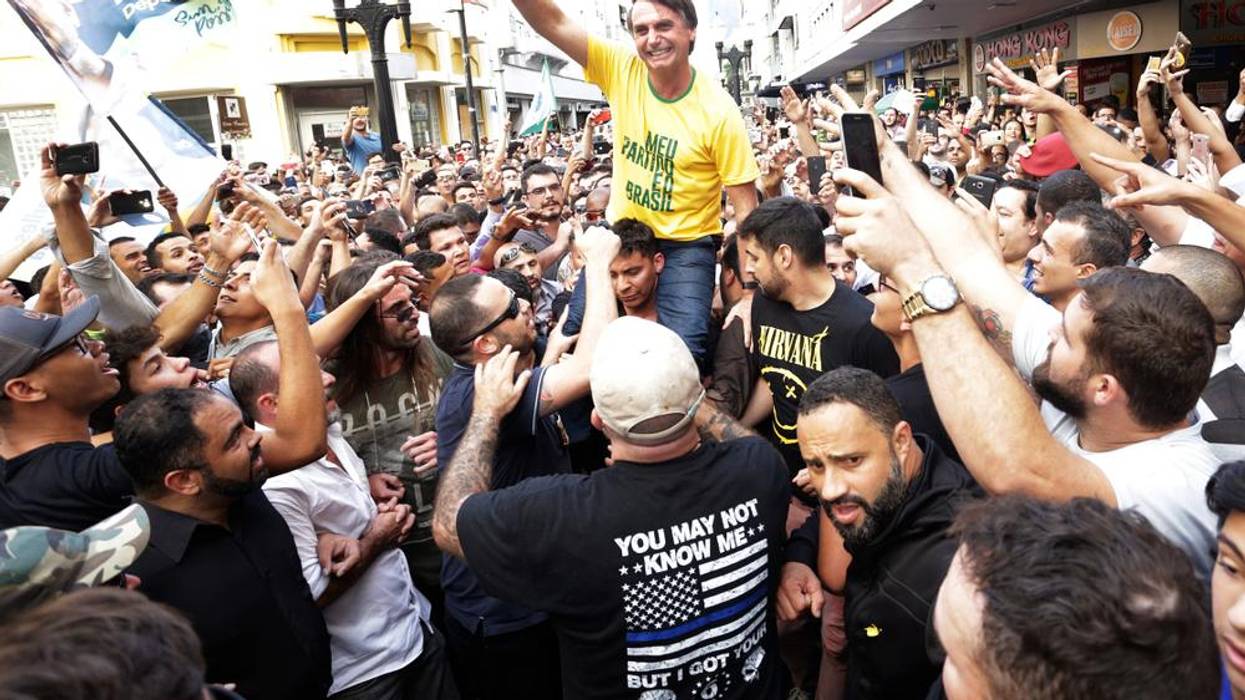
When Brazilians went to the polls this Sunday, nearly half of them voted for this pro-Trump and anti-Lula candidate. Jair Bolsonaro is a free-market ideologue who frequently goes on homophobic, misogynist, and racist rants. He loves guns, torture, and autocracy. Brazilians who fear a return to military rule refer to Bolsonaro as "the Thing."
Bolsonaro nearly won the race in the first round, coming only a few percentage points from capturing the simple majority required to declare outright victory. It's remotely possible that the opposition could pull together for the second round, scheduled for October 28, just as the French did to deprive Marine Le Pen of the presidency last year.
But I doubt it.
Brazil is on the verge of being Trumped. And given the perilous state of the country's economy -- unemployment over 12 percent, extreme poverty on the rise, widening gap between rich and poor -- Bolsonaro will wreak even greater devastation in Brazil than his gringo inspiration has already done in the United States.
The Thing's political success in Brazil demonstrates that the radical right is far from peaking in its global influence.
Elsewhere in the world, the right has certainly mobilized resentment against neoliberal globalization. But that doesn't explain the situation in Brazil. After all, Bolsonaro's chief economic advisor, banker Paulo Guedes, adheres to the same University of Chicago philosophy that gave the world Augusto Pinochet's brave new Chile in the 1970s. Thanks to Guedes, Bolsonaro has reversed his previously anti-liberal positions on economics. Now he promises widespread privatization and cuts in government spending, while also calling for fewer taxes.
I'm not sure that Bolsonaro's supporters, aside from the very wealthy ones, are paying much attention to his economic program. What Brazilians are disgusted with is the status quo, which is corrupt and economically unsustainable. They don't just want reform.
They want a Reformation.
Against the Globalists
In the sixteenth century, the Catholic Church aspired to control the world. Its influence spread well beyond Europe to the New World and, thanks to Jesuit missionaries, to Asia as well. Orthodox Christianity was well ensconced in Russia, and Islam controlled the Middle East and North Africa. But Rome was powerful, wealthy, and corrupt enough to compete with these rivals. The Pope commanded no armies, but he still claimed the allegiance of millions of people, including any number of kings and queens.
And then along came Martin Luther.
As a young monk and then a theologian, Luther absorbed the teachings of the Vatican. But he grew to despise what he saw as the corruptions of Catholicism, chiefly the sale of indulgences as a method of buying one's way into heaven. His attacks on the Catholic order attracted a flock of like-minded protesters and reformers. And thus was born Protestant theology and the Reformation.
Luther challenged the globalists of his era, a political order based on a bogus and highly polarizing economic system (the sale of indulgences). He assailed the bureaucracy of this order, asserting instead that individuals could have a personal relationship with God without the mediation of the priests. He preferred the language of the people, rather than Latin, and translated the Bible into German.
Even before nationalism became a coherent ideology, Luther was asserting national prerogatives against the demands of the global (Catholic) order. He wasn't a big fan of minorities either, considering the anti-Semitism of his treatise, "On the Jews and Their Lies."
Luther also effectively deployed the technology of the era. The printing press, invented in Europe by Johannes Gutenberg around 1439, had become a tool of mass production by the early sixteenth century. Thanks to this new technology, Luther's tracts and his German-language bible spread rapidly around Europe, undermining the Holy See's authority.
Protestantism has proven to be an enduring phenomenon. As a schism, it has itself broken into dozens of denominations. But Catholicism, too, has endured. It has instituted some reforms, like Vatican II, and has become even more globalized since Luther's time.
The Populist Reformation follows the same pattern as Luther's earlier revolution. It targets a global elite. It criticizes a corrupt economic order. It speaks in a national language that the average person can understand. It uses the latest technologies -- social media -- to spread its message. It is full of fire and fury. And with Donald Trump's victory in the 2016 presidential elections, it has spread to the very nerve center of the global order.
If it continues to follow the earlier example, this Populist Reformation will establish a powerful rival "church" that survives past the next election cycle. It may force some changes in the global order, but that order will survive as well. Protestants and Catholics generated one war after another in Europe. The current era looks to be equally contentious.
Modern Day Protestants
The modern-day Luthers are everywhere, railing against the globalists and tweeting their 95 theses around the world.
Eastern Europe is the center of this Reformation.
Poland's Law and Justice Party and Hungary's Fidesz are in firm control of their countries. In the Czech Republic, Prime Minister Andrej Babis, a corrupt media mogul, is trying to Berlusconi his country into submission, with the help of former leftist and current Islamophobe President Milos Zeman. In Bulgaria, the far right-wing United Patriots coalition named six ministerial positions as a reward for helping Prime Minister Boyko Borisov form a government. In Bosnia, the ultra-nationalist Miroslav Dodik was just elected as the Serbian member of the country's unwieldy three-person presidency.
Elsewhere in Europe, the right wing is also on the rise -- in control in Austria, sharing power in Italy, and racking up significant parliamentary numbers in Germany and Sweden. These insurgents are gearing up for the 2019 European Parliament elections in the hopes of securing a large enough minority to block legislation. "We are not fighting against Europe, but against the EU, which has become a totalitarian system," the National Front's Marine Le Pen has said. In France, the National Front polls just a fraction behind Emmanuel Macron's ruling party.
On the borders of Europe, Turkey has been ruled for 15 years by a right-wing autocrat with an Islamist cast -- Recep Tayyip Erdogan. Vladimir Putin, meanwhile, has been in charge in Russia for nearly two decades. This oligarch masquerading as a president aspires to create a vast conservative network -- corrupt, anti-liberal, nationalist, and anti-immigrant -- with Moscow at its center.
In Asia, right-wing nationalist Shinzo Abe is on track to become Japan's longest serving prime minister. After winning his party's presidency last month, Abe is expected to go after his long-sought prize: dismantling the country's "peace constitution."
Southeast Asia is full of right-wing militarists: in Thailand, Cambodia, and Myanmar. Rodrigo Duterte of the Philippines has a predilection for extrajudicial murder and other authoritarian policies that place him firmly among right-wing populists. The surprise presidential victory of 92-year-old Mahathir Mohamad in Malaysia in May suggests that this former authoritarian leader has figured out how to reinvent himself along populist lines. And, of course, Narendra Modi has been busy imposing his Hindu nationalism-inflected right-wing approach in India.
In Latin America, Bolsonaro is not alone. In Colombia, Ivan Duque won the presidential election last June. Like Bolsonaro, Duque embraces a neoliberal economic program of tax cuts and a pro-military approach to security. Daniel Ortega, though he started out as a leftist, has moved further and further toward right-wing clerical militarism in Nicaragua.
The wave of right-wing populism hasn't completely covered the world. Mexico took a long-heralded turn to the left with the election of Andres Manuel Lopez Obrador. South Korean progressive Moon Jae-in is charting a new course for his country after 10 years of conservative rule. Jacinda Ardern is doing great things in New Zealand as is Katrin Jakobsdottir in Iceland. More traditional conservative parties, like the Christian Democrats in Germany, are holding the line against the far right.
But globally speaking, that's a drop in the bucket compared to the influence of the right-wing populists.
The Roots of Right-Wing Radicalism
Some of the countries that have shifted hard to the right have done pretty well economically in recent years, like Poland and the Czech Republic. But the populist parties that did well at the polls still managed to mobilize the resentment of those who didn't benefit from that economic success. The task of appealing to the disgruntled is even easier in countries that haven't recovered fully from the financial crisis of a decade ago.
The actual economic programs of the populists are largely immaterial. They might advocate some kind of welfare state. They might prefer, as in Brazil, the same kind of neoliberal nostrums that pass for orthodoxy among international financial institutions.
In general, however, the populists are interested in state capture: using the mechanisms of state power to enrich themselves and their circle of supporters. It's crony capitalism raised to the nth degree.
Politically, the new right-wing populists are taking advantage of a widespread disgust for political elites. This disgust has been focused in particular on the corruption scandals that have engulfed so many countries. Because they're focused on corruption, voters are willing to embrace candidates who are also members of the political elite and personally corrupt to boot -- as long as these firebrands promise to "drain the swamp."
But it's perhaps hot-button cultural issues that provide the most direct method by which the right-wing populists can distinguish themselves from the competition.
Obviously this cultural populism takes different forms around the world. Duterte challenges the Catholic Church in the Philippines while Ortega embraces it in Nicaragua. But a common denominator is nationalism. It's not just an outward-facing nationalism against globalists and immigrations. These right-wing populists deliberately stoke the anger of majority populations who somehow feel left behind by a world of greater equality and diversity.
Martin Luther King Jr. once envisioned a Poor People's Campaign that brought together a rainbow coalition of the dispossessed. Right-wing populists have discovered an equally powerful coalition: the Privileged People's Campaign that brings together rich and poor on the basis of the color of their skin, not the content of their character. King emphasized the importance of dignity. The insurgent populists make a similar appeal but to the dignity of the dominant race, class, or gender.
The left is compromised on all three grounds. It remains committed to multiculturalism. Once in office, it has often proven just as corrupt (or, at least, status-quo-oriented) as any other political bloc. And left parties have pushed forward economic globalization as vigorously as the right, if not more so -- the Democrats under Clinton, Labor under Blair, the French Socialists under Mitterand, former Communist parties in Eastern Europe, and so on. No surprise, then, that None of the Above has become so popular.
What's remarkable about many of the new right-wing populists is how long they've managed to hold onto power through the ballot box. Putin, Erdogan, Ortega: They've all been in charge for more than a decade apiece. Viktor Orban's been the head of Hungary since 2010, Abe the head of Japan since 2012. Zeman has been the Czech president since 2013.
This Populist Reformation is no recent or temporary blip. Let that be a warning to the U.S. electorate. Even if Donald Trump manages to lose his reelection bid, the populist fury that produced his improbable 2016 victory is not going away any time soon.

Right-wing populists are all the rage these days. Donald Trump and his spleen control the White House, while his counterparts have taken over in Italy, Hungary, Poland, Colombia, India, and elsewhere. Steve Bannon, Trump's former Svengali, hopes to inspire a worldwide revolution of nationalism-inflected right-wing extremism.
But what about left-wing populists? Bernie Sanders made an epic run at the presidency in 2016 only to fall short. Jeremy Corbyn likewise had a good showing in the last British elections, but he too remains distant from power.
Left-wing populism is also popular among certain political theorists, most notably the Belgian thinker Chantal Mouffe whose latest book champions an electoral strategy that appeals to disgruntled workers.
The major problem with left populism, however, is that it tends in practice toward autocracy. The examples of existing left populism -- Venezuela, Nicaragua, and (to a lesser extent) the Philippines -- are embarrassments to anyone who cares deeply about democracy and human rights.
In Venezuela, Nicolas Maduro presides over an economic collapse that has hit the poor the hardest. Corruption, human rights abuses, narcotrafficking: Venezuela under Maduro is a failed state masquerading as left-wing populism. In Nicaragua, former Sandinista Daniel Ortega has been gradually concentrating power in the hands of his presidency, his family, and his cronies, and he now faces a civil insurrection demanding "justice for those who have died at the government's hand and a return to democratic governance," as Rebecca Gordon wrote for TomDispatch. In the Philippines, Rodrigo Duterte also claims to be a leftist but has launched a catastrophic drug war, which has left more than 12,000 people dead, and declared open season on human rights advocates.
Fortunately another wave of left-wing populists, considerably more democratic than what's on offer elsewhere, has been building. The most prominent of these would-be leaders, Andres Manuel Lopez Obrador (AMLO), has an excellent chance of winning the presidential election in Mexico this Sunday.
Can these global Bernies turn the Trump tide?
Toward a Definition
Left-wing populism has two legs, political and economic, and it is clothed in a particular style.
The economic leg is rather old-fashioned. Left populists appeal to those left behind by the forces of globalization by offering a program of government subsidies, job-creation projects, and fair trade. It's an approach predicated on fairness -- that the wealthier members of society should invest in the common good and in raising the living standards of the country's most vulnerable.
Such a program is inspired, more or less, by a social democratic vision (or, if you prefer, a democratic socialist one). But populists also recognize that social democrats, and in some cases self-described socialists as well, have pushed the same austerity programs that their colleagues further to the right have championed. Because of their internationalist orientation, socialists have also been leery of appeals to nationalism (or, if you prefer, patriotism). So, their economic programs have a touch of globalism to them, whether in the form of worker solidarity across borders or transnational solutions to the global ecological crisis.
Left populists, on the other hand, appeal to the people of their own country first and foremost. They are leery of free trade deals, they are often close to unions, and they want to encourage the domestic consumption of industrial and agricultural production. It's "America First" without the racism. It's a variant of Bernie Sanders's economic vision. It's the mexicanismo of AMLO.
Politically, left populists square off against the elite. Members of the political elite are handy targets, for they can always be accused of being "out of touch." In many cases, too, they are corrupt, and a broadside against the "swamp" is always a crowd-pleaser.
In almost every case, of course, the anti-elitist is a member of the elite as well, or else they wouldn't have had the money, the political position, or the cultural notoriety to get on the ballot and attract sufficient votes. The political fortunes of these inside-outsiders rise and fall based on the credibility of their impersonation of a person "of the people."
What distinguishes left populists from the left more generally is their focus on economics rather than identity politics. The left has worked hard to create a "rainbow coalition." Left populists, while not exactly anti-diversity, prefer to emphasize pocketbook issues. They believe that the sharp economic divide between the haves and the have-nots -- the 99 percent versus the 1 percent -- provides a more useful way of contesting elections in the adversarial environment of Western politics. It also takes advantage of the swelling resentment of those who have been steamrollered by globalization.
Stylistically, left populists deploy a "common touch" by rolling up their sleeves, using simple and emotional language, and steering clear of the dreary policy nostrums of wannabe wonks. They do not go high when others go low. They are combative and sometimes even vulgar. You want these populists in your corner in a barroom fight.
And that's, in essence, what politics has always been.
Left Populism in Motion
In Europe, the two most successful left populist movements have been Syriza in Greece and Podemos in Spain.
In Greece, the Coalition of the Radical Left (Syriza) has been in power for three years. It has guided the country through one of its most difficult economic periods as the economy shrank by 26 percent. Greece hasn't yet caught up to where it was in 2007 -- and won't for another decade, according to the International Monetary Fund.
Instead of embracing default and leaving the euro zone, Syriza negotiated the best deal it thought it could get from the European Union and the banks. But the population is still 23 percent poorer than it was before the crisis. Syriza has made any number of political compromises to stay in power, including an alliance with a far-right party. Having started as a populist party, it has governed largely as a conventional political force.
Podemos (We Can) began as the political expression of the indignados-led social movement that took to the streets in Spain in 2011 to protest the government's austerity policies. Started in 2014, Podemos quickly became the country's second largest party in terms of membership. But it has lost ground since then, largely because of its ambivalent position on Catalan independence. In a sign of its political irrelevance, the new government formed by Spanish Socialist Pedro Sanchez snubbed Podemos entirely.
The electoral failures of Podemos are indicative of the political fortunes of left populists more generally. In country after country, they've gone up against conventional parties and lost. The French Bernie Sanders, Jean-Luc Melenchon, failed to make it into a run-off in the presidential elections against Emmanuel Macron. South Korea's Bernie Sanders, Lee Jae-Myung, made little headway in the Korean presidential elections last year. The Canadian Bernie Sanders, Niki Ashton, wound up third in the race to take over the leadership of the New Democratic Party. Iceland's Bernie Sanders, Birgitta Jonsdottir, failed to lead her Pirate Party to victory in the small island nation.
In the last three cases, some very good leftish politicians have instead triumphed: Moon Jae-in in South Korea, Katrin Jacobsdottir in Iceland, and Jagmeet Singh of the New Democratic Party in Canada. Left populism generates a good deal of excitement and press attention, but so far it hasn't won elections. Nor, in the case of Syriza, has it governed in unconventional ways.
But that might change, and soon.
AMLO and the Transformation of Mexico
Third time's the charm, if the polls are correct.
Andres Manuel Lopez Obrador (AMLO) has already run twice for the Mexican presidency and lost both times rather handily (though he claimed that the last election was rigged, which is entirely plausible in Mexico). This time around, he is leading the polls by a large margin. His nearest competitor, the candidate from the conservative PAN, is nearly 18 points behind.
There are several reasons for AMLO's reversal in fortune. Corruption is a huge issue in Mexico, and the circle around current President Enrique Pena Nieto is awash in it. AMLO's chief rival, Ricardo Anaya of PAN, has also run as an anti-corruption candidate. But then he became embroiled in a money-laundering scandal largely cooked up by the government. Still, the affair has undermined Anaya's credibility.
Then there's the Mexican economy, which has experienced only anemic growth under Pena Nieto. The rich, however, have done well, and it's estimated that 70 percent of Mexico City's police force work on behalf of private interests, like guarding banks. Meanwhile, the government spends a mere 7.5 percent of GDP on social programs (compared to 19 percent for the U.S. and 11.2 percent for Chile). Already a polarized country, Mexico has only become more so in recent years.
The last element in the triple whammy has been the explosive expansion of narco-trafficking and the murders that have accompanied it. In 2017, Mexico suffered 27,000 murders. With 11 journalists dead last year, Mexico was the second most dangerous country for reporters after Syria. The government seems incapable of reining in the drug cartels.
Finally, it doesn't hurt AMLO that Donald Trump has directed an endless stream of racist invective at his country. Pena Nieto has certainly criticized the U.S. president, but early on he welcomed the Republican presidential candidate to Mexico and shook his hand. That sealed Pena Nieto's fate as Mexico's "most hated man" and provided AMLO with the opportunity to promote himself as a far more resolute defender of Mexican dignity.
Although very clearly opposed to the U.S. president, AMLO shares some stylistic characteristics with Trump. For instance, AMLO speaks very simply, as Trump does, and even makes up cutting diminutives for his opponents. The Mexican candidate takes aim at the elite -- though as a political insider he is even more a member of the elite than Trump ever was -- and bills himself as the anti-corruption alternative.
In other ways, though, AMLO is definitely the Bernie Sanders of Mexico. He was the mayor of a city, like Sanders, though Mexico City is quite a bit bigger than Burlington, Vermont. He governed in the same pragmatic way that Bernie did, often partnering with the business community. As Jon Lee Anderson writes in The New Yorker, AMLO "succeeded in creating a pension fund for elderly residents, expanding highways to ease congestion, and devising a public-private scheme, with the telecommunications magnate Carlos Slim, to restore the historic downtown." The latter is reminiscent of Sanders's deals to revive Burlington's waterfront.
To win the more conservative north, AMLO has partnered with wealthy businessman Alfonso Romo, who is also slated to be his chief of staff. The proposals designed to win favor from the business community include, as Anderson reports, "establishing a thirty-kilometer duty-free zone along the entire northern border, and lowering taxes for companies, both Mexican and American, that set up factories there. He also offered government patronage, vowing to complete an unfinished dam project in Sinaloa and to provide agricultural subsidies."
Given these pragmatic partnerships, AMLO might follow the lead of Syriza and govern more like a conventional politician than his campaign suggests. That would certainly be a relief to Mexico's political and economic elite, which is practically quaking in its boots at the prospect of AMLO taking over.
But there's a good possibility that AMLO, like Trump, will follow a more surprising trajectory once in power. In his bid to clean the Augean stables of Mexican politics, he has "vowed to slash pensions for former presidents and eliminate private insurance for elected officials. He has promised to cut his own salary in half, to sell Pena Nieto's presidential jet, and not live in Mexico's presidential palace."
On the economic side, AMLO has promised to increase the minimum wage, support farmers so that they don't feel that they must seek a better life across the border, and possibly renationalize the oil sector. He wants to increase government funding for education and pensions, which will appeal to old and young alike.
The urgency of AMLO's campaign can be measured by the vitriol of those who attack him, including former foreign minister Jorge Castenada. "People don't go to his rallies or listen or believe in him because he speaks intelligently or eloquently or charismatically," the former leftist intellectual says. "They go because of what he represents -- the end of the system."
AMLO indeed represents the end of the system, a system that has impoverished so many and permitted narco-traffickers to operate with impunity. Mexicans are desperate for something different. Only AMLO promises a break with the present -- even as he emphasizes continuity with Mexico's more glorious past.
AMLO is likely to shake things up in Mexico. But will he also shock left populism back into life around the world?
His electoral victory, but more importantly his new style of governance, could inspire politicians elsewhere in Latin America, Europe, and Asia to offer a more popular alternative to right-wing populism. That would be quite a gift that Mexico gives to the world, one almost as important as chocolate and chili peppers.

On April 19th, university students in Nicaragua's capital, Managua, exploded onto the streets. Their initial demand? A more effective government response to wildfires burning out of control in the country's most precious repository of biodiversity.
Soon, a social wildfire took hold in Managua and then spread across the country. Thousands of Nicaraguans added a second demand to the first: for President Daniel Ortega to revoke his recent changes to the country's social security law, which had simultaneously raised social security taxes (upsetting private enterprise) and cut benefits to seniors (angering many ordinary people). In the ensuing clashes, close to 200 Nicaraguans have died, hundreds have been arrested, and thousands have been injured, almost all at the hands of anti-riot police, unidentified snipers, or gangs of pro-government thugs on motorcycles. Today, this movement of auto-convocados (self-conveners) articulates two key demands: justice and democracy -- justice for those who have died at the government's hand and a return to democratic governance for Nicaragua.
Why should we care? In a world where the U.S. president proclaims his desire to see his people "sit up and pay attention" to him the way North Koreans do for Kim Jung-Un; where his attorney general tore children from their parents' arms; where the United States plans to initiate the militarization of space (despite our endorsement of the 1967 Outer Space Treaty, which outlaws exactly that) -- in such a world, why should people care what happens in an impoverished Central American nation thousands of miles from the centers of power?
Because there was a time when Nicaragua's imaginative, idiosyncratic revolution offered the world an example of how a people might shuck off the bonds of U.S. dominance and try to build a democratic country devoted to human well-being. I know, because I saw a little of that example during the six months I spent in Nicaragua's war zones in 1984, working with an organization called Witness for Peace. My job there was to report on the U.S.-backed counterrevolutionary (Contra) military campaign to overthrow the Sandinista government, which had replaced a vicious dictator in 1984. The Contras employed an intentional terrorist strategy of torture, kidnapping, and murder, targeting civilians in their homes and fields and workers in rural schools and clinics.
Some (Abbreviated) History
Nicaragua sits dead center on any map of the Americas and, in the 1980s, small as it was, it also occupied the center of the political imaginations of many people. In that country lay the hopes of millions living beyond its borders, hopes that a people really could become the protagonists of their own nation's story or, in the words of the Sandinista anthem, "dueno de su historia, arquitecto de su liberacion" -- directors of their own history, architects of their own liberation.
Before the fallof its Washington-supported dictator, Anastasio Somoza Debayle, in 1979, very few people outside Central America had given a thought to Nicaragua. It was the poorest, most illiterate nation in the region. Indeed, Somoza is reported to have said, "I don't need educated people. I need oxen!" (Or, as our own president put it during his 2016 campaign, "I love the poorly educated!") In the years following the dictator's ouster, Nicaragua became a symbol of hope for people on the left globally.
Somoza had treated Nicaragua like his own private hacienda, leasing out its hillsides for clear-cutting to U.S. and Canadian lumber companies and, along with an oligarchic class of landowners and businessmen, squeezing every dollar out of the people he ruled. He maintained his power thanks to a regime of intimidation, torture, and assassination. His National Guard functioned like a private army (and would eventually form the nucleus of the Contras after many of its members fled to neighboring Honduras when the Sandinistas came to power).
In 1979, however, after a year-long insurrection fought in the mountainous areas of the country by a guerrilla force armed with AK-47s and in the cities by ordinary citizens wielding homemade bombs thrown from behind barricades, the Somoza regime collapsed. By the time he fled, after a brutal final round of aerial bombardment, no sector of the country backed him. Erstwhile allies like the big landowners, private industry, and the Catholic Church, along with the press of all stripes, had all turned on him. So had the majority of Nicaraguans, the rural campesinos (a word inadequately translated as "peasants"), and the country's tiny urban working class. In the end, even his patrons in Washington abandoned Somoza as a hopeless cause.
A group called the Frente Sandinista (the Sandinista National Liberation Front, or FSLN) stepped into the vacuum he left. Founded in 1961, it took its name from Augusto Cesar Sandino, a guerrilla leader who had fought against a U.S. occupation of Nicaragua decades earlier. In 1978, despite internal disagreements, the group united around four basic principles of governance: political pluralism; the formation of a mixed economy, including private ownership, state-owned enterprises, and collectives; popular mobilization through a variety of mass organizations; and a foreign policy of nonalignment.
In July 1979, when Somoza resigned and fled the country, the FSLN assumed power with long-established plans to improve the lives of the rural and urban poor. The party established health clinics, promoted free public education, and offered a "canasta basica" (basic food basket) of affordable staple foods, quickly reducing the endemic malnutrition in the country. Through a national vaccination campaign, it eliminated polio in 1981. It also brought in laws that protected poor farmers from losing their land to banks and instituted agrarian reform, transferring land titles to thousands of previously landless campesinos.
In 1980, 90,000 people, two-thirds of them middle-class high school students from the cities, took part in a national literacy campaign. In the process, those young students spent five months living with campesino families, learning about the hardships (and joys) of subsistence farming. In return for such hospitality, those students taught their host families to read. Today, my partner sits on the board of a Nicaraguan development NGO, several of whose organizers began their lives of community engagement as teenage participants in that literacy campaign.
Of course, the Sandinista government was not perfect. Some of its worst policies reflected the country's endemic racism against indigenous groups and English-speaking Nicaraguans of African descent. Existing conflict between the Sandinistas and Miskito Indians was further exacerbated by the government's imposition of a military draft in response to the Contra war. Many Miskitos were members of the pacifist Moravian church, but the Sandinistas interpreted their resistance to the draft as complicity with the enemy, and so opened the way for successful CIA infiltration of the group.
The military draft became deeply unpopular throughout the country and its enforcement was sometimes heavy-handed. More than once, I sat on a bus stopped at a Sandinista roadblock, waiting for soldiers to check the papers of all the young men on board to be sure none of them were draft dodgers.
The Sandinistas also created and consolidated government structures, including a presidency and national assembly. When the party swept the 1984 elections with 67% of the vote, and Daniel Ortega became president, no one doubted that the result represented the will of the overwhelming majority of Nicaraguans.
In 1986, the National Constitutional Assembly approved a new constitution, which granted abundant rights to Nicaraguans, including women and LGBT people. One of its articles even called for absolute equality between men and women and the full sharing of housework and childcare. (Let's pause here to remember that the U.S. Constitution has yet to include any kind of Equal Rights Amendment, let alone an article requiring men to share equally in domestic labor!)
Among the new constitution's provisions was a six-year fixed term for the presidency.
However, Nicaraguans were not stupid. They knew that, as long as the Sandinistas ran the government, the U.S. would continue its Contra war. So, in 1990, Nicaraguans replaced the FSLN with the UNO party run by Violeta Chamorro in a result that shocked many people outside Nicaragua, including the Sandistas' U.S. polling firm. The people had spoken, and the Sandinistas accepted their verdict.
And that was momentous in itself. For the first time in history, a victorious revolutionary party allowed itself to be voted out of office, relinquishing many of its hopes, but preserving the democratic structures so many Nicaraguans had died to create and maintain.
Nicaragua in U.S. Hearts and Minds
While Nicaragua was having its revolution, back in the United States we were enduring our own: the Reagan Revolution. Former California Governor Ronald Reagan's 1980 presidential victory marked the beginning of the Republican Party's successful attack on the New Deal structures still embedded in American life. The Reagan administration undermined unions, cut taxes on the wealthy, deregulated vital industries from banking to health care (with disastrous results still felt today), attacked social programs like Aid to Families with Dependent Children and Medicaid, and turned perfectly respectable words like "welfare" and "entitlement" into code for African American moral turpitude. AIDS was ravaging gay communities, but the president refused to even say the word in public until the first year of his second term. Meanwhile, the Reagan administration escalated Richard Nixon's "war on drugs" into a full-scale assault on poor communities. In 1986, the president signed a drug law requiring guaranteed -- and long -- prison sentences even for minor, non-violent drug offenses.
In other words, things in the U.S. were pretty grim. That made it tempting indeed to adopt someone else's ready-made revolution, especially one that had already achieved so much and had such a great soundtrack: the music of the brothers Luis and Carlos Mejia Godoy, including the Sandinista anthem mentioned above and the beloved "Nicaragua, Nicaraguita," with its final line, "Pero ahora que ya sos libre, Nicaraguita, yo te quiero mucho mas."("But now that you are free, little Nicaragua, I love you so much more.")
And Nicaragua was indeed free, although also under attack. The United States had always been its biggest trading partner. In 1985, however, President Reagan embargoed all trade with the country and cut off air and sea transport to and from the U.S. Other nations, including Soviet bloc countries, Cuba, and the European Union, along with many thousands of American individuals and organizations, stepped in to offer material aid, technical assistance, and in the case of Witness for Peace, accompaniment in the war zones. Such volunteers risked their lives -- young engineer Ben Linder actually lost his -- for the privilege of being part of this experiment in liberation.
In my six months there, I met Nicaraguans who had never been more than 50 kilometers from the tiny villages in which they were born, but had a vision of change that would spread across Central America, Latin America, and -- as in my case -- even reach the United States. Over and over, people told me, "Americans can stop Congress from voting for aid to the Contras this year; you can stop it next year, but until you make a revolution in your own country, nothing will really change. We will always be confronted by U.S. power."
Heady stuff. And it turned a lot of heads, not always in the most helpful ways. Some visiting Americans became ever more convinced that their own left-wing party back home was destined to become the vanguard that would bring revolution to North America. Some became more rojinegro (red and black, the colors of the FSLN's flag) than the Sandinistas themselves and would hear no criticism of the party or its leaders. Others simply lived for the day when they could abandon the United States, with its hopeless, politically backward population, and make the permanent move to Nicaragua, and its highly conscious (or in today's language, "woke") people.
And some of us reluctantly acknowledged that, much as we loved Nicaragua's brilliant green mountains, our real work lay in our own country. We came home believing that if we could not find a way to love the United States, despite its maddening intransigence, we would never find a way to change it.
Trouble in Paradise
Like everything in Nicaragua, its post-1990 history has proven complicated indeed. As a start, some of the elements in the FSLN most committed to popular democracy left to form smaller Sandinista-style parties, but without significant success at the ballot box. Meanwhile, in the months between the election and the transfer of power, many Sandinistas took part in the Pinata -- a wholesale appropriation of state-owned property, companies, vehicles, and cash. In the process, Daniel Ortega, his wife Rosario Murillo, and other high-ranking party members began amassing personal fortunes and rebuilding their political power. The couple even underwent a well-publicized conversion to a charismatic form of Roman Catholicism (which helps explain why Nicaragua today has one of the world's harshest anti-abortion laws).
By 1999, Ortega had made a pact with the notorious right-wing politician and then-president, Arnoldo Aleman. He and his PLC party, which drew its support from the oligarchic class that once supported Samoza, had beaten Violeta Chamorro in the 1996 election. Aleman was later convicted of corruption on a grand scale and sentenced to years of house arrest.
In 2006, with his wife Murillo as his running mate, Daniel Ortega was again elected president. Having himself weathered a number of personal scandals, including his stepdaughter Zoilamerica's credible accusations of years of sexual abuse, he would gradually grant Aleman complete clemency.
In the 12 years since his second election, Ortega has consolidated his own power, placed family members in important (and lucrative) positions, and achieved full control of the FSLN party apparatus. He engineered constitutional changes that now permit him to serve an unlimited number of terms; that is, he granted himself a potential presidency for life.
In spite of the increasingly autocratic nature of his rule, Nicaragua has seen substantial economic development in the last decade, from which many have benefitted. Ortega's is an authoritarian government that has nonetheless provided real material benefits to Nicaraguans. Furthermore, whether because of a lingering esprit de corps in the police and army or thanks to Ortega's mano dura (harsh hand), or a combination of the two, the country is not suffering the plague of drugs and government-by-cartel that has terrorized the peoples of much of the rest of Central America and Mexico.
Today, the United States is once again Nicaragua's largest trading partner and the Ortega government is on good terms with international lending agencies like the International Monetary Fund (IMF).
At the Crossroads
In towns and urban neighborhoods across the country, people have once again built barricades, as Sandinista supporters did in the 1979 insurrection against Somoza. Once again, they are pulling up the concrete paving blocks once produced in Somoza's own factory -- this time to prevent the Sandinista police from entering their towns and neighborhoods.
Envio, a digital magazine put out by the University of Central America in Managua, calls this uprising an unarmed revolution. "Unarmed" is a modest exaggeration, since defenders at many of the barricades have used homemade mortars (steel tubes which hold hemp fuses attached to bags of gunpowder), but the demonstrators are massively outgunned by the government's regular army and the police, as well as the turbas -- organized gangs of thugs.
For longtime Nicaragua-watchers, it has been strange to see COSEP, the country's private industry council and inveterate Sandinista opponent, joining with university students and campesinos to create a Civil Alliance for Justice and Democracy. In late May, leaders of the Alliance agreed to a dialogue with the government, mediated by the country's council of Catholic bishops. The talks have been on-again, off-again ever since.
Although leftists around the world hailed Ortega's return to power, his is not the revolutionary government of the 1980s. Perhaps because they wish it were, some Ortega supporters here and elsewhere are treating the present uprisings as if they were a reprise of the Contra war, a right-wing coup attempt orchestrated in Washington. I don't think that's true, although I have Nicaraguan friends who disagree with me.
To blame everything that happens in the country on puppet masters in Washington denies Nicaraguans their own agency. As student leader Madelaine Caracas told the German news network Deutsche Welle:
"It's us Nicaraguans who are in the streets. Not a political party, not liberals, not conservatives, not the CIA. It's an awakening, an exhaustion with seeing our brothers murdered."
Y Ahora, Que? (Now What?)
When Somoza left power, the FSLN was waiting, ready to govern. As far as I can tell, today there is no such organized force on the left that could fill the vacuum left by Ortega, for example, by successfully campaigning in any new elections. If, however, Ortega refuses to leave office, the alternatives are at least as painful to consider: his successful repression of a genuine uprising of popular anger through yet more killings, beatings, and jailings (with the continuation of an autocratic government into the unknown future), or a turn from a largely unarmed and, when armed, defensive, resistance to a full-scale civil war, with all the horrors that entails.
The only thing I am sure of is that Nicaragua always does better when the United States is looking elsewhere. So let's hope Trump keeps his focus on infuriating his allies and courting his enemies in other parts of the world.
Many years ago, I sat in a hotel room -- really more of a cot in a shed -- in the tiny town of San Juan de Bocay, talking with my Witness for Peace travelling companion and a young Sandinista soldier. The soldier's pet chipmunk sat on the windowsill chewing sunflower seeds. We discussed what the revolution meant to him and his country, and his hopes as well as ours that Nicaragua's seeds of liberation would spread through the Americas. In that warm, dim light, revolution almost seemed possible.
Maybe I should have paid more attention to the chipmunk's name. It was Napoleon.
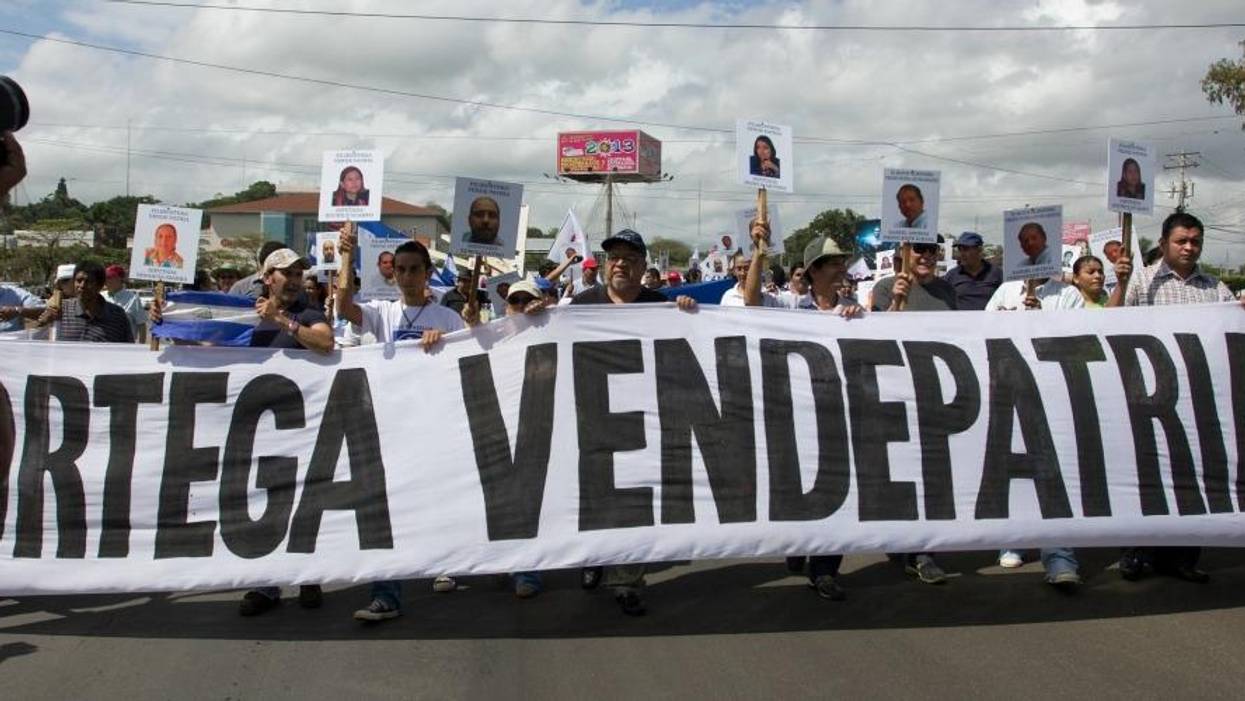
For more than a week, Nicaragua was convulsed in protests that were met with heavy-handed repression that has reportedly left at least 30 dead. Tear gas. Rubber bullets. Live ammunition. Barricades and burning buildings. Daniel Ortega, the revolutionary Sandinista leader -- and president for the past 11 years -- "is suddenly facing a revolution of his own," The New York Times reported.
"The Nicaragua of a week ago no longer exists," Jose Adan Aguerri said to The Times. "The break was really with the [Ortega government's] social security [reforms]," Aguerri later told The Washington Post. Aguerri is the head of COSEP, "the country's main business organization, which organized one of the biggest protest marches," The Post reported.
Based on much of the media coverage so far, it would be fair to think that this "revolutionary" leader has opted to cut pensions -- screwing the very base that has kept him in power -- and providing the impetus for a broad movement to oust him. But missing from almost all of the international news analysis has been salient information on what those reforms actually are -- and perhaps more importantly, what sort of alternative reforms are actually being proposed by many of those, like COSEP, now criticizing the government.
Nicaragua's social security system, INSS, is facing a budget shortfall -- that much is true. The IMF said last year that the institution was broke, and called for urgent reforms. The shortfall is actually running at about $75 million a year, or about 0.5 percentage points of GDP. A potential problem? Yes, but far from the calamitous situation that it has been described as.
To address the situation, the Nicaraguan government, together with COSEP, have been at the negotiation table for years. But earlier this month, COSEP backed away from the table, refusing to discuss the issue unless it was linked to a broader fiscal reform plan. The government responded by publishing its proposed INSS reforms, without an agreement, on April 16. That a unilateral action, in a highly charged atmosphere, would elicit a backlash is hardly surprising. But the specifics of the reforms being negotiated might be.
The IMF has recommended slashing benefits by as much as 20 percent, gradually raising the retirement age from 60 to 63 (or even 65), and indexing benefits at a lower level, among other tweaks. COSEP, the group that organized "one of the biggest protest marches," has largely supported these cuts. Presumably, ordinary Nicaraguan workers would greet such reforms with much less enthusiasm.
And here's what the government proposed: raising employer and employee contributions to the INSS system over the next few years by 3.5 percentage points and 0.75 percentage points, respectively, and a 5 percent cut to pensions. Yes, benefits would be cut, but by far lower amounts than what the IMF and COSEP have been proposing.
Though largely seen as an ally of Ortega, COSEP reacted to the government's unilateral move, and the increase in employer contributions to the INSS, by calling for protests. Some civil society organizations (including some that receive US government funding) criticized the reforms as bad for workers, but are using the same pro-business talking points to do so. Many of those same organizations have actually supported deeper benefit cuts, like those backed by COSEP and the IMF.
Either way, the actual INSS reforms are now moot. Ortega withdrew them this past Sunday. Jaime Wheelock, a former member of the Sandinista inner circle who has more recently been critical of Ortega -- including over the past week -- told The New York Times: "One good thing about Daniel is that if he's not right, he'll back down." Classic authoritarianism.
Backed by the Catholic Church, a new dialogue is planned and COSEP and the government appear willing to return to the table to negotiate over INSS reforms -- and now, more than likely, a panoply of other issues. Though after the last week, it's likely that whatever comes out of that negotiation next will end up being worse for Nicaragua's pensioners than Ortega's original reforms. At least the IMF and the private sector will be pleased.
Of course, that hasn't ended the conflict, at least not yet -- because this was never just about social security, and it has since transformed into a challenge to the very legitimacy of the Ortega administration. It's largely university students at the forefront of the current phase of protests, not the hundreds of thousands of Nicaraguans that currently receive pension benefits -- some of whom had, at least initially, participated in protests. The US government, has, over the last few years, put millions of dollars into civil society and youth organizations -- many of which have been involved in the current conflict. But that doesn't exonerate the government and its repressive response, or discredit the protesters and their frustrations with the Ortega administration.
Rather than reforms to social security, what appears to have given life to the incipient protest movement was the overreaction of state security forces. Local human rights organizations report that at least 38 (and up to 63) people have been killed in the last week, including two police officers and at least one journalist who was shot in the head while filming live on Facebook. There have been reports of arbitrary arrests, with beatings doled out behind prison walls. In addition, independent (and often opposition-aligned) news feeds tensions. Though little information is currently available about the circumstances surrounding the deaths, it is clear that, as the UN has urged, an independent and in-depth investigation is necessary.
After releasing many of the jailed protesters, allowing independent news feeds back on the air, and withdrawing the social security reforms, even some of the hard-line student groups appear willing to join the church-backed negotiations now -- though many are still advocating for Ortega's resignation, and have pledged to continue the protests. Over the last few days, those protests have reportedly occurred without major incident.
As so frequently happens when protests escalate, it was the response of the government that spurred a broader popular backlash rather than Ortega's initial action. He only provoked protesters further by resorting to the same half-baked talking points of his Central American neighbor, Honduran president Juan Orlando Hernandez, who has faced his own protest movement since his controversial reelection late last year. Hernandez consistently refers to the country's youth who have taken to the streets en masse as "gang-bangers," "terrorists," and "infiltrators." Ortega has done the same. "That just made us even more indignant," Enma Gutierrez, a Nicaraguan youth organizer, said to The Times.
But compared to Honduras, state security forces in Nicaragua have largely had a good reputation. As opposed to Central America's Northern Triangle countries, Nicaragua's crime rates are relatively low. And unlike their counterparts in El Salvador, Guatemala, and Honduras -- allegations of extrajudicial killings at the hands of military and police units in Nicaragua have been few and far between. Until the last week, at least.
Still, though scant international attention has been given to the continuing human rights crisis in neighboring Honduras, the protests in Nicaragua have received widespread coverage -- and condemnation. The US withheld any criticism of the role of Honduran state security forces in extrajudicial killings from its annual human rights report, but has strongly condemned the Nicaraguan government and withdrawn families of diplomatic staff -- something they didn't do when the Honduran government declared martial law and deployed the military and live ammunition to repress protests late last year.
While few would argue that Ortega hasn't overseen a consolidation of political and economic power, the reality is that Ortega also remains perhaps the most popular leader in Central America, according to recent polling. Earlier this year, 54 percent of Nicaraguans approved of Ortega's leadership, according to Gallup -- though the director of the firm cautioned that he felt many Nicaraguans were hesitant to express their true feelings.
But it wouldn't be hard to see why Ortega has been able to maintain at least near-majority support, despite anger at his consolidation of power. Nicaragua emerged from its civil war as one of the poorest and most unequal societies in the hemisphere, but that is changing. Throughout his 11 years in the presidency, Ortega has overseen a dramatic economic turnaround. And far from the "Marxist revolutionary" that sent Reaganites into fits in the '80s, and spooked the markets in the aughts, Ortega has worked closely with the local private sector and with international lenders like the International Monetary Fund.
Since 2006, Nicaragua's per-capita GDP has increased by 38 percent -- more than in Costa Rica, Guatemala, El Salvador, or Honduras. Inequality too is lower in Nicaragua than any of those other countries, save El Salvador. Poverty has been cut nearly in half, according to World Bank data, from 48 percent to 25 percent. That brings Nicaragua far closer to Costa Rica (20 percent), than Honduras (over 60 percent).
Ortega's alliance with the private sector -- and a legacy of lingering conflicts between factions of Sandinistas -- has always been a source of tension and discord among Nicaragua's left. But many of those groups supporting the protests today would prefer to see a more draconian reform to social security, more in line with what the IMF has recommended. That's not very revolutionary either.
In the meantime, it's little surprise that the protests have garnered so much media attention. Unlike the US-allied strongman in Honduras, Ortega has been a public enemy of the United States for forty years, and remains in the crosshairs of Trump's hawkish foreign policy team and many US lawmakers. For months, there has been movement in the US Congress to pass the NICA Act, a piece of legislation designed to inflict economic hardship on the people of Nicaragua by having the US vote against multilateral development loans. Already, opportunistic voices are using the protests to encourage the bill's approval.
There are plenty of reasons to criticize the Ortega administration, particularly following deadly repression by state security forces over the past week. And there is no doubt that student protesters, or anyone willing to take to the streets to have their voices heard, should be allowed to do so peacefully. But conflating all of the world's grievances with Ortega, without further analysis of the issues or motivations, into one movement -- a movement destined to overthrow a "dictatorship"-- doesn't do anybody any favors. Except maybe for those who would like to see a more neoliberal economic reform agenda imposed on the Nicaraguan people.
The world according to Donald Trump is very dark indeed. The American economy has tanked. Mexico has sent a horde of criminals over the border to steal jobs and rape women. The Islamic State, cofounded by Barack Obama and Hillary Clinton, is taking over the globe. "Our country's going to hell," he declared during the Republican primaries. It's "like medieval times," he suggested during the second presidential debate. "We haven't seen anything like this, the carnage all over the world."
For Trump, it's not morning in America, it's just a few seconds before midnight on the doomsday clock. Although his campaign doggedly continues to promise a new beginning for the country, the candidate and his advisers are sending out a very different message: the end is nigh. These Cassandras all agree that, although Obama's two terms were no walk in the park, the stakes in 2016 are world-destroyingly higher. If Clinton is elected, the future could be, as conservative political operatives Dick Morris and Eileen McGann titled their recent book, Armageddon.
Presidential challengers often paint a grim picture of the world of the incumbent, overstating the case for dramatic effect. Ever the showman, Trump has no compunction about repeatedly going way over the top, calling the U.S. military a "disaster" because it's supposedly underfunded and the United States a "third-world country" thanks to its precipitous economic decline. Trump talks as if he were the hybrid offspring of Karl Marx and Ann Coulter.
Trumpworld, however, is a photographic negative of statistical reality. The U.S. economy has been on an upswing for the last several years (though its benefits have been anything but evenly distributed). Nationally, violent crime is on the decline (though murder rates are soaring in some cities like Chicago). The Obama administration averted war with Iran and negotiated a detente with Cuba (though it continues to wage war in other parts of the world and has maintained sky-high Pentagon spending). If the Obama years are hardly beyond criticism, they are hardly beneath contempt either.
In dispensing with what one of his senior aides called the "reality-based community," George W. Bush's administration attempted to create an alternative, on-the-ground reality, particularly through the direct exercise of American military power -- and we know how well that turned out. Trump seems to have even less interest in the "reality-based community." He's evidently convinced that the sheer power of his own bluster, even without the firepower of that military, should be sufficient to alter our world. After all, didn't it win him a loyal following on TV and -- to the disbelief of politicians and media commentators everywhere -- the Republican presidential nomination?
The reality-based community -- which Trump labels the "elite" -- wants nothing to do with him. The discrepancy between his rhetoric and what other people call facts explains in part why even conservative elites -- prominent Republicans like Brent Scowcroft and John Warner, conservative columnists like George Will, and even neoconservatives like Bill Kristol, not to speak of right-leaning newspapers like The Arizona Republic and the Dallas Morning News -- have made historic decisions to abandon their party's presidential nominee.
But don't kid yourself. There is method to Trump's particular version of madness. He and his slyly smiling running mate Mike Pence are playing up their vision of scorched-earth America not just to win general political points but to appeal to a very specific set of voters by tapping into the apocalyptic strain in American politics. The evangelicals, anti-globalists, and white power constituencies that form the bedrock of his support hear in Trump's blasts more than just a set of fun-house facts. When the Donald says that Hillary is "the devil" and America's going to hell, this constituency -- steeped in Biblical prophecy, survivalist ideology, and racist conspiracies -- takes him literally. America is on the verge of (take your pick): the Rapture, an end-of-days contest between American patriots and U.N. invaders, or an all-out race war to the finish.
And here's what makes Trump's carnivalesque presidential campaign especially topsy-turvy. He's been slouching toward just about every kind of Armageddon imaginable, except the genuine planetary ones that are -- or should be -- almost unavoidable these days. He has, after all, dismissed climate change as a "hoax" and a Chinese scam. He is so blase about nuclear weapons that he's been comfortable with the thought of American allies Japan, South Korea, and Saudi Arabia developing their own. He has nothing whatsoever to say about potential global pandemics (but plenty to spout about the potentially malign effects of vaccinations).
To grasp the nature of such genuine dangers requires at least a minimal understanding of science. It also requires a genuine concern that the world as we know it could indeed end in our lifetimes or those of our children and grandchildren.
Of course, not everyone thinks the apocalypse is a bad thing.
The Rise of the Evangelical Right
It wasn't particularly difficult to portray 1980 as a gloomy time for America. The spike in oil prices in 1979 had sent the U.S. economy into a tailspin and the Soviet invasion of Afghanistan was propelling the two superpowers into another cycle of Cold War tensions. Iranian radicals were holding 52 U.S. diplomats and citizens hostage in Tehran, which produced a daily (and, thanks to Ted Koppel's Nightline reports, nightly) humiliation for President Jimmy Carter and his administration.
As the Republican Party's presidential candidate, Ronald Reagan responded to these developments by continually playing up the image of an America in decline. His grim vision of that American future cemented his ties to an ascendant right wing within the evangelical community. As early as 1971, intellectual historian Paul Boyer pointed out, Reagan claimed that "the day of Armageddon isn't far off." He was referring then to turmoil in the Middle East and the pivotal role of Israel there. "Everything is falling into place," he added. "It can't be long now."
Reagan was not exactly an easy sell to the Bible belt. Divorced and anything but a devoted churchgoer, he was closely associated in the public mind with that Sodom of the West Coast, Hollywood. In the 1980 election, he was also up against Jimmy Carter, a born-again Christian who openly discussed his faith.
Admittedly, Reagan benefitted from the endorsement of the Moral Majority, founded by Reverend Jerry Falwell in 1979, and he began playing directly to the religious crowd by establishing a new tradition of inserting "God bless America" into his speeches. But it was those repeated references to Armageddon that cemented his relationship with the religious right. Apocalyptic thinking is central to the worldview of evangelicals. Indeed, it's what principally distinguishes themfrom mainstream Christians. "The one thing that affects how they live their daily lives," writes historian of religion Matthew Avery Sutton, "is that they believe we are moving towards the End Times, the rise of the Antichrist, towards a great tribulation and a horrific human holocaust."
The mainstream media was shocked that Reagan then brought such doomsday rhetoric into the Oval Office. "It is hard to believe that the President actually allows Armageddon ideology to shape his policies toward the Soviet Union," the New York Times editorialized just before the 1984 election. "Yet it was he who first portrayed the Russians as satanic and who keeps on talking about that final battle." Reagan easily went on to win a second term. Later, George W. Bush would employ similar apocalyptic references to justify the invasion of Iraq and unqualified support for Israel, and it didn't prevent him from winning a second term either.
When Barack Obama became president in 2008, however, evangelicals suffered a significant drop in political influence. They continued to cling to Congress and a few Supreme Court justices -- along with their guns and religion -- but they had little leverage over a president that a majority of Republicans believed to be a foreign-born Muslim. (You're either with us or you're born in Kenya.)
Eight years later, the evangelical community faced an embarrassment of riches in the Republican primaries: a couple of born-again candidates (Mike Huckabee and Ted Cruz), several evangelical Catholics (Rick Santorum, Marco Rubio, and Jeb Bush), and even an evangelical Seventh Day Adventist (Ben Carson). In comparison, Donald Trump came up way short on the faith front. Many evangelicals were skeptical of him because, like Reagan, he did not fit the mold of an upstanding Christian candidate. He'd been divorced, indulged in high-profile extramarital affairs, taken pro-choice positions, came from that East Coast Gomorrah, New York City, and even refused to ask God for forgiveness. Once he won the party's nomination, however, Trump's approval rating rose sharply among evangelicals who represent one-fifth of the voting public. Seventy-eight percent of them now support him, according to a recent Pew survey.
Trump has triumphed among evangelicals in part by changing his views. For instance, he now claims that he plans to repent before God (in some unspecified future) and swears that he will help restore the evangelical voice to politics. He has become firmly anti-abortion and traded in a more even-handed approach to the Arab-Israeli conflict for the hardline position of Prime Minister Benjamin Netanyahu that finds favor in the evangelical community. He has even convinced some evangelicals that his new relationship with Jesus has turned him into what James Dobson calls a "baby Christian."
Trump also appeals to a certain pragmatic streak among evangelicals. They have become convinced that only he can tip the Supreme Court in the right direction, roll back the nuclear agreement with Iran, and hold back a potential tide of social protest. "Trump speaks to the profound fears animating so many white evangelicals today," says R. Marie Griffith, director of the John C. Danforth Center on Religion and Politics at Washington University. "Above all, the fear that they and their values are being displaced by foreign, immigrant, and Muslim forces as well as by domestic movements such as Black Lives Matter, gay rights, women's rights, and more."
However, this focus on the pragmatic desire of evangelicals to regain the kind of political influence and power they've lost over the last seven years only goes so far in explaining Trump's appeal. Far more important, on millenarian websites, Trump emerges as the mysterious weapon that God is now wielding to bring the righteous closer to the rapture. "God is preparing to shake the nations of the world," an evangelical blogger writes in a typical endorsement of the candidate, "and I believe he is going to use Donald Trump to do it." Another asserts, "I don't know if God will use Trump to push back the coming of the anti-Christ. However, I know that without Trump, the tribulation cannot be far away. Therefore, I have to support Trump."
Much millenarian support comes from a belief that God has anointed Trump the ultimate disrupter of the status quo, the human wrecking ball that will smite all the structures standing in the way of Christ's second coming. No one (other than the Donald himself) would confuse the candidate with the Messiah, but some evangelicals imagine him in the role of a John the Baptist gone slightly berserk.
Certain evangelicals believe that their candidate will avert an apocalypse spurred on by godless Democrats; others that he will hasten that apocalypse and so the second coming. Given that Trump is a mass of contradictions -- a bankrupt billionaire, the most elite of populists, a politician who has never held office -- it's no surprise that evangelicals can read into him almost anything they want, even if they then have a difficult time interpreting his "revelations."
Against the Globalists
The film Amerigeddon, released this year and directed by the son of right-wing actor Chuck Norris, illuminates in graphic detail the paranoid worldview of what has come to be known as the alt-right: the tech-savvy, anti-globalist, anti-immigrant movement that hitherto lurked on the fringes of the Republican Party.
"The greatest threat to our freedom lies within our own government," Amerigeddon proclaims in its trailer. In the film, traitors inside the Beltway have joined up with global terrorists and the United Nations to bring down America. It's a movie with everything a survivalist could ever want: outsiders using an EMP (electro-magnetic pulse) to disable the U.S. power grid, big government imposing martial law, gun owners saving the day. If you could take only one DVD to your reinforced concrete bunker, this would be it.
Given that it debuted on only a handful of screens and disappointed even those who might otherwise embrace its hyperbolic content, Amerigeddon would be too ridiculous to mention -- if it weren't for Alex Jones.
Jones is a talk-radio host who also runs the website Infowars. He believes that the U.S. government has covered up its involvement in everything from the Oklahoma City bombing and 9/11 to the faked moon landing and WikiLeaks. He's a libertarian (hates government), paleoconservative (hates liberals), and survivalist (his Infowars store carries a full line of "preparedness products" for the moment when the grid collapses).
A hero of conspiracy theorists the world over, Jones appears in a cameo in Amerigeddon and has used his media empire to hype the film. For someone with such unorthodox views, he has quite a following. "Jones draws a bigger audience online than Rush Limbaugh and Glenn Beck combined -- and his conspiracy-laced rants make the two hosts sound like tea-sipping NPR hosts on Zoloft," wrote Alexander Zaitchek in Rolling Stone in 2011. His website attracts 40 million unique visitors a month.
Jones has made more than a cameo appearance in Donald Trump's campaign. When the candidate appeared on his show last December, the radio host promised him that he had the support of 90% of his listeners. "Your reputation is amazing," Trump responded, "I will not let you down." By refusing to become a more sensible mainstream presidential candidate and continuing to post bizarre early-morning tweets, he has indeed kept that promise.
If Trump has managed to lock down the evangelical vote with nary a quote from the Bible, with the alt-right crowd he has frequently cited chapter and verse from their prophets. So, for instance, he has peddled such conspiracy theories as the foreign birth of President Obama, the "thousands and thousands" of Muslims who celebrated the attacks on 9/11, and the government-engineered drought in California. Infowars promoted all of these "facts," while also coming up with the "Hillary for Prison" meme that took the Republican convention in Cleveland by storm. Where other candidates have a brain trust, Trump has a mere meme trust.
Jones reserves much of his wrath for what he calls "globalists." For the alt-right, "globalist" is a code word that, like "cosmopolitan," conjures up a shadowy network of conspiratorial (and mostly Jewish) figures: George Soros, Henry Kissinger, the Rothschilds. Jones has his own version of end times. "The globalists are building a world, in their own words, where normal human life is over," he rants. "It's the devil. And the churches are not going to tell you. It's an alien force, not of this world, attacking humanity, like the Bible and every other ancient text says."
Trump has proven as unlikely a hero for anti-globalists as he has been for evangelicals. He is an international capitalist with investments in more than a dozen countries. His signature products are produced in China and Mexico. He has praised Russian President Vladimir Putin and counts Israeli Prime Minister Benjamin Netanyahu as a friend.
But Trump is an outsider where it counts, at least for those who live at the intersection of conspiracy and catastrophe. He rails against international organizations like the United Nations (should be downsized) and NATO ("obsolete"). Despite his global enterprises, he has opposed free trade and threatened to pull the United States out of the World Trade Organization. He supported Brexit, inveighs against immigrants, and insists on putting "America first."
Not surprisingly, these messages also resonate with the white men who form the core of the alt-right, even though they are generally worried neither about the coming of the Antichrist nor the arrival of the U.N.'s "black helicopters." These true "deplorables" obsess instead about a kind of slow-motion Armageddon in which the twin threats of demography and immigration will turn America into an unrecognizable (nonwhite) hell. They welcome, of course, Trump's broadsides against Muslims and undocumented immigrants.
At The Daily Stormer, the neo-Nazi website, editor Andrew Anglin wrote during the Republican primary: "If The Donald gets the nomination, he will almost certainly beat Hillary, as White men such as you and I go out and vote for the first time in our lives for the one man who actually represents our interests." Trump has retweeted a number of messages that originated with the alt-right, and his hiring of Stephen Bannon, the former executive chairman of Breitbart News, as his campaign manager nailed down his connection to that community. "We're the platform for the alt-right," Bannon told journalist Sarah Posner at the Republican convention, referring to Breitbart News.
Trump is not simply a hero of the alt-right, he's the man around which the community has now come to identify itself, the nexus of an anti-feminist, anti-Semitic, racist, conspiratorial worldview. Unlike the evangelical and survivalist communities, there is no ambivalence on the alt-right. Trump is their champion, the only person who can prevent their particular apocalypse -- the victory of multiculturalism -- from taking place.
For all three overlapping constituencies -- evangelicals, anti-globalists, and the alt-right -- Trump has transformed the paranoid style that has long lurked beneath the surface of American politics into a genuine and open electoral force. These groups support Trump because he promises to upend the secular, reality-based, internationalist status quo. On top of that, Trump is fundamentally uninterested in the day-to-day compromises of the policy world. He even disdains politicking within the Republican Party, which appeals to the many Republicans disgusted with their own party elite. As Erick Erickson, one of his conservative opponents, puts it, "At some point, the base of the party just wants to burn the house down and start over."
At heart, Trump is an arsonist. At some level, he's ready to pour that gasoline and strike that match. His apocalyptic approach to everyday politics is what puts fear into the hearts of liberals and conservatives alike -- and what puts fire in the belly of the whitest of America's insurgents.
The Real Dystopia
Supreme Court Justice Ruth Bader Ginsburg voiced the fears of many Americans when she identified New Zealand as a possible refuge from a Trumpocalypse -- as if the Republican candidate's victory in November would be an extreme weather event that renders much of the globe other than a few remote islands uninhabitable.
And there's no doubt that Hurricane Donald would wreck the world. His opposition to efforts to address climate change and desire for a Parexit -- canceling the Paris climate accord -- would guarantee that the mercury in Mother Earth's thermometer soars ever higher. His contempt for the global economy would undoubtedly precipitate a worldwide recession. His support for the unraveling of the European Union would lend a hand to European alt-right groups campaigning for its demise. His pledge to go mano a mano with the Islamic State would surely give that organization a new lease on life.
In the United States, meanwhile, Trump's economic plans would further widen the gulf between the haves and have-nots, making a mockery of the blue-collar support he has attracted. He would hand considerable power over to evangelicals when it comes to transforming social policy and, by way of his Supreme Court nominations, influence the future well beyond his own term in office. Inspired by his example, alt-right forces would unquestionably bring their battles onto the streets of American cities.
Nor is Trump alone. Some version of his populist extremism can be found in every corner of the globe, from Vladimir Putin's Russia and Viktor Orban's Hungary to Recep Tayyip Erdogan's Turkey, Rodrigo Duterte's Philippines, and Daniel Ortega's Nicaragua -- not to mention the countries of other politicians, like France's Marine Le Pen, who hope to seize power someday. Such leaders may be divided by religion, ethnicity, and even putative political ideology, but they all believe in putting their nation -- and their personal ambitions -- above the common global good. Individually, they are intent on constructing illiberal orders in their countries. Collectively, they are bent on destroying that fragile entity known as the international community and, thanks to climate change, the planet that goes with it.
Next month's election is important. But the core supporters of Donald Trump are not going to move to Canada -- or Russia -- if their candidate loses. Those who crave the simplistic, authoritarian solutions offered by dangerous populists around the world are not going to retreat into political apathy simply because of the scorn heaped upon them by the mainstream. The apocalyptic rhetoric of Trump and his followers is a self-fulfilling prophecy. The gale-force winds of this populist hurricane have been intensified by decades of polarizing economic and social policies. Whatever happens in November, the forecast is for more stormy weather ahead.
Venezuela's leftist president Nicolas Maduro told a crowd of supporters Saturday that the turmoil of recent months in progressive Latin American countries are the result of "an imperialist attack on all," teleSUR reports.
"It's an imperialist attack against all. From Venezuela we will fight the coup of the oligarchy."
--Nicolas Maduro
In his speech, Maduro referred to the impeachment process against Workers' Party president Dilma Rousseff--widely decried as a "coup" by many observers--and the recent murder of a Bolivian vice minister by striking miners.
"It's an imperialist attack against all," said Maduro, according to teleSUR. "From Venezuela we will fight the coup of the oligarchy."
Maduro compared the current situation to Operation Condor, the brutal U.S.-backed campaign that killed and "disappeared" leftists and installed repressive rightwing dictatorships in Latin American countries in the 1970s and 1980s.
Venezuela is currently in political and economic turmoil: the country has been struggling with drastic food shortages and blackouts for months as a result of the plunge in oil prices, and right-wing groups are engaging a a sustained attack on Maduro and seeking a recall vote on the progressive leader by the end of the year.
That effort has thus far been unsuccessful, as the Guardian reported earlier this month that a recall vote is unlikely to occur before 2017--at which point Maduro's leftist vice president will likely replace him, an outcome Maduro's opposition has been attempting to avoid.
U.S. and international media has focused on the food shortages without also emphasizing the sustained rightwing assault on Maduro's leadership, as teleSUR notes.
Maduro told the rally on Saturday that "he will fight for sovereignty alongside the Latin American people and with the support of Dilma Rousseff in Brazil, President Evo Morales in Bolivia, President Rafael Correa in Ecuador, and President Daniel Ortega in Nicaragua," naming several other South American leftist leaders, teleSUR reported.
The Latin American news outlet added:
Maduro made the comments as he spoke to workers and supporters of the Bolivarian Revolution at a rally outside the Miraflores presidential palace in Caracas. He called on Venezuelans to defend peace, the future and democracy against what he termed a planned coup by the opposition in the country.
"Venezuela has lived hours of anguish and pain that we can't afford to live again," said Maduro. "In order to maintain and build our freedom and our independence, to not be slaves any more of the Yankee empire."
Maduro asserted earlier this year that Venezuela is being targeted for a U.S.-backed coup, as Common Dreams reported.
The history of political parties is rather boring. Not much has changed since the French Revolution, which produced the the terms "Left" and "Right" to reflect where people sat in the National Assembly. The early 20th century saw the rise of Communist parties on the far left. Shortly later, fascist parties began to emerge on the far right. Aside from these challenges from the margins, most countries have produced some version of a conservative (Christian Democrat, Republican) party and a liberal (Labor, Social Democratic) party. These parties have alternated in power, sometimes even ruling in coalition.
"All over the world, people in democratic societies have grown disgusted with politics as usual."
The one major innovation of the last 50 years has been the Green Party. Starting in Australia but achieving greatest prominence in Germany, Green parties have been both conservative (in terms of preserving the environment) and radical (in challenging economic orthodoxy). There are Green parties in 90 countries around the world. They have participated in several European governments. But they have not fully transformed politics. The traditional liberal and conservative parties have simply made a little room on the political spectrum for their Green colleagues.
Now, however, this stable political order seems on the verge of collapse.
All over the world, people in democratic societies have grown disgusted with politics as usual. The rise of Donald Trump, who has focused the anger of Americans at the elites in both major political parties, is mirrored by similar populist leaders elsewhere: Viktor Orban in Hungary, Vladimir Putin in Russia, Jaroslaw Kaczynski in Poland, Marine Le Pen in France, Nigel Farage in the UK, Rodrigo Duterte in the Philippines, Daniel Ortega in Nicaragua, Narendra Modi in India.
These leaders call themselves different things - left, right, socialist, nationalist. They also all function within democracies. But they all share one thing in common. They are "illiberal."
Illiberal politicians are not very interested in civil liberties. They will manipulate the rule of law to "get things done." They tend to appeal to religious or national identity rather than political ideology. They also generally favor greater state intervention in the economy.
In short, they defy the usual political categories.
If Donald Trump weren't so personally unpopular and so tactically inept, he might be able to join the ranks of these successful illiberal leaders. Still, he has gotten as far as he has - seizing the nomination of a major political party - by articulating the same anger and resentment as the others.
Trump and the other illiberal populists have been benefiting from three overlapping backlashes.
The first is cultural. Movements for civil liberties have been remarkably successful over the last 40 years. Women, ethnic and religious minorities, and the LGBTQ community have secured important gains at a legal and cultural level. It is remarkable, for instance, how quickly same-sex marriage has become legal in more than 20 countries when no country recognized it before 2001.
Resistance has always existed to these movements to expand the realm of civil liberties. But this backlash increasingly has a political face. Thus the rise of parties that challenge multiculturalism and immigration in Europe, the movements throughout Africa and Asia that support the majority over the minorities, and the Trump/Tea Party takeover of the Republican Party with their appeals to primarily white men.
The second backlash is economic. The globalization of the economy has created a class of enormously wealthy individuals (in the financial, technology, and communications sectors). But globalization has left behind huge numbers of low-wage workers and those who have watched their jobs relocate to other countries.
Illiberal populists have directed all that anger on the part of people left behind by the world economy at a series of targets: bankers who make billions, corporations that are constantly looking for even lower-wage workers, immigrants who "take away our jobs," and sometimes ethnic minorities who function as convenient scapegoats. The targets, in other words, include both the very powerful and the very weak.
The third backlash, and perhaps the most consequential, is political. It's not just that people living in democracies are disgusted with their leaders and the parties they represent. Rather, as political scientists Roberto Stefan Foa and Yascha Mounk write in the Journal of Democracy, "they have also become more cynical about the value of democracy as a political system, less hopeful that anything they do might influence public policy, and more willing to express support for authoritarian alternatives."
Foa and Mounk are using 20 years of data collected from surveys of citizens in Western Europe and North America - the democracies with the greatest longevity. And they have found that support for illiberal alternatives is greater among the younger generation than the older one. In other countries outside Europe and North America, the disillusionment with democratic institutions often takes the form of a preference for a powerful leader who can break the rules if necessary to preserve order and stability - like Putin in Russia or Abdel Fattah el-Sisi in Egypt or Prayuth Chan-ocha in Thailand.
These three backlashes - cultural, economic, political - are also anti-internationalist because international institutions have become associated with the promotion of civil liberties and human rights, the greater globalization of the economy, and the constraint of the sovereignty of nations (for instance, through the European Union or the UN's "responsibility to protect" doctrine).
"It's not too late for a different kind of party to challenge the liberal-conservative political order."
The terrible irony is that the planet currently faces tremendous challenges - climate change, health pandemics, global inequality, Islamic State terrorism - that require greater internationalism to resolve. This should be the time when the disgust that people feel toward the political status quo gets channeled toward parties that pledge a much more urgent response to these global issues. Instead, the political focus is turning inward, becoming narrower and more parochial.
It's not too late for a different kind of party to challenge the liberal-conservative political order. Such a party would prioritize the response to climate change. It would promote a sustainable economic system that doesn't generate huge income inequality, consumer waste, and dubious public goods like warships and jet fighters. And it would embrace civil liberties and the rule of law while emphasizing the importance of civic engagement. It would speak to the disgust that people have with the political and economic status quo without shifting the blame onto the weak or retreating from the global challenges before us.
The current political order is coming apart. If we don't come up with a fair, Green, and internationalist alternative, the illiberal populists will keep winning.
The effort to oust twice-elected Brazilian President Dilma Rousseff has been big news in the United States. Since December 2015, when Brazil's Chamber of Deputies began an impeachment process over Rousseff's budget maneuvers, the New York Times has had 74 pieces that mention "Rousseff" and "impeachment," according to the Nexis news database; the Washington Post has had 138 such stories.
The effort to oust twice-elected Brazilian President Dilma Rousseff has been big news in the United States. Since December 2015, when Brazil's Chamber of Deputies began an impeachment process over Rousseff's budget maneuvers, the New York Times has had 74 pieces that mention "Rousseff" and "impeachment," according to the Nexis news database; the Washington Post has had 138 such stories.
But something that hasn't been big news in US corporate media has been the reaction from Brazil's neighbors to Rousseff's suspension pending a Senate trial. While some Latin American governments were supportive--notably, newly right-governed Argentina said it "respects the institutional process" in Brazil, while close US ally Colombia "trusts in the preservation of democratic institutionality and stability"--several others were harshly critical. Nicaraguan President Daniel Ortega called Rousseff's removal an "anti-democratic process that has cast a shadow on the reliability and strength of institutions." Bolivia's Foreign ministry said Rousseff's opponents were trying to "destabilize democratic processes and ignore the will of the people expressed in the popular vote."
Three Latin American countries--Venezuela and El Salvador on May 14, and Ecuador today, May 18--announced they were recalling their ambassadors from Brazil, one of the strongest expressions of disapproval a nation can take. Salvadoran President Sanchez Ceren said he would not recognize the government formed by Vice President Michel Temer after Rousseff's removal. "We respect democracy and the people's will," Ceren said. "In Brazil an act was done that was once done through military coups."
Venezuelan President Nicolas Maduro labeled Rousseff's ouster a "coup," calling it "a grave and dangerous sign for the future stability and peace of all the continent."
The region's major multilateral organizations have also been critical of Brazil's process. Secretary General Ernesto Samper of the Union of South American Nations, representing the continent's 12 nations, called Rousseff the "legitimate leader" of Brazil. Samper, the former president of Colombia, said the attempt to remove her was "compromising the democratic governability of the region in a dangerous way."
Prior to Rousseff's ouster, Secretary General Luis Almagro of the Organization of American States released a strong statement:
Our Organization has made a detailed analysis of the impeachment process against Dilma, and has concluded that it does not fit within the rules that govern this process.
There is no criminal accusation against the president; rather she has been accused of the poor administration of public resources in 2014. This is an accusation that is political in character, and that does not merit an impeachment process.
A Nexis search turns up no US newspaper that reported on the recall of the Venezuelan or Salvadoran ambassadors-and Google News shows no US coverage today of Ecuador's move. Samper's comments do not seem to have been covered by any US paper. Almagro's statement wasn't quoted by any US papers, though his criticism was briefly alluded to in a handful of stories (New York Times, 4/14/16; LA Times, 4/16/16; Washington Post, 5/12/16).
These omissions are perhaps not surprising, given that most US news coverage of Latin America is strongly guided by the attitudes of the US government. And Washington seems amenable to regime change via legislative action for leftist governments in Latin America: After Honduran lawmakers ousted President Manuel Zelaya, then-Secretary of State Hillary Clinton worked for international recognition of the coup regime, as her published emails revealed. Questions have also been raised about a US role in the legislative overthrow of Paraguay's President Fernando Lugo.
If the US government is happy with legislatures overthrowing presidents in Latin America, most US journalists will not go out of their way to indicate that not everyone in the region is celebrating.
One of the few articles in a major US paper to cover the reaction of Latin America to Roussef's ouster as a story in itself appeared in USA Today (5/12/16). Coming out before any ambassadors had been withdrawn, it had a classic here's-what-you-should-think headline:
Leftist Leaders Leap to Defense of Ousted Brazilian President
People who work for an industry that so predictably suppresses news that's unfavorable to the official narrative maybe shouldn't be so quick to mock others for "leaping."