SUBSCRIBE TO OUR FREE NEWSLETTER
Daily news & progressive opinion—funded by the people, not the corporations—delivered straight to your inbox.
5
#000000
#FFFFFF
To donate by check, phone, or other method, see our More Ways to Give page.
Social movements and civil societies from around the world are gathered in Lima, Peru this week with an ambitious goal: to "develop an alternative form of development, one that respects the limits and regenerative capacities of Mother Earth and tackles the structural causes of climate change."
The "People's Summit on Climate Change" is hosted by grassroots organizations and networks--including the Workers General Confederation of Peru, Andean Coordinator of Indigenous organizations, and Workers Autonomous Central of Peru.
It constitutes an alternative to the ongoing United Nations Framework Convention on Climate Change, also in Lima, where government representatives and corporate leaders are holding the latest in a series of UN talks.
"We, the social movements and the progressive forces of civil society are beginning to seriously prepare ourselves for the protracted struggle to defend the people and the planet and create a just transition from the extractive and exploitative economy to a democratic economy that aligns us with the natural processes of the earth," Kali Akuno, from the Mississippi-based organization Cooperation Jackson, told Common Dreams from Lima.
"A framework of global expropriation"
According to Akuno, who is attending the alternative summit as part of a Grassroots Global Justice Alliance delegation of U.S. communities on the front-lines of climate change, what is happening within the UN meeting is cynical: "At this moment the states and the transnational corporations are refining a framework of global expropriation that will complete the capitalist consumption of the earth. And they have become so bold as to remove any mention of human rights and protections from the framework."
The UN conference in Lima, which takes place from December 1-12, is being publicly billed as a gathering to create a draft document that will "lay the foundation for an effective, new, universal climate change agreement in Paris in 2015." The Paris meeting, known as COP21, "will mark a decisive stage in negotiations on the future international agreement on a post-2020 regime, and will, as agreed in Durban, adopt the major outlines of that regime," according to a statement from the French government.
Akuno is not alone in being disillusioned with the UN process. Critics charge that the Lima meeting, in keeping with past UN talks, has been hijacked by corporations and the interests of wealthy people and nations, and as a result, will fail to deliver the urgent action needed.
Representatives from the fossil fuel industry have been holding private meetings with numerous national delegations, including a closed-door meeting between the Canadian delegation and Chevron and TransCanada, according to a report from Leehi Yona and Diego Arguedas Ortiz in Inter Press Service.
On Monday, activists, including indigenous communities in Colombia, Peru, Canada, and beyond, shut down a panel at the Conference. The panel--originally titled, "Why Divest from Fossil Fuels When a Future with Low Emission Fossil Energy Use is Already a Reality?"--which was organized by fossil fuel industry lobbyists and featured speakers from the World Coal Association and Shell.
However, People's Summit organizers say the UN conference presents an opening to civil society and social movement groups to set their own vision for global change heading into the Paris meeting.
As world leaders draft a new climate agreement, those gathered at the alternative summit will "share initiatives, proposals and experiences, as well as define and coordinate our agendas, to bring pressure to bear on the decision makers at COP20, and demand that the official negotiators take account of the world's citizens and peoples," according to organizers.
"People from social movements around the world"
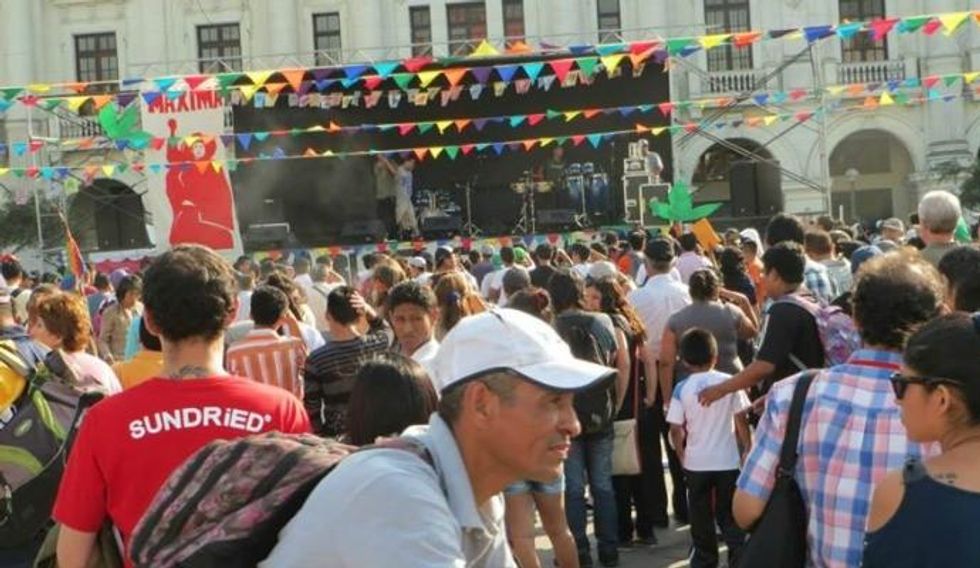
"It's incredible to see so many people from social movements around the world coming together at this People's Summit on Climate Change," Cindy Wiesner, National Coordinator for Grassroots Global Justice Alliance, told Common Dreams.
"There are mass movement organizations like La Via Campesina, broad labor unions like the CUT-Peru (Confederation of Workers of Peru), global feminist movements like the World March of Women, indigenous alliances like Andean Coordinator of Indigenous Organizations (CAOI) and Indigenous Environmental Network (IEN), all putting our heads together in Lima to align our community-led solutions to this climate crisis," Wiesner added.
The summit, which takes place from December 8 to 11, is "split into five tracks which all address a piece of climate change from food to rights of Mother Earth to alternative energy and economies," Diana Lopez of the Southwest Workers Union in San Antonio, Texas told Common Dreams. "A large percent of the participants are indigenous people from the region. Many understand and speak Spanish but it is not their native language."
Lopez shared reflections on the opening day of the gathering:
On one level you have global funders making spaces for their grantees to speak about their work. On another there are more academic, technology and policy spaces. And finally there are the organizer spaces which are self-organized and are concentrated on front-line experience, movement-building and alignment around solutions.
People seem tired and frustrated talking about policy and what the government should be doing. They don't want to talk about those things anymore, and while it's important to know them and keep track of those policies that will ultimately affect our communities the most, people are passionate about shifting towards a systemic change framework. The pueblos are interested in learning how to integrate new sustainable technology into traditional farming practices while still healing Mother Earth. We are talking about fighting against the extreme corporations that continue to destroy communities while developing an alternative space where our people can thrive and begin the healing of Pachamama.
The message is clear that in order to really create solutions to climate change we must also talk about the disparities among funding, patriarchy within our own movement and the role U.S. plays in the destruction of communities.
The Summit is building towards a December 10th "People's Climate March" through Lima, timed to coincide with the International Day of Human Rights, which marks the adoption of the Universal Declaration of Human Rights in 1948.
An announcement for the march declares, "[W]e invite you to come and defend YOUR rights, OUR rights and those of LIFE on Earth."
Social movements and civil societies from around the world are gathered in Lima, Peru this week with an ambitious goal: to "develop an alternative form of development, one that respects the limits and regenerative capacities of Mother Earth and tackles the structural causes of climate change."
The "People's Summit on Climate Change" is hosted by grassroots organizations and networks--including the Workers General Confederation of Peru, Andean Coordinator of Indigenous organizations, and Workers Autonomous Central of Peru.
It constitutes an alternative to the ongoing United Nations Framework Convention on Climate Change, also in Lima, where government representatives and corporate leaders are holding the latest in a series of UN talks.
"We, the social movements and the progressive forces of civil society are beginning to seriously prepare ourselves for the protracted struggle to defend the people and the planet and create a just transition from the extractive and exploitative economy to a democratic economy that aligns us with the natural processes of the earth," Kali Akuno, from the Mississippi-based organization Cooperation Jackson, told Common Dreams from Lima.
"A framework of global expropriation"
According to Akuno, who is attending the alternative summit as part of a Grassroots Global Justice Alliance delegation of U.S. communities on the front-lines of climate change, what is happening within the UN meeting is cynical: "At this moment the states and the transnational corporations are refining a framework of global expropriation that will complete the capitalist consumption of the earth. And they have become so bold as to remove any mention of human rights and protections from the framework."
The UN conference in Lima, which takes place from December 1-12, is being publicly billed as a gathering to create a draft document that will "lay the foundation for an effective, new, universal climate change agreement in Paris in 2015." The Paris meeting, known as COP21, "will mark a decisive stage in negotiations on the future international agreement on a post-2020 regime, and will, as agreed in Durban, adopt the major outlines of that regime," according to a statement from the French government.
Akuno is not alone in being disillusioned with the UN process. Critics charge that the Lima meeting, in keeping with past UN talks, has been hijacked by corporations and the interests of wealthy people and nations, and as a result, will fail to deliver the urgent action needed.
Representatives from the fossil fuel industry have been holding private meetings with numerous national delegations, including a closed-door meeting between the Canadian delegation and Chevron and TransCanada, according to a report from Leehi Yona and Diego Arguedas Ortiz in Inter Press Service.
On Monday, activists, including indigenous communities in Colombia, Peru, Canada, and beyond, shut down a panel at the Conference. The panel--originally titled, "Why Divest from Fossil Fuels When a Future with Low Emission Fossil Energy Use is Already a Reality?"--which was organized by fossil fuel industry lobbyists and featured speakers from the World Coal Association and Shell.
However, People's Summit organizers say the UN conference presents an opening to civil society and social movement groups to set their own vision for global change heading into the Paris meeting.
As world leaders draft a new climate agreement, those gathered at the alternative summit will "share initiatives, proposals and experiences, as well as define and coordinate our agendas, to bring pressure to bear on the decision makers at COP20, and demand that the official negotiators take account of the world's citizens and peoples," according to organizers.
"People from social movements around the world"
"It's incredible to see so many people from social movements around the world coming together at this People's Summit on Climate Change," Cindy Wiesner, National Coordinator for Grassroots Global Justice Alliance, told Common Dreams.
"There are mass movement organizations like La Via Campesina, broad labor unions like the CUT-Peru (Confederation of Workers of Peru), global feminist movements like the World March of Women, indigenous alliances like Andean Coordinator of Indigenous Organizations (CAOI) and Indigenous Environmental Network (IEN), all putting our heads together in Lima to align our community-led solutions to this climate crisis," Wiesner added.
The summit, which takes place from December 8 to 11, is "split into five tracks which all address a piece of climate change from food to rights of Mother Earth to alternative energy and economies," Diana Lopez of the Southwest Workers Union in San Antonio, Texas told Common Dreams. "A large percent of the participants are indigenous people from the region. Many understand and speak Spanish but it is not their native language."
Lopez shared reflections on the opening day of the gathering:
On one level you have global funders making spaces for their grantees to speak about their work. On another there are more academic, technology and policy spaces. And finally there are the organizer spaces which are self-organized and are concentrated on front-line experience, movement-building and alignment around solutions.
People seem tired and frustrated talking about policy and what the government should be doing. They don't want to talk about those things anymore, and while it's important to know them and keep track of those policies that will ultimately affect our communities the most, people are passionate about shifting towards a systemic change framework. The pueblos are interested in learning how to integrate new sustainable technology into traditional farming practices while still healing Mother Earth. We are talking about fighting against the extreme corporations that continue to destroy communities while developing an alternative space where our people can thrive and begin the healing of Pachamama.
The message is clear that in order to really create solutions to climate change we must also talk about the disparities among funding, patriarchy within our own movement and the role U.S. plays in the destruction of communities.
The Summit is building towards a December 10th "People's Climate March" through Lima, timed to coincide with the International Day of Human Rights, which marks the adoption of the Universal Declaration of Human Rights in 1948.
An announcement for the march declares, "[W]e invite you to come and defend YOUR rights, OUR rights and those of LIFE on Earth."
Social movements and civil societies from around the world are gathered in Lima, Peru this week with an ambitious goal: to "develop an alternative form of development, one that respects the limits and regenerative capacities of Mother Earth and tackles the structural causes of climate change."
The "People's Summit on Climate Change" is hosted by grassroots organizations and networks--including the Workers General Confederation of Peru, Andean Coordinator of Indigenous organizations, and Workers Autonomous Central of Peru.
It constitutes an alternative to the ongoing United Nations Framework Convention on Climate Change, also in Lima, where government representatives and corporate leaders are holding the latest in a series of UN talks.
"We, the social movements and the progressive forces of civil society are beginning to seriously prepare ourselves for the protracted struggle to defend the people and the planet and create a just transition from the extractive and exploitative economy to a democratic economy that aligns us with the natural processes of the earth," Kali Akuno, from the Mississippi-based organization Cooperation Jackson, told Common Dreams from Lima.
"A framework of global expropriation"
According to Akuno, who is attending the alternative summit as part of a Grassroots Global Justice Alliance delegation of U.S. communities on the front-lines of climate change, what is happening within the UN meeting is cynical: "At this moment the states and the transnational corporations are refining a framework of global expropriation that will complete the capitalist consumption of the earth. And they have become so bold as to remove any mention of human rights and protections from the framework."
The UN conference in Lima, which takes place from December 1-12, is being publicly billed as a gathering to create a draft document that will "lay the foundation for an effective, new, universal climate change agreement in Paris in 2015." The Paris meeting, known as COP21, "will mark a decisive stage in negotiations on the future international agreement on a post-2020 regime, and will, as agreed in Durban, adopt the major outlines of that regime," according to a statement from the French government.
Akuno is not alone in being disillusioned with the UN process. Critics charge that the Lima meeting, in keeping with past UN talks, has been hijacked by corporations and the interests of wealthy people and nations, and as a result, will fail to deliver the urgent action needed.
Representatives from the fossil fuel industry have been holding private meetings with numerous national delegations, including a closed-door meeting between the Canadian delegation and Chevron and TransCanada, according to a report from Leehi Yona and Diego Arguedas Ortiz in Inter Press Service.
On Monday, activists, including indigenous communities in Colombia, Peru, Canada, and beyond, shut down a panel at the Conference. The panel--originally titled, "Why Divest from Fossil Fuels When a Future with Low Emission Fossil Energy Use is Already a Reality?"--which was organized by fossil fuel industry lobbyists and featured speakers from the World Coal Association and Shell.
However, People's Summit organizers say the UN conference presents an opening to civil society and social movement groups to set their own vision for global change heading into the Paris meeting.
As world leaders draft a new climate agreement, those gathered at the alternative summit will "share initiatives, proposals and experiences, as well as define and coordinate our agendas, to bring pressure to bear on the decision makers at COP20, and demand that the official negotiators take account of the world's citizens and peoples," according to organizers.
"People from social movements around the world"
"It's incredible to see so many people from social movements around the world coming together at this People's Summit on Climate Change," Cindy Wiesner, National Coordinator for Grassroots Global Justice Alliance, told Common Dreams.
"There are mass movement organizations like La Via Campesina, broad labor unions like the CUT-Peru (Confederation of Workers of Peru), global feminist movements like the World March of Women, indigenous alliances like Andean Coordinator of Indigenous Organizations (CAOI) and Indigenous Environmental Network (IEN), all putting our heads together in Lima to align our community-led solutions to this climate crisis," Wiesner added.
The summit, which takes place from December 8 to 11, is "split into five tracks which all address a piece of climate change from food to rights of Mother Earth to alternative energy and economies," Diana Lopez of the Southwest Workers Union in San Antonio, Texas told Common Dreams. "A large percent of the participants are indigenous people from the region. Many understand and speak Spanish but it is not their native language."
Lopez shared reflections on the opening day of the gathering:
On one level you have global funders making spaces for their grantees to speak about their work. On another there are more academic, technology and policy spaces. And finally there are the organizer spaces which are self-organized and are concentrated on front-line experience, movement-building and alignment around solutions.
People seem tired and frustrated talking about policy and what the government should be doing. They don't want to talk about those things anymore, and while it's important to know them and keep track of those policies that will ultimately affect our communities the most, people are passionate about shifting towards a systemic change framework. The pueblos are interested in learning how to integrate new sustainable technology into traditional farming practices while still healing Mother Earth. We are talking about fighting against the extreme corporations that continue to destroy communities while developing an alternative space where our people can thrive and begin the healing of Pachamama.
The message is clear that in order to really create solutions to climate change we must also talk about the disparities among funding, patriarchy within our own movement and the role U.S. plays in the destruction of communities.
The Summit is building towards a December 10th "People's Climate March" through Lima, timed to coincide with the International Day of Human Rights, which marks the adoption of the Universal Declaration of Human Rights in 1948.
An announcement for the march declares, "[W]e invite you to come and defend YOUR rights, OUR rights and those of LIFE on Earth."