SUBSCRIBE TO OUR FREE NEWSLETTER
Daily news & progressive opinion—funded by the people, not the corporations—delivered straight to your inbox.
5
#000000
#FFFFFF
To donate by check, phone, or other method, see our More Ways to Give page.
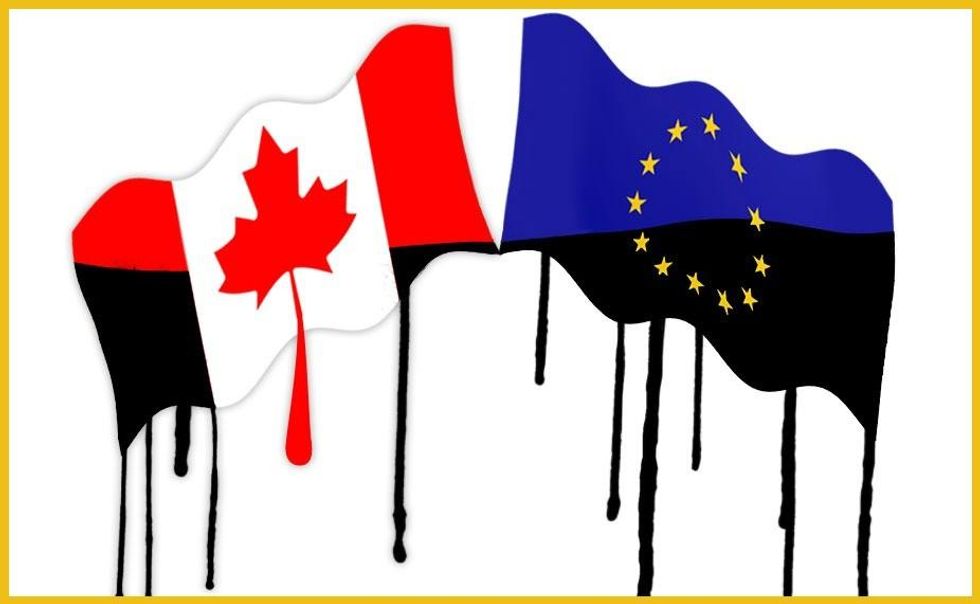
In a letter this week to the EU president Jose Manuel Barroso, EU ministers and heads of state, the prominent group of peace advocates and scientists implored the government leaders to enact a law that would classify the heavy bitumen that comes from tar sands mining as a dirtier fuel than conventional crude oil. Such a move, the letter argues, would provide incentives for cleaner energy choices within the EU and also help discourage further development of Canada's destructive tar sands industry.
"The world can no longer ignore, except at our own peril, that climate change is one of the greatest threats facing life on this planet today," the letter reads. "The impacts of climate change and extreme resource extraction are exacerbating conflicts and environmental destruction around the world. The extraction of unconventional fuels--such as oil sands and oil shale--is having a particularly devastating impact on climate change."
The letter highlights the European Commission's own scientific research which found that one of the unconventional fuel sources identified in the proposed policy, tar sands, produces an average of 23% more greenhouse gas emissions than average conventional oil.
On the particulars of the law the group is pressing on, The Guardian reports:
EU member states approved legislation in 2009, called the fuel quality directive, with the aim of cutting greenhouse gases from transport fuel sold in Europe by 6% by 2020.
In October 2011, the commission proposed detailed rules for implementing the law, including default values to rank fuels by their greenhouse gas output over their wells-to-wheels life cycle.
So far the commission has said it is standing by its value for tar sands - of 107 grams per megajoule - making it clear to buyers that the fuel source had more greenhouse gas impact than average crude oil at 87.5g.
Intense Canadian lobbying and an inconclusive EU vote on the law forced the commission to announce an assessment of the impact of the fuel quality directive in April 2012.
EU sources say the assessment has been concluded, but not yet made public, so the law is still in limbo.
The Canadians have argued the EU law discriminates against Canadian oil and have taken every opportunity to press their case.
The commission has said repeatedly it would stand firm on the law, but the pressure to weaken the measure is intense.
The full letter follows:
EU climate legislation and unconventional fossil fuels The world can no longer ignore, except at our own peril, that climate change is one of the greatest threats facing life on this planet today. The impacts of climate change and extreme resource extraction are exacerbating conflicts and environmental destruction around the world. The extraction of unconventional fuels--such as oil sands and oil shale--is having a particularly devastating impact on climate change.
For this reason, we are writing to urge you to support the immediate implementation of the European Union's (EU) Fuel Quality Directive in order to fulfill its 6% reduction target in greenhouse gas emissions from fuels used for transportation by 2020. We have no doubt that the Directive must be applied fairly to unconventional fuels to ensure their climate impacts are fully taken into account. It follows that the fuel-producing companies should report their climate emissions and be held responsible for any emissions increase.
We welcome the EU's scientific analysis--as it is now proposed for the implementation of the EU Directive--that the extraction and production of fuels from unconventional sources fuels including oil sands, coal-to-liquid, and oil shale leads to higher emissions and that this should be reflected in the regulations.
The International Energy Agency (IEA) is warning that unconventional fuel sources are especially damaging to the environment and climate, and is concerned that these fuel sources are now increasingly competing on a par with conventional fuel sources. In order to avoid catastrophic climate change, the IEA calculates that two thirds of known fossil fuel reserves must be left in the ground.
Now is the time to transition swiftly away from fossil fuels, with a special focus on those that pollute the most. We must all move toward a future built on safe, clean and renewable energy. Fully implementing the EU's Fuel Quality Directive will send a clear signal that the European Union is committed to action that supports the rights of future generations to a healthy planet.
It is not too late to avert our actions that only amount to palliative care for a dying planet. The time for positive action is now. The European Union can demonstrate clear and unambiguous leadership by upholding its climate principles. We look forward to working together as we move forward to confront this frightening challenge to our global survival.
Mairead Maguire, Nobel Peace Prize, 1976, Ireland
Roger Guillemin, Nobel Prize in Physiology or Medicine, 1977, France
Adolfo Perez Esquivel, Nobel Peace Prize 1980, Argentina
Archbishop Desmond Tutu, Nobel Peace Prize 1984, South Africa
Rigoberta Menchu Tum, Nobel Peace Prize, 1992, Guatemala
Richard Roberts, Nobel Prize in Physiology or Medicine, 1993, United Kingdom
Paul Crutzen, Nobel Prize in Chemistry, 1995, Netherlands
Harold Kroto, Nobel Prize in Chemistry, 1996, United Kingdom
Jose Ramos-Horta, Nobel Peace Prize, 1996, East Timor
John Walker, Nobel Prize in Chemistry, 1997, UK
Jody Williams, Nobel Peace Prize, 1997, USA
John Hume, Nobel Peace Prize, 1998, Ireland
Paul Greengard, Nobel Prize in Physiology or Medicine, 2000, USA
Shirin Ebadi, Nobel Peace Prize, 2003, Iran
Gerhard Ertl, Nobel Prize in Chemistry, 2007, Germany
Mark Jaccard, member of the Intergovernmental Panel on Climate Change, Nobel Peace Prize, 2007, Canada
John Stone, member of the Intergovernmental Panel on Climate Change, Nobel Peace Prize, 2007, Canada
Martin Chalfie, Nobel Prize in Chemistry, 2008, USA
Thomas Steitz, Nobel Prize in Chemistry, 2009, USA
Leymah Gbowee, Nobel Peace Prize, 2011, Liberia
Tawakkol Karman, Nobel Peace Prize, 2011, Yemen
_____________________________________________________________
In a letter this week to the EU president Jose Manuel Barroso, EU ministers and heads of state, the prominent group of peace advocates and scientists implored the government leaders to enact a law that would classify the heavy bitumen that comes from tar sands mining as a dirtier fuel than conventional crude oil. Such a move, the letter argues, would provide incentives for cleaner energy choices within the EU and also help discourage further development of Canada's destructive tar sands industry.
"The world can no longer ignore, except at our own peril, that climate change is one of the greatest threats facing life on this planet today," the letter reads. "The impacts of climate change and extreme resource extraction are exacerbating conflicts and environmental destruction around the world. The extraction of unconventional fuels--such as oil sands and oil shale--is having a particularly devastating impact on climate change."
The letter highlights the European Commission's own scientific research which found that one of the unconventional fuel sources identified in the proposed policy, tar sands, produces an average of 23% more greenhouse gas emissions than average conventional oil.
On the particulars of the law the group is pressing on, The Guardian reports:
EU member states approved legislation in 2009, called the fuel quality directive, with the aim of cutting greenhouse gases from transport fuel sold in Europe by 6% by 2020.
In October 2011, the commission proposed detailed rules for implementing the law, including default values to rank fuels by their greenhouse gas output over their wells-to-wheels life cycle.
So far the commission has said it is standing by its value for tar sands - of 107 grams per megajoule - making it clear to buyers that the fuel source had more greenhouse gas impact than average crude oil at 87.5g.
Intense Canadian lobbying and an inconclusive EU vote on the law forced the commission to announce an assessment of the impact of the fuel quality directive in April 2012.
EU sources say the assessment has been concluded, but not yet made public, so the law is still in limbo.
The Canadians have argued the EU law discriminates against Canadian oil and have taken every opportunity to press their case.
The commission has said repeatedly it would stand firm on the law, but the pressure to weaken the measure is intense.
The full letter follows:
EU climate legislation and unconventional fossil fuels The world can no longer ignore, except at our own peril, that climate change is one of the greatest threats facing life on this planet today. The impacts of climate change and extreme resource extraction are exacerbating conflicts and environmental destruction around the world. The extraction of unconventional fuels--such as oil sands and oil shale--is having a particularly devastating impact on climate change.
For this reason, we are writing to urge you to support the immediate implementation of the European Union's (EU) Fuel Quality Directive in order to fulfill its 6% reduction target in greenhouse gas emissions from fuels used for transportation by 2020. We have no doubt that the Directive must be applied fairly to unconventional fuels to ensure their climate impacts are fully taken into account. It follows that the fuel-producing companies should report their climate emissions and be held responsible for any emissions increase.
We welcome the EU's scientific analysis--as it is now proposed for the implementation of the EU Directive--that the extraction and production of fuels from unconventional sources fuels including oil sands, coal-to-liquid, and oil shale leads to higher emissions and that this should be reflected in the regulations.
The International Energy Agency (IEA) is warning that unconventional fuel sources are especially damaging to the environment and climate, and is concerned that these fuel sources are now increasingly competing on a par with conventional fuel sources. In order to avoid catastrophic climate change, the IEA calculates that two thirds of known fossil fuel reserves must be left in the ground.
Now is the time to transition swiftly away from fossil fuels, with a special focus on those that pollute the most. We must all move toward a future built on safe, clean and renewable energy. Fully implementing the EU's Fuel Quality Directive will send a clear signal that the European Union is committed to action that supports the rights of future generations to a healthy planet.
It is not too late to avert our actions that only amount to palliative care for a dying planet. The time for positive action is now. The European Union can demonstrate clear and unambiguous leadership by upholding its climate principles. We look forward to working together as we move forward to confront this frightening challenge to our global survival.
Mairead Maguire, Nobel Peace Prize, 1976, Ireland
Roger Guillemin, Nobel Prize in Physiology or Medicine, 1977, France
Adolfo Perez Esquivel, Nobel Peace Prize 1980, Argentina
Archbishop Desmond Tutu, Nobel Peace Prize 1984, South Africa
Rigoberta Menchu Tum, Nobel Peace Prize, 1992, Guatemala
Richard Roberts, Nobel Prize in Physiology or Medicine, 1993, United Kingdom
Paul Crutzen, Nobel Prize in Chemistry, 1995, Netherlands
Harold Kroto, Nobel Prize in Chemistry, 1996, United Kingdom
Jose Ramos-Horta, Nobel Peace Prize, 1996, East Timor
John Walker, Nobel Prize in Chemistry, 1997, UK
Jody Williams, Nobel Peace Prize, 1997, USA
John Hume, Nobel Peace Prize, 1998, Ireland
Paul Greengard, Nobel Prize in Physiology or Medicine, 2000, USA
Shirin Ebadi, Nobel Peace Prize, 2003, Iran
Gerhard Ertl, Nobel Prize in Chemistry, 2007, Germany
Mark Jaccard, member of the Intergovernmental Panel on Climate Change, Nobel Peace Prize, 2007, Canada
John Stone, member of the Intergovernmental Panel on Climate Change, Nobel Peace Prize, 2007, Canada
Martin Chalfie, Nobel Prize in Chemistry, 2008, USA
Thomas Steitz, Nobel Prize in Chemistry, 2009, USA
Leymah Gbowee, Nobel Peace Prize, 2011, Liberia
Tawakkol Karman, Nobel Peace Prize, 2011, Yemen
_____________________________________________________________
In a letter this week to the EU president Jose Manuel Barroso, EU ministers and heads of state, the prominent group of peace advocates and scientists implored the government leaders to enact a law that would classify the heavy bitumen that comes from tar sands mining as a dirtier fuel than conventional crude oil. Such a move, the letter argues, would provide incentives for cleaner energy choices within the EU and also help discourage further development of Canada's destructive tar sands industry.
"The world can no longer ignore, except at our own peril, that climate change is one of the greatest threats facing life on this planet today," the letter reads. "The impacts of climate change and extreme resource extraction are exacerbating conflicts and environmental destruction around the world. The extraction of unconventional fuels--such as oil sands and oil shale--is having a particularly devastating impact on climate change."
The letter highlights the European Commission's own scientific research which found that one of the unconventional fuel sources identified in the proposed policy, tar sands, produces an average of 23% more greenhouse gas emissions than average conventional oil.
On the particulars of the law the group is pressing on, The Guardian reports:
EU member states approved legislation in 2009, called the fuel quality directive, with the aim of cutting greenhouse gases from transport fuel sold in Europe by 6% by 2020.
In October 2011, the commission proposed detailed rules for implementing the law, including default values to rank fuels by their greenhouse gas output over their wells-to-wheels life cycle.
So far the commission has said it is standing by its value for tar sands - of 107 grams per megajoule - making it clear to buyers that the fuel source had more greenhouse gas impact than average crude oil at 87.5g.
Intense Canadian lobbying and an inconclusive EU vote on the law forced the commission to announce an assessment of the impact of the fuel quality directive in April 2012.
EU sources say the assessment has been concluded, but not yet made public, so the law is still in limbo.
The Canadians have argued the EU law discriminates against Canadian oil and have taken every opportunity to press their case.
The commission has said repeatedly it would stand firm on the law, but the pressure to weaken the measure is intense.
The full letter follows:
EU climate legislation and unconventional fossil fuels The world can no longer ignore, except at our own peril, that climate change is one of the greatest threats facing life on this planet today. The impacts of climate change and extreme resource extraction are exacerbating conflicts and environmental destruction around the world. The extraction of unconventional fuels--such as oil sands and oil shale--is having a particularly devastating impact on climate change.
For this reason, we are writing to urge you to support the immediate implementation of the European Union's (EU) Fuel Quality Directive in order to fulfill its 6% reduction target in greenhouse gas emissions from fuels used for transportation by 2020. We have no doubt that the Directive must be applied fairly to unconventional fuels to ensure their climate impacts are fully taken into account. It follows that the fuel-producing companies should report their climate emissions and be held responsible for any emissions increase.
We welcome the EU's scientific analysis--as it is now proposed for the implementation of the EU Directive--that the extraction and production of fuels from unconventional sources fuels including oil sands, coal-to-liquid, and oil shale leads to higher emissions and that this should be reflected in the regulations.
The International Energy Agency (IEA) is warning that unconventional fuel sources are especially damaging to the environment and climate, and is concerned that these fuel sources are now increasingly competing on a par with conventional fuel sources. In order to avoid catastrophic climate change, the IEA calculates that two thirds of known fossil fuel reserves must be left in the ground.
Now is the time to transition swiftly away from fossil fuels, with a special focus on those that pollute the most. We must all move toward a future built on safe, clean and renewable energy. Fully implementing the EU's Fuel Quality Directive will send a clear signal that the European Union is committed to action that supports the rights of future generations to a healthy planet.
It is not too late to avert our actions that only amount to palliative care for a dying planet. The time for positive action is now. The European Union can demonstrate clear and unambiguous leadership by upholding its climate principles. We look forward to working together as we move forward to confront this frightening challenge to our global survival.
Mairead Maguire, Nobel Peace Prize, 1976, Ireland
Roger Guillemin, Nobel Prize in Physiology or Medicine, 1977, France
Adolfo Perez Esquivel, Nobel Peace Prize 1980, Argentina
Archbishop Desmond Tutu, Nobel Peace Prize 1984, South Africa
Rigoberta Menchu Tum, Nobel Peace Prize, 1992, Guatemala
Richard Roberts, Nobel Prize in Physiology or Medicine, 1993, United Kingdom
Paul Crutzen, Nobel Prize in Chemistry, 1995, Netherlands
Harold Kroto, Nobel Prize in Chemistry, 1996, United Kingdom
Jose Ramos-Horta, Nobel Peace Prize, 1996, East Timor
John Walker, Nobel Prize in Chemistry, 1997, UK
Jody Williams, Nobel Peace Prize, 1997, USA
John Hume, Nobel Peace Prize, 1998, Ireland
Paul Greengard, Nobel Prize in Physiology or Medicine, 2000, USA
Shirin Ebadi, Nobel Peace Prize, 2003, Iran
Gerhard Ertl, Nobel Prize in Chemistry, 2007, Germany
Mark Jaccard, member of the Intergovernmental Panel on Climate Change, Nobel Peace Prize, 2007, Canada
John Stone, member of the Intergovernmental Panel on Climate Change, Nobel Peace Prize, 2007, Canada
Martin Chalfie, Nobel Prize in Chemistry, 2008, USA
Thomas Steitz, Nobel Prize in Chemistry, 2009, USA
Leymah Gbowee, Nobel Peace Prize, 2011, Liberia
Tawakkol Karman, Nobel Peace Prize, 2011, Yemen
_____________________________________________________________