SUBSCRIBE TO OUR FREE NEWSLETTER
Daily news & progressive opinion—funded by the people, not the corporations—delivered straight to your inbox.
5
#000000
#FFFFFF
To donate by check, phone, or other method, see our More Ways to Give page.
Daily news & progressive opinion—funded by the people, not the corporations—delivered straight to your inbox.
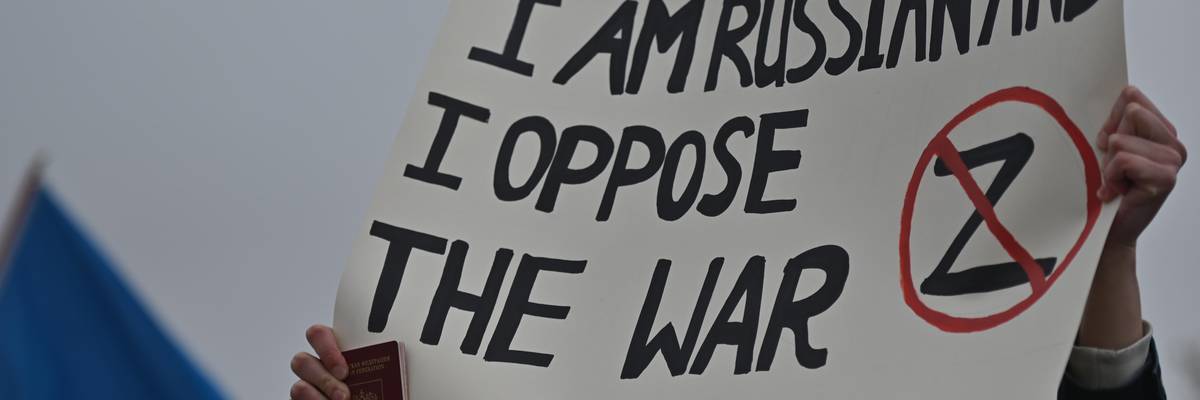
A protester holds a Russian passport and a poster with words '"I am Russian and I oppose the war" during the human chain against the killing of children by the Russian army during the invasion of Ukraine. (Photo: Artur Widak/NurPhoto via Getty Images)
The tragic, illegal war of aggression by Russia against Ukraine should end now, with a ceasefire and then a comprehensive peace agreement. It could be based on the previously negotiated 2015 Minsk II agreement, which is quite detailed and balanced in seeking to resolve territorial, political, cultural, and linguistic disputes. What makes this war so ghastly is the eventual outcome was widely known and achievable before Russia invaded, namely Ukrainian neutrality, no NATO membership, and territorial, legal and political accommodations over Crimea and the Donbas region.
NATO expansion eastward toward Russia's borders and US/Western post-Cold War triumphalism was and is a problem. It was a strategic mistake to treat Russia-with its justifiably proud history and culture--as a miserable, groveling loser that had no choice but to swallow Western supremacy in Eurasia and the world after the collapse of the Soviet Union. But none of that excuses Russian President Vladmir Putin's illegal invasion. Moreover, it has backfired horribly, as Finland and Sweden are now likely to join NATO.
Not one more Ukrainian civilian, or Ukrainian or Russian soldier, needs to die or be maimed for life in this senseless slaughter.
Ukraine has the right to defend itself, and US and Western arms manufacturers and politicians are glad to oblige with military aid and weapons transfers, but the risk of escalation, up to and including threats of using nuclear weapons, needs to be taken seriously.
Unfortunately, the conflict also has potentially dire ripple effects. The Middle East and Africa face a serious food security crisis as wheat, other grains and food, and fertilizer prices are soaring from shortages due to the war, which has and will continue to decrease agricultural production in Ukraine and Russia, the breadbasket for hundreds of millions of people.
"I have to say that I am deeply concerned, namely with the risks of hunger becoming widespread in different parts of the world because of the dramatic food security situation we are facing because of the war in Ukraine," UN Secretary General Antonio Guterres said recently.
The solution to ending this tragic war might well be to go big and go broad, with multilateral negotiations to address areas of common interest to the US, Russia, Ukraine, Europe and the world, on the following issues:
Russia, the United States and the seven other nuclear nations (China, France, Britain, Israel, India, Pakistan, and North Korea) should support and participate in next month's First Meeting of States Party to the Treaty on the Prohibition of Nuclear Weapons in Vienna. To date, 89 countries have signed the treaty. Lastly, the two nuclear behemoths need to lead on honoring their Article VI commitment to pursue global nuclear disarmament codified in the Nuclear Nonproliferation Treaty (NPT), which will convene its delayed (because of Covid) Review Conference at the UN in New York in August. These issues are of the utmost importance on their own, and the war in Ukraine has added new urgency to the denuclearization agenda.
Washington and Moscow already collaborate on many regional nuclear security concerns (Iran and the Middle East, North Korea and Northeast Asia for two), and this work needs to be urgently rejuvenated to avoid nuclear proliferation or threats of war in parts of the world already rife with conflict and instability. China can be brought in on some of these issues if the parties agree (Beijing is already engaged in resolving the Iran and North Korea nuclear problems). Improving US-China-Russian relations in general is crucial to heading off needless and disastrous global conflict.
It's a broad agenda, and may seem too ambitious given the dismal state of relations between Washington and Moscow. But let's put conventional political considerations aside. These are real solutions sorely needed by the people of the United States, Russia, and Ukraine, and a whole world badly in turmoil and on the brink of worse.
Dear Common Dreams reader, It’s been nearly 30 years since I co-founded Common Dreams with my late wife, Lina Newhouser. We had the radical notion that journalism should serve the public good, not corporate profits. It was clear to us from the outset what it would take to build such a project. No paid advertisements. No corporate sponsors. No millionaire publisher telling us what to think or do. Many people said we wouldn't last a year, but we proved those doubters wrong. Together with a tremendous team of journalists and dedicated staff, we built an independent media outlet free from the constraints of profits and corporate control. Our mission has always been simple: To inform. To inspire. To ignite change for the common good. Building Common Dreams was not easy. Our survival was never guaranteed. When you take on the most powerful forces—Wall Street greed, fossil fuel industry destruction, Big Tech lobbyists, and uber-rich oligarchs who have spent billions upon billions rigging the economy and democracy in their favor—the only bulwark you have is supporters who believe in your work. But here’s the urgent message from me today. It's never been this bad out there. And it's never been this hard to keep us going. At the very moment Common Dreams is most needed, the threats we face are intensifying. We need your support now more than ever. We don't accept corporate advertising and never will. We don't have a paywall because we don't think people should be blocked from critical news based on their ability to pay. Everything we do is funded by the donations of readers like you. When everyone does the little they can afford, we are strong. But if that support retreats or dries up, so do we. Will you donate now to make sure Common Dreams not only survives but thrives? —Craig Brown, Co-founder |
The tragic, illegal war of aggression by Russia against Ukraine should end now, with a ceasefire and then a comprehensive peace agreement. It could be based on the previously negotiated 2015 Minsk II agreement, which is quite detailed and balanced in seeking to resolve territorial, political, cultural, and linguistic disputes. What makes this war so ghastly is the eventual outcome was widely known and achievable before Russia invaded, namely Ukrainian neutrality, no NATO membership, and territorial, legal and political accommodations over Crimea and the Donbas region.
NATO expansion eastward toward Russia's borders and US/Western post-Cold War triumphalism was and is a problem. It was a strategic mistake to treat Russia-with its justifiably proud history and culture--as a miserable, groveling loser that had no choice but to swallow Western supremacy in Eurasia and the world after the collapse of the Soviet Union. But none of that excuses Russian President Vladmir Putin's illegal invasion. Moreover, it has backfired horribly, as Finland and Sweden are now likely to join NATO.
Not one more Ukrainian civilian, or Ukrainian or Russian soldier, needs to die or be maimed for life in this senseless slaughter.
Ukraine has the right to defend itself, and US and Western arms manufacturers and politicians are glad to oblige with military aid and weapons transfers, but the risk of escalation, up to and including threats of using nuclear weapons, needs to be taken seriously.
Unfortunately, the conflict also has potentially dire ripple effects. The Middle East and Africa face a serious food security crisis as wheat, other grains and food, and fertilizer prices are soaring from shortages due to the war, which has and will continue to decrease agricultural production in Ukraine and Russia, the breadbasket for hundreds of millions of people.
"I have to say that I am deeply concerned, namely with the risks of hunger becoming widespread in different parts of the world because of the dramatic food security situation we are facing because of the war in Ukraine," UN Secretary General Antonio Guterres said recently.
The solution to ending this tragic war might well be to go big and go broad, with multilateral negotiations to address areas of common interest to the US, Russia, Ukraine, Europe and the world, on the following issues:
Russia, the United States and the seven other nuclear nations (China, France, Britain, Israel, India, Pakistan, and North Korea) should support and participate in next month's First Meeting of States Party to the Treaty on the Prohibition of Nuclear Weapons in Vienna. To date, 89 countries have signed the treaty. Lastly, the two nuclear behemoths need to lead on honoring their Article VI commitment to pursue global nuclear disarmament codified in the Nuclear Nonproliferation Treaty (NPT), which will convene its delayed (because of Covid) Review Conference at the UN in New York in August. These issues are of the utmost importance on their own, and the war in Ukraine has added new urgency to the denuclearization agenda.
Washington and Moscow already collaborate on many regional nuclear security concerns (Iran and the Middle East, North Korea and Northeast Asia for two), and this work needs to be urgently rejuvenated to avoid nuclear proliferation or threats of war in parts of the world already rife with conflict and instability. China can be brought in on some of these issues if the parties agree (Beijing is already engaged in resolving the Iran and North Korea nuclear problems). Improving US-China-Russian relations in general is crucial to heading off needless and disastrous global conflict.
It's a broad agenda, and may seem too ambitious given the dismal state of relations between Washington and Moscow. But let's put conventional political considerations aside. These are real solutions sorely needed by the people of the United States, Russia, and Ukraine, and a whole world badly in turmoil and on the brink of worse.
The tragic, illegal war of aggression by Russia against Ukraine should end now, with a ceasefire and then a comprehensive peace agreement. It could be based on the previously negotiated 2015 Minsk II agreement, which is quite detailed and balanced in seeking to resolve territorial, political, cultural, and linguistic disputes. What makes this war so ghastly is the eventual outcome was widely known and achievable before Russia invaded, namely Ukrainian neutrality, no NATO membership, and territorial, legal and political accommodations over Crimea and the Donbas region.
NATO expansion eastward toward Russia's borders and US/Western post-Cold War triumphalism was and is a problem. It was a strategic mistake to treat Russia-with its justifiably proud history and culture--as a miserable, groveling loser that had no choice but to swallow Western supremacy in Eurasia and the world after the collapse of the Soviet Union. But none of that excuses Russian President Vladmir Putin's illegal invasion. Moreover, it has backfired horribly, as Finland and Sweden are now likely to join NATO.
Not one more Ukrainian civilian, or Ukrainian or Russian soldier, needs to die or be maimed for life in this senseless slaughter.
Ukraine has the right to defend itself, and US and Western arms manufacturers and politicians are glad to oblige with military aid and weapons transfers, but the risk of escalation, up to and including threats of using nuclear weapons, needs to be taken seriously.
Unfortunately, the conflict also has potentially dire ripple effects. The Middle East and Africa face a serious food security crisis as wheat, other grains and food, and fertilizer prices are soaring from shortages due to the war, which has and will continue to decrease agricultural production in Ukraine and Russia, the breadbasket for hundreds of millions of people.
"I have to say that I am deeply concerned, namely with the risks of hunger becoming widespread in different parts of the world because of the dramatic food security situation we are facing because of the war in Ukraine," UN Secretary General Antonio Guterres said recently.
The solution to ending this tragic war might well be to go big and go broad, with multilateral negotiations to address areas of common interest to the US, Russia, Ukraine, Europe and the world, on the following issues:
Russia, the United States and the seven other nuclear nations (China, France, Britain, Israel, India, Pakistan, and North Korea) should support and participate in next month's First Meeting of States Party to the Treaty on the Prohibition of Nuclear Weapons in Vienna. To date, 89 countries have signed the treaty. Lastly, the two nuclear behemoths need to lead on honoring their Article VI commitment to pursue global nuclear disarmament codified in the Nuclear Nonproliferation Treaty (NPT), which will convene its delayed (because of Covid) Review Conference at the UN in New York in August. These issues are of the utmost importance on their own, and the war in Ukraine has added new urgency to the denuclearization agenda.
Washington and Moscow already collaborate on many regional nuclear security concerns (Iran and the Middle East, North Korea and Northeast Asia for two), and this work needs to be urgently rejuvenated to avoid nuclear proliferation or threats of war in parts of the world already rife with conflict and instability. China can be brought in on some of these issues if the parties agree (Beijing is already engaged in resolving the Iran and North Korea nuclear problems). Improving US-China-Russian relations in general is crucial to heading off needless and disastrous global conflict.
It's a broad agenda, and may seem too ambitious given the dismal state of relations between Washington and Moscow. But let's put conventional political considerations aside. These are real solutions sorely needed by the people of the United States, Russia, and Ukraine, and a whole world badly in turmoil and on the brink of worse.