
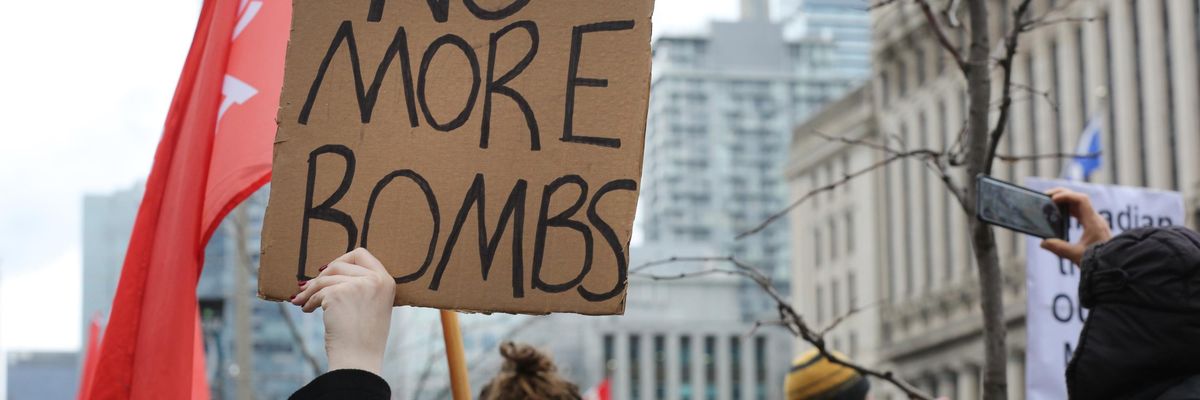
Woman holds a sign saying 'No More Bombs' as Canadians held a protest outside the American consulate in Toronto, Ontario, Canada, on January 04, 2020 to protest against American aggression towards Iran following an American airstrike that killed Iranian Major-General Qassem Soleimani.(Photo: Creative Touch Imaging Ltd./NurPhoto via Getty Images)
Now Is the Time for Canada and the World to Adopt a Feminist Foreign Policy
A feminist foreign policy outlines key principles about who needs to be at the negotiating table, like women peacebuilders who have deep community connections and a vested interest in building peace that is durable.
When Ukrainian and Russian representatives meet to attempt to negotiate a way out of the crisis, the absence of women from those tables is glaring. Yet research shows that peace accords are more likely to last when there is meaningful engagement by women.
This is exactly the moment a strong feminist foreign policy is needed most.
Bringing feminist analysis into the heart of our understanding of global affairs is not merely 'value signaling' or woke-speak. It can make the difference between life and death.
A feminist foreign policy outlines key principles about who needs to be at the negotiating table, like women peacebuilders who have deep community connections and a vested interest in building peace that is durable. And it would ensure our international actions are grounded in commitments to human rights, equality, and human security.
In Canada, we still face a severe gap between promises and clear policy. For many years, we have heard that Canada has a feminist foreign policy. Four Foreign Affairs ministers have framed Canada's foreign policy in this way. Yet we have no guiding document or policy paper that outlines what this means and why this is important in a global crisis like the one we are facing right now.
Where is Canada's feminist foreign policy?
Budget 2022 provoked more questions with $8 billion dollars in new defense spending alongside silence on the promised feminist foreign policy.
New research shows us how much is at stake if we don't bridge the gender gap. Gender inequality correlates with instability and armed conflict. Autonomous feminist movements are key drivers of democracy. Understanding gender roles, relations, and inequalities ensures a fuller picture of violent extremism.
Clearly a particular definition of masculinity informs Putin's self-image and his vision of the world.
This is all strong evidence that bringing feminist analysis into the heart of our understanding of global affairs is not merely 'value signaling' or woke-speak. It can make the difference between life and death.
In February 2020, the then Canadian Minister for Foreign Affairs, Francois-Philippe Champagne, committed to the development of a paper outlining Canada's feminist foreign policy commitments. Since then, there have been discussions but no paper.
With a lack of clarity comes a lack of action.
There are many definitions of feminist foreign policy. Sweden, the pioneer in this area, centers its policy around representation, resources, and rights. Analysts push for a nuanced analysis that goes beyond just focusing on "women and girls," arguing that a "gender analysis" must including include men, boys, and nonbinary understandings of gender. Many activists put demilitarization front and center.
With these differences, it is clear why the federal government needs to step up and outline what it sees as the priorities of Canada's feminist foreign policy, the actions it is committed to and the resources it will invest.
The world's response to the invasion in Ukraine is only the latest example that "old school" approaches to conflict resolution are not working.
It is time to bring anti-racist and decolonial analysis to international relations. It is time to bring more diverse perspectives to the table. It is time to ask questions about whose voices matter. This includes going beyond the warriors and including people who have a vested interest in stopping the guns for good, including women building peace at local, national, and international levels.
The benefits would be felt abroad and right here at home.
Advocates are quick to point out that a feminist policy encompasses more than armed conflict. It is about exploring "what makes us safe" in an increasingly fragile and interconnected world. It is about understanding the threats of climate change, pandemics, and global inequality--and the many ways these threats intersect.
It is about asking what values we stand for as Canadians.
It is about reexamining power and structures in the global system. It is about ensuring that we do not talk principles and peace at the United Nations and then support arms sales and companies guilty of environmental destruction.
A feminist foreign policy is not a luxury that Canada turns to when times are good. It is precisely in this moment of crisis that a clear statement of guiding principles is needed. We have evidence of the relevance and potential impact. We have calls from activists. Now is the time for a clear roadmap with concrete steps for implementation.
We are at a crossroads
This country and this world are at a monumental crossroads. In a few short weeks, US voters will have an opportunity to beat back the forces of fascism and confront the billionaires who are rigging the economy, our media system, and our democracy, making it increasingly impossible for ordinary people to get by. We’re not just talking about the election. We’re talking about what must be done once these fascist elements are vanquished from power. We need a bolder set of solutions than what either major party has so far been willing to offer and a working-class movement ready to fight like hell for it. Trump didn't emerge from nowhere. The conditions that fueled MAGA authoritarianism were created by decades of radical neoliberal economic policies and a corrupt political system dominated by corporate interests. They slashed taxes on the super-rich, promising that the benefits would trickle down. They said giveaways to the corporate titans would make life more affordable for the rest of us. It was all bullshit. And when a bitter, betrayed populace searches for someone to blame, right-wing demagogues have little trouble finding scapegoats. People know when they're being lied to, but you won't hear any of this from the corporate media. Only independent journalism—powered and funded by people who believe in building a better world—can deliver truly trustworthy daily news. Our Fall Campaign is underway, and we need your help. To power our newsroom through the rest of the year, we need to raise $125,000 by midnight on October 31. So if you share our vision, please contribute whatever you can to sustain our work. |
When Ukrainian and Russian representatives meet to attempt to negotiate a way out of the crisis, the absence of women from those tables is glaring. Yet research shows that peace accords are more likely to last when there is meaningful engagement by women.
This is exactly the moment a strong feminist foreign policy is needed most.
Bringing feminist analysis into the heart of our understanding of global affairs is not merely 'value signaling' or woke-speak. It can make the difference between life and death.
A feminist foreign policy outlines key principles about who needs to be at the negotiating table, like women peacebuilders who have deep community connections and a vested interest in building peace that is durable. And it would ensure our international actions are grounded in commitments to human rights, equality, and human security.
In Canada, we still face a severe gap between promises and clear policy. For many years, we have heard that Canada has a feminist foreign policy. Four Foreign Affairs ministers have framed Canada's foreign policy in this way. Yet we have no guiding document or policy paper that outlines what this means and why this is important in a global crisis like the one we are facing right now.
Where is Canada's feminist foreign policy?
Budget 2022 provoked more questions with $8 billion dollars in new defense spending alongside silence on the promised feminist foreign policy.
New research shows us how much is at stake if we don't bridge the gender gap. Gender inequality correlates with instability and armed conflict. Autonomous feminist movements are key drivers of democracy. Understanding gender roles, relations, and inequalities ensures a fuller picture of violent extremism.
Clearly a particular definition of masculinity informs Putin's self-image and his vision of the world.
This is all strong evidence that bringing feminist analysis into the heart of our understanding of global affairs is not merely 'value signaling' or woke-speak. It can make the difference between life and death.
In February 2020, the then Canadian Minister for Foreign Affairs, Francois-Philippe Champagne, committed to the development of a paper outlining Canada's feminist foreign policy commitments. Since then, there have been discussions but no paper.
With a lack of clarity comes a lack of action.
There are many definitions of feminist foreign policy. Sweden, the pioneer in this area, centers its policy around representation, resources, and rights. Analysts push for a nuanced analysis that goes beyond just focusing on "women and girls," arguing that a "gender analysis" must including include men, boys, and nonbinary understandings of gender. Many activists put demilitarization front and center.
With these differences, it is clear why the federal government needs to step up and outline what it sees as the priorities of Canada's feminist foreign policy, the actions it is committed to and the resources it will invest.
The world's response to the invasion in Ukraine is only the latest example that "old school" approaches to conflict resolution are not working.
It is time to bring anti-racist and decolonial analysis to international relations. It is time to bring more diverse perspectives to the table. It is time to ask questions about whose voices matter. This includes going beyond the warriors and including people who have a vested interest in stopping the guns for good, including women building peace at local, national, and international levels.
The benefits would be felt abroad and right here at home.
Advocates are quick to point out that a feminist policy encompasses more than armed conflict. It is about exploring "what makes us safe" in an increasingly fragile and interconnected world. It is about understanding the threats of climate change, pandemics, and global inequality--and the many ways these threats intersect.
It is about asking what values we stand for as Canadians.
It is about reexamining power and structures in the global system. It is about ensuring that we do not talk principles and peace at the United Nations and then support arms sales and companies guilty of environmental destruction.
A feminist foreign policy is not a luxury that Canada turns to when times are good. It is precisely in this moment of crisis that a clear statement of guiding principles is needed. We have evidence of the relevance and potential impact. We have calls from activists. Now is the time for a clear roadmap with concrete steps for implementation.
When Ukrainian and Russian representatives meet to attempt to negotiate a way out of the crisis, the absence of women from those tables is glaring. Yet research shows that peace accords are more likely to last when there is meaningful engagement by women.
This is exactly the moment a strong feminist foreign policy is needed most.
Bringing feminist analysis into the heart of our understanding of global affairs is not merely 'value signaling' or woke-speak. It can make the difference between life and death.
A feminist foreign policy outlines key principles about who needs to be at the negotiating table, like women peacebuilders who have deep community connections and a vested interest in building peace that is durable. And it would ensure our international actions are grounded in commitments to human rights, equality, and human security.
In Canada, we still face a severe gap between promises and clear policy. For many years, we have heard that Canada has a feminist foreign policy. Four Foreign Affairs ministers have framed Canada's foreign policy in this way. Yet we have no guiding document or policy paper that outlines what this means and why this is important in a global crisis like the one we are facing right now.
Where is Canada's feminist foreign policy?
Budget 2022 provoked more questions with $8 billion dollars in new defense spending alongside silence on the promised feminist foreign policy.
New research shows us how much is at stake if we don't bridge the gender gap. Gender inequality correlates with instability and armed conflict. Autonomous feminist movements are key drivers of democracy. Understanding gender roles, relations, and inequalities ensures a fuller picture of violent extremism.
Clearly a particular definition of masculinity informs Putin's self-image and his vision of the world.
This is all strong evidence that bringing feminist analysis into the heart of our understanding of global affairs is not merely 'value signaling' or woke-speak. It can make the difference between life and death.
In February 2020, the then Canadian Minister for Foreign Affairs, Francois-Philippe Champagne, committed to the development of a paper outlining Canada's feminist foreign policy commitments. Since then, there have been discussions but no paper.
With a lack of clarity comes a lack of action.
There are many definitions of feminist foreign policy. Sweden, the pioneer in this area, centers its policy around representation, resources, and rights. Analysts push for a nuanced analysis that goes beyond just focusing on "women and girls," arguing that a "gender analysis" must including include men, boys, and nonbinary understandings of gender. Many activists put demilitarization front and center.
With these differences, it is clear why the federal government needs to step up and outline what it sees as the priorities of Canada's feminist foreign policy, the actions it is committed to and the resources it will invest.
The world's response to the invasion in Ukraine is only the latest example that "old school" approaches to conflict resolution are not working.
It is time to bring anti-racist and decolonial analysis to international relations. It is time to bring more diverse perspectives to the table. It is time to ask questions about whose voices matter. This includes going beyond the warriors and including people who have a vested interest in stopping the guns for good, including women building peace at local, national, and international levels.
The benefits would be felt abroad and right here at home.
Advocates are quick to point out that a feminist policy encompasses more than armed conflict. It is about exploring "what makes us safe" in an increasingly fragile and interconnected world. It is about understanding the threats of climate change, pandemics, and global inequality--and the many ways these threats intersect.
It is about asking what values we stand for as Canadians.
It is about reexamining power and structures in the global system. It is about ensuring that we do not talk principles and peace at the United Nations and then support arms sales and companies guilty of environmental destruction.
A feminist foreign policy is not a luxury that Canada turns to when times are good. It is precisely in this moment of crisis that a clear statement of guiding principles is needed. We have evidence of the relevance and potential impact. We have calls from activists. Now is the time for a clear roadmap with concrete steps for implementation.