

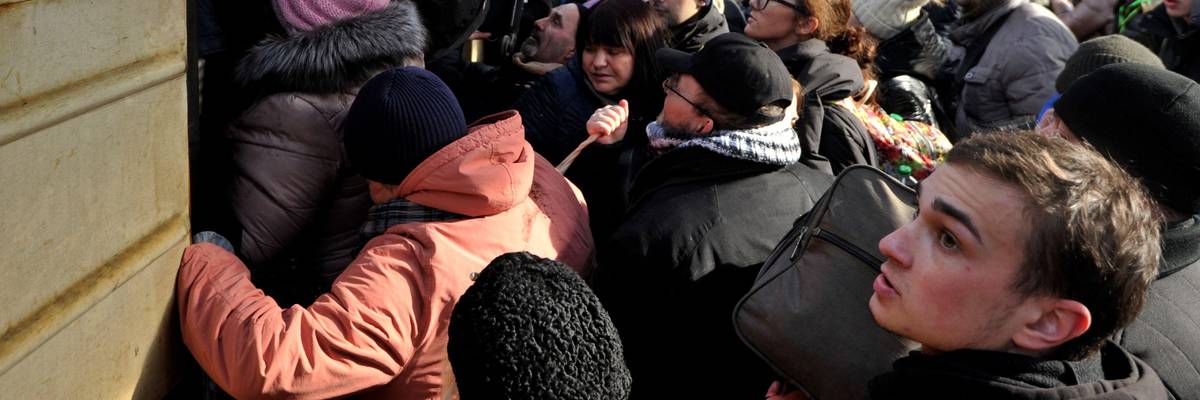
People try to get an evacuation train at Kyiv central train station on March 4, 2022. - Ukraine accused the Kremlin of "nuclear terror" on March 4, after Europe's largest atomic power plant was attacked and taken over by invading forces, sparking Western horror at the threat of Russia's war contaminating all of Europe. (Photo: Sergei Chuzavkov/AFP via Getty Images)
Ukraine, Existential Threats, and Moving Back From the Brink
We can no longer continue to wage war over finite resources and survive in a nuclear-armed world.
This spring, as those before, beckons a season of renewal and opportunity for the future. We have just witnessed the major religions of the world celebrate Easter, Passover, and Ramadan and in the words of Ambassador El Yazidi of the Coordinating Council of Muslims in Germany, "We are all siblings in humanity and must work together for good."
This is also a time when the world celebrates Earth Day with a heightened awareness of the fragility of our world and the intersectionality of mankind's actions on the survival of our planet. Yet our world is in peril with many intersecting crises from the continued global pandemic, now in its third year, to climate crises that continue to inflict progressive epic storms and devastation. Add to that the two-month-old Russian war on Ukraine with threats and nuclear posturing by the superpowers bringing us closer to nuclear war by intent, miscalculation, or cyber-attack portending the greatest threat of a global near-death event since the end of the last Cold War.
Against this backdrop, it is also tax season in the United States when the nation funds its priorities as we look to the future. In the words of Rev. Jim Wallis, founder of Sojourners magazine, "Budgets are moral documents." And so what are those priorities and how do nuclear weapons factor in?
The 2022 fiscal year budget, the first by President Joe Biden, will see the U.S. rob our communities of precious resources spending nearly $77 billion on all nuclear weapons programs, exceeding the expenditures of the last budget from the Trump administration. In total, the U.S. will have spent approximately $219 billion on all nuclear weapons programs in the last 3 fiscal years while fighting a global pandemic. To see the costs to your community, see the annual Nuclear Weapons Community Costs Project just released by Physicians for Social Responsibility Los Angeles.
Current global nuclear arsenals contain about 12,700 nuclear warheads, with the United States and Russia having near 90% of those. The use of even a tiny fraction of these weapons threatens life as we know it. A regional nuclear war using 100 Hiroshima size weapons (less than half of one percent of the global nuclear arsenals) over cities in India and Pakistan--South Asia's nuclear powers who have had a tumultuous relationship for decades--could cause a global famine threatening 2 billion people due to the devastating nuclear winter and climate change that would follow. A larger nuclear war between the U.S. and Russia targeting the major cities in each nation could possibly lead to the extinction of the human race.
This is not a situation that has to be. The existence of nuclear weapons and the continued dependence on fossil fuels with the destruction of our environment result from our way of thinking and behavior. We cannot continue to wage war over finite resources and survive in a nuclear-armed world. We must end our dependence on fossil fuels that threaten destruction of our life-sustaining ecosystems. Instead, we must recognize our interdependence as one human family. Nuclear weapons have been made by man and can only be eliminated by man. Ending the subsidy and our dependence on fossil fuels while transitioning to sustainable renewable resources is also in reach given the political will.
The United States can and must lead on these issues. There is a rapidly growing national intersectional movement in the U.S. called Back from the Brink. It is a coalition of individuals, organizations, and elected officials working together toward a world free of nuclear weapons and advocating for common sense nuclear weapons policies to secure a safer, more just future. Endorsed by over 400 organizations, 326 U.S. elected officials, 58 municipalities and 6 state legislative bodies, it calls on the United States to lead a global effort to prevent nuclear war by:
- Actively pursuing a verifiable agreement among nuclear-armed states to eliminate their nuclear arsenals
- Renouncing the option of using nuclear weapons first
- Ending the sole, unchecked authority of any U.S. President to launch a nuclear attack
- Taking U.S. nuclear weapons off hair-trigger alert
- Canceling the plan to replace the entire U.S. nuclear arsenal with enhanced weapons
All are invited to endorse and join this movement. We have a way out. There is hope for the future and that of our children's children. At this moment in history, we must understand the threat and opportunity before us. Let this be a time when we choose hope for all of humanity.
An Urgent Message From Our Co-Founder
Dear Common Dreams reader, It’s been nearly 30 years since I co-founded Common Dreams with my late wife, Lina Newhouser. We had the radical notion that journalism should serve the public good, not corporate profits. It was clear to us from the outset what it would take to build such a project. No paid advertisements. No corporate sponsors. No millionaire publisher telling us what to think or do. Many people said we wouldn't last a year, but we proved those doubters wrong. Together with a tremendous team of journalists and dedicated staff, we built an independent media outlet free from the constraints of profits and corporate control. Our mission has always been simple: To inform. To inspire. To ignite change for the common good. Building Common Dreams was not easy. Our survival was never guaranteed. When you take on the most powerful forces—Wall Street greed, fossil fuel industry destruction, Big Tech lobbyists, and uber-rich oligarchs who have spent billions upon billions rigging the economy and democracy in their favor—the only bulwark you have is supporters who believe in your work. But here’s the urgent message from me today. It's never been this bad out there. And it's never been this hard to keep us going. At the very moment Common Dreams is most needed, the threats we face are intensifying. We need your support now more than ever. We don't accept corporate advertising and never will. We don't have a paywall because we don't think people should be blocked from critical news based on their ability to pay. Everything we do is funded by the donations of readers like you. When everyone does the little they can afford, we are strong. But if that support retreats or dries up, so do we. Will you donate now to make sure Common Dreams not only survives but thrives? —Craig Brown, Co-founder |
This spring, as those before, beckons a season of renewal and opportunity for the future. We have just witnessed the major religions of the world celebrate Easter, Passover, and Ramadan and in the words of Ambassador El Yazidi of the Coordinating Council of Muslims in Germany, "We are all siblings in humanity and must work together for good."
This is also a time when the world celebrates Earth Day with a heightened awareness of the fragility of our world and the intersectionality of mankind's actions on the survival of our planet. Yet our world is in peril with many intersecting crises from the continued global pandemic, now in its third year, to climate crises that continue to inflict progressive epic storms and devastation. Add to that the two-month-old Russian war on Ukraine with threats and nuclear posturing by the superpowers bringing us closer to nuclear war by intent, miscalculation, or cyber-attack portending the greatest threat of a global near-death event since the end of the last Cold War.
Against this backdrop, it is also tax season in the United States when the nation funds its priorities as we look to the future. In the words of Rev. Jim Wallis, founder of Sojourners magazine, "Budgets are moral documents." And so what are those priorities and how do nuclear weapons factor in?
The 2022 fiscal year budget, the first by President Joe Biden, will see the U.S. rob our communities of precious resources spending nearly $77 billion on all nuclear weapons programs, exceeding the expenditures of the last budget from the Trump administration. In total, the U.S. will have spent approximately $219 billion on all nuclear weapons programs in the last 3 fiscal years while fighting a global pandemic. To see the costs to your community, see the annual Nuclear Weapons Community Costs Project just released by Physicians for Social Responsibility Los Angeles.
Current global nuclear arsenals contain about 12,700 nuclear warheads, with the United States and Russia having near 90% of those. The use of even a tiny fraction of these weapons threatens life as we know it. A regional nuclear war using 100 Hiroshima size weapons (less than half of one percent of the global nuclear arsenals) over cities in India and Pakistan--South Asia's nuclear powers who have had a tumultuous relationship for decades--could cause a global famine threatening 2 billion people due to the devastating nuclear winter and climate change that would follow. A larger nuclear war between the U.S. and Russia targeting the major cities in each nation could possibly lead to the extinction of the human race.
This is not a situation that has to be. The existence of nuclear weapons and the continued dependence on fossil fuels with the destruction of our environment result from our way of thinking and behavior. We cannot continue to wage war over finite resources and survive in a nuclear-armed world. We must end our dependence on fossil fuels that threaten destruction of our life-sustaining ecosystems. Instead, we must recognize our interdependence as one human family. Nuclear weapons have been made by man and can only be eliminated by man. Ending the subsidy and our dependence on fossil fuels while transitioning to sustainable renewable resources is also in reach given the political will.
The United States can and must lead on these issues. There is a rapidly growing national intersectional movement in the U.S. called Back from the Brink. It is a coalition of individuals, organizations, and elected officials working together toward a world free of nuclear weapons and advocating for common sense nuclear weapons policies to secure a safer, more just future. Endorsed by over 400 organizations, 326 U.S. elected officials, 58 municipalities and 6 state legislative bodies, it calls on the United States to lead a global effort to prevent nuclear war by:
- Actively pursuing a verifiable agreement among nuclear-armed states to eliminate their nuclear arsenals
- Renouncing the option of using nuclear weapons first
- Ending the sole, unchecked authority of any U.S. President to launch a nuclear attack
- Taking U.S. nuclear weapons off hair-trigger alert
- Canceling the plan to replace the entire U.S. nuclear arsenal with enhanced weapons
All are invited to endorse and join this movement. We have a way out. There is hope for the future and that of our children's children. At this moment in history, we must understand the threat and opportunity before us. Let this be a time when we choose hope for all of humanity.
This spring, as those before, beckons a season of renewal and opportunity for the future. We have just witnessed the major religions of the world celebrate Easter, Passover, and Ramadan and in the words of Ambassador El Yazidi of the Coordinating Council of Muslims in Germany, "We are all siblings in humanity and must work together for good."
This is also a time when the world celebrates Earth Day with a heightened awareness of the fragility of our world and the intersectionality of mankind's actions on the survival of our planet. Yet our world is in peril with many intersecting crises from the continued global pandemic, now in its third year, to climate crises that continue to inflict progressive epic storms and devastation. Add to that the two-month-old Russian war on Ukraine with threats and nuclear posturing by the superpowers bringing us closer to nuclear war by intent, miscalculation, or cyber-attack portending the greatest threat of a global near-death event since the end of the last Cold War.
Against this backdrop, it is also tax season in the United States when the nation funds its priorities as we look to the future. In the words of Rev. Jim Wallis, founder of Sojourners magazine, "Budgets are moral documents." And so what are those priorities and how do nuclear weapons factor in?
The 2022 fiscal year budget, the first by President Joe Biden, will see the U.S. rob our communities of precious resources spending nearly $77 billion on all nuclear weapons programs, exceeding the expenditures of the last budget from the Trump administration. In total, the U.S. will have spent approximately $219 billion on all nuclear weapons programs in the last 3 fiscal years while fighting a global pandemic. To see the costs to your community, see the annual Nuclear Weapons Community Costs Project just released by Physicians for Social Responsibility Los Angeles.
Current global nuclear arsenals contain about 12,700 nuclear warheads, with the United States and Russia having near 90% of those. The use of even a tiny fraction of these weapons threatens life as we know it. A regional nuclear war using 100 Hiroshima size weapons (less than half of one percent of the global nuclear arsenals) over cities in India and Pakistan--South Asia's nuclear powers who have had a tumultuous relationship for decades--could cause a global famine threatening 2 billion people due to the devastating nuclear winter and climate change that would follow. A larger nuclear war between the U.S. and Russia targeting the major cities in each nation could possibly lead to the extinction of the human race.
This is not a situation that has to be. The existence of nuclear weapons and the continued dependence on fossil fuels with the destruction of our environment result from our way of thinking and behavior. We cannot continue to wage war over finite resources and survive in a nuclear-armed world. We must end our dependence on fossil fuels that threaten destruction of our life-sustaining ecosystems. Instead, we must recognize our interdependence as one human family. Nuclear weapons have been made by man and can only be eliminated by man. Ending the subsidy and our dependence on fossil fuels while transitioning to sustainable renewable resources is also in reach given the political will.
The United States can and must lead on these issues. There is a rapidly growing national intersectional movement in the U.S. called Back from the Brink. It is a coalition of individuals, organizations, and elected officials working together toward a world free of nuclear weapons and advocating for common sense nuclear weapons policies to secure a safer, more just future. Endorsed by over 400 organizations, 326 U.S. elected officials, 58 municipalities and 6 state legislative bodies, it calls on the United States to lead a global effort to prevent nuclear war by:
- Actively pursuing a verifiable agreement among nuclear-armed states to eliminate their nuclear arsenals
- Renouncing the option of using nuclear weapons first
- Ending the sole, unchecked authority of any U.S. President to launch a nuclear attack
- Taking U.S. nuclear weapons off hair-trigger alert
- Canceling the plan to replace the entire U.S. nuclear arsenal with enhanced weapons
All are invited to endorse and join this movement. We have a way out. There is hope for the future and that of our children's children. At this moment in history, we must understand the threat and opportunity before us. Let this be a time when we choose hope for all of humanity.