SUBSCRIBE TO OUR FREE NEWSLETTER
Daily news & progressive opinion—funded by the people, not the corporations—delivered straight to your inbox.
5
#000000
#FFFFFF
To donate by check, phone, or other method, see our More Ways to Give page.
Daily news & progressive opinion—funded by the people, not the corporations—delivered straight to your inbox.
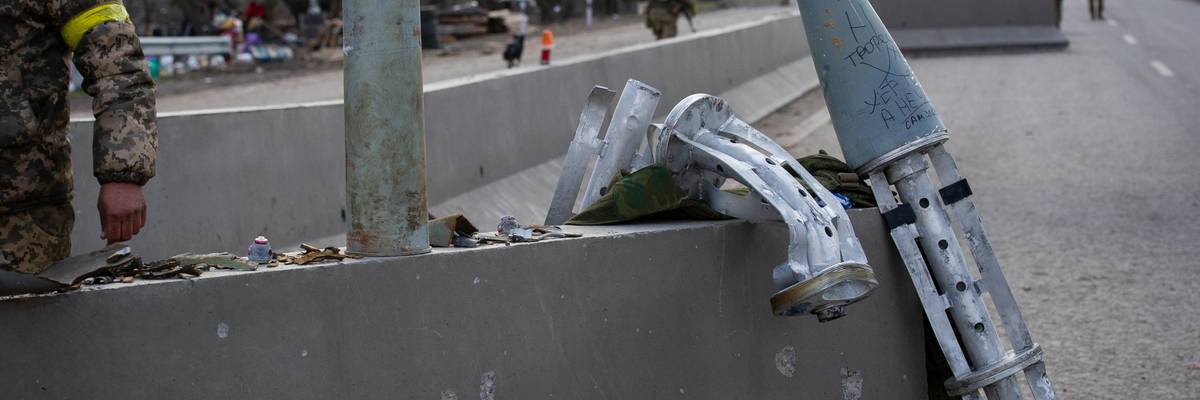
The casing of a Russian cluster bomb rocket is seen as Ukraine Army troops dig in at frontline trench positions to continue repelling Russian attacks, east of the strategic port city of Mykolaiv, Ukraine, on March 10, 2022. (Photo by Scott Peterson/Getty Images)
On Wednesday, Boris Johnson accused Russian President Vladimir Putin of committing war crimes in Ukraine. Johnson is certainly right that Ukrainian civilians are being killed by indiscriminate attacks, but will anyone end up in the dock?
International law prohibits deliberate attacks on civilians or civilian infrastructure such as hospitals and schools.
The international community has mobilized to ensure that there are consequences for the invasion and likely war crimes in Ukraine. International law prohibits deliberate attacks on civilians or civilian infrastructure such as hospitals and schools, as well as attacks which do not discriminate between civilians and legitimate military targets, or cause excessive civilian harm. Such serious violations of laws of war, if carried out intentionally or recklessly, can constitute war crimes.
On Wednesday, the UN General Assembly voted overwhelmingly in favor of a resolution condemning the aggression on Ukraine and the violations of international law that have led to civilian deaths. In another unprecedented step, 38 countries, led by the UK, asked the International Criminal Court (ICC) prosecutor, Karim Khan, to open an investigation into serious crimes in Ukraine. Mr Khan has confirmed he will do so, and his investigation will cover actions by all parties to the conflict including Russian officials.
Why raise matters to the International Criminal Court? Because there are very real fears that attacks conducted by Russian forces in Ukraine may amount to war crimes. Just one week into this war, Human Rights Watch and others have already documented serious violations of the laws of war including Russian use of cluster munitions that hit a hospital and a preschool killing a number of civilians, including a child.
Cluster munitions should never be used because of their inherently indiscriminate nature and the long-lasting danger they cause to civilians. The United Nations estimates that at least 227 civilians have been killed, and these numbers will certainly increase as the fighting moves further into urban areas.
The international community now needs to ensure that the International Criminal Court has the financial means and political backing to do its vital work on behalf of victims. Every effort needs to be made to support the collection and preservation of evidence so that one day, those who commit and order crimes in this conflict can face justice.
There will be hurdles to bringing perpetrators of war crimes in Ukraine to justice, not least Russia's resistance. But the world should continue to send a clear message that serious crimes will not be tolerated. Ukraine's civilians are counting on it.
Dear Common Dreams reader, It’s been nearly 30 years since I co-founded Common Dreams with my late wife, Lina Newhouser. We had the radical notion that journalism should serve the public good, not corporate profits. It was clear to us from the outset what it would take to build such a project. No paid advertisements. No corporate sponsors. No millionaire publisher telling us what to think or do. Many people said we wouldn't last a year, but we proved those doubters wrong. Together with a tremendous team of journalists and dedicated staff, we built an independent media outlet free from the constraints of profits and corporate control. Our mission has always been simple: To inform. To inspire. To ignite change for the common good. Building Common Dreams was not easy. Our survival was never guaranteed. When you take on the most powerful forces—Wall Street greed, fossil fuel industry destruction, Big Tech lobbyists, and uber-rich oligarchs who have spent billions upon billions rigging the economy and democracy in their favor—the only bulwark you have is supporters who believe in your work. But here’s the urgent message from me today. It's never been this bad out there. And it's never been this hard to keep us going. At the very moment Common Dreams is most needed, the threats we face are intensifying. We need your support now more than ever. We don't accept corporate advertising and never will. We don't have a paywall because we don't think people should be blocked from critical news based on their ability to pay. Everything we do is funded by the donations of readers like you. When everyone does the little they can afford, we are strong. But if that support retreats or dries up, so do we. Will you donate now to make sure Common Dreams not only survives but thrives? —Craig Brown, Co-founder |
On Wednesday, Boris Johnson accused Russian President Vladimir Putin of committing war crimes in Ukraine. Johnson is certainly right that Ukrainian civilians are being killed by indiscriminate attacks, but will anyone end up in the dock?
International law prohibits deliberate attacks on civilians or civilian infrastructure such as hospitals and schools.
The international community has mobilized to ensure that there are consequences for the invasion and likely war crimes in Ukraine. International law prohibits deliberate attacks on civilians or civilian infrastructure such as hospitals and schools, as well as attacks which do not discriminate between civilians and legitimate military targets, or cause excessive civilian harm. Such serious violations of laws of war, if carried out intentionally or recklessly, can constitute war crimes.
On Wednesday, the UN General Assembly voted overwhelmingly in favor of a resolution condemning the aggression on Ukraine and the violations of international law that have led to civilian deaths. In another unprecedented step, 38 countries, led by the UK, asked the International Criminal Court (ICC) prosecutor, Karim Khan, to open an investigation into serious crimes in Ukraine. Mr Khan has confirmed he will do so, and his investigation will cover actions by all parties to the conflict including Russian officials.
Why raise matters to the International Criminal Court? Because there are very real fears that attacks conducted by Russian forces in Ukraine may amount to war crimes. Just one week into this war, Human Rights Watch and others have already documented serious violations of the laws of war including Russian use of cluster munitions that hit a hospital and a preschool killing a number of civilians, including a child.
Cluster munitions should never be used because of their inherently indiscriminate nature and the long-lasting danger they cause to civilians. The United Nations estimates that at least 227 civilians have been killed, and these numbers will certainly increase as the fighting moves further into urban areas.
The international community now needs to ensure that the International Criminal Court has the financial means and political backing to do its vital work on behalf of victims. Every effort needs to be made to support the collection and preservation of evidence so that one day, those who commit and order crimes in this conflict can face justice.
There will be hurdles to bringing perpetrators of war crimes in Ukraine to justice, not least Russia's resistance. But the world should continue to send a clear message that serious crimes will not be tolerated. Ukraine's civilians are counting on it.
On Wednesday, Boris Johnson accused Russian President Vladimir Putin of committing war crimes in Ukraine. Johnson is certainly right that Ukrainian civilians are being killed by indiscriminate attacks, but will anyone end up in the dock?
International law prohibits deliberate attacks on civilians or civilian infrastructure such as hospitals and schools.
The international community has mobilized to ensure that there are consequences for the invasion and likely war crimes in Ukraine. International law prohibits deliberate attacks on civilians or civilian infrastructure such as hospitals and schools, as well as attacks which do not discriminate between civilians and legitimate military targets, or cause excessive civilian harm. Such serious violations of laws of war, if carried out intentionally or recklessly, can constitute war crimes.
On Wednesday, the UN General Assembly voted overwhelmingly in favor of a resolution condemning the aggression on Ukraine and the violations of international law that have led to civilian deaths. In another unprecedented step, 38 countries, led by the UK, asked the International Criminal Court (ICC) prosecutor, Karim Khan, to open an investigation into serious crimes in Ukraine. Mr Khan has confirmed he will do so, and his investigation will cover actions by all parties to the conflict including Russian officials.
Why raise matters to the International Criminal Court? Because there are very real fears that attacks conducted by Russian forces in Ukraine may amount to war crimes. Just one week into this war, Human Rights Watch and others have already documented serious violations of the laws of war including Russian use of cluster munitions that hit a hospital and a preschool killing a number of civilians, including a child.
Cluster munitions should never be used because of their inherently indiscriminate nature and the long-lasting danger they cause to civilians. The United Nations estimates that at least 227 civilians have been killed, and these numbers will certainly increase as the fighting moves further into urban areas.
The international community now needs to ensure that the International Criminal Court has the financial means and political backing to do its vital work on behalf of victims. Every effort needs to be made to support the collection and preservation of evidence so that one day, those who commit and order crimes in this conflict can face justice.
There will be hurdles to bringing perpetrators of war crimes in Ukraine to justice, not least Russia's resistance. But the world should continue to send a clear message that serious crimes will not be tolerated. Ukraine's civilians are counting on it.