SUBSCRIBE TO OUR FREE NEWSLETTER
Daily news & progressive opinion—funded by the people, not the corporations—delivered straight to your inbox.
5
#000000
#FFFFFF
To donate by check, phone, or other method, see our More Ways to Give page.
Daily news & progressive opinion—funded by the people, not the corporations—delivered straight to your inbox.
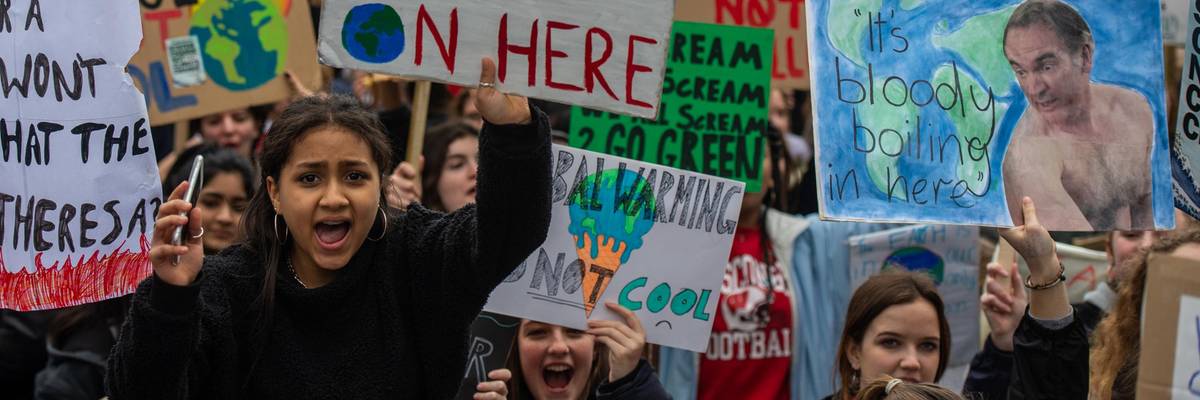
Young people take part in a student climate protest on March 15, 2019 in London, England. (Photo: Chris J. Ratcliffe/Getty Images)
In recent years, the world has been shaken by protests. From the Arab Spring to the social uprisings in Chile and Latin America, the world has seen a dramatic rise in protests. In a polarized world, the COVID-19 pandemic has only accentuated feelings of outrage and discontent.
New research brings evidence of this by analyzing nearly three thousand protests since the beginning of the 21st century, in over a hundred countries covering more than 93 percent of the world population.
Beginning in 2006, there was a steady rise in overall protests each year up to 2020. As the global financial crisis began to unfold in 2007-08, demonstrations increased, and further intensified after 2010 with the worldwide adoption of austerity cuts.
Frustration grew over the lack of decent jobs, inadequate social protection and public services, unfair taxation and a perceived lack of real democracy and accountability of decision makers to the people.
This led to a new and more political wave of protests in 2016, often becoming "omnibus protests" (protests addressing multiple issues) against the political and economic status quo. Polls worldwide reflect dissatisfaction with democracies and lack of trust in governments.
Increasingly, demonstrations are not only the purview of activists and trade unionists, but have become an outlet for the middle classes, women, youths, pensioners, indigenous and racial groups. These citizens do not consider themselves activists and yet they protest because they feel disenfranchised by official processes and political parties.
Decades of neoliberal policies have generated huge inequalities and eroded the incomes and the welfare of both the lower and middle classes, fueling feelings of injustice, disappointment with malfunctioning democracies, and frustration with failures of economic and social development.
Whist the media often portrays protests as sporadic, disorganized riots, most of the world protests studied were planned, with clearly articulated demands. The main cause of discontent (in 1,503 protests) relates to the failure of democracies and political systems, lack of real democracy, accountability and justice; corruption; as well as the perceived power of a deep government or oligarchy, sovereignty and patriotic issues; and protests against wars, the surveillance of citizens, and anti-socialism/communism.
A second cause relates to economic justice, expressing grievance and outrage against unequal austerity cuts and policy reforms (1,484 protests), demanding improved jobs, wages and labor conditions, better public services and housing, agrarian and tax justice; and against corporate influence, deregulation, privatization, inequality and low living standards; as well as against pension reforms, high energy and food prices.
The third main cause of protests is the demand for civil rights (1,360 protests) on indigenous and racial rights; women's rights; labor rights; LGBT and sexual rights; right to the commons (digital, cultural, atmospheric); immigrants' rights; freedom of assembly, speech, and press; prisoners' rights and religious issues.
A last cluster of protests encompases demands for global justice (897 protests) on issues such as environmental and climate justice; against the International Monetary Fund (IMF), the World Bank, and the European Union/European Central Bank; against imperialism (United States, China); against free trade or the G20 - demanding a better and more equitable world order.
Not only has the number of protests increased, but also the number of protestors. Crowd estimates suggest that at least 52 events had one million or more protesters.
The period 2006-2020 has evinced some of the largest protests in world history; the largest recorded was the 2020 strike in India against the government's plan to liberalize farming and labor, estimated to have involved 250 million protestors.
The second decade of the 21st century has also seen a global rise of the far right, attracting dissatisfied citizens to a radical right "counterrevolution" that typically includes an assault on the tenets of liberal democracy by authoritarian leaders.
Falling into this category were the QAnon protests in 2020 in the United States and globally; opposition to Muslims, migrants, and refugees in Europe; and the protests against the Workers Party in Brazil in 2013 and 2015.
While the rhetoric is anti-elite, far right politics does not seek significant structural power change, rather directing the popular fire and fury against minorities, denying rights to migrants, blacks, gays or Muslims, who are depicted as a threat to the jobs, security and values of the majority.
Other rallying cries include calls for personal freedoms (to carry a gun, not to wear a mask, not to be quarantined), nationalism, and the promotion of traditional values. To counter radical right authoritarianism, societies must fight misinformation and expose the contradictions of far right politics.
Nonetheless, the overwhelming majority of protests have made progressive demands for real democracy, civil rights, economic and global justice. Peaceful protests are a fundamental aspect of a vibrant democracy. Historically, protests have been a means to achieve fundamental rights at the national and international level.
While new research shows that global political instability is increasing, there are solutions. Governments need to listen to the grievances coming from protesters and act upon them. The demands of people around the world have much in common and ask for no more than established Human Rights and internationally agreed UN development goals.
Dear Common Dreams reader, It’s been nearly 30 years since I co-founded Common Dreams with my late wife, Lina Newhouser. We had the radical notion that journalism should serve the public good, not corporate profits. It was clear to us from the outset what it would take to build such a project. No paid advertisements. No corporate sponsors. No millionaire publisher telling us what to think or do. Many people said we wouldn't last a year, but we proved those doubters wrong. Together with a tremendous team of journalists and dedicated staff, we built an independent media outlet free from the constraints of profits and corporate control. Our mission has always been simple: To inform. To inspire. To ignite change for the common good. Building Common Dreams was not easy. Our survival was never guaranteed. When you take on the most powerful forces—Wall Street greed, fossil fuel industry destruction, Big Tech lobbyists, and uber-rich oligarchs who have spent billions upon billions rigging the economy and democracy in their favor—the only bulwark you have is supporters who believe in your work. But here’s the urgent message from me today. It's never been this bad out there. And it's never been this hard to keep us going. At the very moment Common Dreams is most needed, the threats we face are intensifying. We need your support now more than ever. We don't accept corporate advertising and never will. We don't have a paywall because we don't think people should be blocked from critical news based on their ability to pay. Everything we do is funded by the donations of readers like you. When everyone does the little they can afford, we are strong. But if that support retreats or dries up, so do we. Will you donate now to make sure Common Dreams not only survives but thrives? —Craig Brown, Co-founder |
In recent years, the world has been shaken by protests. From the Arab Spring to the social uprisings in Chile and Latin America, the world has seen a dramatic rise in protests. In a polarized world, the COVID-19 pandemic has only accentuated feelings of outrage and discontent.
New research brings evidence of this by analyzing nearly three thousand protests since the beginning of the 21st century, in over a hundred countries covering more than 93 percent of the world population.
Beginning in 2006, there was a steady rise in overall protests each year up to 2020. As the global financial crisis began to unfold in 2007-08, demonstrations increased, and further intensified after 2010 with the worldwide adoption of austerity cuts.
Frustration grew over the lack of decent jobs, inadequate social protection and public services, unfair taxation and a perceived lack of real democracy and accountability of decision makers to the people.
This led to a new and more political wave of protests in 2016, often becoming "omnibus protests" (protests addressing multiple issues) against the political and economic status quo. Polls worldwide reflect dissatisfaction with democracies and lack of trust in governments.
Increasingly, demonstrations are not only the purview of activists and trade unionists, but have become an outlet for the middle classes, women, youths, pensioners, indigenous and racial groups. These citizens do not consider themselves activists and yet they protest because they feel disenfranchised by official processes and political parties.
Decades of neoliberal policies have generated huge inequalities and eroded the incomes and the welfare of both the lower and middle classes, fueling feelings of injustice, disappointment with malfunctioning democracies, and frustration with failures of economic and social development.
Whist the media often portrays protests as sporadic, disorganized riots, most of the world protests studied were planned, with clearly articulated demands. The main cause of discontent (in 1,503 protests) relates to the failure of democracies and political systems, lack of real democracy, accountability and justice; corruption; as well as the perceived power of a deep government or oligarchy, sovereignty and patriotic issues; and protests against wars, the surveillance of citizens, and anti-socialism/communism.
A second cause relates to economic justice, expressing grievance and outrage against unequal austerity cuts and policy reforms (1,484 protests), demanding improved jobs, wages and labor conditions, better public services and housing, agrarian and tax justice; and against corporate influence, deregulation, privatization, inequality and low living standards; as well as against pension reforms, high energy and food prices.
The third main cause of protests is the demand for civil rights (1,360 protests) on indigenous and racial rights; women's rights; labor rights; LGBT and sexual rights; right to the commons (digital, cultural, atmospheric); immigrants' rights; freedom of assembly, speech, and press; prisoners' rights and religious issues.
A last cluster of protests encompases demands for global justice (897 protests) on issues such as environmental and climate justice; against the International Monetary Fund (IMF), the World Bank, and the European Union/European Central Bank; against imperialism (United States, China); against free trade or the G20 - demanding a better and more equitable world order.
Not only has the number of protests increased, but also the number of protestors. Crowd estimates suggest that at least 52 events had one million or more protesters.
The period 2006-2020 has evinced some of the largest protests in world history; the largest recorded was the 2020 strike in India against the government's plan to liberalize farming and labor, estimated to have involved 250 million protestors.
The second decade of the 21st century has also seen a global rise of the far right, attracting dissatisfied citizens to a radical right "counterrevolution" that typically includes an assault on the tenets of liberal democracy by authoritarian leaders.
Falling into this category were the QAnon protests in 2020 in the United States and globally; opposition to Muslims, migrants, and refugees in Europe; and the protests against the Workers Party in Brazil in 2013 and 2015.
While the rhetoric is anti-elite, far right politics does not seek significant structural power change, rather directing the popular fire and fury against minorities, denying rights to migrants, blacks, gays or Muslims, who are depicted as a threat to the jobs, security and values of the majority.
Other rallying cries include calls for personal freedoms (to carry a gun, not to wear a mask, not to be quarantined), nationalism, and the promotion of traditional values. To counter radical right authoritarianism, societies must fight misinformation and expose the contradictions of far right politics.
Nonetheless, the overwhelming majority of protests have made progressive demands for real democracy, civil rights, economic and global justice. Peaceful protests are a fundamental aspect of a vibrant democracy. Historically, protests have been a means to achieve fundamental rights at the national and international level.
While new research shows that global political instability is increasing, there are solutions. Governments need to listen to the grievances coming from protesters and act upon them. The demands of people around the world have much in common and ask for no more than established Human Rights and internationally agreed UN development goals.
In recent years, the world has been shaken by protests. From the Arab Spring to the social uprisings in Chile and Latin America, the world has seen a dramatic rise in protests. In a polarized world, the COVID-19 pandemic has only accentuated feelings of outrage and discontent.
New research brings evidence of this by analyzing nearly three thousand protests since the beginning of the 21st century, in over a hundred countries covering more than 93 percent of the world population.
Beginning in 2006, there was a steady rise in overall protests each year up to 2020. As the global financial crisis began to unfold in 2007-08, demonstrations increased, and further intensified after 2010 with the worldwide adoption of austerity cuts.
Frustration grew over the lack of decent jobs, inadequate social protection and public services, unfair taxation and a perceived lack of real democracy and accountability of decision makers to the people.
This led to a new and more political wave of protests in 2016, often becoming "omnibus protests" (protests addressing multiple issues) against the political and economic status quo. Polls worldwide reflect dissatisfaction with democracies and lack of trust in governments.
Increasingly, demonstrations are not only the purview of activists and trade unionists, but have become an outlet for the middle classes, women, youths, pensioners, indigenous and racial groups. These citizens do not consider themselves activists and yet they protest because they feel disenfranchised by official processes and political parties.
Decades of neoliberal policies have generated huge inequalities and eroded the incomes and the welfare of both the lower and middle classes, fueling feelings of injustice, disappointment with malfunctioning democracies, and frustration with failures of economic and social development.
Whist the media often portrays protests as sporadic, disorganized riots, most of the world protests studied were planned, with clearly articulated demands. The main cause of discontent (in 1,503 protests) relates to the failure of democracies and political systems, lack of real democracy, accountability and justice; corruption; as well as the perceived power of a deep government or oligarchy, sovereignty and patriotic issues; and protests against wars, the surveillance of citizens, and anti-socialism/communism.
A second cause relates to economic justice, expressing grievance and outrage against unequal austerity cuts and policy reforms (1,484 protests), demanding improved jobs, wages and labor conditions, better public services and housing, agrarian and tax justice; and against corporate influence, deregulation, privatization, inequality and low living standards; as well as against pension reforms, high energy and food prices.
The third main cause of protests is the demand for civil rights (1,360 protests) on indigenous and racial rights; women's rights; labor rights; LGBT and sexual rights; right to the commons (digital, cultural, atmospheric); immigrants' rights; freedom of assembly, speech, and press; prisoners' rights and religious issues.
A last cluster of protests encompases demands for global justice (897 protests) on issues such as environmental and climate justice; against the International Monetary Fund (IMF), the World Bank, and the European Union/European Central Bank; against imperialism (United States, China); against free trade or the G20 - demanding a better and more equitable world order.
Not only has the number of protests increased, but also the number of protestors. Crowd estimates suggest that at least 52 events had one million or more protesters.
The period 2006-2020 has evinced some of the largest protests in world history; the largest recorded was the 2020 strike in India against the government's plan to liberalize farming and labor, estimated to have involved 250 million protestors.
The second decade of the 21st century has also seen a global rise of the far right, attracting dissatisfied citizens to a radical right "counterrevolution" that typically includes an assault on the tenets of liberal democracy by authoritarian leaders.
Falling into this category were the QAnon protests in 2020 in the United States and globally; opposition to Muslims, migrants, and refugees in Europe; and the protests against the Workers Party in Brazil in 2013 and 2015.
While the rhetoric is anti-elite, far right politics does not seek significant structural power change, rather directing the popular fire and fury against minorities, denying rights to migrants, blacks, gays or Muslims, who are depicted as a threat to the jobs, security and values of the majority.
Other rallying cries include calls for personal freedoms (to carry a gun, not to wear a mask, not to be quarantined), nationalism, and the promotion of traditional values. To counter radical right authoritarianism, societies must fight misinformation and expose the contradictions of far right politics.
Nonetheless, the overwhelming majority of protests have made progressive demands for real democracy, civil rights, economic and global justice. Peaceful protests are a fundamental aspect of a vibrant democracy. Historically, protests have been a means to achieve fundamental rights at the national and international level.
While new research shows that global political instability is increasing, there are solutions. Governments need to listen to the grievances coming from protesters and act upon them. The demands of people around the world have much in common and ask for no more than established Human Rights and internationally agreed UN development goals.