SUBSCRIBE TO OUR FREE NEWSLETTER
Daily news & progressive opinion—funded by the people, not the corporations—delivered straight to your inbox.
5
#000000
#FFFFFF
To donate by check, phone, or other method, see our More Ways to Give page.
Daily news & progressive opinion—funded by the people, not the corporations—delivered straight to your inbox.
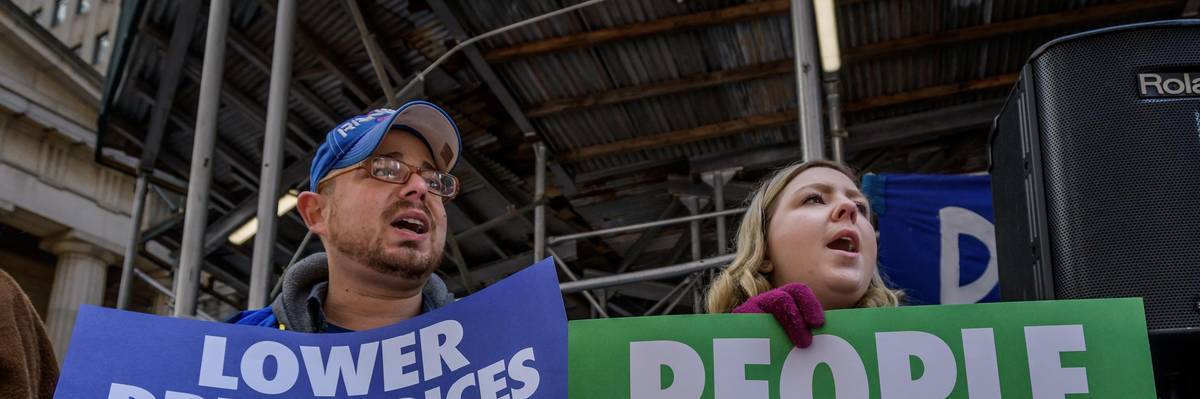
Participants holding protest signs at the rally. People living with diabetes, activists, faith leaders, and health care advocates rallied in front of the New York Stock Exchange to commemorate World Diabetes Day 2019, as part of a National Day of Action called by the Lower Drug Prices Now Campaign. (Photo by Erik McGregor/LightRocket via Getty Images)
In the thick of the coronavirus pandemic, while receiving billions in taxpayer dollars to help develop critically needed vaccines, the biggest pharmaceutical corporations hoped no one would notice that they were raising prices on more than 800 prescription medicines that families rely on for their health and wellbeing.
That's nothing new: between 2007 and 2018, drug corporations increased list prices on prescription drugs by 160%. As a result, Americans today pay two- to four times more for prescription drugs than people in other countries for the same medicines. That's why Democrats and Republicans alike have campaigned for years to lower drug prices, because the cost is simply unaffordable for too many.
No matter what excuses we hear from drug corporations, prescription medicines can't help people if most Americans can't afford them. In his first address to Congress in April, President Joe Biden called for allowing Medicare to negotiate lower drug prices, urging lawmakers to act this year. But he himself passed up a golden opportunity to include this policy in his American Families Plan.
Lowering prescription drug prices is politically popular--it's the No. 1 issue that voters want Congress to act on. More than 85% of voters in a January 2021 poll agreed that lower drug prices should be a top priority for the Biden administration.
Democrats in both the House and Senate have called for lowering drug prices as part of the American Families Plan. They followed the recommendations in a letter our coalition of 60 social, racial, and economic justice organizations sent to House Speaker Nancy Pelosi and Senate Majority Leader Chuck Schumer calling on them to advance legislation to stop price gouging and lower drug prices.
Making prescription drugs affordable isn't an issue the U.S. can put off. The price of prescription drugs is rising faster than the price of any other medical good or service. As a result of high costs, one-third of Americans say they've skipped refilling their prescriptions, and one-in-10 admitted to rationing medications in the past. American families' health and financial wellbeing is at risk.
To do so, Americans need their elected leaders to stand up for patients.
The drug-pricing legislation recently reintroduced by House Democrats, the Lower Drug Costs Now Act, would be a significant and long-overdue step towards making prescription medicines more affordable, and finally holding the pharmaceutical industry accountable for price-gouging that puts prescriptions out of reach for millions of people.
Critically, it would allow Medicare to directly negotiate prices on behalf of beneficiaries for the first time, saving taxpayers more than $450 billion. New polling shows that 85% of voters, including a majority of Republicans, support giving Medicare the ability to negotiate drug prices.
These savings could prove a critical resource in the Biden Administration's efforts to rebuild our economy, make healthcare more affordable, create jobs, and ensure accountability for taxpayer funding. Drug corporations would also no longer be able to charge seniors and families more for drugs in the United States than people in other countries pay for that same drug.
Real drug-pricing reform is the last thing Big Pharma wants: they've already launched a seven-figure ad campaign to oppose efforts to rein in their out of control price gouging. It's an industry intent on protecting the status quo that has made pharmaceuticals the most profitable industry in the U.S., even as a growing number of Americans struggle to afford the medications they need.
There's never been a better time for action by our elected leaders than now. Despite the industry's speedy production of vaccines we are still in the midst of a pandemic where access to prescription drugs is even more critical and concerns about affordability are magnified. To truly "build back better," we must make the most of this once-in-a-generation opportunity to reform our healthcare system to lower the price of prescription drugs.
After all, building back better is not possible if millions of people have to continue choosing between paying their bills or paying for prescriptions they need -- that's not a choice we should have to make in one of the wealthiest countries on earth. No matter what excuses we hear from drug corporations, prescription medicines can't help people if most Americans can't afford them.
Dear Common Dreams reader, It’s been nearly 30 years since I co-founded Common Dreams with my late wife, Lina Newhouser. We had the radical notion that journalism should serve the public good, not corporate profits. It was clear to us from the outset what it would take to build such a project. No paid advertisements. No corporate sponsors. No millionaire publisher telling us what to think or do. Many people said we wouldn't last a year, but we proved those doubters wrong. Together with a tremendous team of journalists and dedicated staff, we built an independent media outlet free from the constraints of profits and corporate control. Our mission has always been simple: To inform. To inspire. To ignite change for the common good. Building Common Dreams was not easy. Our survival was never guaranteed. When you take on the most powerful forces—Wall Street greed, fossil fuel industry destruction, Big Tech lobbyists, and uber-rich oligarchs who have spent billions upon billions rigging the economy and democracy in their favor—the only bulwark you have is supporters who believe in your work. But here’s the urgent message from me today. It's never been this bad out there. And it's never been this hard to keep us going. At the very moment Common Dreams is most needed, the threats we face are intensifying. We need your support now more than ever. We don't accept corporate advertising and never will. We don't have a paywall because we don't think people should be blocked from critical news based on their ability to pay. Everything we do is funded by the donations of readers like you. When everyone does the little they can afford, we are strong. But if that support retreats or dries up, so do we. Will you donate now to make sure Common Dreams not only survives but thrives? —Craig Brown, Co-founder |
In the thick of the coronavirus pandemic, while receiving billions in taxpayer dollars to help develop critically needed vaccines, the biggest pharmaceutical corporations hoped no one would notice that they were raising prices on more than 800 prescription medicines that families rely on for their health and wellbeing.
That's nothing new: between 2007 and 2018, drug corporations increased list prices on prescription drugs by 160%. As a result, Americans today pay two- to four times more for prescription drugs than people in other countries for the same medicines. That's why Democrats and Republicans alike have campaigned for years to lower drug prices, because the cost is simply unaffordable for too many.
No matter what excuses we hear from drug corporations, prescription medicines can't help people if most Americans can't afford them. In his first address to Congress in April, President Joe Biden called for allowing Medicare to negotiate lower drug prices, urging lawmakers to act this year. But he himself passed up a golden opportunity to include this policy in his American Families Plan.
Lowering prescription drug prices is politically popular--it's the No. 1 issue that voters want Congress to act on. More than 85% of voters in a January 2021 poll agreed that lower drug prices should be a top priority for the Biden administration.
Democrats in both the House and Senate have called for lowering drug prices as part of the American Families Plan. They followed the recommendations in a letter our coalition of 60 social, racial, and economic justice organizations sent to House Speaker Nancy Pelosi and Senate Majority Leader Chuck Schumer calling on them to advance legislation to stop price gouging and lower drug prices.
Making prescription drugs affordable isn't an issue the U.S. can put off. The price of prescription drugs is rising faster than the price of any other medical good or service. As a result of high costs, one-third of Americans say they've skipped refilling their prescriptions, and one-in-10 admitted to rationing medications in the past. American families' health and financial wellbeing is at risk.
To do so, Americans need their elected leaders to stand up for patients.
The drug-pricing legislation recently reintroduced by House Democrats, the Lower Drug Costs Now Act, would be a significant and long-overdue step towards making prescription medicines more affordable, and finally holding the pharmaceutical industry accountable for price-gouging that puts prescriptions out of reach for millions of people.
Critically, it would allow Medicare to directly negotiate prices on behalf of beneficiaries for the first time, saving taxpayers more than $450 billion. New polling shows that 85% of voters, including a majority of Republicans, support giving Medicare the ability to negotiate drug prices.
These savings could prove a critical resource in the Biden Administration's efforts to rebuild our economy, make healthcare more affordable, create jobs, and ensure accountability for taxpayer funding. Drug corporations would also no longer be able to charge seniors and families more for drugs in the United States than people in other countries pay for that same drug.
Real drug-pricing reform is the last thing Big Pharma wants: they've already launched a seven-figure ad campaign to oppose efforts to rein in their out of control price gouging. It's an industry intent on protecting the status quo that has made pharmaceuticals the most profitable industry in the U.S., even as a growing number of Americans struggle to afford the medications they need.
There's never been a better time for action by our elected leaders than now. Despite the industry's speedy production of vaccines we are still in the midst of a pandemic where access to prescription drugs is even more critical and concerns about affordability are magnified. To truly "build back better," we must make the most of this once-in-a-generation opportunity to reform our healthcare system to lower the price of prescription drugs.
After all, building back better is not possible if millions of people have to continue choosing between paying their bills or paying for prescriptions they need -- that's not a choice we should have to make in one of the wealthiest countries on earth. No matter what excuses we hear from drug corporations, prescription medicines can't help people if most Americans can't afford them.
In the thick of the coronavirus pandemic, while receiving billions in taxpayer dollars to help develop critically needed vaccines, the biggest pharmaceutical corporations hoped no one would notice that they were raising prices on more than 800 prescription medicines that families rely on for their health and wellbeing.
That's nothing new: between 2007 and 2018, drug corporations increased list prices on prescription drugs by 160%. As a result, Americans today pay two- to four times more for prescription drugs than people in other countries for the same medicines. That's why Democrats and Republicans alike have campaigned for years to lower drug prices, because the cost is simply unaffordable for too many.
No matter what excuses we hear from drug corporations, prescription medicines can't help people if most Americans can't afford them. In his first address to Congress in April, President Joe Biden called for allowing Medicare to negotiate lower drug prices, urging lawmakers to act this year. But he himself passed up a golden opportunity to include this policy in his American Families Plan.
Lowering prescription drug prices is politically popular--it's the No. 1 issue that voters want Congress to act on. More than 85% of voters in a January 2021 poll agreed that lower drug prices should be a top priority for the Biden administration.
Democrats in both the House and Senate have called for lowering drug prices as part of the American Families Plan. They followed the recommendations in a letter our coalition of 60 social, racial, and economic justice organizations sent to House Speaker Nancy Pelosi and Senate Majority Leader Chuck Schumer calling on them to advance legislation to stop price gouging and lower drug prices.
Making prescription drugs affordable isn't an issue the U.S. can put off. The price of prescription drugs is rising faster than the price of any other medical good or service. As a result of high costs, one-third of Americans say they've skipped refilling their prescriptions, and one-in-10 admitted to rationing medications in the past. American families' health and financial wellbeing is at risk.
To do so, Americans need their elected leaders to stand up for patients.
The drug-pricing legislation recently reintroduced by House Democrats, the Lower Drug Costs Now Act, would be a significant and long-overdue step towards making prescription medicines more affordable, and finally holding the pharmaceutical industry accountable for price-gouging that puts prescriptions out of reach for millions of people.
Critically, it would allow Medicare to directly negotiate prices on behalf of beneficiaries for the first time, saving taxpayers more than $450 billion. New polling shows that 85% of voters, including a majority of Republicans, support giving Medicare the ability to negotiate drug prices.
These savings could prove a critical resource in the Biden Administration's efforts to rebuild our economy, make healthcare more affordable, create jobs, and ensure accountability for taxpayer funding. Drug corporations would also no longer be able to charge seniors and families more for drugs in the United States than people in other countries pay for that same drug.
Real drug-pricing reform is the last thing Big Pharma wants: they've already launched a seven-figure ad campaign to oppose efforts to rein in their out of control price gouging. It's an industry intent on protecting the status quo that has made pharmaceuticals the most profitable industry in the U.S., even as a growing number of Americans struggle to afford the medications they need.
There's never been a better time for action by our elected leaders than now. Despite the industry's speedy production of vaccines we are still in the midst of a pandemic where access to prescription drugs is even more critical and concerns about affordability are magnified. To truly "build back better," we must make the most of this once-in-a-generation opportunity to reform our healthcare system to lower the price of prescription drugs.
After all, building back better is not possible if millions of people have to continue choosing between paying their bills or paying for prescriptions they need -- that's not a choice we should have to make in one of the wealthiest countries on earth. No matter what excuses we hear from drug corporations, prescription medicines can't help people if most Americans can't afford them.