
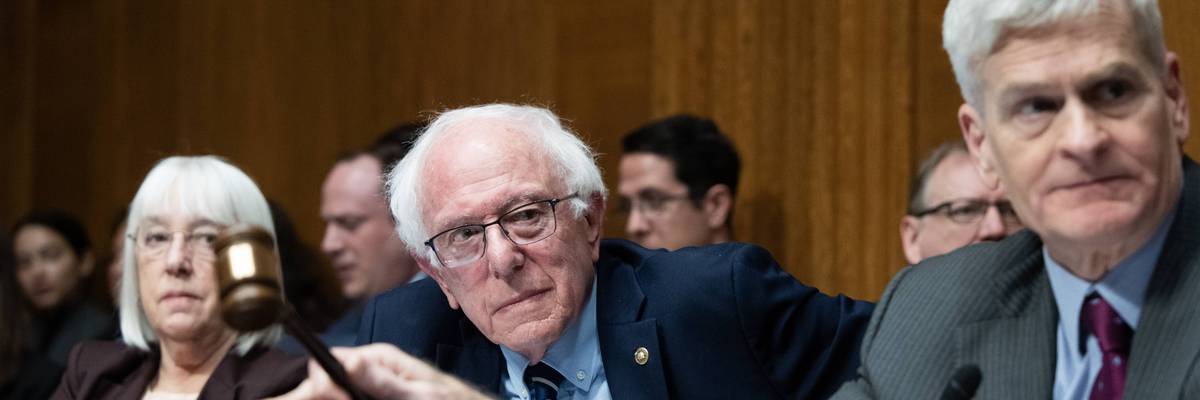
US Sen. Bernie Sanders (I-Vt.) looks on during a Senate hearing on February 25, 2026.
Senate Republicans Block Sanders Amendment to Cut US Drug Prices by More Than 50%
Sen. Bernie Sanders said the amendment blocked by the GOP "would prevent pharmaceutical companies from charging more for prescription drugs in the United States than they do in Canada, the UK, Germany, France, and Japan."
Senate Republicans voted in the early hours of Thursday morning to reject an amendment offered by Sen. Bernie Sanders that aimed to cut US prescription drug prices in half by mandating that Americans pay no more for medications than people in Canada and other wealthy nations.
Just two Republicans, Sens. Josh Hawley of Missouri and Dan Sullivan of Alaska, voted with every present Democrat in support of Sanders' (I-Vt.) proposed amendment to the GOP's emerging budget reconciliation package. Republicans plan to use the legislative vehicle to fund the Department of Homeland Security and its component agencies, principally Immigration and Customs Enforcement (ICE) and Customs and Border Protection (CBP).
The amendment vote put nearly every Senate Republican on the record against a policy supported by President Donald Trump. Last year, Trump signed an executive order directing federal health officials to "communicate most-favored-nation price targets to pharmaceutical manufacturers to bring prices for American patients in line with comparably developed nations."
But experts have noted that, without congressional action giving the federal government more power over drug pricing, pharmaceutical companies would not be required to comply with the proposed targets—rendering Trump's order effectively meaningless. Drug prices have continued to rise in the US despite Trump's order and his outlandish, mathematically impossible claims.
"If Trump is serious about making real change rather than just issuing a press release," Sanders said last year in response to Trump's executive order, "he will support legislation I will soon be introducing to make sure we pay no more for prescription drugs than people in other major countries. If Republicans and Democrats come together on this legislation, we can get it passed in a few weeks."
The Sanders-led amendment that Republicans blocked on Thursday called for reducing "the price of prescription drugs in the United States by more than 50% by adopting most-favored-nation drug pricing so that the American people pay no more for prescription drugs than Europeans or Canadians."
Research has shown that Americans pay at least twice as much on average for prescription drugs as people in other wealthy nations.
"This amendment is very simple," Sanders said during Senate debate on Thursday. "It would prevent pharmaceutical companies from charging more for prescription drugs in the United States than they do in Canada, the UK, Germany, France, and Japan.”
Last May, Sanders and several of his Democratic colleagues in the Senate introduced the Prescription Drug Price Relief Act, which would require federal health officials to "review brand-name drugs annually for excessive pricing and, if a drug is found to be priced excessively, to void any exclusivity granted to its sponsor."
"Under the bill, a price is considered excessive if the domestic average manufacturing price exceeds the median price for the drug in Canada, the United Kingdom, Germany, France, and Japan," according to a summary of the legislation. "If a price does not meet this criteria, or if pricing information is unavailable in at least three of these countries, the price is still considered excessive if it is higher than reasonable in light of specified factors, including development cost, revenue, and the size of the affected patient population."
We are at a crossroads
This country and this world are at a monumental crossroads. In a few short weeks, US voters will have an opportunity to beat back the forces of fascism and confront the billionaires who are rigging the economy, our media system, and our democracy, making it increasingly impossible for ordinary people to get by. We’re not just talking about the election. We’re talking about what must be done once these fascist elements are vanquished from power. We need a bolder set of solutions than what either major party has so far been willing to offer and a working-class movement ready to fight like hell for it. Trump didn't emerge from nowhere. The conditions that fueled MAGA authoritarianism were created by decades of radical neoliberal economic policies and a corrupt political system dominated by corporate interests. They slashed taxes on the super-rich, promising that the benefits would trickle down. They said giveaways to the corporate titans would make life more affordable for the rest of us. It was all bullshit. And when a bitter, betrayed populace searches for someone to blame, right-wing demagogues have little trouble finding scapegoats. People know when they're being lied to, but you won't hear any of this from the corporate media. Only independent journalism—powered and funded by people who believe in building a better world—can deliver truly trustworthy daily news. Our Fall Campaign is underway, and we need your help. To power our newsroom through the rest of the year, we need to raise $125,000 by midnight on October 31. So if you share our vision, please contribute whatever you can to sustain our work. |
Senate Republicans voted in the early hours of Thursday morning to reject an amendment offered by Sen. Bernie Sanders that aimed to cut US prescription drug prices in half by mandating that Americans pay no more for medications than people in Canada and other wealthy nations.
Just two Republicans, Sens. Josh Hawley of Missouri and Dan Sullivan of Alaska, voted with every present Democrat in support of Sanders' (I-Vt.) proposed amendment to the GOP's emerging budget reconciliation package. Republicans plan to use the legislative vehicle to fund the Department of Homeland Security and its component agencies, principally Immigration and Customs Enforcement (ICE) and Customs and Border Protection (CBP).
The amendment vote put nearly every Senate Republican on the record against a policy supported by President Donald Trump. Last year, Trump signed an executive order directing federal health officials to "communicate most-favored-nation price targets to pharmaceutical manufacturers to bring prices for American patients in line with comparably developed nations."
But experts have noted that, without congressional action giving the federal government more power over drug pricing, pharmaceutical companies would not be required to comply with the proposed targets—rendering Trump's order effectively meaningless. Drug prices have continued to rise in the US despite Trump's order and his outlandish, mathematically impossible claims.
"If Trump is serious about making real change rather than just issuing a press release," Sanders said last year in response to Trump's executive order, "he will support legislation I will soon be introducing to make sure we pay no more for prescription drugs than people in other major countries. If Republicans and Democrats come together on this legislation, we can get it passed in a few weeks."
The Sanders-led amendment that Republicans blocked on Thursday called for reducing "the price of prescription drugs in the United States by more than 50% by adopting most-favored-nation drug pricing so that the American people pay no more for prescription drugs than Europeans or Canadians."
Research has shown that Americans pay at least twice as much on average for prescription drugs as people in other wealthy nations.
"This amendment is very simple," Sanders said during Senate debate on Thursday. "It would prevent pharmaceutical companies from charging more for prescription drugs in the United States than they do in Canada, the UK, Germany, France, and Japan.”
Last May, Sanders and several of his Democratic colleagues in the Senate introduced the Prescription Drug Price Relief Act, which would require federal health officials to "review brand-name drugs annually for excessive pricing and, if a drug is found to be priced excessively, to void any exclusivity granted to its sponsor."
"Under the bill, a price is considered excessive if the domestic average manufacturing price exceeds the median price for the drug in Canada, the United Kingdom, Germany, France, and Japan," according to a summary of the legislation. "If a price does not meet this criteria, or if pricing information is unavailable in at least three of these countries, the price is still considered excessive if it is higher than reasonable in light of specified factors, including development cost, revenue, and the size of the affected patient population."
Senate Republicans voted in the early hours of Thursday morning to reject an amendment offered by Sen. Bernie Sanders that aimed to cut US prescription drug prices in half by mandating that Americans pay no more for medications than people in Canada and other wealthy nations.
Just two Republicans, Sens. Josh Hawley of Missouri and Dan Sullivan of Alaska, voted with every present Democrat in support of Sanders' (I-Vt.) proposed amendment to the GOP's emerging budget reconciliation package. Republicans plan to use the legislative vehicle to fund the Department of Homeland Security and its component agencies, principally Immigration and Customs Enforcement (ICE) and Customs and Border Protection (CBP).
The amendment vote put nearly every Senate Republican on the record against a policy supported by President Donald Trump. Last year, Trump signed an executive order directing federal health officials to "communicate most-favored-nation price targets to pharmaceutical manufacturers to bring prices for American patients in line with comparably developed nations."
But experts have noted that, without congressional action giving the federal government more power over drug pricing, pharmaceutical companies would not be required to comply with the proposed targets—rendering Trump's order effectively meaningless. Drug prices have continued to rise in the US despite Trump's order and his outlandish, mathematically impossible claims.
"If Trump is serious about making real change rather than just issuing a press release," Sanders said last year in response to Trump's executive order, "he will support legislation I will soon be introducing to make sure we pay no more for prescription drugs than people in other major countries. If Republicans and Democrats come together on this legislation, we can get it passed in a few weeks."
The Sanders-led amendment that Republicans blocked on Thursday called for reducing "the price of prescription drugs in the United States by more than 50% by adopting most-favored-nation drug pricing so that the American people pay no more for prescription drugs than Europeans or Canadians."
Research has shown that Americans pay at least twice as much on average for prescription drugs as people in other wealthy nations.
"This amendment is very simple," Sanders said during Senate debate on Thursday. "It would prevent pharmaceutical companies from charging more for prescription drugs in the United States than they do in Canada, the UK, Germany, France, and Japan.”
Last May, Sanders and several of his Democratic colleagues in the Senate introduced the Prescription Drug Price Relief Act, which would require federal health officials to "review brand-name drugs annually for excessive pricing and, if a drug is found to be priced excessively, to void any exclusivity granted to its sponsor."
"Under the bill, a price is considered excessive if the domestic average manufacturing price exceeds the median price for the drug in Canada, the United Kingdom, Germany, France, and Japan," according to a summary of the legislation. "If a price does not meet this criteria, or if pricing information is unavailable in at least three of these countries, the price is still considered excessive if it is higher than reasonable in light of specified factors, including development cost, revenue, and the size of the affected patient population."