SUBSCRIBE TO OUR FREE NEWSLETTER
Daily news & progressive opinion—funded by the people, not the corporations—delivered straight to your inbox.
5
#000000
#FFFFFF
To donate by check, phone, or other method, see our More Ways to Give page.
Daily news & progressive opinion—funded by the people, not the corporations—delivered straight to your inbox.
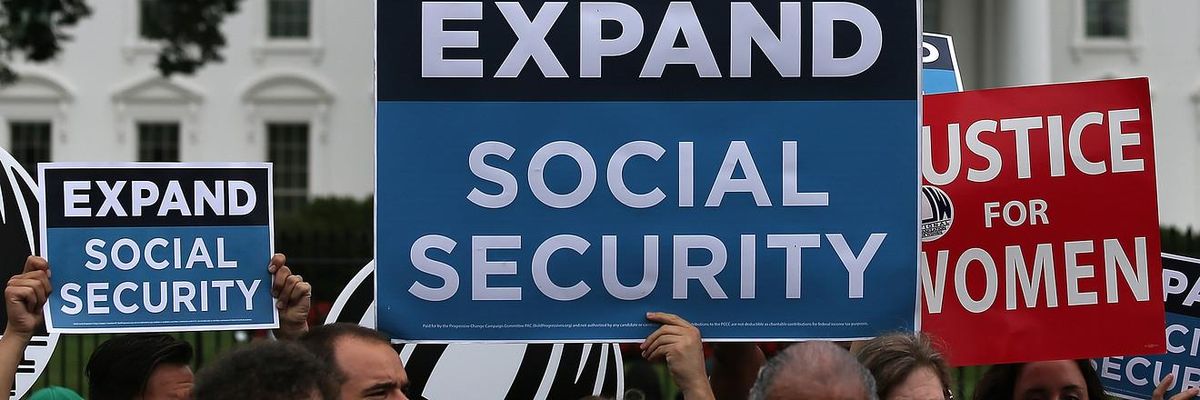
Raising the minimum wage doesn't just increase workers' current compensation," writes Lawson. "It also increases their future compensation: Social Security." (Photo: Getty Images)
What does the minimum wage have to do with Social Security? On the surface, they might seem like unrelated issues. After all, the minimum wage is for workers and Social Security is for people who've stopped working due to old age or disability. But in fact, the two are closely linked--and raising the minimum wage to a $15/hour living wage would strengthen Social Security.
"Democrats have 50 votes in the Senate, and they must do whatever it takes to get this done."
Social Security is extremely popular, effective, and efficient, but it has one major flaw--benefits are too low. Raising the minimum wage would be a big step towards fixing this problem. That's because the more money workers pay into Social Security, the greater their future benefits. In other words, raising the minimum wage doesn't just increase workers' current compensation. It also increases their future compensation: Social Security.
In practice, this means that a $15 minimum wage will increase the future Social Security benefits of low-income workers by up to $5100 a year. That translates to millions of seniors and people with disabilities who won't have to cut their medications in half in order to afford groceries.
Raising the minimum wage would also bolster the Social Security trust funds. When workers earn more, they contribute more into Social Security. A $15 minimum wage would generate over $130 billion for our Social Security system by 2035. But the same Republicans who endlessly demand cuts to Social Security so it doesn't go "bankrupt" (which is impossible) refuse to support a living wage.
The benefits to Social Security are just one of many reasons why we need to update the minimum wage to $15. It will make millions of workers and their families more economically secure. It will pump billions of dollars into communities across the country. And it will save money on means-tested assistance programs.
A $15 minimum wage just passed the House of Representative. This is a huge milestone for grassroots activists and unions who have been fighting for $15 for nearly a decade. Now, the ball is in the Senate's court--and they need to act now.
Raising the wage isn't just the right thing to do, it's also popular with Americans across the political spectrum. Democrats have 50 votes in the Senate, and they must do whatever it takes to get this done. The American people won't take no for an answer.
Dear Common Dreams reader, It’s been nearly 30 years since I co-founded Common Dreams with my late wife, Lina Newhouser. We had the radical notion that journalism should serve the public good, not corporate profits. It was clear to us from the outset what it would take to build such a project. No paid advertisements. No corporate sponsors. No millionaire publisher telling us what to think or do. Many people said we wouldn't last a year, but we proved those doubters wrong. Together with a tremendous team of journalists and dedicated staff, we built an independent media outlet free from the constraints of profits and corporate control. Our mission has always been simple: To inform. To inspire. To ignite change for the common good. Building Common Dreams was not easy. Our survival was never guaranteed. When you take on the most powerful forces—Wall Street greed, fossil fuel industry destruction, Big Tech lobbyists, and uber-rich oligarchs who have spent billions upon billions rigging the economy and democracy in their favor—the only bulwark you have is supporters who believe in your work. But here’s the urgent message from me today. It's never been this bad out there. And it's never been this hard to keep us going. At the very moment Common Dreams is most needed, the threats we face are intensifying. We need your support now more than ever. We don't accept corporate advertising and never will. We don't have a paywall because we don't think people should be blocked from critical news based on their ability to pay. Everything we do is funded by the donations of readers like you. When everyone does the little they can afford, we are strong. But if that support retreats or dries up, so do we. Will you donate now to make sure Common Dreams not only survives but thrives? —Craig Brown, Co-founder |
What does the minimum wage have to do with Social Security? On the surface, they might seem like unrelated issues. After all, the minimum wage is for workers and Social Security is for people who've stopped working due to old age or disability. But in fact, the two are closely linked--and raising the minimum wage to a $15/hour living wage would strengthen Social Security.
"Democrats have 50 votes in the Senate, and they must do whatever it takes to get this done."
Social Security is extremely popular, effective, and efficient, but it has one major flaw--benefits are too low. Raising the minimum wage would be a big step towards fixing this problem. That's because the more money workers pay into Social Security, the greater their future benefits. In other words, raising the minimum wage doesn't just increase workers' current compensation. It also increases their future compensation: Social Security.
In practice, this means that a $15 minimum wage will increase the future Social Security benefits of low-income workers by up to $5100 a year. That translates to millions of seniors and people with disabilities who won't have to cut their medications in half in order to afford groceries.
Raising the minimum wage would also bolster the Social Security trust funds. When workers earn more, they contribute more into Social Security. A $15 minimum wage would generate over $130 billion for our Social Security system by 2035. But the same Republicans who endlessly demand cuts to Social Security so it doesn't go "bankrupt" (which is impossible) refuse to support a living wage.
The benefits to Social Security are just one of many reasons why we need to update the minimum wage to $15. It will make millions of workers and their families more economically secure. It will pump billions of dollars into communities across the country. And it will save money on means-tested assistance programs.
A $15 minimum wage just passed the House of Representative. This is a huge milestone for grassroots activists and unions who have been fighting for $15 for nearly a decade. Now, the ball is in the Senate's court--and they need to act now.
Raising the wage isn't just the right thing to do, it's also popular with Americans across the political spectrum. Democrats have 50 votes in the Senate, and they must do whatever it takes to get this done. The American people won't take no for an answer.
What does the minimum wage have to do with Social Security? On the surface, they might seem like unrelated issues. After all, the minimum wage is for workers and Social Security is for people who've stopped working due to old age or disability. But in fact, the two are closely linked--and raising the minimum wage to a $15/hour living wage would strengthen Social Security.
"Democrats have 50 votes in the Senate, and they must do whatever it takes to get this done."
Social Security is extremely popular, effective, and efficient, but it has one major flaw--benefits are too low. Raising the minimum wage would be a big step towards fixing this problem. That's because the more money workers pay into Social Security, the greater their future benefits. In other words, raising the minimum wage doesn't just increase workers' current compensation. It also increases their future compensation: Social Security.
In practice, this means that a $15 minimum wage will increase the future Social Security benefits of low-income workers by up to $5100 a year. That translates to millions of seniors and people with disabilities who won't have to cut their medications in half in order to afford groceries.
Raising the minimum wage would also bolster the Social Security trust funds. When workers earn more, they contribute more into Social Security. A $15 minimum wage would generate over $130 billion for our Social Security system by 2035. But the same Republicans who endlessly demand cuts to Social Security so it doesn't go "bankrupt" (which is impossible) refuse to support a living wage.
The benefits to Social Security are just one of many reasons why we need to update the minimum wage to $15. It will make millions of workers and their families more economically secure. It will pump billions of dollars into communities across the country. And it will save money on means-tested assistance programs.
A $15 minimum wage just passed the House of Representative. This is a huge milestone for grassroots activists and unions who have been fighting for $15 for nearly a decade. Now, the ball is in the Senate's court--and they need to act now.
Raising the wage isn't just the right thing to do, it's also popular with Americans across the political spectrum. Democrats have 50 votes in the Senate, and they must do whatever it takes to get this done. The American people won't take no for an answer.