SUBSCRIBE TO OUR FREE NEWSLETTER
Daily news & progressive opinion—funded by the people, not the corporations—delivered straight to your inbox.
5
#000000
#FFFFFF
To donate by check, phone, or other method, see our More Ways to Give page.
Daily news & progressive opinion—funded by the people, not the corporations—delivered straight to your inbox.
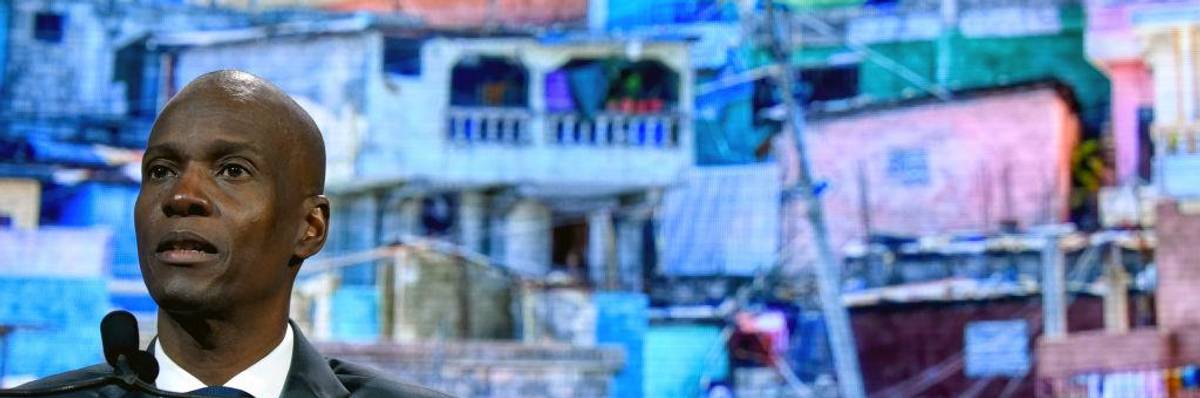
President of the Republic of Haiti H.E. Jovenel Moise speaks onstage during the 2018 Concordia Annual Summit - Day 2 at Grand Hyatt New York on September 25, 2018 in New York City. (Photo by Riccardo Savi/Getty Images for Concordia Summit)
A meaningful way to honor Black History Month is by questioning Canada's role in a country born in struggle to make Black Lives Matter. In Haiti today Ottawa is supporting a government that is reviving the specter of the infamous Papa Doc and Baby Doc Duvalier dictatorship.
More than two centuries ago Africans in Saint-Domingue rose up against the most barbaric of all the slave economies to become a beacon for Black liberation. Over 13 years they freed themselves, defeating multiple colonial powers including a British force led by Toronto icon John Graves Simcoe. The Haitian Revolution represents what may be the greatest example of liberation in the history of humanity, abolishing slavery three decades before Canada and six decades before the US.
There is a different kind of resilience emerging in Haiti today. Unfortunately, this time, it is the fortitude of a reactionary elite--that should have long been discredited--when supported by Washington and Ottawa.
Canada funds and trains a police force that has violently repressed anti-Moise protests with the Canadian ambassador repeatedly attending police functions and refusing to criticize their repression.
Neo-Duvalierist President Jovenel Moise, who should be leaving office February 7, looks set to extend his term in defiance of the constitution and popular will. After surviving 18 months of massive protests and strikes spurred by a huge corruption scandal Moise has consolidated his grip during the pandemic. In the summer he forced out the entire electoral council and instigated a gang alliance to instill fear in the slums of Port-au-Prince. Soon after parliament was disbanded because he failed to hold elections, Moise began to rewrite the constitution in violation of the law. Over the past few months he has released presidential decrees criminalizing protest blockades as "terrorism" and establishing a new intelligence agency empowered to infiltrate and arrest anyone engaged in "subversive" acts or threatening "state security." The new agency may become analogous to the Duvalier dictatorship's infamous Ton Ton Macoutes.
Canadian officials have barely criticized any of Moise's authoritarian measures. On the contrary, Ottawa has backed Moise at almost every turn. During a week-long general strike in February 2019 and an even longer one in October Canadian officials publicly backed the president. Canada funds and trains a police force that has violently repressed anti-Moise protests with the Canadian ambassador repeatedly attending police functions and refusing to criticize their repression.
Alongside the US, France, Germany, Brazil, Organization of American States (OAS), UN and Spain, Canada is part of the "Core Group" of foreign ambassadors in Port-au-Prince generally believed to be the real power behind Moise. Last year Radio Canada's flagship investigative program Enquete pointed out that the Core Group was spawned at the "Ottawa Initiative on Haiti". On January 31, 2003 the Canadian government convened top US, French and OAS officials to discuss Haiti's future. No Haitian officials were invited to the secret two-day meeting where they discussed the removal of the elected president and putting the country under UN trusteeship.
On the final day of Black History Month not long after the country celebrated the 200-year anniversary of the Haitian Revolution US Marines forced President Jean-Bertrand Aristide out of the country in the middle of the night. Canadian JTF2 special forces "secured" the airport from which Aristide said he was "kidnapped." A 15-year UN occupation of the country began.
Last year Bloc Quebecois MP Mario Beaulieu sponsored a parliamentary petition calling on the federal government to "publish all documents relating to the 'Ottawa Initiative on Haiti'" and to "hold a hearing of the Standing Committee on Foreign Affairs and International Development to learn everything there is to know about the 'Ottawa Initiative on Haiti,' including its link to the 'Core Group." The petition gathered the signatures required to be presented in parliament but was sideswiped by the global pandemic. Opposition parties should press the matter.
Rather than just words acknowledging structural racism, Ottawa must take action that improves the lives of long-marginalized Black people.
This week protests and a general strike are planned in Haiti to oppose Moise's bid to extend his mandate. The opposition has largely united behind a proposal for a caretaker government to oversee elections.
To commemorate Black History Month the Canadian Foreign Policy Institute has launched a letter writing campaign to new Foreign Minister Marc Garneau asking him to reset Canadian policy towards a country that did so much to make Black lives matter.
Rather than just words acknowledging structural racism, Ottawa must take action that improves the lives of long-marginalized Black people. At the international level a good place to begin would be ending Canada's support for the revival of Duvalierism in Haiti.
Dear Common Dreams reader, It’s been nearly 30 years since I co-founded Common Dreams with my late wife, Lina Newhouser. We had the radical notion that journalism should serve the public good, not corporate profits. It was clear to us from the outset what it would take to build such a project. No paid advertisements. No corporate sponsors. No millionaire publisher telling us what to think or do. Many people said we wouldn't last a year, but we proved those doubters wrong. Together with a tremendous team of journalists and dedicated staff, we built an independent media outlet free from the constraints of profits and corporate control. Our mission has always been simple: To inform. To inspire. To ignite change for the common good. Building Common Dreams was not easy. Our survival was never guaranteed. When you take on the most powerful forces—Wall Street greed, fossil fuel industry destruction, Big Tech lobbyists, and uber-rich oligarchs who have spent billions upon billions rigging the economy and democracy in their favor—the only bulwark you have is supporters who believe in your work. But here’s the urgent message from me today. It's never been this bad out there. And it's never been this hard to keep us going. At the very moment Common Dreams is most needed, the threats we face are intensifying. We need your support now more than ever. We don't accept corporate advertising and never will. We don't have a paywall because we don't think people should be blocked from critical news based on their ability to pay. Everything we do is funded by the donations of readers like you. When everyone does the little they can afford, we are strong. But if that support retreats or dries up, so do we. Will you donate now to make sure Common Dreams not only survives but thrives? —Craig Brown, Co-founder |
A meaningful way to honor Black History Month is by questioning Canada's role in a country born in struggle to make Black Lives Matter. In Haiti today Ottawa is supporting a government that is reviving the specter of the infamous Papa Doc and Baby Doc Duvalier dictatorship.
More than two centuries ago Africans in Saint-Domingue rose up against the most barbaric of all the slave economies to become a beacon for Black liberation. Over 13 years they freed themselves, defeating multiple colonial powers including a British force led by Toronto icon John Graves Simcoe. The Haitian Revolution represents what may be the greatest example of liberation in the history of humanity, abolishing slavery three decades before Canada and six decades before the US.
There is a different kind of resilience emerging in Haiti today. Unfortunately, this time, it is the fortitude of a reactionary elite--that should have long been discredited--when supported by Washington and Ottawa.
Canada funds and trains a police force that has violently repressed anti-Moise protests with the Canadian ambassador repeatedly attending police functions and refusing to criticize their repression.
Neo-Duvalierist President Jovenel Moise, who should be leaving office February 7, looks set to extend his term in defiance of the constitution and popular will. After surviving 18 months of massive protests and strikes spurred by a huge corruption scandal Moise has consolidated his grip during the pandemic. In the summer he forced out the entire electoral council and instigated a gang alliance to instill fear in the slums of Port-au-Prince. Soon after parliament was disbanded because he failed to hold elections, Moise began to rewrite the constitution in violation of the law. Over the past few months he has released presidential decrees criminalizing protest blockades as "terrorism" and establishing a new intelligence agency empowered to infiltrate and arrest anyone engaged in "subversive" acts or threatening "state security." The new agency may become analogous to the Duvalier dictatorship's infamous Ton Ton Macoutes.
Canadian officials have barely criticized any of Moise's authoritarian measures. On the contrary, Ottawa has backed Moise at almost every turn. During a week-long general strike in February 2019 and an even longer one in October Canadian officials publicly backed the president. Canada funds and trains a police force that has violently repressed anti-Moise protests with the Canadian ambassador repeatedly attending police functions and refusing to criticize their repression.
Alongside the US, France, Germany, Brazil, Organization of American States (OAS), UN and Spain, Canada is part of the "Core Group" of foreign ambassadors in Port-au-Prince generally believed to be the real power behind Moise. Last year Radio Canada's flagship investigative program Enquete pointed out that the Core Group was spawned at the "Ottawa Initiative on Haiti". On January 31, 2003 the Canadian government convened top US, French and OAS officials to discuss Haiti's future. No Haitian officials were invited to the secret two-day meeting where they discussed the removal of the elected president and putting the country under UN trusteeship.
On the final day of Black History Month not long after the country celebrated the 200-year anniversary of the Haitian Revolution US Marines forced President Jean-Bertrand Aristide out of the country in the middle of the night. Canadian JTF2 special forces "secured" the airport from which Aristide said he was "kidnapped." A 15-year UN occupation of the country began.
Last year Bloc Quebecois MP Mario Beaulieu sponsored a parliamentary petition calling on the federal government to "publish all documents relating to the 'Ottawa Initiative on Haiti'" and to "hold a hearing of the Standing Committee on Foreign Affairs and International Development to learn everything there is to know about the 'Ottawa Initiative on Haiti,' including its link to the 'Core Group." The petition gathered the signatures required to be presented in parliament but was sideswiped by the global pandemic. Opposition parties should press the matter.
Rather than just words acknowledging structural racism, Ottawa must take action that improves the lives of long-marginalized Black people.
This week protests and a general strike are planned in Haiti to oppose Moise's bid to extend his mandate. The opposition has largely united behind a proposal for a caretaker government to oversee elections.
To commemorate Black History Month the Canadian Foreign Policy Institute has launched a letter writing campaign to new Foreign Minister Marc Garneau asking him to reset Canadian policy towards a country that did so much to make Black lives matter.
Rather than just words acknowledging structural racism, Ottawa must take action that improves the lives of long-marginalized Black people. At the international level a good place to begin would be ending Canada's support for the revival of Duvalierism in Haiti.
A meaningful way to honor Black History Month is by questioning Canada's role in a country born in struggle to make Black Lives Matter. In Haiti today Ottawa is supporting a government that is reviving the specter of the infamous Papa Doc and Baby Doc Duvalier dictatorship.
More than two centuries ago Africans in Saint-Domingue rose up against the most barbaric of all the slave economies to become a beacon for Black liberation. Over 13 years they freed themselves, defeating multiple colonial powers including a British force led by Toronto icon John Graves Simcoe. The Haitian Revolution represents what may be the greatest example of liberation in the history of humanity, abolishing slavery three decades before Canada and six decades before the US.
There is a different kind of resilience emerging in Haiti today. Unfortunately, this time, it is the fortitude of a reactionary elite--that should have long been discredited--when supported by Washington and Ottawa.
Canada funds and trains a police force that has violently repressed anti-Moise protests with the Canadian ambassador repeatedly attending police functions and refusing to criticize their repression.
Neo-Duvalierist President Jovenel Moise, who should be leaving office February 7, looks set to extend his term in defiance of the constitution and popular will. After surviving 18 months of massive protests and strikes spurred by a huge corruption scandal Moise has consolidated his grip during the pandemic. In the summer he forced out the entire electoral council and instigated a gang alliance to instill fear in the slums of Port-au-Prince. Soon after parliament was disbanded because he failed to hold elections, Moise began to rewrite the constitution in violation of the law. Over the past few months he has released presidential decrees criminalizing protest blockades as "terrorism" and establishing a new intelligence agency empowered to infiltrate and arrest anyone engaged in "subversive" acts or threatening "state security." The new agency may become analogous to the Duvalier dictatorship's infamous Ton Ton Macoutes.
Canadian officials have barely criticized any of Moise's authoritarian measures. On the contrary, Ottawa has backed Moise at almost every turn. During a week-long general strike in February 2019 and an even longer one in October Canadian officials publicly backed the president. Canada funds and trains a police force that has violently repressed anti-Moise protests with the Canadian ambassador repeatedly attending police functions and refusing to criticize their repression.
Alongside the US, France, Germany, Brazil, Organization of American States (OAS), UN and Spain, Canada is part of the "Core Group" of foreign ambassadors in Port-au-Prince generally believed to be the real power behind Moise. Last year Radio Canada's flagship investigative program Enquete pointed out that the Core Group was spawned at the "Ottawa Initiative on Haiti". On January 31, 2003 the Canadian government convened top US, French and OAS officials to discuss Haiti's future. No Haitian officials were invited to the secret two-day meeting where they discussed the removal of the elected president and putting the country under UN trusteeship.
On the final day of Black History Month not long after the country celebrated the 200-year anniversary of the Haitian Revolution US Marines forced President Jean-Bertrand Aristide out of the country in the middle of the night. Canadian JTF2 special forces "secured" the airport from which Aristide said he was "kidnapped." A 15-year UN occupation of the country began.
Last year Bloc Quebecois MP Mario Beaulieu sponsored a parliamentary petition calling on the federal government to "publish all documents relating to the 'Ottawa Initiative on Haiti'" and to "hold a hearing of the Standing Committee on Foreign Affairs and International Development to learn everything there is to know about the 'Ottawa Initiative on Haiti,' including its link to the 'Core Group." The petition gathered the signatures required to be presented in parliament but was sideswiped by the global pandemic. Opposition parties should press the matter.
Rather than just words acknowledging structural racism, Ottawa must take action that improves the lives of long-marginalized Black people.
This week protests and a general strike are planned in Haiti to oppose Moise's bid to extend his mandate. The opposition has largely united behind a proposal for a caretaker government to oversee elections.
To commemorate Black History Month the Canadian Foreign Policy Institute has launched a letter writing campaign to new Foreign Minister Marc Garneau asking him to reset Canadian policy towards a country that did so much to make Black lives matter.
Rather than just words acknowledging structural racism, Ottawa must take action that improves the lives of long-marginalized Black people. At the international level a good place to begin would be ending Canada's support for the revival of Duvalierism in Haiti.