SUBSCRIBE TO OUR FREE NEWSLETTER
Daily news & progressive opinion—funded by the people, not the corporations—delivered straight to your inbox.
5
#000000
#FFFFFF
To donate by check, phone, or other method, see our More Ways to Give page.
Daily news & progressive opinion—funded by the people, not the corporations—delivered straight to your inbox.
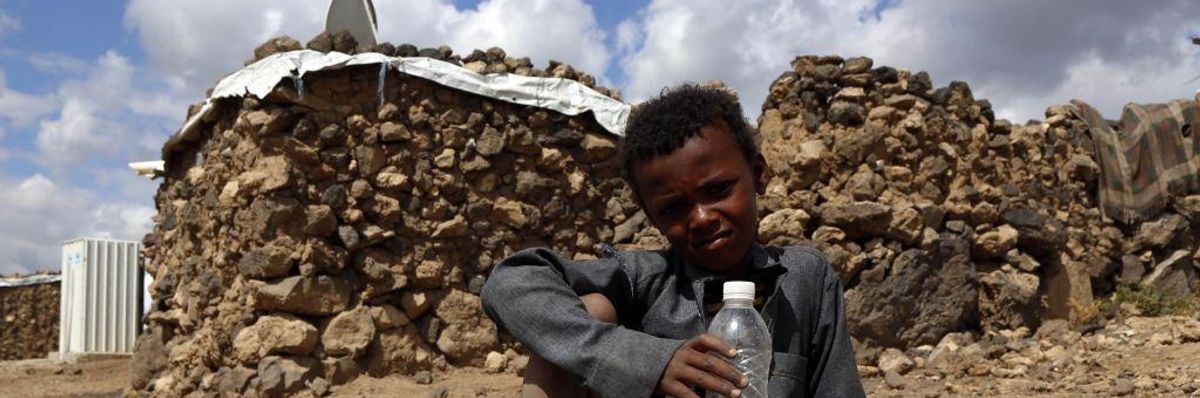
Civilians, who fled from the ongoing civil war where numerous civilian killed, are seen during their daily lives despite many difficulties at Al-Raqah refugee camp in Amran province of northern Sanaa, Yemen on November 24, 2019. (Photo by Mohammed Hamoud/Anadolu Agency via Getty Images)
The villagers of Arhab were in a celebratory mood before the bomb exploded. The small Yemeni town had just struck water on a new well when a precision-guided munition crashed into the site, killing 31 and maiming many more.
Among the death and debris, investigators would later find a bomb fragment with a serial code indicating it came from Tucson--home of Raytheon Technologies.
The U.S. government is providing the weapons that are destroying a country, and Arizonans are unwittingly involved. We all deserve better.
It's time to confront the powerful interests of the arms industry, stop arms sales to those who are indiscriminately bombing civilians, and end U.S. complicity in the war in Yemen for good.
Since 2015, the United States has been militarily backing the authoritarian governments of Saudi Arabia and the United Arab Emirates as they intervene in Yemen's civil war, including by arming them with more than $85 billion worth of bombs, drones and fighter jets.
These sales have proven to be nothing short of a disaster. U.S.-sold weapons are regularly used to commit apparent war crimes, have repeatedly fallen into the hands of violent non-state actors, and have served only to prolong the conflict.
Yemen's war rages on today, and the country is now the world's largest humanitarian disaster--and U.S.-made bombs are partly to blame.
But despite the total failure of this strategy to bring peace or security, the sales continue. There's a simple explanation for that: the weapons industry wants them to.
While companies like Raytheon, whose missile program is headquartered in Tucson, pretend that they're merely passive actors meeting their products' demand, they actually have a large hand in the decision-making process.
Every year, Raytheon and the rest of the weapons industry spend millions of dollars influencing elections and lobbying for more arms sales--fueling horrific wars like Yemen's for the sake of profits. The blood money from these sales isn't going to everyday employees either: while Raytheon assembly workers receive about $37,000 per year, its CEO brings home more than 450 times that.
And it looks like the lobbying is paying off. Late last year, the U.S. Senate narrowly rejected legislation to block part of President Trump's last-minute $23 billion weapons sale to the UAE when Arizona Sens. Mark Kelly and Kyrsten Sinema defected from the Democratic party to vote "no."
Understandably, Kelly and Sinema, along with other Arizonans, might worry that jobs depend on these sales. But the fact is, the arms industry is a poor job creator. Every government dollar spent on weapons manufacturing creates less jobs than the same spent on teachers, nurses, frontline pandemic responders, or green energy workers. Places like Huntsville, Ala.--former weapons hot spots that are successfully transitioning to green technology--can show us the way.
Arizonans don't want their hard work to go toward massacring civilians halfway around the world, and they don't want their senators voting to sell arms to dictators.
I should know. As a born-and-raised Arizonan and proud UofA alum, I care deeply about what's best for my home state. And as the digital campaign director of one of the country's leading anti-militarism advocacy organizations, I have seen Raytheon lobbyists in action as they trample the voices of everyday people from across the country, including our thousands of grassroots activists in Arizona.
With President Biden's recent decision to pause arms sales to the UAE and Saudi Arabia pending review, we're closer than ever to ending this terrible practice for good. Now is the time to put the pressure on.
From Arhab to Tucson, the Arabian Desert to the Sonoran, everyday people would be better off without Raytheon's weapons. It's time for Arizona to say no to these disastrous arms sales and the corporate powers that back them.
Dear Common Dreams reader, It’s been nearly 30 years since I co-founded Common Dreams with my late wife, Lina Newhouser. We had the radical notion that journalism should serve the public good, not corporate profits. It was clear to us from the outset what it would take to build such a project. No paid advertisements. No corporate sponsors. No millionaire publisher telling us what to think or do. Many people said we wouldn't last a year, but we proved those doubters wrong. Together with a tremendous team of journalists and dedicated staff, we built an independent media outlet free from the constraints of profits and corporate control. Our mission has always been simple: To inform. To inspire. To ignite change for the common good. Building Common Dreams was not easy. Our survival was never guaranteed. When you take on the most powerful forces—Wall Street greed, fossil fuel industry destruction, Big Tech lobbyists, and uber-rich oligarchs who have spent billions upon billions rigging the economy and democracy in their favor—the only bulwark you have is supporters who believe in your work. But here’s the urgent message from me today. It's never been this bad out there. And it's never been this hard to keep us going. At the very moment Common Dreams is most needed, the threats we face are intensifying. We need your support now more than ever. We don't accept corporate advertising and never will. We don't have a paywall because we don't think people should be blocked from critical news based on their ability to pay. Everything we do is funded by the donations of readers like you. When everyone does the little they can afford, we are strong. But if that support retreats or dries up, so do we. Will you donate now to make sure Common Dreams not only survives but thrives? —Craig Brown, Co-founder |
The villagers of Arhab were in a celebratory mood before the bomb exploded. The small Yemeni town had just struck water on a new well when a precision-guided munition crashed into the site, killing 31 and maiming many more.
Among the death and debris, investigators would later find a bomb fragment with a serial code indicating it came from Tucson--home of Raytheon Technologies.
The U.S. government is providing the weapons that are destroying a country, and Arizonans are unwittingly involved. We all deserve better.
It's time to confront the powerful interests of the arms industry, stop arms sales to those who are indiscriminately bombing civilians, and end U.S. complicity in the war in Yemen for good.
Since 2015, the United States has been militarily backing the authoritarian governments of Saudi Arabia and the United Arab Emirates as they intervene in Yemen's civil war, including by arming them with more than $85 billion worth of bombs, drones and fighter jets.
These sales have proven to be nothing short of a disaster. U.S.-sold weapons are regularly used to commit apparent war crimes, have repeatedly fallen into the hands of violent non-state actors, and have served only to prolong the conflict.
Yemen's war rages on today, and the country is now the world's largest humanitarian disaster--and U.S.-made bombs are partly to blame.
But despite the total failure of this strategy to bring peace or security, the sales continue. There's a simple explanation for that: the weapons industry wants them to.
While companies like Raytheon, whose missile program is headquartered in Tucson, pretend that they're merely passive actors meeting their products' demand, they actually have a large hand in the decision-making process.
Every year, Raytheon and the rest of the weapons industry spend millions of dollars influencing elections and lobbying for more arms sales--fueling horrific wars like Yemen's for the sake of profits. The blood money from these sales isn't going to everyday employees either: while Raytheon assembly workers receive about $37,000 per year, its CEO brings home more than 450 times that.
And it looks like the lobbying is paying off. Late last year, the U.S. Senate narrowly rejected legislation to block part of President Trump's last-minute $23 billion weapons sale to the UAE when Arizona Sens. Mark Kelly and Kyrsten Sinema defected from the Democratic party to vote "no."
Understandably, Kelly and Sinema, along with other Arizonans, might worry that jobs depend on these sales. But the fact is, the arms industry is a poor job creator. Every government dollar spent on weapons manufacturing creates less jobs than the same spent on teachers, nurses, frontline pandemic responders, or green energy workers. Places like Huntsville, Ala.--former weapons hot spots that are successfully transitioning to green technology--can show us the way.
Arizonans don't want their hard work to go toward massacring civilians halfway around the world, and they don't want their senators voting to sell arms to dictators.
I should know. As a born-and-raised Arizonan and proud UofA alum, I care deeply about what's best for my home state. And as the digital campaign director of one of the country's leading anti-militarism advocacy organizations, I have seen Raytheon lobbyists in action as they trample the voices of everyday people from across the country, including our thousands of grassroots activists in Arizona.
With President Biden's recent decision to pause arms sales to the UAE and Saudi Arabia pending review, we're closer than ever to ending this terrible practice for good. Now is the time to put the pressure on.
From Arhab to Tucson, the Arabian Desert to the Sonoran, everyday people would be better off without Raytheon's weapons. It's time for Arizona to say no to these disastrous arms sales and the corporate powers that back them.
The villagers of Arhab were in a celebratory mood before the bomb exploded. The small Yemeni town had just struck water on a new well when a precision-guided munition crashed into the site, killing 31 and maiming many more.
Among the death and debris, investigators would later find a bomb fragment with a serial code indicating it came from Tucson--home of Raytheon Technologies.
The U.S. government is providing the weapons that are destroying a country, and Arizonans are unwittingly involved. We all deserve better.
It's time to confront the powerful interests of the arms industry, stop arms sales to those who are indiscriminately bombing civilians, and end U.S. complicity in the war in Yemen for good.
Since 2015, the United States has been militarily backing the authoritarian governments of Saudi Arabia and the United Arab Emirates as they intervene in Yemen's civil war, including by arming them with more than $85 billion worth of bombs, drones and fighter jets.
These sales have proven to be nothing short of a disaster. U.S.-sold weapons are regularly used to commit apparent war crimes, have repeatedly fallen into the hands of violent non-state actors, and have served only to prolong the conflict.
Yemen's war rages on today, and the country is now the world's largest humanitarian disaster--and U.S.-made bombs are partly to blame.
But despite the total failure of this strategy to bring peace or security, the sales continue. There's a simple explanation for that: the weapons industry wants them to.
While companies like Raytheon, whose missile program is headquartered in Tucson, pretend that they're merely passive actors meeting their products' demand, they actually have a large hand in the decision-making process.
Every year, Raytheon and the rest of the weapons industry spend millions of dollars influencing elections and lobbying for more arms sales--fueling horrific wars like Yemen's for the sake of profits. The blood money from these sales isn't going to everyday employees either: while Raytheon assembly workers receive about $37,000 per year, its CEO brings home more than 450 times that.
And it looks like the lobbying is paying off. Late last year, the U.S. Senate narrowly rejected legislation to block part of President Trump's last-minute $23 billion weapons sale to the UAE when Arizona Sens. Mark Kelly and Kyrsten Sinema defected from the Democratic party to vote "no."
Understandably, Kelly and Sinema, along with other Arizonans, might worry that jobs depend on these sales. But the fact is, the arms industry is a poor job creator. Every government dollar spent on weapons manufacturing creates less jobs than the same spent on teachers, nurses, frontline pandemic responders, or green energy workers. Places like Huntsville, Ala.--former weapons hot spots that are successfully transitioning to green technology--can show us the way.
Arizonans don't want their hard work to go toward massacring civilians halfway around the world, and they don't want their senators voting to sell arms to dictators.
I should know. As a born-and-raised Arizonan and proud UofA alum, I care deeply about what's best for my home state. And as the digital campaign director of one of the country's leading anti-militarism advocacy organizations, I have seen Raytheon lobbyists in action as they trample the voices of everyday people from across the country, including our thousands of grassroots activists in Arizona.
With President Biden's recent decision to pause arms sales to the UAE and Saudi Arabia pending review, we're closer than ever to ending this terrible practice for good. Now is the time to put the pressure on.
From Arhab to Tucson, the Arabian Desert to the Sonoran, everyday people would be better off without Raytheon's weapons. It's time for Arizona to say no to these disastrous arms sales and the corporate powers that back them.