SUBSCRIBE TO OUR FREE NEWSLETTER
Daily news & progressive opinion—funded by the people, not the corporations—delivered straight to your inbox.
5
#000000
#FFFFFF
To donate by check, phone, or other method, see our More Ways to Give page.
Daily news & progressive opinion—funded by the people, not the corporations—delivered straight to your inbox.
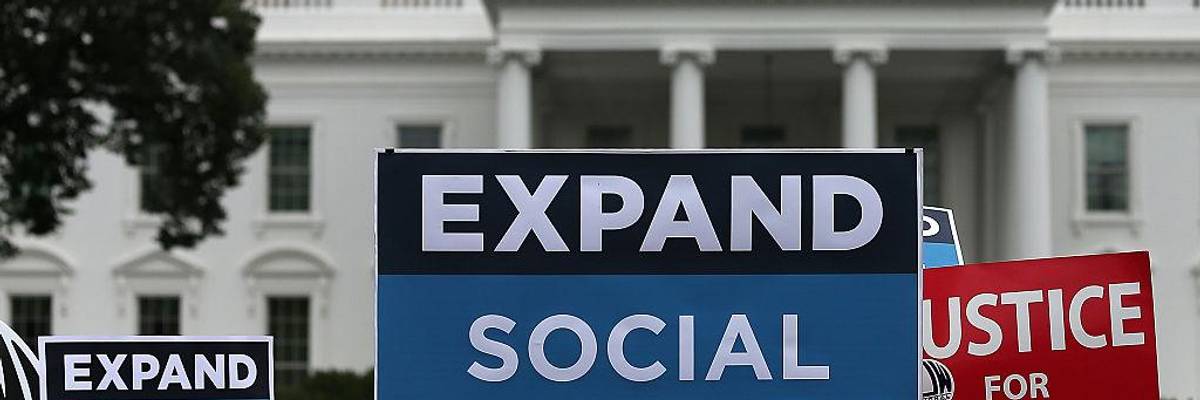
Activists participate in a rally urging the expansion of Social Security benefits in front of the White House July 13, 2015 in Washington, DC. Social Security Works, the AFL-CIO and additional organizations held the event to deliver "more than 2 million petition signatures" in support of expanding Social Security benefits. (Photo by Win McNamee/Getty Images)
Along with a crippling pandemic and a struggling economy, President Biden inherited another significant challenge: a Social Security program that needs enhancements to survive and thrive. Former President Trump promised to "protect" Social Security, but spent four years trying to undermine and cut SSDI - the part of the program that covers workers with disabilities. Congressional Democrats introduced legislation to strengthen and expand Social Security, but Trump officials and GOP allies on the Hill called for "entitlement reform" immediately after giving the wealthy and big corporations a $2 trillion tax cut.
Contrary to conservative propaganda, Social Security is not "going bankrupt." But if Congress takes no action, the Social Security trust fund reserves are projected to run dry in 2035, at which time the program still will be able to pay about 80% of promised benefits (an outcome nobody wants). Economic fallout from the COVID pandemic may well drain the trust funds sooner. Fortunately, President Biden has a plan to fortify Social Security for the future while also boosting benefits. It is a commonsense plan that overlaps in important ways with legislation introduced in the last Congress by Rep. John Larson (D-Conn.).
President Biden wants to improve the formula for calculating the annual Social Security cost-of-living adjustment (COLA). This year's COLA was a paltry 1.3%, or about $20 a month for the average beneficiary. Rising prescription drug prices and an increase in the Medicare Part B premium will eat away at that meager amount.
Workers have earned these benefits over a lifetime of Social Security payroll contributions and cannot afford to see their Social Security checks slashed. As one senior, Kath Allen, recently wrote in the Manchester Union Leader, "How does our government expect seniors to keep pace with a [COLA] that has us sliding backward as we enter the new calendar year? Those of us who pay our own way are spending too much money for necessities."
The current cost-of-living formula underestimates the impact of inflation on seniors, who spend significantly more on health care than the younger workers who currently make up the base upon which the COLA is calculated. After years of advocacy by seniors' organizations, Congress should adopt the Consumer Price Index for the Elderly (CPI-E), a more accurate COLA formula that reflects retirees' actual living costs.
Another commonsense fix for Social Security on President Biden's list: boosting benefits for retirees 85 years and older. By that age, many seniors have depleted their retirement savings and are more likely to need costly long-term care. President Biden also wants to give widows and widowers, who often struggle to make ends meet after the death of a spouse, a much-needed bump in benefits. He supports the creation of 'caregiver credits' so that workers who take extended leave from their jobs to care for children and other family members don't suffer a reduction in their Social Security benefits later.
These enhancements especially would benefit women, who typically live longer and have less retirement savings than men. Women often deplete their savings and rely exclusively on Social Security as they age. Most widows receive a smaller Social Security benefit than widowers and are more likely to live in poverty than men. And women are more likely than men to be family caregivers.
To pay for expanded benefits and address Social Security's long-term financing challenges, the President proposes to adjust the payroll wage cap (currently set at $142,800). While workers earning less than the cap pay into Social Security all year, millionaires stop contributing in mid-February. That's unfair - and deprives Social Security of crucial revenue. President Biden wants wages over $400,000 a year to be subject to the payroll tax, too. It's time for the wealthy to pay their fair share.
Meanwhile, let's be clear about what we should not do. We should not cut benefits for current or future retirees, either by raising the retirement age or any other measure that asks beneficiaries to bear the cost. Nearly half of seniors rely on their Social Security benefits (averaging $18,500 per year) for all or most of their income. Without Social Security, 38% of elderly Americans would fall into poverty.
During the pandemic, Social Security has been there as a financial lifeline for older Americans forced into retirement early or saddled with unexpected medical costs. Many of these seniors are helping support family members who have lost their jobs due to the pandemic, helping keep entire communities financially afloat. Workers have earned these benefits over a lifetime of Social Security payroll contributions and cannot afford to see their Social Security checks slashed.
Most importantly, the program must not be privatized. Recent news from Wall Street proves anew that workers should not risk their hard-earned benefits on increasingly volatile markets. In fact, Social Security is there to protect against what President Franklin D. Roosevelt called "the hazards and vicissitudes of life," not to gamble on them. We support our new President's commitment to expand benefits now--and safeguard Social Security for the future.
Dear Common Dreams reader, It’s been nearly 30 years since I co-founded Common Dreams with my late wife, Lina Newhouser. We had the radical notion that journalism should serve the public good, not corporate profits. It was clear to us from the outset what it would take to build such a project. No paid advertisements. No corporate sponsors. No millionaire publisher telling us what to think or do. Many people said we wouldn't last a year, but we proved those doubters wrong. Together with a tremendous team of journalists and dedicated staff, we built an independent media outlet free from the constraints of profits and corporate control. Our mission has always been simple: To inform. To inspire. To ignite change for the common good. Building Common Dreams was not easy. Our survival was never guaranteed. When you take on the most powerful forces—Wall Street greed, fossil fuel industry destruction, Big Tech lobbyists, and uber-rich oligarchs who have spent billions upon billions rigging the economy and democracy in their favor—the only bulwark you have is supporters who believe in your work. But here’s the urgent message from me today. It's never been this bad out there. And it's never been this hard to keep us going. At the very moment Common Dreams is most needed, the threats we face are intensifying. We need your support now more than ever. We don't accept corporate advertising and never will. We don't have a paywall because we don't think people should be blocked from critical news based on their ability to pay. Everything we do is funded by the donations of readers like you. When everyone does the little they can afford, we are strong. But if that support retreats or dries up, so do we. Will you donate now to make sure Common Dreams not only survives but thrives? —Craig Brown, Co-founder |
Along with a crippling pandemic and a struggling economy, President Biden inherited another significant challenge: a Social Security program that needs enhancements to survive and thrive. Former President Trump promised to "protect" Social Security, but spent four years trying to undermine and cut SSDI - the part of the program that covers workers with disabilities. Congressional Democrats introduced legislation to strengthen and expand Social Security, but Trump officials and GOP allies on the Hill called for "entitlement reform" immediately after giving the wealthy and big corporations a $2 trillion tax cut.
Contrary to conservative propaganda, Social Security is not "going bankrupt." But if Congress takes no action, the Social Security trust fund reserves are projected to run dry in 2035, at which time the program still will be able to pay about 80% of promised benefits (an outcome nobody wants). Economic fallout from the COVID pandemic may well drain the trust funds sooner. Fortunately, President Biden has a plan to fortify Social Security for the future while also boosting benefits. It is a commonsense plan that overlaps in important ways with legislation introduced in the last Congress by Rep. John Larson (D-Conn.).
President Biden wants to improve the formula for calculating the annual Social Security cost-of-living adjustment (COLA). This year's COLA was a paltry 1.3%, or about $20 a month for the average beneficiary. Rising prescription drug prices and an increase in the Medicare Part B premium will eat away at that meager amount.
Workers have earned these benefits over a lifetime of Social Security payroll contributions and cannot afford to see their Social Security checks slashed. As one senior, Kath Allen, recently wrote in the Manchester Union Leader, "How does our government expect seniors to keep pace with a [COLA] that has us sliding backward as we enter the new calendar year? Those of us who pay our own way are spending too much money for necessities."
The current cost-of-living formula underestimates the impact of inflation on seniors, who spend significantly more on health care than the younger workers who currently make up the base upon which the COLA is calculated. After years of advocacy by seniors' organizations, Congress should adopt the Consumer Price Index for the Elderly (CPI-E), a more accurate COLA formula that reflects retirees' actual living costs.
Another commonsense fix for Social Security on President Biden's list: boosting benefits for retirees 85 years and older. By that age, many seniors have depleted their retirement savings and are more likely to need costly long-term care. President Biden also wants to give widows and widowers, who often struggle to make ends meet after the death of a spouse, a much-needed bump in benefits. He supports the creation of 'caregiver credits' so that workers who take extended leave from their jobs to care for children and other family members don't suffer a reduction in their Social Security benefits later.
These enhancements especially would benefit women, who typically live longer and have less retirement savings than men. Women often deplete their savings and rely exclusively on Social Security as they age. Most widows receive a smaller Social Security benefit than widowers and are more likely to live in poverty than men. And women are more likely than men to be family caregivers.
To pay for expanded benefits and address Social Security's long-term financing challenges, the President proposes to adjust the payroll wage cap (currently set at $142,800). While workers earning less than the cap pay into Social Security all year, millionaires stop contributing in mid-February. That's unfair - and deprives Social Security of crucial revenue. President Biden wants wages over $400,000 a year to be subject to the payroll tax, too. It's time for the wealthy to pay their fair share.
Meanwhile, let's be clear about what we should not do. We should not cut benefits for current or future retirees, either by raising the retirement age or any other measure that asks beneficiaries to bear the cost. Nearly half of seniors rely on their Social Security benefits (averaging $18,500 per year) for all or most of their income. Without Social Security, 38% of elderly Americans would fall into poverty.
During the pandemic, Social Security has been there as a financial lifeline for older Americans forced into retirement early or saddled with unexpected medical costs. Many of these seniors are helping support family members who have lost their jobs due to the pandemic, helping keep entire communities financially afloat. Workers have earned these benefits over a lifetime of Social Security payroll contributions and cannot afford to see their Social Security checks slashed.
Most importantly, the program must not be privatized. Recent news from Wall Street proves anew that workers should not risk their hard-earned benefits on increasingly volatile markets. In fact, Social Security is there to protect against what President Franklin D. Roosevelt called "the hazards and vicissitudes of life," not to gamble on them. We support our new President's commitment to expand benefits now--and safeguard Social Security for the future.
Along with a crippling pandemic and a struggling economy, President Biden inherited another significant challenge: a Social Security program that needs enhancements to survive and thrive. Former President Trump promised to "protect" Social Security, but spent four years trying to undermine and cut SSDI - the part of the program that covers workers with disabilities. Congressional Democrats introduced legislation to strengthen and expand Social Security, but Trump officials and GOP allies on the Hill called for "entitlement reform" immediately after giving the wealthy and big corporations a $2 trillion tax cut.
Contrary to conservative propaganda, Social Security is not "going bankrupt." But if Congress takes no action, the Social Security trust fund reserves are projected to run dry in 2035, at which time the program still will be able to pay about 80% of promised benefits (an outcome nobody wants). Economic fallout from the COVID pandemic may well drain the trust funds sooner. Fortunately, President Biden has a plan to fortify Social Security for the future while also boosting benefits. It is a commonsense plan that overlaps in important ways with legislation introduced in the last Congress by Rep. John Larson (D-Conn.).
President Biden wants to improve the formula for calculating the annual Social Security cost-of-living adjustment (COLA). This year's COLA was a paltry 1.3%, or about $20 a month for the average beneficiary. Rising prescription drug prices and an increase in the Medicare Part B premium will eat away at that meager amount.
Workers have earned these benefits over a lifetime of Social Security payroll contributions and cannot afford to see their Social Security checks slashed. As one senior, Kath Allen, recently wrote in the Manchester Union Leader, "How does our government expect seniors to keep pace with a [COLA] that has us sliding backward as we enter the new calendar year? Those of us who pay our own way are spending too much money for necessities."
The current cost-of-living formula underestimates the impact of inflation on seniors, who spend significantly more on health care than the younger workers who currently make up the base upon which the COLA is calculated. After years of advocacy by seniors' organizations, Congress should adopt the Consumer Price Index for the Elderly (CPI-E), a more accurate COLA formula that reflects retirees' actual living costs.
Another commonsense fix for Social Security on President Biden's list: boosting benefits for retirees 85 years and older. By that age, many seniors have depleted their retirement savings and are more likely to need costly long-term care. President Biden also wants to give widows and widowers, who often struggle to make ends meet after the death of a spouse, a much-needed bump in benefits. He supports the creation of 'caregiver credits' so that workers who take extended leave from their jobs to care for children and other family members don't suffer a reduction in their Social Security benefits later.
These enhancements especially would benefit women, who typically live longer and have less retirement savings than men. Women often deplete their savings and rely exclusively on Social Security as they age. Most widows receive a smaller Social Security benefit than widowers and are more likely to live in poverty than men. And women are more likely than men to be family caregivers.
To pay for expanded benefits and address Social Security's long-term financing challenges, the President proposes to adjust the payroll wage cap (currently set at $142,800). While workers earning less than the cap pay into Social Security all year, millionaires stop contributing in mid-February. That's unfair - and deprives Social Security of crucial revenue. President Biden wants wages over $400,000 a year to be subject to the payroll tax, too. It's time for the wealthy to pay their fair share.
Meanwhile, let's be clear about what we should not do. We should not cut benefits for current or future retirees, either by raising the retirement age or any other measure that asks beneficiaries to bear the cost. Nearly half of seniors rely on their Social Security benefits (averaging $18,500 per year) for all or most of their income. Without Social Security, 38% of elderly Americans would fall into poverty.
During the pandemic, Social Security has been there as a financial lifeline for older Americans forced into retirement early or saddled with unexpected medical costs. Many of these seniors are helping support family members who have lost their jobs due to the pandemic, helping keep entire communities financially afloat. Workers have earned these benefits over a lifetime of Social Security payroll contributions and cannot afford to see their Social Security checks slashed.
Most importantly, the program must not be privatized. Recent news from Wall Street proves anew that workers should not risk their hard-earned benefits on increasingly volatile markets. In fact, Social Security is there to protect against what President Franklin D. Roosevelt called "the hazards and vicissitudes of life," not to gamble on them. We support our new President's commitment to expand benefits now--and safeguard Social Security for the future.