SUBSCRIBE TO OUR FREE NEWSLETTER
Daily news & progressive opinion—funded by the people, not the corporations—delivered straight to your inbox.
5
#000000
#FFFFFF
To donate by check, phone, or other method, see our More Ways to Give page.
Daily news & progressive opinion—funded by the people, not the corporations—delivered straight to your inbox.
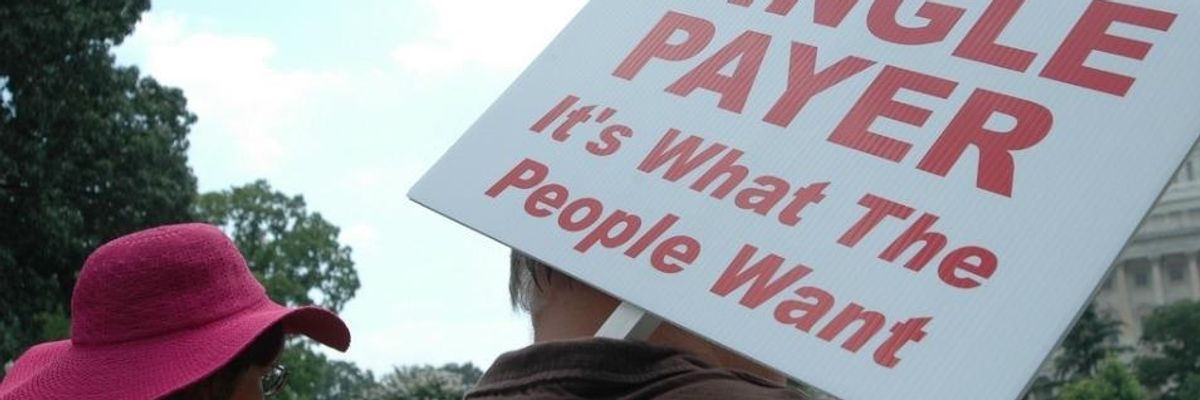
Our dysfunctional health care system remains an outlier among the rest of the developed world for not providing universal health coverage. (Photo: Joe Newman via Public Citizen/flickr/cc)
The federal response to the deadly coronavirus pandemic under President Trump has been a public health disaster with nearly 250,000 Americans dead and no clear end in sight.
In sharp contrast, President-elect Joe Biden pledged to mount a serious response against the coronavirus. Biden implored Americans in a recent speech to continue to wear face masks and announced a panel of health care experts to begin to counter a surge of COVID-19 hospitalizations throughout the country.
The American health care system devours an ever-increasing share of our economy with health spending accounting for an astounding 17.9 percent of the GDP, the highest in the world. Yet we have little to show for it.
On the matter of health reform, however, the president-elect offers measures that would merely bolster and even expand the same private health insurance system that has generated increasing profit during the pandemic while depriving the country of the resources necessary to produce an adequate supply of PPE. Physicians, nurses and other frontline health care workers are fighting COVID-19 with their hands tied behind their backs.
Biden ran on returning the country to normalcy, but there was nothing normal about the American health care system even before the pandemic. In fact, our dysfunctional health care system remains an outlier among the rest of the developed world for not providing universal health coverage.
The American health care system devours an ever-increasing share of our economy with health spending accounting for an astounding 17.9 percent of the GDP, the highest in the world. Yet we have little to show for it. Americans suffer some of the worst health outcomes compared to other industrialized nations. Even before the coronavirus hit the U.S., life expectancy was on the decline. Our infant and maternal mortality rates are higher than those of any comparable country, and racial and ethnic disparities in infant and maternal mortality are getting worse.
The quality of American health care isn't any good either. Shockingly, more than 250,000 Americans die each year from medical errors. That's nearly as many as the amount of people that have died from COVID-19 as of this writing.
Is that the kind of return to normalcy that Americans want, need, or deserve?
The answer, of course, is no.
In poll after poll, Americans have indicated their preference for a universal, single-payer health care system. An exit poll on election day conducted by Fox News revealed that 72 percent of voters wanted a government-run health care system.
That publicly-funded system, more commonly known as Expanded and Improved Medicare for All, is within our grasp. All we need to do is call out those Senators and Congresspeople who are in the pockets of the private, for-profit health care industry. According to Open Secrets, health care providers, Big Pharma, medical equipment manufacturers, and drug and medical product retailers pumped $178 million into the 2020 election cycle so far. Separately the insurance industry (including but not limited to health insurance) added another $85 million. The new kid on the block, adark-money group called the Partnership for America's Health Care Future, has been targeting Democrats who support either Medicare for All or the "public option" in its 2020 election year ad campaigns. No wonder legislators continue to ignore the clear desire of their constituents for a health care system that puts the public, not the shareholder, first.
For health care reform advocates who want to purge profiteering from health care, returning to "normal" is not an option.
The ACA has not changed the fact that medical bills continue to push millions of people into personal bankruptcy, with Americans having borrowed a stunning $88 billion to pay for medical treatment in 2018 alone.
More than 10 years after the passage of the Affordable Care Act (ACA),87 million Americans remain uninsured or underinsured. The ACA has not changed the fact that medical bills continue to push millions of people into personal bankruptcy, with Americans having borrowed a stunning $88 billion to pay for medical treatment in 2018 alone. Nor has the ACA halted the inexorable increase in premiums, deductibles and copayments that are blocking access to care for millions of workers and their families who have employer-based group health insurance that is too expensive to use.
Biden's public option plan, which would enable people to enroll in publicly-funded insurance plans that would compete against private insurers on the ACA's marketplace exchanges, won't change this picture either. A 2013 analysis conducted by the Congressional Budget Office predicted that a public option would have "minimal effects" on the number of uninsured. For a real world example, we need only to look at the abysmal failure of the nonprofit health insurance co-ops that were given a similar mandate to compete with private insurance under the ACA. Out of the 26 original co-ops, only three exist today.
The public option is destined to fail as long as private health insurers are allowed to thrive. They will find new and increasingly sophisticated ways to undermine public insurance by cherry-picking the healthiest subscribers for themselves and shunting the more expensive, chronically ill patients to public insurance, compromising the potential savings that universal public financing of health care would yield.
While the historic election of Biden and Harris removed the immediate threat of a draconian take-down of the ACA, it does not augur well for the kind of transformative social change that Americans need right now. The struggle continues. Compromise and half-measures are not acceptable. Medicare for All remains the goal.
Dear Common Dreams reader, It’s been nearly 30 years since I co-founded Common Dreams with my late wife, Lina Newhouser. We had the radical notion that journalism should serve the public good, not corporate profits. It was clear to us from the outset what it would take to build such a project. No paid advertisements. No corporate sponsors. No millionaire publisher telling us what to think or do. Many people said we wouldn't last a year, but we proved those doubters wrong. Together with a tremendous team of journalists and dedicated staff, we built an independent media outlet free from the constraints of profits and corporate control. Our mission has always been simple: To inform. To inspire. To ignite change for the common good. Building Common Dreams was not easy. Our survival was never guaranteed. When you take on the most powerful forces—Wall Street greed, fossil fuel industry destruction, Big Tech lobbyists, and uber-rich oligarchs who have spent billions upon billions rigging the economy and democracy in their favor—the only bulwark you have is supporters who believe in your work. But here’s the urgent message from me today. It's never been this bad out there. And it's never been this hard to keep us going. At the very moment Common Dreams is most needed, the threats we face are intensifying. We need your support now more than ever. We don't accept corporate advertising and never will. We don't have a paywall because we don't think people should be blocked from critical news based on their ability to pay. Everything we do is funded by the donations of readers like you. When everyone does the little they can afford, we are strong. But if that support retreats or dries up, so do we. Will you donate now to make sure Common Dreams not only survives but thrives? —Craig Brown, Co-founder |
The federal response to the deadly coronavirus pandemic under President Trump has been a public health disaster with nearly 250,000 Americans dead and no clear end in sight.
In sharp contrast, President-elect Joe Biden pledged to mount a serious response against the coronavirus. Biden implored Americans in a recent speech to continue to wear face masks and announced a panel of health care experts to begin to counter a surge of COVID-19 hospitalizations throughout the country.
The American health care system devours an ever-increasing share of our economy with health spending accounting for an astounding 17.9 percent of the GDP, the highest in the world. Yet we have little to show for it.
On the matter of health reform, however, the president-elect offers measures that would merely bolster and even expand the same private health insurance system that has generated increasing profit during the pandemic while depriving the country of the resources necessary to produce an adequate supply of PPE. Physicians, nurses and other frontline health care workers are fighting COVID-19 with their hands tied behind their backs.
Biden ran on returning the country to normalcy, but there was nothing normal about the American health care system even before the pandemic. In fact, our dysfunctional health care system remains an outlier among the rest of the developed world for not providing universal health coverage.
The American health care system devours an ever-increasing share of our economy with health spending accounting for an astounding 17.9 percent of the GDP, the highest in the world. Yet we have little to show for it. Americans suffer some of the worst health outcomes compared to other industrialized nations. Even before the coronavirus hit the U.S., life expectancy was on the decline. Our infant and maternal mortality rates are higher than those of any comparable country, and racial and ethnic disparities in infant and maternal mortality are getting worse.
The quality of American health care isn't any good either. Shockingly, more than 250,000 Americans die each year from medical errors. That's nearly as many as the amount of people that have died from COVID-19 as of this writing.
Is that the kind of return to normalcy that Americans want, need, or deserve?
The answer, of course, is no.
In poll after poll, Americans have indicated their preference for a universal, single-payer health care system. An exit poll on election day conducted by Fox News revealed that 72 percent of voters wanted a government-run health care system.
That publicly-funded system, more commonly known as Expanded and Improved Medicare for All, is within our grasp. All we need to do is call out those Senators and Congresspeople who are in the pockets of the private, for-profit health care industry. According to Open Secrets, health care providers, Big Pharma, medical equipment manufacturers, and drug and medical product retailers pumped $178 million into the 2020 election cycle so far. Separately the insurance industry (including but not limited to health insurance) added another $85 million. The new kid on the block, adark-money group called the Partnership for America's Health Care Future, has been targeting Democrats who support either Medicare for All or the "public option" in its 2020 election year ad campaigns. No wonder legislators continue to ignore the clear desire of their constituents for a health care system that puts the public, not the shareholder, first.
For health care reform advocates who want to purge profiteering from health care, returning to "normal" is not an option.
The ACA has not changed the fact that medical bills continue to push millions of people into personal bankruptcy, with Americans having borrowed a stunning $88 billion to pay for medical treatment in 2018 alone.
More than 10 years after the passage of the Affordable Care Act (ACA),87 million Americans remain uninsured or underinsured. The ACA has not changed the fact that medical bills continue to push millions of people into personal bankruptcy, with Americans having borrowed a stunning $88 billion to pay for medical treatment in 2018 alone. Nor has the ACA halted the inexorable increase in premiums, deductibles and copayments that are blocking access to care for millions of workers and their families who have employer-based group health insurance that is too expensive to use.
Biden's public option plan, which would enable people to enroll in publicly-funded insurance plans that would compete against private insurers on the ACA's marketplace exchanges, won't change this picture either. A 2013 analysis conducted by the Congressional Budget Office predicted that a public option would have "minimal effects" on the number of uninsured. For a real world example, we need only to look at the abysmal failure of the nonprofit health insurance co-ops that were given a similar mandate to compete with private insurance under the ACA. Out of the 26 original co-ops, only three exist today.
The public option is destined to fail as long as private health insurers are allowed to thrive. They will find new and increasingly sophisticated ways to undermine public insurance by cherry-picking the healthiest subscribers for themselves and shunting the more expensive, chronically ill patients to public insurance, compromising the potential savings that universal public financing of health care would yield.
While the historic election of Biden and Harris removed the immediate threat of a draconian take-down of the ACA, it does not augur well for the kind of transformative social change that Americans need right now. The struggle continues. Compromise and half-measures are not acceptable. Medicare for All remains the goal.
The federal response to the deadly coronavirus pandemic under President Trump has been a public health disaster with nearly 250,000 Americans dead and no clear end in sight.
In sharp contrast, President-elect Joe Biden pledged to mount a serious response against the coronavirus. Biden implored Americans in a recent speech to continue to wear face masks and announced a panel of health care experts to begin to counter a surge of COVID-19 hospitalizations throughout the country.
The American health care system devours an ever-increasing share of our economy with health spending accounting for an astounding 17.9 percent of the GDP, the highest in the world. Yet we have little to show for it.
On the matter of health reform, however, the president-elect offers measures that would merely bolster and even expand the same private health insurance system that has generated increasing profit during the pandemic while depriving the country of the resources necessary to produce an adequate supply of PPE. Physicians, nurses and other frontline health care workers are fighting COVID-19 with their hands tied behind their backs.
Biden ran on returning the country to normalcy, but there was nothing normal about the American health care system even before the pandemic. In fact, our dysfunctional health care system remains an outlier among the rest of the developed world for not providing universal health coverage.
The American health care system devours an ever-increasing share of our economy with health spending accounting for an astounding 17.9 percent of the GDP, the highest in the world. Yet we have little to show for it. Americans suffer some of the worst health outcomes compared to other industrialized nations. Even before the coronavirus hit the U.S., life expectancy was on the decline. Our infant and maternal mortality rates are higher than those of any comparable country, and racial and ethnic disparities in infant and maternal mortality are getting worse.
The quality of American health care isn't any good either. Shockingly, more than 250,000 Americans die each year from medical errors. That's nearly as many as the amount of people that have died from COVID-19 as of this writing.
Is that the kind of return to normalcy that Americans want, need, or deserve?
The answer, of course, is no.
In poll after poll, Americans have indicated their preference for a universal, single-payer health care system. An exit poll on election day conducted by Fox News revealed that 72 percent of voters wanted a government-run health care system.
That publicly-funded system, more commonly known as Expanded and Improved Medicare for All, is within our grasp. All we need to do is call out those Senators and Congresspeople who are in the pockets of the private, for-profit health care industry. According to Open Secrets, health care providers, Big Pharma, medical equipment manufacturers, and drug and medical product retailers pumped $178 million into the 2020 election cycle so far. Separately the insurance industry (including but not limited to health insurance) added another $85 million. The new kid on the block, adark-money group called the Partnership for America's Health Care Future, has been targeting Democrats who support either Medicare for All or the "public option" in its 2020 election year ad campaigns. No wonder legislators continue to ignore the clear desire of their constituents for a health care system that puts the public, not the shareholder, first.
For health care reform advocates who want to purge profiteering from health care, returning to "normal" is not an option.
The ACA has not changed the fact that medical bills continue to push millions of people into personal bankruptcy, with Americans having borrowed a stunning $88 billion to pay for medical treatment in 2018 alone.
More than 10 years after the passage of the Affordable Care Act (ACA),87 million Americans remain uninsured or underinsured. The ACA has not changed the fact that medical bills continue to push millions of people into personal bankruptcy, with Americans having borrowed a stunning $88 billion to pay for medical treatment in 2018 alone. Nor has the ACA halted the inexorable increase in premiums, deductibles and copayments that are blocking access to care for millions of workers and their families who have employer-based group health insurance that is too expensive to use.
Biden's public option plan, which would enable people to enroll in publicly-funded insurance plans that would compete against private insurers on the ACA's marketplace exchanges, won't change this picture either. A 2013 analysis conducted by the Congressional Budget Office predicted that a public option would have "minimal effects" on the number of uninsured. For a real world example, we need only to look at the abysmal failure of the nonprofit health insurance co-ops that were given a similar mandate to compete with private insurance under the ACA. Out of the 26 original co-ops, only three exist today.
The public option is destined to fail as long as private health insurers are allowed to thrive. They will find new and increasingly sophisticated ways to undermine public insurance by cherry-picking the healthiest subscribers for themselves and shunting the more expensive, chronically ill patients to public insurance, compromising the potential savings that universal public financing of health care would yield.
While the historic election of Biden and Harris removed the immediate threat of a draconian take-down of the ACA, it does not augur well for the kind of transformative social change that Americans need right now. The struggle continues. Compromise and half-measures are not acceptable. Medicare for All remains the goal.