SUBSCRIBE TO OUR FREE NEWSLETTER
Daily news & progressive opinion—funded by the people, not the corporations—delivered straight to your inbox.
5
#000000
#FFFFFF
To donate by check, phone, or other method, see our More Ways to Give page.
Daily news & progressive opinion—funded by the people, not the corporations—delivered straight to your inbox.
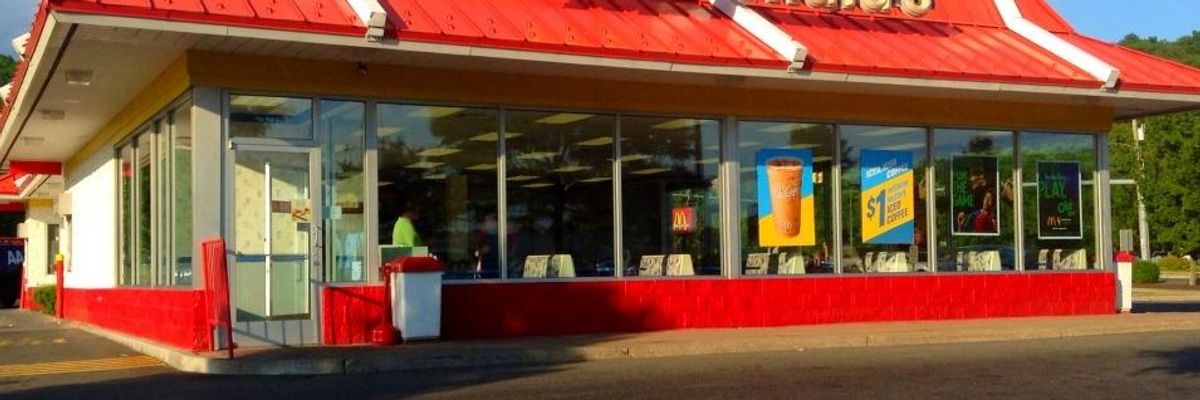
To get a sense of the potential impact on specific companies, consider McDonald's. Last year, CEO Stephen Easterbrook made $17.4 million before stepping down in November. (Photo: Mike Mozart/flickr/cc)
CEOs did not cause the pandemic. But they deserve a good deal of the blame for a model that shoveled profits up the corporate ladder, leaving lower-level employees financially insecure. When Covid-19 struck, it didn't take much to push millions of vulnerable workers over the edge.
If we want to not only survive the pandemic but emerge as a nation more resilient to future crises, we need to reverse these obscenely unfair pay practices.
On November 3, San Francisco voters will have a chance to take a significant step in that direction.
The city's Board of Supervisors has placed a measure on the ballot, Proposition L, which would increase taxes on corporations with extreme gaps between CEO and worker pay.
Specifically, the proposal would increase tax rates on local business revenue, ranging from an additional 0.1 percent on corporations that pay their CEO more than 100 times their typical San Francisco worker pay to 0.6 percent for companies with pay ratios of 600 to 1 or more.
To get a sense of the potential impact on specific companies, consider McDonald's. Last year, CEO Stephen Easterbrook made $17.4 million before stepping down in November. That's about 522 times as much as one of the fast food giant's crew members would make earning San Francisco's $16.07 minimum wage on an annual, full-time basis.
Unless McDonald's makes big changes to its pay practices, these numbers suggest the company would pay a tax increase on the higher end of the proposed range, as a percentage of sales from their 16 or so San Francisco restaurants.
The benefits of the ballot measure are twofold. It would encourage corporations to narrow their pay gaps while generating revenue for programs to reduce poverty and inequality. City officials estimate the tax would raise $140 million per year.
If San Francisco voters approve the plan, the city would be the second in the nation to adopt a tax on large CEO-worker pay gaps. The first was Portland, Oregon.
Inequality.org co-editor Sarah Anderson speaks about the proposed Overpaid Executive Gross Receipts Tax on "Civic," a podcast of the San Francisco Public Press.
For the tax design nerds out there, let me point out some differences between the San Francisco proposal and the Portland tax:
All these technicalities aside, both models advance the movement to reverse inequality in ways that should give a strong boost to other efforts. Lawmakers have introduced similar bills in at least eight state legislatures, including California, as well as in the U.S. Senate and House of Representatives.
In the midst of the pandemic crisis, the argument for such taxes is even stronger.
"We believe that big corporations that can afford to pay their executives million-dollar salaries every year can afford to pay their fair share in taxes to help us recover," wrote San Francisco Supervisor Matt Haney in a statement supporting Proposition L. Revenue from the tax, he pointed out, would allow the city to hire hundreds of nurses, doctors, first responders, and essential health care workers.
Of course Proposition L also has its detractors. Republican Richie Greenberg, who ran an unsuccessful race for San Francisco mayor in 2018, issued a statement claiming the tax would serve no purpose because "Employees' salaries are based on experience and value to a company."
That tired argument should've been dead after the 2008 financial crisis, when financial executives chasing massive bonuses drove our economy off a cliff.
It should be even deader now, as CEOs continue to pocket fat paychecks in a recession while essential frontlines workers show us every day just how undervalued they've long been.
When the smoke from California's fires and the fog from all the election chaos lift, San Francisco may shine a new light towards a more equitable future.
Dear Common Dreams reader, It’s been nearly 30 years since I co-founded Common Dreams with my late wife, Lina Newhouser. We had the radical notion that journalism should serve the public good, not corporate profits. It was clear to us from the outset what it would take to build such a project. No paid advertisements. No corporate sponsors. No millionaire publisher telling us what to think or do. Many people said we wouldn't last a year, but we proved those doubters wrong. Together with a tremendous team of journalists and dedicated staff, we built an independent media outlet free from the constraints of profits and corporate control. Our mission has always been simple: To inform. To inspire. To ignite change for the common good. Building Common Dreams was not easy. Our survival was never guaranteed. When you take on the most powerful forces—Wall Street greed, fossil fuel industry destruction, Big Tech lobbyists, and uber-rich oligarchs who have spent billions upon billions rigging the economy and democracy in their favor—the only bulwark you have is supporters who believe in your work. But here’s the urgent message from me today. It's never been this bad out there. And it's never been this hard to keep us going. At the very moment Common Dreams is most needed, the threats we face are intensifying. We need your support now more than ever. We don't accept corporate advertising and never will. We don't have a paywall because we don't think people should be blocked from critical news based on their ability to pay. Everything we do is funded by the donations of readers like you. When everyone does the little they can afford, we are strong. But if that support retreats or dries up, so do we. Will you donate now to make sure Common Dreams not only survives but thrives? —Craig Brown, Co-founder |
CEOs did not cause the pandemic. But they deserve a good deal of the blame for a model that shoveled profits up the corporate ladder, leaving lower-level employees financially insecure. When Covid-19 struck, it didn't take much to push millions of vulnerable workers over the edge.
If we want to not only survive the pandemic but emerge as a nation more resilient to future crises, we need to reverse these obscenely unfair pay practices.
On November 3, San Francisco voters will have a chance to take a significant step in that direction.
The city's Board of Supervisors has placed a measure on the ballot, Proposition L, which would increase taxes on corporations with extreme gaps between CEO and worker pay.
Specifically, the proposal would increase tax rates on local business revenue, ranging from an additional 0.1 percent on corporations that pay their CEO more than 100 times their typical San Francisco worker pay to 0.6 percent for companies with pay ratios of 600 to 1 or more.
To get a sense of the potential impact on specific companies, consider McDonald's. Last year, CEO Stephen Easterbrook made $17.4 million before stepping down in November. That's about 522 times as much as one of the fast food giant's crew members would make earning San Francisco's $16.07 minimum wage on an annual, full-time basis.
Unless McDonald's makes big changes to its pay practices, these numbers suggest the company would pay a tax increase on the higher end of the proposed range, as a percentage of sales from their 16 or so San Francisco restaurants.
The benefits of the ballot measure are twofold. It would encourage corporations to narrow their pay gaps while generating revenue for programs to reduce poverty and inequality. City officials estimate the tax would raise $140 million per year.
If San Francisco voters approve the plan, the city would be the second in the nation to adopt a tax on large CEO-worker pay gaps. The first was Portland, Oregon.
Inequality.org co-editor Sarah Anderson speaks about the proposed Overpaid Executive Gross Receipts Tax on "Civic," a podcast of the San Francisco Public Press.
For the tax design nerds out there, let me point out some differences between the San Francisco proposal and the Portland tax:
All these technicalities aside, both models advance the movement to reverse inequality in ways that should give a strong boost to other efforts. Lawmakers have introduced similar bills in at least eight state legislatures, including California, as well as in the U.S. Senate and House of Representatives.
In the midst of the pandemic crisis, the argument for such taxes is even stronger.
"We believe that big corporations that can afford to pay their executives million-dollar salaries every year can afford to pay their fair share in taxes to help us recover," wrote San Francisco Supervisor Matt Haney in a statement supporting Proposition L. Revenue from the tax, he pointed out, would allow the city to hire hundreds of nurses, doctors, first responders, and essential health care workers.
Of course Proposition L also has its detractors. Republican Richie Greenberg, who ran an unsuccessful race for San Francisco mayor in 2018, issued a statement claiming the tax would serve no purpose because "Employees' salaries are based on experience and value to a company."
That tired argument should've been dead after the 2008 financial crisis, when financial executives chasing massive bonuses drove our economy off a cliff.
It should be even deader now, as CEOs continue to pocket fat paychecks in a recession while essential frontlines workers show us every day just how undervalued they've long been.
When the smoke from California's fires and the fog from all the election chaos lift, San Francisco may shine a new light towards a more equitable future.
CEOs did not cause the pandemic. But they deserve a good deal of the blame for a model that shoveled profits up the corporate ladder, leaving lower-level employees financially insecure. When Covid-19 struck, it didn't take much to push millions of vulnerable workers over the edge.
If we want to not only survive the pandemic but emerge as a nation more resilient to future crises, we need to reverse these obscenely unfair pay practices.
On November 3, San Francisco voters will have a chance to take a significant step in that direction.
The city's Board of Supervisors has placed a measure on the ballot, Proposition L, which would increase taxes on corporations with extreme gaps between CEO and worker pay.
Specifically, the proposal would increase tax rates on local business revenue, ranging from an additional 0.1 percent on corporations that pay their CEO more than 100 times their typical San Francisco worker pay to 0.6 percent for companies with pay ratios of 600 to 1 or more.
To get a sense of the potential impact on specific companies, consider McDonald's. Last year, CEO Stephen Easterbrook made $17.4 million before stepping down in November. That's about 522 times as much as one of the fast food giant's crew members would make earning San Francisco's $16.07 minimum wage on an annual, full-time basis.
Unless McDonald's makes big changes to its pay practices, these numbers suggest the company would pay a tax increase on the higher end of the proposed range, as a percentage of sales from their 16 or so San Francisco restaurants.
The benefits of the ballot measure are twofold. It would encourage corporations to narrow their pay gaps while generating revenue for programs to reduce poverty and inequality. City officials estimate the tax would raise $140 million per year.
If San Francisco voters approve the plan, the city would be the second in the nation to adopt a tax on large CEO-worker pay gaps. The first was Portland, Oregon.
Inequality.org co-editor Sarah Anderson speaks about the proposed Overpaid Executive Gross Receipts Tax on "Civic," a podcast of the San Francisco Public Press.
For the tax design nerds out there, let me point out some differences between the San Francisco proposal and the Portland tax:
All these technicalities aside, both models advance the movement to reverse inequality in ways that should give a strong boost to other efforts. Lawmakers have introduced similar bills in at least eight state legislatures, including California, as well as in the U.S. Senate and House of Representatives.
In the midst of the pandemic crisis, the argument for such taxes is even stronger.
"We believe that big corporations that can afford to pay their executives million-dollar salaries every year can afford to pay their fair share in taxes to help us recover," wrote San Francisco Supervisor Matt Haney in a statement supporting Proposition L. Revenue from the tax, he pointed out, would allow the city to hire hundreds of nurses, doctors, first responders, and essential health care workers.
Of course Proposition L also has its detractors. Republican Richie Greenberg, who ran an unsuccessful race for San Francisco mayor in 2018, issued a statement claiming the tax would serve no purpose because "Employees' salaries are based on experience and value to a company."
That tired argument should've been dead after the 2008 financial crisis, when financial executives chasing massive bonuses drove our economy off a cliff.
It should be even deader now, as CEOs continue to pocket fat paychecks in a recession while essential frontlines workers show us every day just how undervalued they've long been.
When the smoke from California's fires and the fog from all the election chaos lift, San Francisco may shine a new light towards a more equitable future.