SUBSCRIBE TO OUR FREE NEWSLETTER
Daily news & progressive opinion—funded by the people, not the corporations—delivered straight to your inbox.
5
#000000
#FFFFFF
To donate by check, phone, or other method, see our More Ways to Give page.
Daily news & progressive opinion—funded by the people, not the corporations—delivered straight to your inbox.
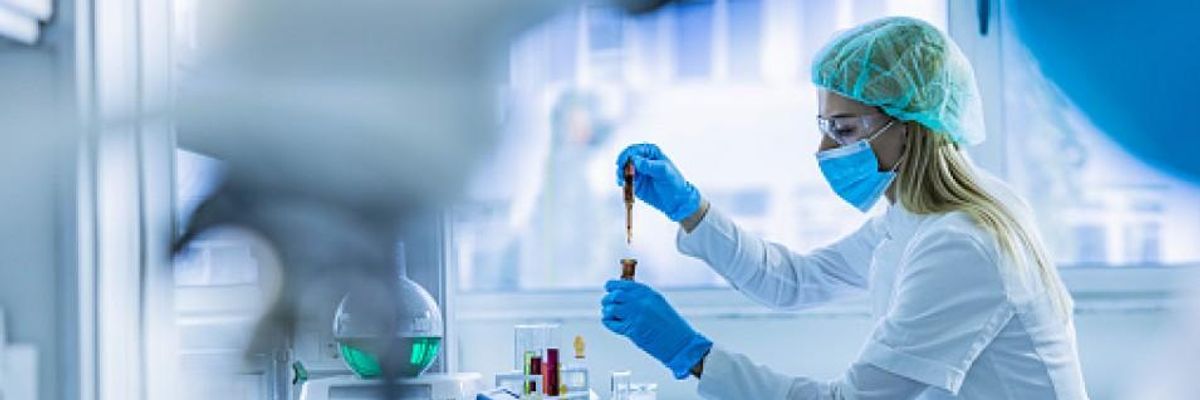
"Big pharma's secretive, profit-driven model of science is making the invention and dissemination of COVID treatments and vaccines more difficult than it needs to be," writes Morten. The industry, he warns, "generally prefers to keep its scientific advances on COVID-19 as secret as possible, even though this secrecy needlessly slows down the process of developing effective treatments and vaccines. And our law currently lets them." (Photo: Skynesher/Getty Images)
All of us desperately await the day when we can send our children to school, spend time with our grandparents and grandkids, and live without fear of COVID-19.
An ad campaign from the pharmaceutical industry's largest lobbying group promises us that "science is how we get back to normal." They're right that science can defeat COVID-19, but they're wrong about the kind of science we need most.
Big pharma's secretive, profit-driven model of science is making the invention and dissemination of COVID treatments and vaccines more difficult than it needs to be. Big pharma generally prefers to keep its scientific advances on COVID-19 as secret as possible, even though this secrecy needlessly slows down the process of developing effective treatments and vaccines. And our law currently lets them.
"Open science means broad, ready, equitable access to scientific knowledge, and to the data that generates that knowledge, across drugs' and vaccines' entire lifecycles, through the pandemic and beyond. And it will save lives."
For example, in the spring, Gilead announced that the drug remdesivir is the first antiviral proven effective against COVID-19 but declined, at first, to share its clinical trial results, leaving doctors and researchers in the dark. AstraZeneca recently halted a major trial of its COVID-19 vaccine candidate because of safety concerns--which might conceivably affect other vaccines, too--but has so far refused to disclose any details. If and when we do have a working vaccine, knowledge vital to scale up manufacturing and distribution around the entire world is likely to be held as trade secrets, slowing the global public health response and perpetuating the pandemic.
(As I've co-written elsewhere, big pharma's efforts through the COVID-19 pandemic to keep scientific knowledge proprietary are particularly galling given that the U.S. and other governments have invested billions of dollars of public money to create that knowledge.)
There is a better way: open science. Open science means broad, ready, equitable access to scientific knowledge, and to the data that generates that knowledge, across drugs' and vaccines' entire lifecycles, through the pandemic and beyond.
Open science is essential to focus research and development activity on the most crucial health needs, accelerate R&D, expand competition and prevent monopolization, reduce costs, and ensure affordable, equitable access. We must provide access to the "means, methods, and materials" of biomedical innovation, including various preclinical, clinical, and financial data that is currently kept mostly hidden by industry--and too often by government and academia, too.
This could be done in two phases. In phase one, the National Institutes of Health (NIH), the Food and Drug Administration (FDA), and other public agencies should begin discretionary sharing of preclinical and clinical data they hold. Government-held results of experiments and clinical trials, and information on the costs of this research, can and should be shared regardless of whether the results are generated by government, industry, or academia. Such data sharing would make it easier for researchers to replicate research findings, reduce redundancy and other inefficiency, and speed the development of new therapies.
Phase one could be achieved immediately, through agency discretion, without changes to existing law. However, Congress could maximize public benefit by making this data sharing mandatory.
Phase two would extend open science to manufacturing. Sharing data and know-how on manufacturing processes would accelerate development of new drugs, especially biologics and biosimilars. This would break anti-competitive monopolies and lower sky-high prices.
To achieve this, Congress should amend federal statute (such as the Food, Drug, and Cosmetic Act or the Biologics Price Competition and Innovation Act) to require manufacturers and the FDA to share information that is currently protected as trade secrets once the appropriate exclusivity period has passed. Congress should also provide the FDA and Department of Health and Human Services (HHS) discretion to share manufacturing information--and clinical data, too--sooner, before the exclusivity period expires, to accelerate competition in the event of anticompetitive conduct or pressing public health needs.
The Patent Act should also be reformed to require patent owners to disclose more useful information.
The COVID-19 pandemic has confirmed that we must change our laws to prevent drug companies from keeping valuable medical knowledge secret for years, even decades. It is time for our government to put science and public health ahead of private profit, by passing new laws to ensure broad, ready, equitable access to scientific and medical knowledge, from test tube to pharmacy.
This op-ed is part of an ongoing series on public medicines. View the first in the series here, the second here, the third here, and the fourth here.
Dear Common Dreams reader, It’s been nearly 30 years since I co-founded Common Dreams with my late wife, Lina Newhouser. We had the radical notion that journalism should serve the public good, not corporate profits. It was clear to us from the outset what it would take to build such a project. No paid advertisements. No corporate sponsors. No millionaire publisher telling us what to think or do. Many people said we wouldn't last a year, but we proved those doubters wrong. Together with a tremendous team of journalists and dedicated staff, we built an independent media outlet free from the constraints of profits and corporate control. Our mission has always been simple: To inform. To inspire. To ignite change for the common good. Building Common Dreams was not easy. Our survival was never guaranteed. When you take on the most powerful forces—Wall Street greed, fossil fuel industry destruction, Big Tech lobbyists, and uber-rich oligarchs who have spent billions upon billions rigging the economy and democracy in their favor—the only bulwark you have is supporters who believe in your work. But here’s the urgent message from me today. It's never been this bad out there. And it's never been this hard to keep us going. At the very moment Common Dreams is most needed, the threats we face are intensifying. We need your support now more than ever. We don't accept corporate advertising and never will. We don't have a paywall because we don't think people should be blocked from critical news based on their ability to pay. Everything we do is funded by the donations of readers like you. When everyone does the little they can afford, we are strong. But if that support retreats or dries up, so do we. Will you donate now to make sure Common Dreams not only survives but thrives? —Craig Brown, Co-founder |
All of us desperately await the day when we can send our children to school, spend time with our grandparents and grandkids, and live without fear of COVID-19.
An ad campaign from the pharmaceutical industry's largest lobbying group promises us that "science is how we get back to normal." They're right that science can defeat COVID-19, but they're wrong about the kind of science we need most.
Big pharma's secretive, profit-driven model of science is making the invention and dissemination of COVID treatments and vaccines more difficult than it needs to be. Big pharma generally prefers to keep its scientific advances on COVID-19 as secret as possible, even though this secrecy needlessly slows down the process of developing effective treatments and vaccines. And our law currently lets them.
"Open science means broad, ready, equitable access to scientific knowledge, and to the data that generates that knowledge, across drugs' and vaccines' entire lifecycles, through the pandemic and beyond. And it will save lives."
For example, in the spring, Gilead announced that the drug remdesivir is the first antiviral proven effective against COVID-19 but declined, at first, to share its clinical trial results, leaving doctors and researchers in the dark. AstraZeneca recently halted a major trial of its COVID-19 vaccine candidate because of safety concerns--which might conceivably affect other vaccines, too--but has so far refused to disclose any details. If and when we do have a working vaccine, knowledge vital to scale up manufacturing and distribution around the entire world is likely to be held as trade secrets, slowing the global public health response and perpetuating the pandemic.
(As I've co-written elsewhere, big pharma's efforts through the COVID-19 pandemic to keep scientific knowledge proprietary are particularly galling given that the U.S. and other governments have invested billions of dollars of public money to create that knowledge.)
There is a better way: open science. Open science means broad, ready, equitable access to scientific knowledge, and to the data that generates that knowledge, across drugs' and vaccines' entire lifecycles, through the pandemic and beyond.
Open science is essential to focus research and development activity on the most crucial health needs, accelerate R&D, expand competition and prevent monopolization, reduce costs, and ensure affordable, equitable access. We must provide access to the "means, methods, and materials" of biomedical innovation, including various preclinical, clinical, and financial data that is currently kept mostly hidden by industry--and too often by government and academia, too.
This could be done in two phases. In phase one, the National Institutes of Health (NIH), the Food and Drug Administration (FDA), and other public agencies should begin discretionary sharing of preclinical and clinical data they hold. Government-held results of experiments and clinical trials, and information on the costs of this research, can and should be shared regardless of whether the results are generated by government, industry, or academia. Such data sharing would make it easier for researchers to replicate research findings, reduce redundancy and other inefficiency, and speed the development of new therapies.
Phase one could be achieved immediately, through agency discretion, without changes to existing law. However, Congress could maximize public benefit by making this data sharing mandatory.
Phase two would extend open science to manufacturing. Sharing data and know-how on manufacturing processes would accelerate development of new drugs, especially biologics and biosimilars. This would break anti-competitive monopolies and lower sky-high prices.
To achieve this, Congress should amend federal statute (such as the Food, Drug, and Cosmetic Act or the Biologics Price Competition and Innovation Act) to require manufacturers and the FDA to share information that is currently protected as trade secrets once the appropriate exclusivity period has passed. Congress should also provide the FDA and Department of Health and Human Services (HHS) discretion to share manufacturing information--and clinical data, too--sooner, before the exclusivity period expires, to accelerate competition in the event of anticompetitive conduct or pressing public health needs.
The Patent Act should also be reformed to require patent owners to disclose more useful information.
The COVID-19 pandemic has confirmed that we must change our laws to prevent drug companies from keeping valuable medical knowledge secret for years, even decades. It is time for our government to put science and public health ahead of private profit, by passing new laws to ensure broad, ready, equitable access to scientific and medical knowledge, from test tube to pharmacy.
This op-ed is part of an ongoing series on public medicines. View the first in the series here, the second here, the third here, and the fourth here.
All of us desperately await the day when we can send our children to school, spend time with our grandparents and grandkids, and live without fear of COVID-19.
An ad campaign from the pharmaceutical industry's largest lobbying group promises us that "science is how we get back to normal." They're right that science can defeat COVID-19, but they're wrong about the kind of science we need most.
Big pharma's secretive, profit-driven model of science is making the invention and dissemination of COVID treatments and vaccines more difficult than it needs to be. Big pharma generally prefers to keep its scientific advances on COVID-19 as secret as possible, even though this secrecy needlessly slows down the process of developing effective treatments and vaccines. And our law currently lets them.
"Open science means broad, ready, equitable access to scientific knowledge, and to the data that generates that knowledge, across drugs' and vaccines' entire lifecycles, through the pandemic and beyond. And it will save lives."
For example, in the spring, Gilead announced that the drug remdesivir is the first antiviral proven effective against COVID-19 but declined, at first, to share its clinical trial results, leaving doctors and researchers in the dark. AstraZeneca recently halted a major trial of its COVID-19 vaccine candidate because of safety concerns--which might conceivably affect other vaccines, too--but has so far refused to disclose any details. If and when we do have a working vaccine, knowledge vital to scale up manufacturing and distribution around the entire world is likely to be held as trade secrets, slowing the global public health response and perpetuating the pandemic.
(As I've co-written elsewhere, big pharma's efforts through the COVID-19 pandemic to keep scientific knowledge proprietary are particularly galling given that the U.S. and other governments have invested billions of dollars of public money to create that knowledge.)
There is a better way: open science. Open science means broad, ready, equitable access to scientific knowledge, and to the data that generates that knowledge, across drugs' and vaccines' entire lifecycles, through the pandemic and beyond.
Open science is essential to focus research and development activity on the most crucial health needs, accelerate R&D, expand competition and prevent monopolization, reduce costs, and ensure affordable, equitable access. We must provide access to the "means, methods, and materials" of biomedical innovation, including various preclinical, clinical, and financial data that is currently kept mostly hidden by industry--and too often by government and academia, too.
This could be done in two phases. In phase one, the National Institutes of Health (NIH), the Food and Drug Administration (FDA), and other public agencies should begin discretionary sharing of preclinical and clinical data they hold. Government-held results of experiments and clinical trials, and information on the costs of this research, can and should be shared regardless of whether the results are generated by government, industry, or academia. Such data sharing would make it easier for researchers to replicate research findings, reduce redundancy and other inefficiency, and speed the development of new therapies.
Phase one could be achieved immediately, through agency discretion, without changes to existing law. However, Congress could maximize public benefit by making this data sharing mandatory.
Phase two would extend open science to manufacturing. Sharing data and know-how on manufacturing processes would accelerate development of new drugs, especially biologics and biosimilars. This would break anti-competitive monopolies and lower sky-high prices.
To achieve this, Congress should amend federal statute (such as the Food, Drug, and Cosmetic Act or the Biologics Price Competition and Innovation Act) to require manufacturers and the FDA to share information that is currently protected as trade secrets once the appropriate exclusivity period has passed. Congress should also provide the FDA and Department of Health and Human Services (HHS) discretion to share manufacturing information--and clinical data, too--sooner, before the exclusivity period expires, to accelerate competition in the event of anticompetitive conduct or pressing public health needs.
The Patent Act should also be reformed to require patent owners to disclose more useful information.
The COVID-19 pandemic has confirmed that we must change our laws to prevent drug companies from keeping valuable medical knowledge secret for years, even decades. It is time for our government to put science and public health ahead of private profit, by passing new laws to ensure broad, ready, equitable access to scientific and medical knowledge, from test tube to pharmacy.
This op-ed is part of an ongoing series on public medicines. View the first in the series here, the second here, the third here, and the fourth here.