SUBSCRIBE TO OUR FREE NEWSLETTER
Daily news & progressive opinion—funded by the people, not the corporations—delivered straight to your inbox.
5
#000000
#FFFFFF
To donate by check, phone, or other method, see our More Ways to Give page.
Daily news & progressive opinion—funded by the people, not the corporations—delivered straight to your inbox.
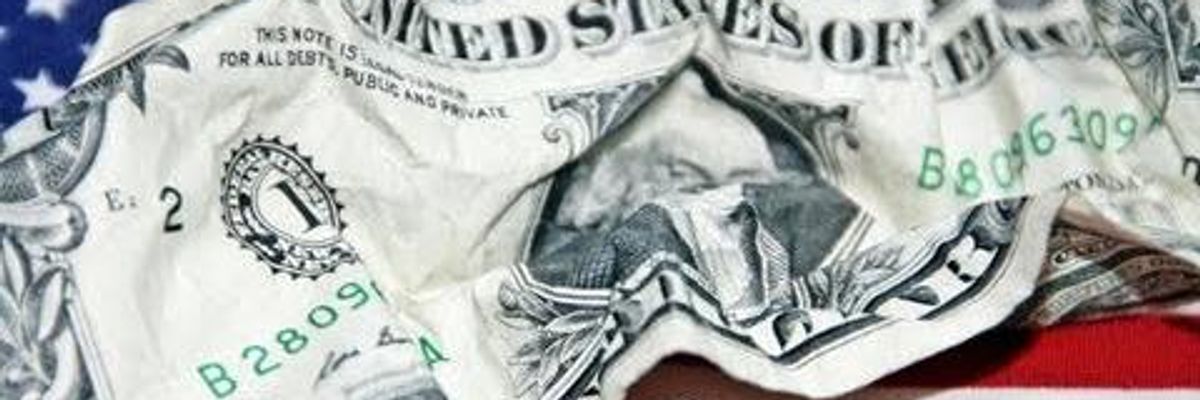
"The world is awash in the savings of the wealthy, and interest rates are at historic lows," writes Buell, "Tax policy can and should address anti-democratic extremes of wealth distribution, but governments must not wait for success in that endeavor to address the climate crisis." (Photo: Informed Comment)
Even as California burns, the states of the Gulf of Mexico brace for another hurricane, a global pandemic rages, an influential segment of DC political opinion wants the populace to focus on the national debt. Employing arguments that go back at least as far as Andrew Mellon, Herbert Hoover's Treasury Secretary, Politico reports:
"Sen. Ted Cruz (R-Texas) is among the fiscal hawks who argue that additional relief measures won't help.
Sen. Cruz believes existing proposals in Congress will add even more to the debt without taking meaningful steps to spur economic growth and get Americans safely back to work, which will have devastating consequences for future generations."
These ideas are not limited to the Republican hawks.
Talmon Joseph Smith, NYT staff writer points out: "The embrace of austerity was remarkably widespread in the early 2010s. Democrats from President Barack Obama to House Speaker Nancy Pelosi supported deals to decrease annual deficits. Mr. Obama lowered the deficit as a share of G.D.P. throughout his time in office--even in the immediate wake of the Great Recession, and at the expense of spending more on policies he ran on in his 2008 presidential campaign."
A painfully slow recovery from the world financial crisis and reductions in already inadequate climate crisis mitigation were the price Obama paid. Budget hawks maintain these sacrifices are necessary in order to avoid leaving a crushing debt burden and high levels of taxation to our grandchildren. Budget hawks warn social justice and climate activists that if they wish to avoid this scenario they must cut other domestic programs--Social Security is their most tempting target--or raise taxes. Advocates of the Green New Deal need to tear down this debtor's prison the Right has fashioned.
For starters talk about the fiscal burden faced by our grandchildren is nonsense. The vast majority of bonds issued by the US Government are held by US citizens. Some of our grandchildren will be paying interest to others of our grandchildren. There may be a distributional issue here, but that pales in comparison to the inegalitarian stock holdings.
As for the moral judgment that today's policy makers are irresponsible spendthrifts there are several important counterarguments. Governments around the world have seen their debt to GDP ratios worsen dramatically, but in almost all cases this trend has been a consequence of the global financial crisis (GFC) occasioned by private megabanks and the burdens that crisis imposed on government balance sheets. (Spain for instance had an exemplary balance sheet before the Great Recession.)
Imposing budget balancing austerity on economies before they are fully recovered is a tragic mistake. Recovery in the US has been tepid at best, and Europe, which swallowed an even harsher dose, has experienced an economic and political crisis.
In an amusing discussion about how government could fund a pony for every citizen, economist Stephanie Kelton points out "Without raising a dime from the rest of us, the Senate quietly approved an $80-billion annual increase [in the military budget]... And just where did the government get the money to do that? It authorized it into existence . . . Congress has special powers: It's the patent-holder on the U.S. dollar. No one else is legally allowed to create it. This means that Congress can always afford the pony because it can always create the money to pay for it. Now, that doesn't mean the government can buy absolutely anything it wants ... our economy has internal limits. If the government tries to buy too much of something, it will drive up prices ... There are plenty of ways for the government to get a handle on inflation, though. For example, it can take money out of the economy through taxation."
For advocates of the Green New Deal more attention to fiscal politics is imperative. The world is awash in the savings of the wealthy, and interest rates are at historic lows. Tax policy can and should address anti-democratic extremes of wealth distribution, but governments must not wait for success in that endeavor to address the climate crisis. It is the height of moral and fiscal irresponsibility not to borrow massively to meet life- saving needs.
Dear Common Dreams reader, It’s been nearly 30 years since I co-founded Common Dreams with my late wife, Lina Newhouser. We had the radical notion that journalism should serve the public good, not corporate profits. It was clear to us from the outset what it would take to build such a project. No paid advertisements. No corporate sponsors. No millionaire publisher telling us what to think or do. Many people said we wouldn't last a year, but we proved those doubters wrong. Together with a tremendous team of journalists and dedicated staff, we built an independent media outlet free from the constraints of profits and corporate control. Our mission has always been simple: To inform. To inspire. To ignite change for the common good. Building Common Dreams was not easy. Our survival was never guaranteed. When you take on the most powerful forces—Wall Street greed, fossil fuel industry destruction, Big Tech lobbyists, and uber-rich oligarchs who have spent billions upon billions rigging the economy and democracy in their favor—the only bulwark you have is supporters who believe in your work. But here’s the urgent message from me today. It's never been this bad out there. And it's never been this hard to keep us going. At the very moment Common Dreams is most needed, the threats we face are intensifying. We need your support now more than ever. We don't accept corporate advertising and never will. We don't have a paywall because we don't think people should be blocked from critical news based on their ability to pay. Everything we do is funded by the donations of readers like you. When everyone does the little they can afford, we are strong. But if that support retreats or dries up, so do we. Will you donate now to make sure Common Dreams not only survives but thrives? —Craig Brown, Co-founder |
Even as California burns, the states of the Gulf of Mexico brace for another hurricane, a global pandemic rages, an influential segment of DC political opinion wants the populace to focus on the national debt. Employing arguments that go back at least as far as Andrew Mellon, Herbert Hoover's Treasury Secretary, Politico reports:
"Sen. Ted Cruz (R-Texas) is among the fiscal hawks who argue that additional relief measures won't help.
Sen. Cruz believes existing proposals in Congress will add even more to the debt without taking meaningful steps to spur economic growth and get Americans safely back to work, which will have devastating consequences for future generations."
These ideas are not limited to the Republican hawks.
Talmon Joseph Smith, NYT staff writer points out: "The embrace of austerity was remarkably widespread in the early 2010s. Democrats from President Barack Obama to House Speaker Nancy Pelosi supported deals to decrease annual deficits. Mr. Obama lowered the deficit as a share of G.D.P. throughout his time in office--even in the immediate wake of the Great Recession, and at the expense of spending more on policies he ran on in his 2008 presidential campaign."
A painfully slow recovery from the world financial crisis and reductions in already inadequate climate crisis mitigation were the price Obama paid. Budget hawks maintain these sacrifices are necessary in order to avoid leaving a crushing debt burden and high levels of taxation to our grandchildren. Budget hawks warn social justice and climate activists that if they wish to avoid this scenario they must cut other domestic programs--Social Security is their most tempting target--or raise taxes. Advocates of the Green New Deal need to tear down this debtor's prison the Right has fashioned.
For starters talk about the fiscal burden faced by our grandchildren is nonsense. The vast majority of bonds issued by the US Government are held by US citizens. Some of our grandchildren will be paying interest to others of our grandchildren. There may be a distributional issue here, but that pales in comparison to the inegalitarian stock holdings.
As for the moral judgment that today's policy makers are irresponsible spendthrifts there are several important counterarguments. Governments around the world have seen their debt to GDP ratios worsen dramatically, but in almost all cases this trend has been a consequence of the global financial crisis (GFC) occasioned by private megabanks and the burdens that crisis imposed on government balance sheets. (Spain for instance had an exemplary balance sheet before the Great Recession.)
Imposing budget balancing austerity on economies before they are fully recovered is a tragic mistake. Recovery in the US has been tepid at best, and Europe, which swallowed an even harsher dose, has experienced an economic and political crisis.
In an amusing discussion about how government could fund a pony for every citizen, economist Stephanie Kelton points out "Without raising a dime from the rest of us, the Senate quietly approved an $80-billion annual increase [in the military budget]... And just where did the government get the money to do that? It authorized it into existence . . . Congress has special powers: It's the patent-holder on the U.S. dollar. No one else is legally allowed to create it. This means that Congress can always afford the pony because it can always create the money to pay for it. Now, that doesn't mean the government can buy absolutely anything it wants ... our economy has internal limits. If the government tries to buy too much of something, it will drive up prices ... There are plenty of ways for the government to get a handle on inflation, though. For example, it can take money out of the economy through taxation."
For advocates of the Green New Deal more attention to fiscal politics is imperative. The world is awash in the savings of the wealthy, and interest rates are at historic lows. Tax policy can and should address anti-democratic extremes of wealth distribution, but governments must not wait for success in that endeavor to address the climate crisis. It is the height of moral and fiscal irresponsibility not to borrow massively to meet life- saving needs.
Even as California burns, the states of the Gulf of Mexico brace for another hurricane, a global pandemic rages, an influential segment of DC political opinion wants the populace to focus on the national debt. Employing arguments that go back at least as far as Andrew Mellon, Herbert Hoover's Treasury Secretary, Politico reports:
"Sen. Ted Cruz (R-Texas) is among the fiscal hawks who argue that additional relief measures won't help.
Sen. Cruz believes existing proposals in Congress will add even more to the debt without taking meaningful steps to spur economic growth and get Americans safely back to work, which will have devastating consequences for future generations."
These ideas are not limited to the Republican hawks.
Talmon Joseph Smith, NYT staff writer points out: "The embrace of austerity was remarkably widespread in the early 2010s. Democrats from President Barack Obama to House Speaker Nancy Pelosi supported deals to decrease annual deficits. Mr. Obama lowered the deficit as a share of G.D.P. throughout his time in office--even in the immediate wake of the Great Recession, and at the expense of spending more on policies he ran on in his 2008 presidential campaign."
A painfully slow recovery from the world financial crisis and reductions in already inadequate climate crisis mitigation were the price Obama paid. Budget hawks maintain these sacrifices are necessary in order to avoid leaving a crushing debt burden and high levels of taxation to our grandchildren. Budget hawks warn social justice and climate activists that if they wish to avoid this scenario they must cut other domestic programs--Social Security is their most tempting target--or raise taxes. Advocates of the Green New Deal need to tear down this debtor's prison the Right has fashioned.
For starters talk about the fiscal burden faced by our grandchildren is nonsense. The vast majority of bonds issued by the US Government are held by US citizens. Some of our grandchildren will be paying interest to others of our grandchildren. There may be a distributional issue here, but that pales in comparison to the inegalitarian stock holdings.
As for the moral judgment that today's policy makers are irresponsible spendthrifts there are several important counterarguments. Governments around the world have seen their debt to GDP ratios worsen dramatically, but in almost all cases this trend has been a consequence of the global financial crisis (GFC) occasioned by private megabanks and the burdens that crisis imposed on government balance sheets. (Spain for instance had an exemplary balance sheet before the Great Recession.)
Imposing budget balancing austerity on economies before they are fully recovered is a tragic mistake. Recovery in the US has been tepid at best, and Europe, which swallowed an even harsher dose, has experienced an economic and political crisis.
In an amusing discussion about how government could fund a pony for every citizen, economist Stephanie Kelton points out "Without raising a dime from the rest of us, the Senate quietly approved an $80-billion annual increase [in the military budget]... And just where did the government get the money to do that? It authorized it into existence . . . Congress has special powers: It's the patent-holder on the U.S. dollar. No one else is legally allowed to create it. This means that Congress can always afford the pony because it can always create the money to pay for it. Now, that doesn't mean the government can buy absolutely anything it wants ... our economy has internal limits. If the government tries to buy too much of something, it will drive up prices ... There are plenty of ways for the government to get a handle on inflation, though. For example, it can take money out of the economy through taxation."
For advocates of the Green New Deal more attention to fiscal politics is imperative. The world is awash in the savings of the wealthy, and interest rates are at historic lows. Tax policy can and should address anti-democratic extremes of wealth distribution, but governments must not wait for success in that endeavor to address the climate crisis. It is the height of moral and fiscal irresponsibility not to borrow massively to meet life- saving needs.