

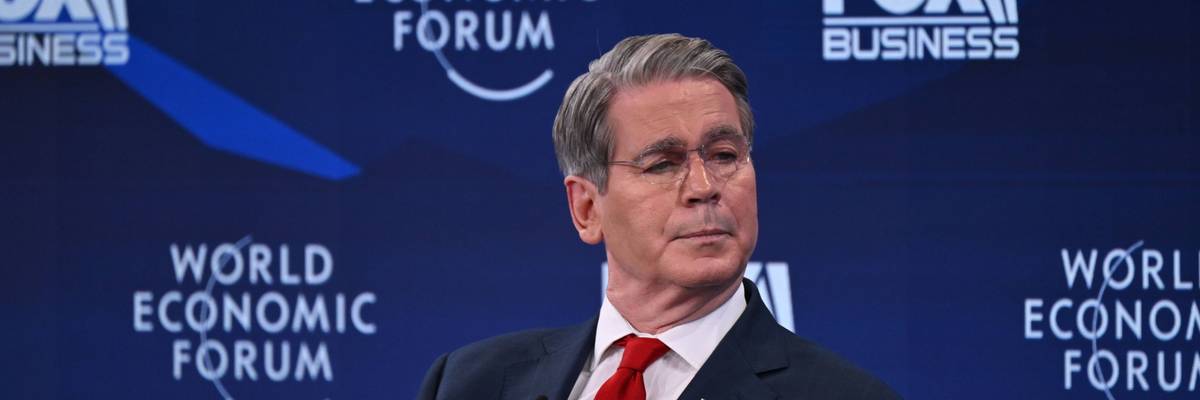
US Treasury Secretary Scott Bessent speaks at the 56th World Economic Forum (WEF) Annual Meeting in Davos, Switzerland on January 20, 2026.
Danish Pension Fund to Divest Its Holding in US Treasuries After Greenland Threats
An investor at Deutsche Bank said the US reliance on foreign debt is a “key weakness” that could be used as leverage against Trump’s aggression.
A Danish pension fund is selling off its US treasuries in the wake of President Donald Trump's repeated threats to annex its sovereign territory, Greenland.
The fund, known as AkademikerPension, said on Tuesday that it was selling off assets worth $100 million by the end of this month.
Its investment director, Anders Schelde, insisted that the decision was due to "poor US government finances," and had nothing to do with Trump's bellicose threats in recent weeks, which have led several European nations to move troops to the island and conduct military exercises in preparation for a US invasion.
But, he said, Trump's threats "didn't make it more difficult to take the decision."
The US president said over the weekend that he would institute tariffs on several European nations if the US did not acquire Greenland by February 1. He has previously said he would not rule out using military force to conquer the island if diplomatic means failed, and when asked about it again on Monday, replied "No comment."
Greenland's prime minister, Jens-Frederik Nielsen, responded on Monday that it would “not be pressured” and “stand firm on dialogue, on respect, and on international law.” A day later, Nielsen warned the people of Greenland to start preparing for a possible military invasion. He said, "It’s not likely there will be a military conflict, but it can’t be ruled out."
Trump's threats against Greenland have rattled markets in recent days, with CNBC reporting on Tuesday that bond prices have fallen along with stock prices and the value of the US dollar, as investors sell American assets that have long been considered among the safest investments.
While Denmark accounts for only a sliver, Europe collectively holds about 40% of foreign US Treasury holdings, which it could use as a choke point in the event of further escalation by Trump.
"Europeans hold roughly $10 trillion in US assets: around $6 trillion in US equities and roughly $4 trillion in Treasuries and other bonds," said Ipek Ozkardeskaya, senior analyst at Swissquote. "Selling those assets would pull the rug from under US markets."
The idea of a wider European boycott of US bonds appears to have unnerved US Treasury Secretary Scott Bessent, who protested during remarks at the annual World Economic Forum summit in Davos that it "defies any logic" and urged European nations not to "listen to the media who are hysterical."
George Saravelos, head of FX research at Deutsche Bank, said if Trump is intent on shredding the long-standing US military alliance with Europe, it can return the favor by backing out of its role as America's number-one lender, which could trigger heightened inflation, dollar depreciation, and higher interest rates that make borrowing and spending more costly.
"For all its military and economic strength," Saravelos wrote, "the US has one key weakness: It relies on others to pay its bills via large external deficits."
We are at a crossroads
This country and this world are at a monumental crossroads. In a few short weeks, US voters will have an opportunity to beat back the forces of fascism and confront the billionaires who are rigging the economy, our media system, and our democracy, making it increasingly impossible for ordinary people to get by. We’re not just talking about the election. We’re talking about what must be done once these fascist elements are vanquished from power. We need a bolder set of solutions than what either major party has so far been willing to offer and a working-class movement ready to fight like hell for it. Trump didn't emerge from nowhere. The conditions that fueled MAGA authoritarianism were created by decades of radical neoliberal economic policies and a corrupt political system dominated by corporate interests. They slashed taxes on the super-rich, promising that the benefits would trickle down. They said giveaways to the corporate titans would make life more affordable for the rest of us. It was all bullshit. And when a bitter, betrayed populace searches for someone to blame, right-wing demagogues have little trouble finding scapegoats. People know when they're being lied to, but you won't hear any of this from the corporate media. Only independent journalism—powered and funded by people who believe in building a better world—can deliver truly trustworthy daily news. Our Fall Campaign is underway, and we need your help. To power our newsroom through the rest of the year, we need to raise $125,000 by midnight on October 31. So if you share our vision, please contribute whatever you can to sustain our work. |
A Danish pension fund is selling off its US treasuries in the wake of President Donald Trump's repeated threats to annex its sovereign territory, Greenland.
The fund, known as AkademikerPension, said on Tuesday that it was selling off assets worth $100 million by the end of this month.
Its investment director, Anders Schelde, insisted that the decision was due to "poor US government finances," and had nothing to do with Trump's bellicose threats in recent weeks, which have led several European nations to move troops to the island and conduct military exercises in preparation for a US invasion.
But, he said, Trump's threats "didn't make it more difficult to take the decision."
The US president said over the weekend that he would institute tariffs on several European nations if the US did not acquire Greenland by February 1. He has previously said he would not rule out using military force to conquer the island if diplomatic means failed, and when asked about it again on Monday, replied "No comment."
Greenland's prime minister, Jens-Frederik Nielsen, responded on Monday that it would “not be pressured” and “stand firm on dialogue, on respect, and on international law.” A day later, Nielsen warned the people of Greenland to start preparing for a possible military invasion. He said, "It’s not likely there will be a military conflict, but it can’t be ruled out."
Trump's threats against Greenland have rattled markets in recent days, with CNBC reporting on Tuesday that bond prices have fallen along with stock prices and the value of the US dollar, as investors sell American assets that have long been considered among the safest investments.
While Denmark accounts for only a sliver, Europe collectively holds about 40% of foreign US Treasury holdings, which it could use as a choke point in the event of further escalation by Trump.
"Europeans hold roughly $10 trillion in US assets: around $6 trillion in US equities and roughly $4 trillion in Treasuries and other bonds," said Ipek Ozkardeskaya, senior analyst at Swissquote. "Selling those assets would pull the rug from under US markets."
The idea of a wider European boycott of US bonds appears to have unnerved US Treasury Secretary Scott Bessent, who protested during remarks at the annual World Economic Forum summit in Davos that it "defies any logic" and urged European nations not to "listen to the media who are hysterical."
George Saravelos, head of FX research at Deutsche Bank, said if Trump is intent on shredding the long-standing US military alliance with Europe, it can return the favor by backing out of its role as America's number-one lender, which could trigger heightened inflation, dollar depreciation, and higher interest rates that make borrowing and spending more costly.
"For all its military and economic strength," Saravelos wrote, "the US has one key weakness: It relies on others to pay its bills via large external deficits."
A Danish pension fund is selling off its US treasuries in the wake of President Donald Trump's repeated threats to annex its sovereign territory, Greenland.
The fund, known as AkademikerPension, said on Tuesday that it was selling off assets worth $100 million by the end of this month.
Its investment director, Anders Schelde, insisted that the decision was due to "poor US government finances," and had nothing to do with Trump's bellicose threats in recent weeks, which have led several European nations to move troops to the island and conduct military exercises in preparation for a US invasion.
But, he said, Trump's threats "didn't make it more difficult to take the decision."
The US president said over the weekend that he would institute tariffs on several European nations if the US did not acquire Greenland by February 1. He has previously said he would not rule out using military force to conquer the island if diplomatic means failed, and when asked about it again on Monday, replied "No comment."
Greenland's prime minister, Jens-Frederik Nielsen, responded on Monday that it would “not be pressured” and “stand firm on dialogue, on respect, and on international law.” A day later, Nielsen warned the people of Greenland to start preparing for a possible military invasion. He said, "It’s not likely there will be a military conflict, but it can’t be ruled out."
Trump's threats against Greenland have rattled markets in recent days, with CNBC reporting on Tuesday that bond prices have fallen along with stock prices and the value of the US dollar, as investors sell American assets that have long been considered among the safest investments.
While Denmark accounts for only a sliver, Europe collectively holds about 40% of foreign US Treasury holdings, which it could use as a choke point in the event of further escalation by Trump.
"Europeans hold roughly $10 trillion in US assets: around $6 trillion in US equities and roughly $4 trillion in Treasuries and other bonds," said Ipek Ozkardeskaya, senior analyst at Swissquote. "Selling those assets would pull the rug from under US markets."
The idea of a wider European boycott of US bonds appears to have unnerved US Treasury Secretary Scott Bessent, who protested during remarks at the annual World Economic Forum summit in Davos that it "defies any logic" and urged European nations not to "listen to the media who are hysterical."
George Saravelos, head of FX research at Deutsche Bank, said if Trump is intent on shredding the long-standing US military alliance with Europe, it can return the favor by backing out of its role as America's number-one lender, which could trigger heightened inflation, dollar depreciation, and higher interest rates that make borrowing and spending more costly.
"For all its military and economic strength," Saravelos wrote, "the US has one key weakness: It relies on others to pay its bills via large external deficits."