SUBSCRIBE TO OUR FREE NEWSLETTER
Daily news & progressive opinion—funded by the people, not the corporations—delivered straight to your inbox.
5
#000000
#FFFFFF
To donate by check, phone, or other method, see our More Ways to Give page.
Daily news & progressive opinion—funded by the people, not the corporations—delivered straight to your inbox.
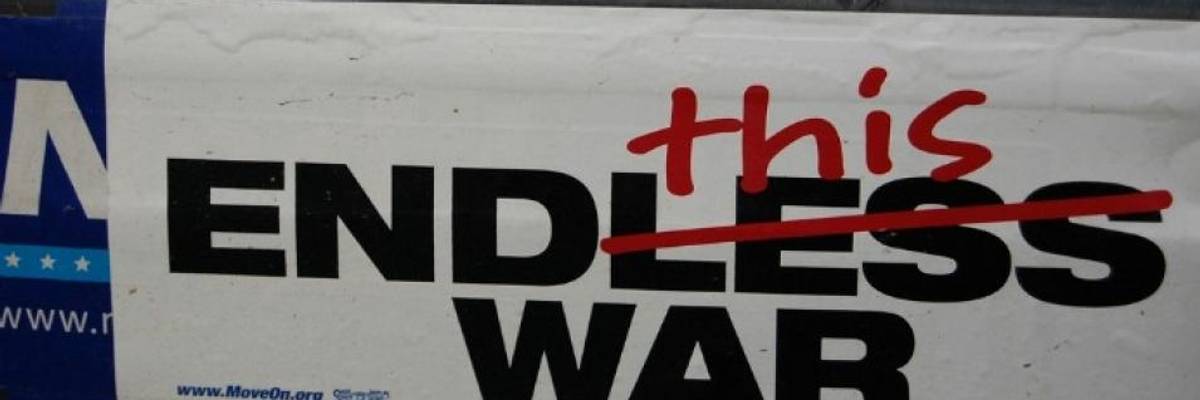
"We must reconceptualize how we build security both at home and abroad to uphold the well-being and dignity of all people," writes Lee, "Endless war has not made us, or the world, safer." (Photo: Alex Guerrero/flickr/cc)
More Americans have now died from COVID-19 than from the wars in Korea, Vietnam, Iraq and Afghanistan combined. Yet the United States is poised to continue spending more money on the Pentagon than the next 10 countries combined, with some 1 million troops deployed in about 175 countries. In other words, there's no end in sight for our forever wars.
Monday marked the 19th anniversary of the vote to pass the post-9/11 Authorization for Use of Military Force, or AUMF, a blank check to deploy U.S. military personnel anywhere in the world in the name of going after terrorists. Our country's response to that attack has had unintended and tragic consequences: war profiteering by military contractors, traumatic impact to our soldiers, and massive numbers of refugees and civilian casualties around the world.
And the high cost of waging these wars has diverted our resources and energy away from dealing with grave threats to our national security--for example, infectious diseases and the climate crisis, which is responsible for disasters, like the West Coast wildfires, that are killing more Americans every year.
"Yet the past four years have also seen a growing recognition in Congress that--in order to rein in our excessive and reckless war-making--we must repeal these laws and reclaim the legislative branch's sole constitutional authority to declare war."
Under the auspices of two laws that are now nearly 20 years old, the 2001 and 2002 AUMFs, the United States is militarily engaged in 80 countries, outside of the public eye and with little congressional oversight. The past four years have seen the Trump administration cite these laws as the legal justification to assassinate a foreign government official and take us to the brink of war with Iran, expand the U.S. military footprint in the African continent and indefinitely occupy eastern Syria.
Yet the past four years have also seen a growing recognition in Congress that--in order to rein in our excessive and reckless war-making--we must repeal these laws and reclaim the legislative branch's sole constitutional authority to declare war. Last year, that momentum culminated with the House of Representatives passing my amendments to repeal the 2001 and 2002 AUMFs in the defense appropriations bill and National Defense Authorization Act, respectively.
Continuing to build on the momentum, the House Appropriations Committee recently passed my amendment to repeal the 2001 AUMF 245 days after enactment of the legislation providing Congress ample time to debate and vote on any new authorization. Keeping this pressure on the Trump administration is not only important to show that Congress will guard against the president's ability to escalate endless war during his remaining time in office--it also helps frame the debate for a potential Biden administration.
Another important development that serves to frame future action is the Democratic platform committee's adoption of the Democratic platform. As a member of the platform drafting committee, I supported language acknowledging the widespread agreement within our party that we must repeal these decades-old authorizations, and that a replacement must be within a narrow and specific framework.
A framework must clearly define who we are at war with and where, must have a time limit and must have strict reporting requirements to Congress. Anything short of that would represent dangerous backsliding and another failure to reassert Congress' role as a coequal branch of government.
These parameters are crucial. For far too long, Congress has relied on the executive branch to tell us what does and does not constitute war, and that has led to our entanglement in conflicts from Yemen to Niger to the Philippines, at the cost of the lives of U.S. service members and hundreds of thousands of civilians.
It is clear to me that 20 years of endless war have led to massive levels of civilian harm, environmental destruction and militarization of our own and other societies around the world--not to mention an expansion of the number and influence of violent groups and conflict since these wars began. Let's make sure the public can be a part of this reckoning.
The current public awakening in response to the dual crises of a global pandemic and systemic racial injustices have exposed the gross inequity and institutionalized violence in our society. It also makes clear that we must reconceptualize how we build security both at home and abroad to uphold the well-being and dignity of all people. Endless war has not made us, or the world, safer.
Now is the time for Congress, and eventually the White House, to reckon with this reality, focus on broad reforms to end our government's ability to do harm in the world--such as by repealing the AUMFs and publicly debating any future use of military force--and finally reimagine what tools we employ to confront the threats of the 21st century.
Dear Common Dreams reader, It’s been nearly 30 years since I co-founded Common Dreams with my late wife, Lina Newhouser. We had the radical notion that journalism should serve the public good, not corporate profits. It was clear to us from the outset what it would take to build such a project. No paid advertisements. No corporate sponsors. No millionaire publisher telling us what to think or do. Many people said we wouldn't last a year, but we proved those doubters wrong. Together with a tremendous team of journalists and dedicated staff, we built an independent media outlet free from the constraints of profits and corporate control. Our mission has always been simple: To inform. To inspire. To ignite change for the common good. Building Common Dreams was not easy. Our survival was never guaranteed. When you take on the most powerful forces—Wall Street greed, fossil fuel industry destruction, Big Tech lobbyists, and uber-rich oligarchs who have spent billions upon billions rigging the economy and democracy in their favor—the only bulwark you have is supporters who believe in your work. But here’s the urgent message from me today. It's never been this bad out there. And it's never been this hard to keep us going. At the very moment Common Dreams is most needed, the threats we face are intensifying. We need your support now more than ever. We don't accept corporate advertising and never will. We don't have a paywall because we don't think people should be blocked from critical news based on their ability to pay. Everything we do is funded by the donations of readers like you. When everyone does the little they can afford, we are strong. But if that support retreats or dries up, so do we. Will you donate now to make sure Common Dreams not only survives but thrives? —Craig Brown, Co-founder |
More Americans have now died from COVID-19 than from the wars in Korea, Vietnam, Iraq and Afghanistan combined. Yet the United States is poised to continue spending more money on the Pentagon than the next 10 countries combined, with some 1 million troops deployed in about 175 countries. In other words, there's no end in sight for our forever wars.
Monday marked the 19th anniversary of the vote to pass the post-9/11 Authorization for Use of Military Force, or AUMF, a blank check to deploy U.S. military personnel anywhere in the world in the name of going after terrorists. Our country's response to that attack has had unintended and tragic consequences: war profiteering by military contractors, traumatic impact to our soldiers, and massive numbers of refugees and civilian casualties around the world.
And the high cost of waging these wars has diverted our resources and energy away from dealing with grave threats to our national security--for example, infectious diseases and the climate crisis, which is responsible for disasters, like the West Coast wildfires, that are killing more Americans every year.
"Yet the past four years have also seen a growing recognition in Congress that--in order to rein in our excessive and reckless war-making--we must repeal these laws and reclaim the legislative branch's sole constitutional authority to declare war."
Under the auspices of two laws that are now nearly 20 years old, the 2001 and 2002 AUMFs, the United States is militarily engaged in 80 countries, outside of the public eye and with little congressional oversight. The past four years have seen the Trump administration cite these laws as the legal justification to assassinate a foreign government official and take us to the brink of war with Iran, expand the U.S. military footprint in the African continent and indefinitely occupy eastern Syria.
Yet the past four years have also seen a growing recognition in Congress that--in order to rein in our excessive and reckless war-making--we must repeal these laws and reclaim the legislative branch's sole constitutional authority to declare war. Last year, that momentum culminated with the House of Representatives passing my amendments to repeal the 2001 and 2002 AUMFs in the defense appropriations bill and National Defense Authorization Act, respectively.
Continuing to build on the momentum, the House Appropriations Committee recently passed my amendment to repeal the 2001 AUMF 245 days after enactment of the legislation providing Congress ample time to debate and vote on any new authorization. Keeping this pressure on the Trump administration is not only important to show that Congress will guard against the president's ability to escalate endless war during his remaining time in office--it also helps frame the debate for a potential Biden administration.
Another important development that serves to frame future action is the Democratic platform committee's adoption of the Democratic platform. As a member of the platform drafting committee, I supported language acknowledging the widespread agreement within our party that we must repeal these decades-old authorizations, and that a replacement must be within a narrow and specific framework.
A framework must clearly define who we are at war with and where, must have a time limit and must have strict reporting requirements to Congress. Anything short of that would represent dangerous backsliding and another failure to reassert Congress' role as a coequal branch of government.
These parameters are crucial. For far too long, Congress has relied on the executive branch to tell us what does and does not constitute war, and that has led to our entanglement in conflicts from Yemen to Niger to the Philippines, at the cost of the lives of U.S. service members and hundreds of thousands of civilians.
It is clear to me that 20 years of endless war have led to massive levels of civilian harm, environmental destruction and militarization of our own and other societies around the world--not to mention an expansion of the number and influence of violent groups and conflict since these wars began. Let's make sure the public can be a part of this reckoning.
The current public awakening in response to the dual crises of a global pandemic and systemic racial injustices have exposed the gross inequity and institutionalized violence in our society. It also makes clear that we must reconceptualize how we build security both at home and abroad to uphold the well-being and dignity of all people. Endless war has not made us, or the world, safer.
Now is the time for Congress, and eventually the White House, to reckon with this reality, focus on broad reforms to end our government's ability to do harm in the world--such as by repealing the AUMFs and publicly debating any future use of military force--and finally reimagine what tools we employ to confront the threats of the 21st century.
More Americans have now died from COVID-19 than from the wars in Korea, Vietnam, Iraq and Afghanistan combined. Yet the United States is poised to continue spending more money on the Pentagon than the next 10 countries combined, with some 1 million troops deployed in about 175 countries. In other words, there's no end in sight for our forever wars.
Monday marked the 19th anniversary of the vote to pass the post-9/11 Authorization for Use of Military Force, or AUMF, a blank check to deploy U.S. military personnel anywhere in the world in the name of going after terrorists. Our country's response to that attack has had unintended and tragic consequences: war profiteering by military contractors, traumatic impact to our soldiers, and massive numbers of refugees and civilian casualties around the world.
And the high cost of waging these wars has diverted our resources and energy away from dealing with grave threats to our national security--for example, infectious diseases and the climate crisis, which is responsible for disasters, like the West Coast wildfires, that are killing more Americans every year.
"Yet the past four years have also seen a growing recognition in Congress that--in order to rein in our excessive and reckless war-making--we must repeal these laws and reclaim the legislative branch's sole constitutional authority to declare war."
Under the auspices of two laws that are now nearly 20 years old, the 2001 and 2002 AUMFs, the United States is militarily engaged in 80 countries, outside of the public eye and with little congressional oversight. The past four years have seen the Trump administration cite these laws as the legal justification to assassinate a foreign government official and take us to the brink of war with Iran, expand the U.S. military footprint in the African continent and indefinitely occupy eastern Syria.
Yet the past four years have also seen a growing recognition in Congress that--in order to rein in our excessive and reckless war-making--we must repeal these laws and reclaim the legislative branch's sole constitutional authority to declare war. Last year, that momentum culminated with the House of Representatives passing my amendments to repeal the 2001 and 2002 AUMFs in the defense appropriations bill and National Defense Authorization Act, respectively.
Continuing to build on the momentum, the House Appropriations Committee recently passed my amendment to repeal the 2001 AUMF 245 days after enactment of the legislation providing Congress ample time to debate and vote on any new authorization. Keeping this pressure on the Trump administration is not only important to show that Congress will guard against the president's ability to escalate endless war during his remaining time in office--it also helps frame the debate for a potential Biden administration.
Another important development that serves to frame future action is the Democratic platform committee's adoption of the Democratic platform. As a member of the platform drafting committee, I supported language acknowledging the widespread agreement within our party that we must repeal these decades-old authorizations, and that a replacement must be within a narrow and specific framework.
A framework must clearly define who we are at war with and where, must have a time limit and must have strict reporting requirements to Congress. Anything short of that would represent dangerous backsliding and another failure to reassert Congress' role as a coequal branch of government.
These parameters are crucial. For far too long, Congress has relied on the executive branch to tell us what does and does not constitute war, and that has led to our entanglement in conflicts from Yemen to Niger to the Philippines, at the cost of the lives of U.S. service members and hundreds of thousands of civilians.
It is clear to me that 20 years of endless war have led to massive levels of civilian harm, environmental destruction and militarization of our own and other societies around the world--not to mention an expansion of the number and influence of violent groups and conflict since these wars began. Let's make sure the public can be a part of this reckoning.
The current public awakening in response to the dual crises of a global pandemic and systemic racial injustices have exposed the gross inequity and institutionalized violence in our society. It also makes clear that we must reconceptualize how we build security both at home and abroad to uphold the well-being and dignity of all people. Endless war has not made us, or the world, safer.
Now is the time for Congress, and eventually the White House, to reckon with this reality, focus on broad reforms to end our government's ability to do harm in the world--such as by repealing the AUMFs and publicly debating any future use of military force--and finally reimagine what tools we employ to confront the threats of the 21st century.